
UNITED STATES
SECURITIES AND EXCHANGE COMMISSION
Washington, D.C. 20549
FORM 10-K
(Mark One)
ANNUAL REPORT PURSUANT TO SECTION 13 OR 15(d) OF THE SECURITIES EXCHANGE ACT OF 1934 | |||||
For the fiscal year ended December 31 , 2025
OR
| TRANSITION REPORT PURSUANT TO SECTION 13 OR 15(d) OF THE SECURITIES EXCHANGE ACT OF 1934 | |||||
For the transition period from __________ to __________
Commission File Number: 001-37388
(Exact name of registrant as specified in its charter)
(State or other jurisdiction of incorporation or organization) | (IRS Employer Identification No.) | ||||
(Address of principal executive offices) (Zip Code)
(888 ) 211-6011
(Registrant’s telephone number, including area code)
Not applicable
(Former name, former address and former fiscal year, if changed since last report)
Securities registered pursuant to Section 12(b) of the Act:
| Title of each class | Trading Symbol(s) | Name of each exchange on which registered | ||||||||||||
Securities registered pursuant to Section 12(g) of the Act: None
Indicate by check mark if the registrant is a well-known seasoned issuer, as defined in Rule 405 of the Securities Act. Yes ☒ No ☐
Indicate by check mark if the registrant is not required to file reports pursuant to Section 13 or Section 15(d) of the Act. Yes ☐ No ☒
Indicate by check mark whether the registrant (1) has filed all reports required to be filed by Section 13 or 15(d) of the Securities Exchange Act of 1934 during the preceding 12 months (or for such shorter period that the registrant was required to file such reports), and (2) has been subject to such filing requirements for the past 90 days. Yes ☒ No ☐
Indicate by check mark whether the registrant has submitted electronically every Interactive Data File required to be submitted pursuant to Rule 405 of Regulation S-T (§ 232.405 of this chapter) during the preceding 12 months (or for such shorter period that the registrant was required to submit such files). Yes ☒ No ☐
Indicate by check mark whether the registrant is a large accelerated filer, an accelerated filer, a non-accelerated filer, a smaller reporting company, or an emerging growth company. See the definitions of “large accelerated filer,” “accelerated filer,” “smaller reporting company,” and “emerging growth company” in Rule 12b-2 of the Exchange Act.
| ☒ | ☐ | Accelerated filer | ☐ | Non-accelerated filer | Smaller reporting company | Emerging growth company | |||||||||||||||||||||||
If an emerging growth company, indicate by check mark if the registrant has elected not to use the extended transition period for complying with any new or revised financial accounting standards provided pursuant to Section 13(a) of the Exchange Act. ☐
Indicate by check mark whether the registrant has filed a report on and attestation to its management’s assessment of the effectiveness of its internal control over financial reporting under Section 404(b) of the Sarbanes-Oxley Act (15 U.S.C. 7262(b)) by the registered public accounting firm that prepared or issued its audit report. ☒
If securities are registered pursuant to Section 12(b) of the Act, indicate by check mark whether the financial statements of the registrant included in the filing reflect the correction of an error to previously issued financial statements. ☐
Indicate by check mark whether any of those error corrections are restatements that required a recovery analysis of incentive-based compensation received by any of the registrant's executive officers during the relevant recovery period pursuant to §240.10D-1(b). ☐
Indicate by check mark whether the registrant is a shell company (as defined in Rule 12b-2 of the Exchange Act). Yes ☐ No ☒
Indicate by check mark whether the registrant has filed all documents and reports required to be filed by Sections 12, 13 or 15(d) of the Securities Exchange Act of 1934 subsequent to the distribution of securities under a plan confirmed by a court. Yes ☐ No ☒
The aggregate market value of the voting and non-voting common equity held by non-affiliates of the registrant was approximately $13.3 billion as of June 30, 2025, the last business day of the registrant’s most recently completed second fiscal quarter, based on 45,659,227 shares then outstanding at the Nasdaq closing price of $290.77 per share.
As of February 26, 2026, the registrant had outstanding 45,695,007 shares of common stock, par value $0.001 per share (“common stock”).
Documents Incorporated by Reference
The information required pursuant to Part III of this Annual Report on Form 10-K will be set forth in, and incorporated by reference from, the registrant’s definitive proxy statement for the 2026 annual meeting of stockholders (the “2026 Proxy Statement”), which will be filed with the U.S. Securities and Exchange Commission not later than 120 days after the end of the fiscal year ended December 31, 2025.
TALEN ENERGY CORPORATION
ANNUAL REPORT ON FORM 10-K
TABLE OF CONTENTS
| Page | |||||||||||
Capitalized terms and abbreviations used but not defined in this Annual Report on Form 10-K are defined in the glossary.
CAUTIONARY NOTE REGARDING FORWARD-LOOKING INFORMATION
This Annual Report on Form 10-K (this “Report”) contains forward-looking statements concerning expectations, beliefs, plans, objectives, goals, strategies, and (or) future performance or other events, as well as underlying assumptions and other statements, that are not statements of historical fact. These statements often include words such as “believe,” “expect,” “anticipate,” “intend,” “plan,” “estimate,” “target,” “project,” “forecast,” “seek,” “will,” “may,” “should,” “could,” “would,” or similar expressions. Although we believe that the expectations and assumptions reflected in these forward-looking statements are reasonable, there can be no assurance that these expectations and assumptions will prove to be correct. Forward-looking statements are subject to many risks and uncertainties. The results, events, or circumstances reflected in forward-looking statements may not be achieved or occur, and actual results, events, or circumstances may differ materially from those discussed in forward-looking statements.
The risks, uncertainties, and other factors that could cause actual results to differ materially from the forward-looking statements made by us include those discussed in this Report, including but not limited to “Item 1A. Risk Factors.” Moreover, we operate in a very competitive and rapidly changing environment. New risks and uncertainties emerge from time to time, and it is not possible for us to predict all risks and uncertainties that could have an impact on the forward-looking statements contained in this Report.
You should not rely on forward-looking statements as predictions of future events. We have based the forward-looking statements contained in this Report primarily on our current expectations and assumptions about future events. Furthermore, statements such as “we believe” and similar statements reflect our beliefs and opinions on the relevant subject. These statements are based on information available to us as of the date of this Report. While we believe such information provides a reasonable basis for these statements, such information may be limited or incomplete, and there can be no assurance that any expectations, assumptions, beliefs, or opinions will prove to be correct. Our statements should not be read to indicate that we have conducted an exhaustive inquiry into, or review of, all relevant information. These statements are inherently uncertain, and readers are cautioned not to unduly rely on these statements.
The forward-looking statements made in this Report relate only to events as of the date on which the statements are made. We undertake no obligation to update any forward-looking statements made in this Report to reflect events or circumstances after the date of this Report or to reflect new information, actual results, revised expectations, or the occurrence of unanticipated events, except as required by law. We may not actually achieve the plans, intentions, or expectations described in our forward-looking statements, and you should not place undue reliance on our forward-looking statements. Our forward-looking statements do not reflect the potential impact of any future acquisitions, mergers, dispositions, joint ventures, or investments.
MARKET AND INDUSTRY DATA
This Report includes estimates regarding market and industry data. Unless otherwise indicated, information concerning our industry and the markets in which we operate, including our general expectations, market position, market opportunity, and market size, are based on our management’s knowledge and experience in the markets in which we operate, together with currently available information obtained from various sources, including publicly available information, industry reports and publications, surveys, our customers, trade and business organizations, and other contacts in the markets in which we operate. Certain information is based on management estimates, which have been derived from third-party sources, as well as data from our internal research.
In presenting this information, we have made certain assumptions that we believe to be reasonable based on such data and other similar sources and on our knowledge of, and our experience to date in, the markets in which we operate. While we believe the estimated market and industry data included in this Report is generally reliable, such information is inherently uncertain and imprecise. Market and industry data is subject to change and may be limited by the availability of raw data, the voluntary nature of the data gathering process, and other limitations inherent in any statistical survey of such data. In addition, projections, assumptions, and estimates of the future performance of the markets in which we operate are necessarily subject to uncertainty and risk due to a variety of factors, including those described in “Cautionary Note Regarding Forward-Looking Information” and “Item 1A. Risk Factors” of this Report. These and other factors could cause results to differ materially from those expressed in the estimates made by third parties and by us. Accordingly, you are cautioned not to place undue reliance on such market and industry data or any other such estimates.
1
PART I.
ITEM 1. BUSINESS
Talen is a leading independent power producer and energy infrastructure company dedicated to powering the future. We own and operate approximately 13.1 GW of power infrastructure in the United States, including 2.2 GW of nuclear power and a significant dispatchable fossil fleet. We produce and sell electricity, capacity, and ancillary services into wholesale U.S. power markets, with our generation fleet principally located in the Mid-Atlantic, Ohio, and Montana. Our team is committed to generating power safely and reliably and delivering the most value per megawatt produced. Talen is also powering the digital infrastructure revolution. We are well-positioned to serve this growing industry, as artificial intelligence data centers increasingly demand more reliable power.
Our Operations
Our Fleet
The following discussion provides a brief overview of our fleet. See “Item 2. Properties” for additional information on each of our facilities
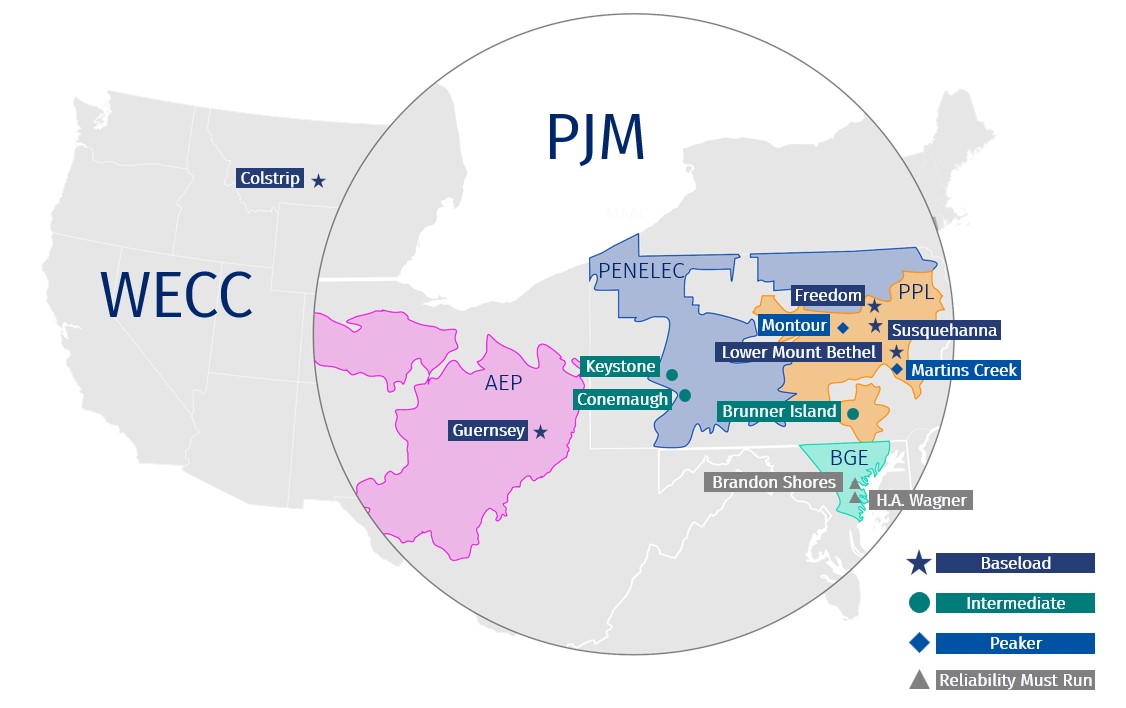
Highly efficient baseload generation. We own and operate over 5.7 GW of low- and zero-carbon baseload generation, including a 90% interest in, the 2.5 GW Susquehanna facility, the seventh largest nuclear-powered generation facility in the U.S. In 2025, we produced approximately 17 TWh of reliable, zero-carbon power from Susquehanna at a low all-in cost of approximately $27 per MWh, while also maintaining excellent safety and operational performance (when measured by standards adopted by the nuclear industry). While Susquehanna has typically comprised approximately half of our total annual generation, we recently added an additional 2.8 GW of low-carbon generation—the equivalent of more than the entire Susquehanna plant—through our recent acquisitions of Freedom and Guernsey, which are some of the new newest, most highly-efficient H-class combined-cycle baseload natural gas facilities in the market. We also recently entered into an agreement to acquire the Lawrenceburg Power Plant and Waterford Energy Center, combined-cycle baseload natural gas facilities totaling an additional 2.0 GW in Indiana and Ohio, as part of the pending Cornerstone Acquisition. These strategically located facilities complement our existing fleet and add to our large load contracting strategy by serving as a backstop for our other existing units, further enhancing our fleet’s efficiency, flexibility, environmental performance, and geographic reach while concurrently modernizing our asset base. See “—Recent Developments” and Note 17 to our Annual Financial Statements for additional information on the Freedom and Guernsey Acquisitions and the proposed Cornerstone Acquisition.
2
Our baseload fleet has historically generated revenues primarily from energy sales into the PJM wholesale market, PJM capacity sales, and strategic hedging; however, as discussed further below, in June 2025, we and AWS entered into an expanded power purchase agreement for the long-term, fixed-price supply of up to 1,920 MW of power annually from Susquehanna to the adjacent AWS data center campus through 2042. See “—Our Key Markets and Revenue Streams—Contracted Revenues—AWS PPA” for additional information. The success of this arrangement opens up contractable opportunities for other assets under our “Talen flywheel” strategy. See “—Our Strategies—Combine the above strengths to execute on our “Talen flywheel” strategy” for additional information.
Dispatchable natural gas and oil intermediate and peaking units. Our 4.6 GW intermediate and peaking fleet (of which 2.9 GW is from Brunner Island and Montour after conversion, as discussed below) currently includes three technologically diverse natural gas generation facilities, with certain units capable of utilizing multiple fuel sources. We also recently entered into an agreement to acquire the Darby Generating Station, a 456 MW dual-fuel natural gas and oil peaking unit in Ohio, as part of the pending Cornerstone Acquisition. See “—Recent Developments” and Note 17 to the Annual Financial Statements for additional information. The dispatch diversity added by our intermediate and peaking units provides meaningful commercial and operational flexibility. These strategically located assets include significant generation in the attractive PJM wholesale market, allowing them to generate predictable revenues on cleared capacity while also benefiting from varying market dynamics and enhancing our ability to backstop long-term contractual obligations and other baseload capacity. See “Item 2. Properties” for additional information on each of these facilities.
Reliability assets and carbon deleveraging. Our coal-fired generation assets continue to be impacted by changing environmental regulations and power market economics. We have already completed the conversion of approximately 3.2 GW of our legacy coal fleet to lower-carbon fuels, including our Brunner Island and Montour facilities and Unit 3 of our H.A. Wagner facility. We are currently running our H.A. Wagner and Brandon Shores facilities, totaling 2.0 GW of capacity, under RMR agreements pursuant to which we receive fixed monthly payments in exchange for continuing to operate those facilities until May 31, 2029 (beyond their previously scheduled 2025 retirement dates) to maintain grid and transmission reliability in the Baltimore area until upgrades can be completed. See “—Our Key Markets and Revenue Streams—Contracted Revenues—Brandon Shores and H.A. Wagner RMR Arrangements” and Note 3 to the Annual Financial Statements for additional information on the RMR arrangements. We also own minority interests, totaling approximately 800 MW, in three coal-fired generation facilities in PJM and WECC, and we are exploring ways to maximize the value of these assets in the context of changing market conditions. See “Item 2. Properties” for additional information on each of these facilities.
Our Key Markets and Revenue Streams
Our operating revenues have historically consisted primarily of capacity revenues, energy/ancillary services revenues, and unrealized gain (loss) on hedging instruments. As further discussed below, we sell capacity and energy through a combination of forward auctions, future contracts, and spot market sales (as applicable). Beginning in mid-2025, our Brandon Shores and H.A. Wagner facilities began operating as reliability resources under RMR agreements that provide fixed payments to us in addition to reimbursement for certain costs and expenses. In addition, our Susquehanna facility is party to the AWS PPA for the supply of power from Susquehanna to AWS through long-term, fixed-price power commitments that increase over time. See “—Contracted Revenues” for additional information on both the RMR arrangements and the AWS PPA. We continue to evaluate business opportunities resulting from technological and industrial load growth. See “—Demand Growth from Multiple Sources” for additional information. We also benefit from the Nuclear PTC under the Inflation Reduction Act. See Notes 3 and 4 to the Annual Financial Statements for additional information.
Wholesale Markets
The substantial majority of our generation capacity is located in, and accordingly the majority of our revenues are derived from, PJM. Specifically, approximately 13 GW of our generation capacity is located in the MAAC (Mid-Atlantic Area Council), BGE (Baltimore Gas and Electric), and AEP (American Electric Power) regions of PJM. The remainder of our generation capacity is from the Colstrip facility within WECC. See “Item 2. Properties” for additional information on the market location of each of our facilities.
PJM. PJM is an RTO responsible for the operation of wholesale electric markets and for centrally dispatching electric systems in all or parts of 13 states and the District of Columbia. It coordinates the dispatch of approximately 182,000 MW of generating capacity to more than 67 million people and operates wholesale electricity markets with approximately 1,110 members. Generators in PJM may earn revenues from sales of capacity, energy, and (or) ancillary services.
3
The PJM Reliability Pricing Model is intended to ensure that resources are available when needed for grid reliability. Under this model, PJM conducts a series of forward capacity auctions, which establish a long-term market for capacity. We sell capacity through PJM Base Residual Auctions and, to the extent we are unable to sell capacity through the PJM BRAs, we may sell uncleared capacity through PJM Incremental Auctions or bilateral capacity transactions. PJM BRAs are typically conducted three years prior to the start of the applicable capacity year (which runs from June 1–May 31), but the FERC has accepted requests by PJM to delay certain PJM BRAs in order to propose additional changes to the PJM Reliability Pricing Model. See “Item 1A. Risk Factors—Regulatory, Environmental, and Legal Risks—We could be impacted by changes in, or state interference with, the structure or operation of the markets in which we operate, including ongoing market restructuring in PJM.” and Note 9 to the Annual Financial Statements for additional information on ongoing market reforms in PJM and related auction delays. PJM also operates day-ahead and real-time markets into which generators can bid to provide energy and ancillary services. We sell energy/ancillary services into these markets. We also enter into bilateral transactions for the sale of energy directly to power purchasers.
WECC. WECC is a non-profit corporation that promotes a reliable and secure bulk electric system in the Western Interconnection, covering all or parts of Montana, 13 other U.S. States, Canada, and Mexico. WECC does not operate energy or capacity markets. The Colstrip facility in Montana operates within NorthWestern’s Balancing Authority within WECC. We enter into bilateral transactions for the direct sale of energy from our portion of the generation from Colstrip.
Contracted Revenues
AWS PPA. In June 2025, we entered into an amended AWS PPA to expand, and eventually replace, the existing PPA with AWS. The existing Susquehanna co-located load AWS PPA between us and AWS will begin transitioning to a “front-of-the-meter” arrangement after the completion of transmission reconfiguration projects expected to occur in spring 2026 with full transition expected to occur in spring 2027. The AWS PPA requires Talen to deliver carbon-free power to AWS over a significant contract term at anticipated premium prices. At the full contract quantity, we will provide AWS with 1,920 MW of carbon-free nuclear power through 2042 (with options to further extend its duration) for operations at the AWS Data Campus adjacent to Susquehanna (with the ability to deliver to other sites throughout Pennsylvania). The AWS PPA, which has minimum commitments, has a power delivery schedule that ramps up over time, which is expected to achieve the full volume no later than 2032, with the potential to meaningfully accelerate. See “Item 3. Legal Proceedings—Susquehanna ISA Amendment” for more information on the resolution of previous legal and regulatory matters relating to the AWS PPA.
Brandon Shores and H.A. Wagner RMR Arrangements. The Brandon Shores and H.A. Wagner RMR arrangements extend the operating life of these plants through May 31, 2029, or until such time the necessary transmission upgrades are placed into service. Beginning June 1, 2025, the RMR arrangements provide an annual fixed-cost payment of $145 million ($312/MWd) for Brandon Shores and $35 million ($137/MWd) for H.A. Wagner, which includes a performance “hold back” of $5 million per year for Brandon Shores and $2.5 million per year for H.A. Wagner, each to be paid out based on unit performance. We also receive separate reimbursement for variable costs and approved project investments. See Note 3 to the Annual Financial Statements for additional information on the RMR arrangements.
Demand Growth from Multiple Sources
Power demand forecasts continue to rise over time in PJM compared to previous expectations. Summer peak load is forecasted to grow by approximately 66 GW by 2036, or an average of 3.6% per year over the next 10-year period. In January 2026, PJM released updated long-term load forecasts which point to RTO-wide load in summer 2036 that is approximately 5% higher than 2025 expectations. Fundamental demand growth in PJM is expected to come from multiple sources, most notably high-performance computing and data center demand, continued re-shoring in the wake of the COVID-19 pandemic and associated supply chain disruptions, and continued electrification of the U.S. economy. This demand growth is not currently well matched with increases in supply, as the PJM queue for new-build generation is predominately intermittent rather than dispatchable in nature. In addition, continued PJM coal plant retirements are expected through the end of the decade. These drivers of demand have had, and could continue to have, direct impacts on the overall supply/demand balance and resulting energy and capacity prices in the markets in which we operate, the profitability, value, and growth prospects of our business, and the regulatory framework under which we operate.
Fuel Supply
Our power generation assets are advantaged by significant fuel diversity, including nuclear, natural gas, coal, and oil capabilities. Further, our natural gas generation assets are situated near the Marcellus and Utica shale regions of Pennsylvania and Ohio, which provide access to fuel from some of the largest producing natural gas regions in the U.S. See “Item 2. Properties” for additional information on the fuel capabilities of each of our facilities.
4
Nuclear. Susquehanna has a portfolio of supply contracts for raw uranium, conversion, enrichment, and fabrication. Our nuclear fuel cycle is fully contracted through the 2028 fuel load, more than 50% contracted through 2029, and over 20% contracted through 2030. We have no current fuel exposure to any Russian-affiliated counterparties. Susquehanna has an on-site dry-cask spent fuel storage facility that, together with its spent fuel pools, accommodates discharged SNF. We expect to continue expanding this storage facility in phases to accommodate additional SNF and, assuming receipt of appropriate approvals, we expect such expansion to accommodate all of the SNF discharged by Susquehanna through 2044, the current license life of unit 2. Federal law requires the U.S. government to provide for the permanent disposal of commercial SNF, but the government has not yet done so. Consequently, the government is required to reimburse Susquehanna for certain SNF storage costs through 2025 under a related settlement agreement, which we are currently in the process of seeking to extend through 2028. See Note 9 to the Annual Financial Statements for additional information on this arrangement.
Natural Gas and Oil. We manage our natural gas and oil supply utilizing a combination of contracted purchases, spot market purchases, and on-site storage for the commodities and pipeline capacity. The amount and duration of contracted purchases vary due to factors including fuel availability, economic considerations, and generation facility location on the pipeline grid. A significant portion of our natural gas needs are satisfied through short-term transactions on a spot basis. Oil is generally supplied from on-site inventory and replenished through purchases on the spot market. The price risk associated with these transactions is managed via financial hedges.
Coal. We actively manage our coal requirements by purchasing coal from central and northern Appalachia for our PJM facilities and from a mine adjacent to Colstrip for that facility. Reliability of coal deliveries can be affected from time to time by a number of factors, including fluctuations in demand, coal mine production issues, and other supplier or transporter operating difficulties. We maintain coal inventory at levels estimated to be necessary to avoid operational disruptions at our coal-fired units. Short- and long-term supply contracts support adequate coal inventory levels and are augmented with spot market purchases as needed.
Seasonality/Scheduled Maintenance
The demand for and market prices of electricity and natural gas are affected considerably by weather and, as a result, our operating results may fluctuate significantly on a seasonal basis. In general, below-average temperatures in the winter and above-average temperatures in the summer tend to increase electricity demand, energy prices, and revenues. Alternatively, moderate temperatures tend to decrease electricity demand and may adversely affect resulting energy margins, particularly in PJM. In addition, our operating expenses typically fluctuate geographically on a seasonal basis, with peak power generation and expenses during the winter in the Mid-Atlantic. We ordinarily perform planned facility maintenance during milder non-peak demand periods in the spring and fall to ensure reliability during peak periods. The pattern of fluctuations in our operating results varies depending on the type and location of the facilities being serviced, the capacity markets served, the maintenance requirements of our facilities, and the terms of bilateral contracts to purchase or sell electricity. We maintain our fossil generation fleet through a combination of self-service and contracted maintenance activity (including long-term service agreements at certain facilities). Our largest recurring maintenance project is the annual spring refueling outage at Susquehanna. See also “Item 1A. Risk Factors—Industry and Market Risks—Our business is subject to physical, market, economic, and regulatory risks relating to weather conditions and extreme weather events.”
Competition
Increased competition in U.S. energy markets exists in part due to federal and state competitive market initiatives. The power generation business is regionally varied in industry structure and fundamentals. PJM, the primary market in which we operate, is a competitive market and has from time-to-time considered new market rules, while some states have considered re-regulation measures that could result in more limited opportunities for competitive energy suppliers. See Note 9 to the Annual Financial Statements for additional information on ongoing market reforms in PJM. We face competition in wholesale markets from other suppliers of available energy, capacity, and ancillary services, which may include operators of various competing generation technologies, such as natural gas-fired, coal-fired, and nuclear generation, as well as renewable and other alternative energy sources. Competition is affected by electricity and fuel prices, grid congestion, government subsidies for new and certain existing generation facilities (including some which might otherwise retire), new market entrants, construction of new generation assets, technological advances in power generation, environmental and regulatory matters, and various other factors. Competitors in wholesale power markets include other non-utility generators, regulated utilities and their competitive subsidiaries, industrial companies, financial institutions, and other energy marketers. See also “Item 1A. Risk Factors—Industry and Market Risks—We face intense competition in the competitive power generation market.” and “Item 1A. Risk Factors—Regulatory, Environmental, and Legal Risks—We could be impacted by changes in, or state interference with, the structure or operation of the markets in which we operate, including ongoing market restructuring in PJM.”
5
Insurance
Power generation involves hazardous activities, which could expose our assets, employees, contractors, customers, and the general public to various risks inherent in the nature of our operations. Various hazards, including but not limited to accidents or natural disasters, can cause damage or destruction of our assets or other property and equipment, personal injury or loss of life, pollution or environmental damage, and (or) suspension of operations. We maintain a portfolio of general liability, property, business interruption, pollution liability, workers’ compensation, nuclear, cybersecurity, financial lines, and other insurance policies (as applicable) with varying limits, deductibles, and self-insurance that we believe are reasonable and prudent under the circumstances to cover our operations and assets; however, we cannot provide any assurance that our insurance program will be sufficient or effective under all circumstances and against all hazards or liabilities to which we may be subject, or that insurance coverage will continue to be available at economic rates or at all. We will continue to periodically evaluate our policy limits and retentions as they relate to the overall cost and scope of our insurance program. See also “Item 1A. Risk Factors—Commercial and Operational Risks—Operation of power generation facilities involves significant risks and hazards customary to the power industry, which we cannot assure our insurance will be adequate to cover.,” “Item 1C. Cybersecurity,” and Note 9 to the Annual Financial Statements.
Our Strategies
We believe we are well-positioned to achieve our business objectives through the following strategies:
Continue to focus on our core generation fleet that provides stable earnings and cash flows through operational excellence, high reliability, capital discipline, and prudent risk management. The foundation of our platform is safe, disciplined operational and commercial performance. Our core fleet, anchored by low-carbon baseload generation, produces stable earnings from cleared capacity and cash flows backed by multiple sources, including our AWS PPA and RMR arrangements. In today’s robust but volatile energy markets, our team has been able to capture high realized pricing through both reliable generation and strategic risk management. See “Item 7. Management’s Discussion and Analysis of Financial Condition and Results of Operations—Results of Operations.” We now also benefit from long-term, stable cash flows from both contractual revenues under the Brandon Shores and H.A. Wagner RMR arrangements and fixed-price power sales under the AWS PPA. See “—Our Key Markets and Revenue Streams—Contracted Revenues.” We drive operational excellence by maximizing the safety, reliability, and efficiency of our core assets. While we will continue to evaluate ways to find the highest and best use of our assets and capital, we are committed to maintaining best-in-class operations at our core generation facilities, including a disciplined cost structure across all categories. Our integrated generation, wholesale marketing, and commercial capabilities enable us to produce significant recurring cash flow, and our commercial and risk management strategies provide cash flow stability while balancing operational, price, and liquidity risk through physical and financial commodity transactions. We target a hedge range of 60-80% of our expected generation for the prompt 12 months and ratably scale the hedge percentage down further out in time to align with financial objectives, and we remain focused on maintaining appropriate risk management policies in the context of a right-sized balance sheet and the cash flow stability provided by long-term revenue contracts and backstopped by the Nuclear PTC.
Capture opportunities for long-term contracting arrangements with high quality counterparties. In addition to optimizing core operations, we believe we can unlock further value from our existing assets by driving the highest value per megawatt produced—supported by long-term power sales to computing, industrial, and other end users across our reliable portfolio that provides both baseload and dispatchable generation. We intend to grow our base of long-term contracting arrangements with high-quality, creditworthy counterparties to enhance earnings visibility, support sustainable growth, and create long-term value. Our focus will be on counterparties with strong credit profiles and strategic alignment, with contract terms designed to balance competitive pricing, operational flexibility, and appropriate risk protections. Accelerating demand from hyperscalers, industrial customers, and re-shoring of manufacturing drives load growth, which creates an attractive opportunity to contract reliable baseload generation for extended periods. Our operational track record and ability to deliver speed-to-market, price certainty, and scale position us well to achieve pricing premiums and contract structures that capture significant margin while also materially reducing commodity exposure and cash flow cyclicality. Importantly, these arrangements will also enable more efficient planning and resource deployment across the Company and the markets in which we operate. We will also continue to maintain a balanced portfolio by retaining a merchant component to serve as a backstop, preserve flexibility, provide downside protection, and selectively benefit from volatility.
6
Maintain balance sheet strength with disciplined financial policy and capital allocation. We will continue to deploy a disciplined financial policy centered on high-quality cash flow generation, prudent leverage, and an efficient cost of capital. We have a strong balance sheet underpinned by modest leverage, robust liquidity, and long-dated debt maturities, as well as ample capacity and counterparty appetite for lien-based hedging, which does not require cash collateral posting. We view our balance sheet as a tool, providing flexibility to fund operations, manage commercial activity, and pursue value-accretive activities if the right opportunities arise. We will continue balancing reinvestment and deleveraging priorities with a commitment to returning capital to shareholders as free cash flow expands. We expect to target net leverage of approximately 3.5x or less through the cycle, while retaining a deliberate “toggle” to prioritize the most accretive use of capital—whether deleveraging, reinvestment, or shareholder returns—and to selectively lean into opportunities that are clearly cash flow accretive and value-enhancing. This framework preserves financial flexibility, supports counterparties’ confidence, and positions us to execute through market cycles. Our leverage framework is a target, not an absolute constraint, and we retain the flexibility to temporarily lean into incremental leverage for the right opportunity when returns justify it, while maintaining a clear path back to our leverage objectives. This disciplined approach strengthens financial resilience, supports commercial execution, and reinforces our ability to deploy capital dynamically as conditions evolve.
Continue to grow and diversify our fleet in a capital efficient manner. We intend to continue building on our track record to grow and diversify our generation fleet in a capital-efficient manner through a disciplined mix of value-uplift initiatives that expand scale, improve flexibility and reliability, and provide durable economics. We intend to maintain flexibility to pursue both organic and inorganic growth opportunities and to deploy capital where we can generate compelling risk-adjusted returns. This could include uprates and other improvements to existing assets, selectively acquiring assets that are immediately accretive, and advancing development opportunities. We will prioritize opportunities that complement our operational strengths, support long-term contracting premiums, and improve portfolio resilience. For instance, our recent Freedom and Guernsey Acquisitions bring highly-efficient baseload assets with high-capacity performance that are a reliable part of the grid today. Our platform provides additional pathways to growth, including advantaged land positions at or near existing assets with large interconnects that provide speed-to-market and expand our range of development and partnership options. We will continue to evaluate strategic opportunities where the economics are compelling, leveraging our experience to replicate successful structures and transactions, with any investment requiring a clear, durable returns profile relative to other uses of capital. We will apply disciplined investment criteria in our underwriting cases that are centered on risk-adjusted returns, resilience across market cycles, and clear pathways to value creation while also maintaining appropriate liquidity and leverage and adhering to a thoughtful overall capital allocation framework.
Combine the above strengths to execute on our “Talen flywheel” strategy. The Talen flywheel is a repeatable value creation strategy that leverages our platform of reliable, scalable generation assets and commercial capabilities to deliver durable free cash flow growth across market cycles. The flywheel includes contracting long-term power sales with high-quality, large-load counterparties where our assets and sites are advantaged in delivering speed-to-market, large-scale capability, price certainty, and appropriate credit support. These contracts can lock in meaningful premiums and provide visible, stable cash flows, improving the risk profile of our business and its related cash flows, which ultimately strengthen our financial foundation. With that strengthened cash flow profile and balance sheet, we are positioned to grow and diversify our fleet in a capital-efficient manner through a disciplined mix of acquisitions, selective development, land and interconnection monetization, and strategic partnerships, expanding our long-term contracting opportunity set while maintaining operational flexibility. This strategy is enabled by utilizing our balance sheet capacity as a strategic asset—toggling between shareholder returns and accretive strategic investments as market conditions and relative returns warrant—while targeting prudent leverage levels over time. For instance, we recently completed the acquisitions of Freedom and Guernsey and expect to acquire additional facilities through our pending Cornerstone Acquisition later this year. This cycle—contract assets, add assets, contract again—which we call the “Talen flywheel,” is designed to increase the number of high-quality, contractable opportunities across the portfolio, enabling us to pair reliable assets with long-term, creditworthy demand in a way that enhances stability while preserving flexibility.
Recent Developments
Cornerstone Acquisition
On January 15, 2026, we entered into the Cornerstone Merger Agreement to acquire from affiliates of Energy Capital Partners (“ECP”) the 875 MW Waterford Energy Center and 456 MW Darby Generating Station, both located in Ohio, and the 1,120 MW Lawrenceburg Power Plant located in Indiana, for an aggregate purchase price of $3.45 billion, consisting of $2.55 billion in cash, subject to working capital and other customary adjustments, and 2,400,000 shares of Talen common stock, valued at approximately $900 million at the time of the entry into the Cornerstone Merger Agreement. The Company expects the cash portion of the purchase price to be funded from the proceeds of new indebtedness. The stock consideration will be subject to lock-ups of 90 days on 50% of the stock consideration and 180 days on the remaining stock consideration.
7
The addition of these assets to Talen’s portfolio will increase generation capacity by approximately 2.5 GW of natural gas generation, substantially expanding Talen’s presence in the western PJM market and adding additional efficient baseload generation assets to its fleet.
In connection with the stock consideration, at the closing of the Cornerstone Acquisition, we intend to enter into the Cornerstone RRA with certain parties thereto substantially in the form attached to this Report as Exhibit 4.16. Pursuant to the terms of the Cornerstone RRA, the Company will agree to use its commercially reasonable efforts to file a registration statement on Form S-3 under the Securities Act of 1933, as amended, to register the TEC common stock issued pursuant to the Cornerstone Merger Agreement with the SEC within three business days (and in any event within five business days) after issuance. See also “Item 1A. Risk Factors—Financial and Equity Risks—A number of factors could adversely affect the market price or trading volume of our common stock, even if our business is doing well, including but not limited to substantial sales of our common stock by existing shareholders, future issuances of equity or debt securities by us, and (or) research or reports published by financial analysts.”
The proposed Cornerstone Acquisition is subject to regulatory approvals and the satisfaction of other customary closing conditions, and is expected to close early in the second half of 2026.
See Note 17 to the Annual Financial Statements for additional information on the Cornerstone Acquisition and “Item 1A. Risk Factors—Risks Related to the Cornerstone Acquisition” of this Report for a discussion of the associated risks.
The foregoing description of the Cornerstone Merger Agreement and the transaction contemplated thereby is only a summary, does not purport to be complete, and is qualified in its entirety by reference to the full text of the Cornerstone Merger Agreement, a copy of which is incorporated by reference as Exhibit 2.1 to this Report. The Cornerstone Merger Agreement is being filed only to provide investors with information regarding their terms and are not intended to provide any other factual information about the parties thereto. Investors should not rely on the representations, warranties, or covenants in the Cornerstone Merger Agreement, which may be subject to important limitations and qualifications, and which may change after the date of the Cornerstone Merger Agreement, as characterizations of the actual state of facts or condition of the Company, the sellers, or any of their respective subsidiaries or affiliates.
PJM 2027/2028 Base Residual Auction
In December 2025, PJM announced the results of the 2027/2028 PJM BRA. Talen cleared 8,745 MW at a price of $333.44/MWd.
See “Item 7. Management’s Discussion and Analysis of Financial Condition and Results of Operations—Factors Affecting Our Financial Condition and Results of Operations—Capacity Markets” for additional information.
Closing of the Freedom and Guernsey Acquisitions
In November 2025, the Company consummated the Freedom and Guernsey Acquisitions for an aggregate $3.8 billion which is subject to certain post-closing adjustments for net working capital and other customary items. The Freedom and Guernsey Acquisitions were funded from the proceeds of the Unsecured Notes and the TLB-3. Additionally, TES increased its RCF (including its revolving LC capacity) from $700 million to $900 million and increased its LCF from $900 million to $1.1 billion and extended its maturity from December 2026 to December 2027.
Issuance of Senior Notes. In October 2025, TES issued (i) $1.4 billion in aggregate principal amount of 6.250% Senior Unsecured Notes due 2034, and (ii) $1.3 billion in aggregate principal amount of 6.500% Senior Unsecured Notes due 2036
See Notes 10 and 17 to the Annual Financial Statements for additional information on the financing transactions and issuance of the Unsecured Notes, and the Freedom and Guernsey Acquisitions, respectively.
Legal, Regulatory, and Environmental Matters
Legal Matters
We are involved in various legal and administrative proceedings, investigations, claims, and litigation from time to time in the course of our business. Such matters may include, but are not limited to, those relating to employment and benefits, commercial disputes, personal injury, property damage, regulatory matters, environmental matters, and various other claims for injuries and (or) damages. While we believe we have meritorious positions and will continue to appropriately respond to all legal matters, because of the inherently unpredictable nature of legal proceedings, there is a wide range of potential outcomes for any such matter. See “Item 1A. Risk Factors—Regulatory, Environmental, and Legal Risks” for additional information on legal risks related to our business. See “Item 3. Legal Proceedings” and Note 9 to the Annual Financial Statements for additional information on specific legal matters.
8
Energy Regulation
We are subject to regulation by federal and state agencies and other bodies that exercise regulatory authority in the various regions where we conduct business, including but not limited to the FERC; the Department of Energy; the NRC; NERC; the Federal Communications Commission; and state public utility commissions. In addition, the RTOs and ISOs in the regions in which we conduct business inherently have complex rules that are intended to balance the interests of market stakeholders. See “Item 1A. Risk Factors—Regulatory, Environmental, and Legal Risks” for additional information on regulatory risks related to our business. The following discussion provides an overview of certain key regulatory matters applicable to our business. See Note 9 to the Annual Financial Statements for additional information on these and other regulatory topics.
FERC. Our subsidiaries that own or control electric generation facilities are defined as public utilities under the Federal Power Act and are subject to the FERC’s exclusive ratemaking jurisdiction over wholesale sales of electricity and the transmission of electricity in interstate commerce. The FERC has the authority to grant or deny market-based rate authority for wholesale sales of energy, capacity, and ancillary services to ensure that such sales are just and reasonable and not unduly discriminatory, and to suspend market-based rate authority and set cost-based rates if it finds that its previous grant of market-based rate authority is no longer just and reasonable. Other matters subject to the FERC’s jurisdiction include, but are not limited to: review of certain public utility dispositions of jurisdictional facilities, mergers, acquisitions of other public utility securities, or acquisitions of existing generation facilities; review of certain holding company acquisitions of securities of, or mergers with, a public utility or other holding company; third-party financings; affiliate transactions; intercompany financings and cash management arrangements; and certain internal corporate reorganizations.
RTOs and ISOs. RTOs and ISOs are the FERC-regulated entities that exist in several regions to provide transmission service across multiple transmission systems. The FERC has approved PJM, MISO, ISO-NE, and SPP as RTOs and CAISO and NYISO as ISOs. These entities are responsible for regional planning, managing transmission congestion, developing wholesale markets for energy and capacity, maintaining reliability, market monitoring, the scheduling of physical power sales brokered through ICE and NYMEX, and managing transmission charges across multiple systems. With the exception of Colstrip in Montana, all of our generation facilities currently participate in the wholesale electricity markets administered by PJM. See “—Our Operations—Our Key Markets and Revenue Streams—Wholesale Markets” for additional information on the RTOs and ISOs in which we operate.
Nuclear. Under the Atomic Energy Act of 1954, as amended (the “Atomic Energy Act”), our operation and 90% ownership of Susquehanna are subject to regulation by the NRC, including requirements pertaining to, among other matters: licensing, inspection, and enforcement; testing, evaluation, and modification of all aspects of nuclear reactor power generation facility design and operation; environmental and safety performance; handling and storage of SNF; technical and financial qualifications; decommissioning funding assurance; and transfer and foreign ownership restrictions. The NRC may modify, suspend, or revoke operating licenses and impose civil or criminal penalties for failure to comply with the Atomic Energy Act or the terms of nuclear operating licenses. In addition, new or amended NRC safety and regulatory requirements may give rise to additional operation and maintenance costs and capital expenditures. The current facility operating licenses for our two units at Susquehanna expire in 2042 and 2044. See Note 6 to the Annual Financial Statements for additional information on the NDT. See “—Our Operations—Fuel Supply—Nuclear” for additional information on SNF.
Other Regulation. In addition to federal regulation, our operations are subject to various state and local laws and regulations. These include oversight of siting, permitting, and environmental compliance for our facilities, as well as participation in state-specific energy markets and programs. Our operations are also subject to compliance with reliability standards developed and enforced by NERC and its regional entities. Compliance with these standards is critical to maintaining the reliability of the bulk electric system and avoiding penalties for violations. See “—Environmental Regulation” for additional information on environmental regulation of our business.
Environmental Regulation
Our business is subject to extensive federal, state, and local environmental laws, regulations, and requirements, including but not limited to those related to air emissions, water discharges, hazardous substances, and solid waste management. These requirements have become more stringent over time and impose, among other things: (i) permitting requirements for regulated activities; (ii) costs to limit or prevent pollution or other contamination; and (iii) substantial liabilities and remedial obligations for pollution or contamination. Accordingly, in the ordinary course of our business, we may: (i) incur significant costs to comply with environmental requirements; (ii) be required to modify, curtail, replace, or cease certain operations for environmental reasons; (iii) be required to perform environmental remediation work; or (iv) become involved in other environmental matters, including government enforcement actions and citizen’s suit litigation. In addition, environmental requirements are rapidly evolving, and we may become subject to new or revised environmental laws, regulations, or requirements. Legal challenges to environmental regulations, rules, and requirements add to the uncertainty of estimating future compliance and remedial costs. In addition, in January 2025, President Trump issued executive orders directing the heads of all federal agencies to identify and begin the processes to suspend, revise, or rescind all agency actions, including existing regulations, that are unduly burdensome on the identification, development, or use of domestic energy resources. Consequently, future implementation and enforcement of these rules remains uncertain at this time.
9
See “Item 1A. Risk Factors—Regulatory, Environmental, and Legal Risks” for additional information on environmental risks related to our business. The following discussion provides an overview of certain key environmental matters. See Note 9 to the Annual Financial Statements for additional information on these and other environmental topics.
Air. Under the Clean Air Act, as well as comparable state laws and local ordinances, our plants are subject to extensive emission control, emission allowance, emission monitoring, and air reporting obligations. Compliance with these requirements impacts the operation of our plants as well as their operating costs. In addition, new or modified obligations could significantly impact how we produce electricity and the life of certain plants (in some cases resulting in premature unit retirements) and could impede strategic planning. Key air matters currently affecting our business include, but are not limited to, nitrogen oxides requirements (including potential implementation of the EPA’s Good Neighbor Plan or similar requirements) as well as the revised 2024 GHG Rule, which could significantly impact certain facilities, including our Colstrip facility. These rules are being legally challenged by us and others and are being reconsidered by the EPA.
Hazardous Substances and Waste Handling. Our business is subject to a range of waste laws and regulations at the federal, state, and local levels. These rules are designed to manage and mitigate the potential environmental and health impacts of waste generated by power plants during the production of electricity, and they put controls in place on waste disposal, management, transportation, and storage. The Comprehensive Environmental Response, Compensation, and Liability Act (“CERCLA”), also known as the “Superfund” law, and comparable state laws impose liability, without regard to fault or the legality of the original conduct, on certain classes of persons that are considered to have contributed to the release of a “hazardous substance” into the environment. These persons include the current and past owners or operators of the site where the release occurred and companies that transported or disposed, or arranged for the transport or disposal, of the hazardous substances at the site where the release occurred. Most states have also enacted statutes that contain provisions substantially similar to CERCLA. We generate materials in the course of our operations that may be regulated as hazardous substances based on their characteristics under CERCLA and analogous state laws.
The EPA’s regulation of CCRs under the RCRA is a currently evolving regulatory program under which we may incur significant costs impacting AROs. We have joined several parties to legally challenge the EPA’s requirements for legacy CCR surface impoundments under the EPA CCR Rule that was finalized in 2024, while also following the Rule’s timeline to assess applicability and define cost impacts to our business.
Water. Various statutes and regulations at the federal, state, regional, and local levels govern water use, discharge, protection, and influence and add challenge and uncertainty to our business. The Federal Water Pollution Control Act, known as the Clean Water Act (“CWA”), and comparable state laws impose restrictions and strict controls regarding the discharge of pollutants into federal and state waters. The discharge of pollutants into regulated waters is prohibited except in accordance with the terms of a permit issued by the EPA or a state equivalent agency. Compliance with existing and future requirements may increase costs, affect operations, and impede strategic planning. One of the most impactful CWA programs currently affecting our business is the 2024 EPA ELG Rule, under which certain of our generation facilities have incurred operating restrictions and committed to prematurely end the use of certain fuels. In the future, new permit conditions could be established to meet the requirements in the EPA ELG Rule, which will be defined following negotiations with state permitting authorities. We and other parties are legally challenging the 2024 EPA ELG Rule. Additionally, the EPA has extended the compliance deadlines for the 2024 EPA ELG Rule by five years. The extension rule has been legally challenged by environmental groups. Until litigation is complete and permit conditions are established, full cost impacts remain uncertain.
Health and Safety. We are also subject to the requirements of the federal Occupational Safety and Health Act and comparable state laws that regulate the protection of the health and safety of employees. In addition, the Occupational Health and Safety Administration's (“OSHA”) hazard communication standard, the Emergency Planning and Community Right to Know Act and implementing regulations and similar state statutes and regulations require us to maintain information about hazardous materials used or produced in our operations, and this information is required to be provided to employees, state and local government authorities, and citizens.
Corporate Responsibility
Through our core values of Excellence, No Harm, Integrity, and Continuous Improvement, we are committed to operating thoughtfully and ethically as we strive to consider impacts to our stakeholders, including communities, employees, customers, suppliers, investors, and the environment. Our approach to corporate responsibility, with oversight from our Board of Directors, is a key to the long-term success of our business.
Environmental
Our emission profile is anchored by Susquehanna, which enabled us to generate 42% of our electricity output carbon-free in 2025, and our natural gas portfolio also includes a number of energy-efficient assets with low heat rates that provide a lower carbon intensity than traditional fossil fuel sources. The acquisitions of the Freedom and Guernsey plants further enhance our fleet, adding approximately 2.8 GW of high-quality, modern, efficient, baseload natural gas generation to our portfolio. We have reduced our environmental footprint over the past several years, investing heavily in environmental controls and switching to cleaner fuels in response to market and other conditions. We have already completed the conversion of our Brunner Island, Montour, and H.A. Wagner plants to lower-carbon fuels. See “—Our Fleet—Reliability assets and carbon deleveraging” for additional information.
10
We are an innovator in the movement to power critical infrastructure and industry with carbon-free nuclear generation. Prior to its sale to AWS, we initially developed the data center campus adjacent to our Susquehanna facility, the world’s first 24x7 carbon-free, direct-connect data center campus, to provide digital infrastructure powered by generation from Susquehanna. We are well-positioned to continue leading the energy transition by responsibly providing zero- and low-carbon power to meet growing demand from energy consumers in a variety of sectors, many of whom have sustainability requirements.
Community Engagement
We generally focus our community engagement and philanthropic efforts in the local communities we serve and where our employees live and work. We believe that a decentralized approach to engagement and giving allows us to more effectively identify areas of need and have a greater local impact. Across our fleet and our corporate offices, our facilities and their employees, often in conjunction with charitable organizations such as United Way, Salvation Army, and local food banks, we strive to participate regularly in events supplying holiday toys, school supplies, food, winter coats, volunteer hours, and monetary donations. For instance, to date, events hosted by Susquehanna have raised approximately $1.5 million for the Berwick Area United Way. Our plants also provide community education through both on-site and off-site programs and events with first responders, professional organizations, students, interns, scouts, and other groups. The majority of our operating facilities also provide nature preserves or other recreational sites that allow for community activities such as golf, fishing and boating, walking and hiking, outdoor education, sports, and other events.
Our business also provides significant support to the communities in which we operate in the form of critical services, high-quality jobs, economic development, and tax dollars. We have adopted a Supplier Code of Conduct (available on our website) to promote safe, ethical, and socially conscious behavior among our suppliers. In 2025, we reached a settlement with key stakeholders to continue running both of our Maryland generation facilities through May 2029 under RMR arrangements. The continued operation of these facilities maintains critical infrastructure, facilitates reliable electricity in Baltimore, and protects Maryland consumer electricity rates. See “—Our Key Markets and Revenue Streams—Contracted Revenues—Brandon Shores and H.A. Wagner RMR Arrangements” and Note 3 to the Annual Financial Statements for additional information on the RMR arrangements.
We believe the emerging data economy and the growing importance of artificial intelligence and continued re-shoring of manufacturing and other industries will require an all-of-the-above approach to generating the electricity necessary to power load in a responsible and efficient manner. Our AWS PPA is an example of how we are powering the future in partnership with data center and artificial intelligence enterprises and, in the case of the AWS PPA, doing so with large volumes of clean, carbon-free energy. We are actively engaged in the policy discussions taking place between generators, PJM, political leaders, and consumer advocates to solve burgeoning resource adequacy issues and seek to ensure the availability of affordable and reliable power in the regions we serve.
Human Capital
We strive to maintain a culture that empowers our employees to influence operational decisions and to trust and rely on each other, while driving safety, operational excellence, and strong financial performance. We view our people as vital assets and key stakeholders in our business. Accordingly, we invest in our employees by prioritizing their safety, offering numerous training and development opportunities, valuing employee feedback, providing competitive compensation that shares in the success of our business, delivering comprehensive health and wellness benefits, and fostering an inclusive and respectful workplace.
Safety. At Talen, safety is a core value. We strive for a “No Harm” culture for all our employees, suppliers, guests, and communities, and we strive to continuously improve our systems, processes, and communications to support the safe operation of our business. Our safety management system focuses on four key components: Safety Policy, Risk Management, Safety Assurance, and Promotion. Within our safety management framework, we take a decentralized approach to health and safety coupled with centralized reporting, information sharing, and oversight. This empowers our business units and operating plants to determine the most appropriate health and safety procedures, training, engagement, and incident resolution at their sites while facilitating knowledge sharing, enabling continuous improvement, and fostering a “No Harm” culture across our organization.
We track and (or) externally report OSHA recordable incidents, lost time injuries, and near miss incidents to enhance knowledge sharing and organizational learning. In 2025, we had eleven OSHA recordable incidents and an OSHA Total Recordable Incident Rate (“TRIR”) of 0.55. Our overall safety performance is a result of an enhanced health and safety framework and training, increased leadership visibility and accountability, and a greater focus on incident reporting, including near misses and good catches. Our safety team reviews several proactive metrics to mitigate risks before they become safety incidents. All employees and contractors are required to immediately report all safety-related incidents and have a responsibility to stop work when there is a safety concern. Once a “stop work” situation has been identified, a corrective plan must be developed and the safety team determines a path to continue work. Prior to resumption of work, a supervisor or manager that is “one step removed” must review and concur with the plan to continue work. Susquehanna has an additional corrective action Employee Concerns Program that establishes procedures for reporting and resolving nuclear safety and general work environment concerns.
11
We continuously work to improve safety. In 2022, we implemented an annual Safety Assessment Program, under which safety professionals from across the organization inspect plants with a focus on workplace inspections, work observations, and regulatory compliance. Other recent safety enhancements have included improvements to our overall safety management system, as well as the addition of a company-wide safety summit, a strain/sprain program, a supervisor safety assessment program, and a human performance management program. We believe these initiatives will continue to support our strong safety culture. Our safety management system allows frequent analysis of all aspects of safety for continuous monitoring and improvement, and has been key to our safety performance in 2025.
Training, Development, and Feedback. We recognize that our success depends on our ability to attract, retain, motivate, and develop qualified personnel, and we strive to provide our employees with the tools they need to succeed personally and professionally. We provide training programs covering a wide range of relevant job- and Company-specific topics for employees in all positions, including continuing education resources for professional licenses, and we also regularly promote and train interested employees into new roles. To support continuous development, we offer a self-directed professional learning framework that enables employees to take ownership of their learning through curated development pathways, skill-building resources, and development planning tools aligned to business needs. This framework supports internal mobility, leadership readiness, and the development of skills critical to our evolving business. To train the next generation of professionals, we offer apprenticeship programs, internships, and educational assistance. To further develop promising leadership across our organization, we offer programs such as the Talen Leadership Academy and the Union Leader Academy, which are seminars covering a variety of business, operational, leadership, and interpersonal skills.
Formal and informal feedback at Talen runs in all directions. In addition to this feedback, non-union employees annually receive a formal review to discuss their performance, development, and goals. Coaching and performance improvement plans are used when appropriate. We strive to thoughtfully consider and respond to ideas and feedback from all employees, including plant management teams, asset managers, and frontline workers, and we provide a variety of avenues for employee feedback, including through performance review dialogue, appropriate escalation of informal feedback, and various identifiable and anonymous formal reporting channels.
Compensation, Benefits, and Wellness. We are committed to maintaining a highly competitive compensation structure. We maintain short-term and long-term cash incentive programs for many employees, as well as a long-term equity compensation program that aligns the interests of key team members with our strategy and the interests of our stockholders. In 2025, we began offering an employee stock purchase program, under which eligible employees can purchase our common stock at a discount through payroll deductions. Full- and part-time employees also qualify for our 401(k) plan, under which we make fixed, matching, and (or) additional discretionary contributions (depending on employment specifics).
We maintain a comprehensive benefits program, under which eligible employees and their dependents are offered healthcare coverage, life and accident insurance, short- and long-term disability, maternity and parental leave, and (or) identity theft protection. To further support employee wellness, we also offer virtual health screenings, diabetes management programs, and reduced pricing on specialty medications. All employees are also eligible for our employee assistance program, which provides mental and physical health resources and discounts on essentials such as childcare, education, and insurance, among other things.
Collective Bargaining Agreements. As of December 31, 2025, we had approximately 1,880 full-time employees, approximately 43% of which were represented by labor unions. Our collective bargaining agreements (“CBA”) include: (i) a CBA with IBEW Local 1638, covering 186 Talen Montana employees, which is in effect until April 2026; (ii) a CBA with Teamsters Local 190, covering six Talen Montana employees, which is in effect until August 2027; and (iii) a CBA with IBEW Local 1600, covering 624 Pennsylvania employees, which is in effect until August 2030.
Governance
We are committed to maintaining corporate governance policies and practices that support the interests of all our stakeholders. Our values of Excellence, No Harm, Integrity, and Continuous Improvement help foster a culture of robust governance from the Board of Directors and officers to each employee. Additional information about our corporate governance will be set forth in the 2026 Proxy Statement.
Corporate and Other Available Information
We are a Delaware corporation with our principal executive office located at 2929 Allen Parkway, Suite 2200, Houston, TX 77019. The telephone number for our principal executive office is (888) 211-6011. We maintain a website at www.talenenergy.com. Information contained on or accessible from our website is not, and shall not be deemed to be, incorporated by reference into this Report or any other filings with the U.S. Securities and Exchange Commission (the “SEC”).
12
We file our Annual Reports on Form 10-K, Quarterly Reports on Form 10-Q, Current Reports on Form 8-K, and any amendments to those reports with the SEC. You may obtain copies of these documents, free of charge, on the SEC's website at www.sec.gov. In addition, as soon as reasonably practicable after such materials are filed or furnished with the SEC, we make copies available free of charge on the “Investor Relations” section of our website at https://ir.talenenergy.com. We also post important information, including press releases, investor presentations, and notices of upcoming events on our website, and utilize it as a channel for distributions to public investors and for disclosing material non-public information in compliance with Regulation FD. Investors may be notified of postings to our website by signing up for email alerts under the “Resources” tab on the “Investor Relations” section of our website.
ITEM 1A. RISK FACTORS
You should carefully read and consider all the risks and uncertainties described below, as well as the other information included in this Report, including the Annual Financial Statements. Although we believe the following discussion includes the key risks affecting our business, new risks and uncertainties emerge from time to time, and it is not possible for us to predict all risks and uncertainties that could have an impact on our business. The occurrence of any of the following risks, or additional risks and uncertainties not presently known to us or that we currently believe to be immaterial, could materially and adversely affect our business, financial condition, results of operations, cash flows, and (or) liquidity.
Industry and Market Risks
We may be adversely impacted by changes in the market prices, availability, and transmission of electricity, fuel, and other commodities.
Market prices for electricity, capacity, ancillary services, natural gas, uranium, coal, and fuel oil are unpredictable and fluctuate substantially over relatively short periods. Market prices for electricity are particularly volatile due to the inability to store electricity in large quantities (requiring it to be used as it is produced), which can result in significant price fluctuations based on supply and demand imbalances in the day-ahead and real-time markets. Because natural gas facilities often serve as the marginal, price-setting generating units, there is a strong positive correlation between the price of natural gas and the wholesale market price of electricity in the competitive power markets in which we operate. In recent years, the market price of natural gas has experienced substantial volatility, while prices for other fuels have also varied. Our energy margin is influenced by the relationship between the prices of electricity and natural gas and, to a lesser extent, other fuels like coal and uranium. A decline, or significant volatility, in the price of natural gas or other fuels could negatively impact energy margin and energy revenues.
Additionally, we purchase some of our fuel and other consumables such as water, lime, limestone, and other chemicals and sorbents on a short-term or spot market basis. Delivery of these products to our facilities depends on available transportation infrastructure and available shipping capacity. In certain market conditions, transportation costs to our facilities may be significant and fluctuate substantially. Accordingly, as the prices for our fuels, other consumables, and transportation fluctuate, the price we can obtain for the sale of electricity may not rise similarly or at all to match any increase in our costs. Any inability to obtain supply or delivery of necessary fuel or other products could impair our ability to operate our facilities profitably or at all.
Our business is subject to physical, market, economic, and regulatory risks relating to weather conditions and extreme weather events.
Because weather can influence actual and expected electricity demand, as well as current and future prices of electricity and fuel, mild or unexpected weather conditions could have an adverse effect on our business. Our operations are substantially concentrated in PJM, where sustained cold weather during the winter and sustained hot weather during the summer generally result in increased market demand and higher prices for electricity. Conversely, mild winter or summer temperatures in the Mid-Atlantic tend to suppress electric demand and may result in lower overall settled prices that reduce our energy margin. Additionally, extreme weather events or sustained mild weather could result in market conditions that generate substantial gains or losses. For example, certain market and operating conditions may require us to purchase electricity in the wholesale market during periods of unusually high prices to meet our supply obligations or to sell electricity in the wholesale market during periods of low prices.
The effects of storms, floods, and other climatic events could disrupt our operations and cause us to incur significant costs in preparing for or responding to these effects. These or other meteorological changes could lead to increased operating costs, capital expenses, or power purchase costs. Such climatic events could also affect the availability of secure and economical fuel and water supplies in some locations, both of which are essential for the continued operation of our generation facilities.
Furthermore, under PJM’s Capacity Performance model, we may be (and have in the past been) subject to substantial monetary penalties for failing to meet the Capacity Performance requirements set forth by PJM in certain emergency events, including extreme weather events. See also “—Commercial and Operational Risks—We may experience unplanned interruptions or periods of reduced output, which could result in lower energy margin, lost opportunities, monetary penalties, contractual damages, and (or) other losses.” Extreme weather events could also result (and in the past have resulted) in governmental investigations and changes in applicable laws and regulations, reliability requirements, and market rules, including efforts to reform PJM. See also “—Regulatory, Environmental, and Legal Risks—We could be impacted by changes in, or state interference with, the structure or operation of the markets in which we operate, including ongoing market restructuring in PJM.” and “—Regulatory, Environmental, and Legal Risks—We may be affected by changes in applicable laws and regulations.”
13
Expected demand growth from the technology sector, manufacturing, and other uses of electricity, which has driven recent improvements in the outlook for the competitive wholesale power generation market, may not actually occur or be sustained.
Recently, the market outlook for competitive wholesale power generation has improved largely based on expected future demand from several sources, including data centers and other technology sector requirements, re-shoring of manufacturing in the U.S., the electrification of industry, and other demand drivers. Various factors including but not limited to unfavorable macroeconomic conditions, increases in energy efficiency or supply, or advances in technology, could result in lower-than-expected electricity demand and unfavorable market conditions for our business. A general economic slowdown or recession, a downturn in technology, manufacturing, or other sectors, an oversupply of generation resources or natural gas, or various other economic conditions could reduce electricity demand and prices. Improvements in energy efficiency, conservation efforts, and demand-side power management technologies, as well as other shifts in energy consumption, may reduce demand or slow demand growth. Furthermore, the penetration of renewable generation resources has, and may continue to have, negative effects on wholesale power prices and the economics of dispatchable generation units. Advances in technology may also provide alternative methods to produce, dispatch, and store power, which could also lead to increased overall electricity supply. Any of these factors could impact the dispatch, capacity factors, and value of our generation facilities.
We face intense competition in the competitive power generation market.
Market competition may adversely affect our ability to operate profitably and generate positive cash flow. We sell our capacity, electricity, and ancillary services into competitive wholesale markets through a combination of capacity auctions, day-ahead and real-time spot markets, and futures contracts. Our business model depends on us successfully operating in a competitive environment and, unlike regulated utilities, we are not assured of any rate of return on capital investments through a regulated rate structure. Competitors in wholesale power markets include other non-utility generators, regulated utilities and their competitive subsidiaries, industrial companies, financial institutions, and other energy marketers. See also “Item 1. Business—Our Operations—Competition.” Some of our competitors may have advantages over us through access to greater resources, newer generation facilities, lower costs, or more experience. Our ability to compete is affected primarily by electricity prices, fuel prices, the relative cost of electric generation, and the reliability and availability of generation assets. These factors can be impacted by generation additions or retirements from the market, changes in natural gas distribution networks that affect the price and availability of fuel utilized for electric generation, changes in storage assets and transmission capacity, and technological advances in power generation and efficiency. Competition may also be impacted by the actions of environmental and other governmental authorities, including but not limited to the establishment of legislation or subsidies favoring one form of generation over another (such as investment tax credits, production tax credits, and other factors); for example, the Inflation Reduction Act contains a number of tax credits and incentives relating to renewable energy projects and clean energy technologies. Any negative impact on our ability to compete could adversely impact our business. See also “—Regulatory, Environmental, and Legal Risks—We could be impacted by changes in, or state interference with, the structure or operation of the markets in which we operate, including ongoing market restructuring in PJM.”
Our business is subject to extensive regulation, which may increase our costs, reduce our revenues, or limit operation of our facilities.
Our business is subject to extensive energy, reliability, market, nuclear, environmental, and safety laws, regulations, and requirements, among others. See also “Item 1. Business—Legal, Regulatory, and Environmental Matters.” Some of the key rules and regulations impacting our business include, among others, those set forth by: (i) the FERC, relating to the generation, sale, and transmission of electricity, and its designated Electric Reliability Organization (currently NERC), relating to reliability standards for the bulk power system; (ii) PJM, relating to the reliability and performance of generation facilities and operation of the energy and capacity markets; (iii) the NRC, relating to the licensing, operation, and ownership of nuclear facilities; (iv) the EPA, relating to environmental protection and permitting; and (v) various state and local jurisdictions, relating to similar and other matters. We may also from time-to-time become subject to new or revised laws, regulations, or requirements. The costs of compliance with these requirements may be substantial, and any non-compliance or inability to comply could result in the suspension or curtailment of our electricity sales and power delivery; the cessation, suspension, delay, or limitation of our operations; premature unit retirements; and (or) monetary penalties, increased compliance obligations, or other types of sanctions. See also “—Regulatory, Environmental, and Legal Risks.”
14
Our business could be adversely affected by events outside of our control, including armed conflicts, war, terrorist attacks or threats, government shutdowns, pandemics, natural disasters, cyber-based attacks, or other significant events.
Instability and unrest, as well as war, other armed conflicts, economic sanctions, acts of terrorism, or threats thereof may lead to economic disruption that could adversely affect our business through high volatility in fuel and other commodity prices, difficulty obtaining products such as nuclear fuel, disruptions in supply chains, disruptions or volatility in financial markets, or other factors. Additionally, during periods of federal government shutdowns, many government agencies cease to operate at full capacity or at all, which could result in the suspension of ongoing application processes, significant delays in regulatory approvals or other project timing, and difficulty in conducting any other business requiring government participation or approval. In addition, we could be adversely affected by an epidemic, an infectious disease outbreak, or other public health events, which could impact our workforce and the availability of other resources, resulting in decreased service levels and increased costs. Furthermore, as a significant portion of our power generation facilities are geographically concentrated in the mid-Atlantic area of the United States, we face increased risk that a natural or man-made disaster in that area could adversely affect a large part of our operations.
We are also subject to cyber-based security disruption and integrity risk, which could result in an adverse impact to our results of operations or business reputation. The operation of our business relies on cyber-based technologies and is, therefore, subject to the risk that such systems could be the target of disruptive actions, particularly through cyberattack or cyberintrusion by hackers, foreign governments, state-sponsored actors, or cyberterrorists. Our cyber-based systems and technologies may otherwise also be compromised by unintentional errors or other events, including by vendors or third-parties. As a result, operations could be interrupted or impacted, property or other assets damaged, funds misappropriated, security compromised, or employee or third-party information lost or stolen, causing us to incur significant revenue losses, costs to replace or repair equipment, and other liabilities and damages, including regulatory actions, litigation, or reputational harm. In addition, we may also incur increased capital and operating costs to implement increased cybersecurity systems and protections throughout our business.
Commercial and Operational Risks
Operation of power generation facilities involves significant risks and hazards customary to the power industry, which we cannot assure our insurance will be adequate to cover.
Power generation involves hazardous activities, including transporting, storing and handling fuel, operating industrial, electrical and other equipment, and connecting to high voltage transmission and distribution systems. As a result, our assets, employees, contractors, customers, and the general public may be exposed to risks inherent in the nature of our operations, including hazards such as nuclear accidents, accidents involving high voltage electrical equipment, environmental hazards, fires or explosions, structural failures, machinery failures, and other dangerous incidents. These and other hazards can cause damage or destruction of our assets or other property and equipment, personal injury or loss of life, pollution or environmental damage, and (or) suspension of operations, and any such event may expose us to liability for substantial damages, fines, or penalties. Although we maintain insurance that we believe is reasonable and prudent under the circumstances to cover our operations and assets, we cannot provide any assurance that our insurance program will be sufficient or effective under all circumstances and against all hazards or liabilities to which we may be subject. See also “Item 1. Business—Our Operations—Insurance.” Even if we do have coverage for a particular incident, we may be subject to deductibles, caps, and (or) policy limits, and the amount recoverable under applicable insurance may not fully cover the impacts on our revenue or other potential consequences. Furthermore, due to rising insurance costs and changes in the insurance markets, we cannot provide any assurance that our insurance coverage will continue to be available at economic rates or at all.
Our activities related to hedging and asset management may result in economic losses and (or) volatility in our financial results.
We are exposed to price variability associated with future sales and (or) purchases of power products, fuel, environmental products, and other commodities in competitive wholesale markets, which contribute to uncertainty in the future performance and cash flows of our business. See also “—Industry and Market Risks—We may be adversely impacted by changes in the market prices, availability, and transmission of electricity, fuel, and other commodities.” We actively manage the market risk inherent in our business through our commercial risk management activities, which utilize a variety of physical and financial instruments to protect cash flow and preserve forward margin. See also “Item 1. Business—Our Strategies—Continue to focus on our core generation fleet that provides stable earnings and cash flows through operational excellence, high reliability, capital discipline, and prudent risk management.” Nonetheless, such activities may not effectively manage or fully eliminate risks as expected due to differing conditions than those assumed or forecasted, including those related to demand, pricing, volatility, market correlations, generation facility availability, unforeseen market disruptions, and weather events. Given the inherent uncertainty in developing future market expectations, actual market conditions could be materially different than our expectations. The financial markets in which we hedge may have insufficient liquidity or excessive counterparty risk, impairing our ability to enter into new transactions. Furthermore, when a commercial contract expires or is terminated, we may not secure replacement on acceptable terms or at all, and it is possible that subsequent commercial contracts may not be available at prices that permit the operation of our generation fleet on a profitable basis. If our commercial risk management activities are unable to predict or manage the market risk inherent in our operations, economic losses or other costs to our business could result.
15
Additionally, our commercial risk management activities could contribute to significant volatility in our financial results. Commercial transactions with future delivery dates may meet certain accounting criteria requiring them to be carried on the balance sheet at fair value. The “mark-to-market” effect, or remeasurement of these transactions to fair value at current market prices, is generally recognized in earnings through contract delivery. However, many commercial transactions with future delivery dates do not meet the criteria for “mark-to-market” accounting, and the income effect of these transactions is generally recognized at contract delivery. Accordingly, we are exposed to timing differences in the earnings recognition for commercial contracts with the same delivery date. As a result, during periods of extreme price volatility or significant changes in market prices, our quarterly and annual results may be subject to fluctuations due to changes in fair values of commercial transactions caused by changes in market prices.
We may experience unplanned interruptions or periods of reduced output, which could result in lower energy margin, lost opportunities, monetary penalties, contractual damages, and (or) other losses.
Our facilities require periodic planned outages to perform maintenance and repair activities, which are typically scheduled during seasonal non-peak demand periods to minimize their financial impacts to our business. However, our facilities may also experience unplanned outages, periods of reduced output, or other interruptions due to a number of factors, including but not limited to equipment failures, accidents, electrical delivery or transportation problems, fuel supply disruptions, acts of nature, environmental incidents, security or information technology breaches, labor disputes, intentional attacks, obsolescence, or below-expected performance. Any unexpected failure, including those associated with breakdowns or forced outages, could result in reduced profitability, including from lost energy margin, costs to cover power at then-current market prices to satisfy our commitments, and additional repair and (or) ongoing maintenance costs. Although we maintain customary insurance coverage for certain of these risks, no assurance can be given that our insurance coverage will be sufficient to fully compensate us for any such losses.
Facility outages could also subject us to market or contractual penalties. Under PJM’s Capacity Performance model, we may be (and have in the past been) subject to substantial monetary penalties for failing to meet the Capacity Performance requirements set forth by PJM in certain emergency events. For example, certain of our generation facilities incurred Capacity Performance penalties for failing to meet PJM’s Capacity Performance requirements during Winter Storm Elliott in 2022. See also “—Regulatory, Environmental, and Legal Risks.” Additionally, under the AWS PPA, we have committed to certain delivery quantities over time with agreed reliability standards and AWS may be entitled to contractual or other remedies in the event of our non-performance.
Because our generation facilities are part of interconnected regional grids, we face the risk of congestion and other interruptions that could impact our operations.
Our operations depend on transmission and distribution facilities owned and operated by RTOs, ISOs, and other unaffiliated parties to transmit and deliver the electricity that we produce. If the transmission service from these facilities is unavailable or disrupted, or if the transmission capacity infrastructure is inadequate, our ability to sell and deliver power may be materially affected. Electric power blackouts are possible, have occurred, and can disrupt electrical service for extended periods of time, which could result in interruptions to our operations, increased costs to replace existing contractual obligations, possible regulatory investigations, and potential operational risks to our facilities. Furthermore, transmission constraints and outages, including line maintenance outages, can cause transmission congestion that negatively impacts energy prices at our facilities, which could affect the realized margins of our generation fleet. The rates for transmission capacity from our facilities are set by others and thus are subject to changes outside of our control, some of which could be significant.
Our ownership and operation of Susquehanna subjects us to substantial risks associated with nuclear generation.
Although the safety record of nuclear reactors generally has been very good, accidents and other unforeseen problems have occurred both in the United States and abroad. The consequences of a major incident could be significant, including loss of life, destruction of property, and environmental damage. Because Susquehanna accounts for a substantial amount of our generation and associated earnings, any adverse development in Susquehanna’s operations, such as an unplanned outage or catastrophic event, could have a significant impact on our business. The risks and uncertainties associated with our nuclear generation include, among other things:
•impairment of reactor operation and safety systems, unscheduled outages or unexpected costs due to equipment, mechanical, structural, or other problems, inadequacy or lapses in maintenance protocols, human error, or force majeure;
•costs and liabilities relating to the procurement, safeguarding, storage, handling, treatment, transport, release, use, and disposal of nuclear fuel and other radioactive materials, including the costs of storing and maintaining SNF at our on-site dry cask storage facility;
•potential impacts of natural disasters, terrorist or other attacks, cybersecurity threats and (or) cyber-related attacks, or other unforeseen events, and the costs of preventing, preparing for, and responding to any such events;
•limitations on the amounts and types of insurance coverage commercially available;
•the technological and financial aspects of modifying or decommissioning nuclear facilities at the end of their useful lives;
16
•extensive regulation associated with ownership and operation of nuclear facilities (see also “—Regulatory, Environmental, and Legal Risks—Our ownership and operation of a nuclear power facility subjects us to regulations, costs, and liabilities uniquely associated with these types of facilities.”); and
•uncertainties surrounding public perception of nuclear generation, as well as the potential for a serious incident at Susquehanna or another nuclear facility, which could adversely affect the demand for nuclear power and could lead to increased regulation of the nuclear power industry.
The frequency and duration of outages affect Susquehanna’s availability. If future refueling outages last longer than anticipated or Susquehanna experiences unplanned outages, our business could be adversely affected. In addition, a significant operational disruption at Susquehanna could impair our ability to meet our PJM Capacity Performance requirements and our obligations under long-term power supply contracts, including under the AWS PPA. See also “—We may experience unplanned interruptions or periods of reduced output, which could result in lower energy margin, lost opportunities, monetary penalties, contractual damages, and (or) other losses.”
In addition, the costs associated with the nuclear fuel cycle are substantial, and suppliers of certain components and other materials required to produce nuclear fuel are limited. Any disruption to the availability of these components and other materials, whether temporary or long-term, could cause unplanned outages and have a significant impact on the cost of nuclear fuel or otherwise impact our ability to profitably operate Susquehanna. Furthermore, there remains substantial uncertainty regarding the nuclear industry’s permanent disposal of SNF, which could result in substantial additional costs to us that cannot be predicted. See Note 9 to the Annual Financial Statements for additional information on SNF.
Our commercial and operational activities may constrain our liquidity or require excessive levels of financial support.
Many of our commercial counterparties require us to provide credit support in the form of guarantees, LCs, security interests, netting arrangements, and (or) cash collateral. Because we are required to collateralize hedges that settle in future delivery periods, but do not receive settlements for electric generation until delivery, collateral requirements could result in periods of lower available liquidity. Furthermore, significant movements in market prices may require us to provide cash collateral or LCs in very large amounts (for instance, as happened prior to the Restructuring). The effectiveness of our commercial strategy may be dependent on the amount of collateral available to support our hedging arrangements, and these collateral requirements may be greater than we anticipate or are able to meet. Without sufficient working capital or borrowing capacity, we may not be successful in managing market and price risks. Our ability to increase liquidity could be limited by the terms of our debt or other agreements, unwillingness of financing sources to extend us credit or other capital, overall financial market conditions, or other factors. As a result, we could be required to liquidate commercial positions at significant losses to mitigate collateral requirements.
From time-to-time in the ordinary course of our business, we are also required to provide financial assurance to third parties for the performance of certain obligations. This may include guarantees, stand-by LCs issued by financial institutions, surety bonds issued by insurance or surety companies, and indemnifications. Some of these assurance products may limit our available liquidity by requiring collateralization, reducing available borrowings under our credit facilities, or utilizing available basket capacity under our debt agreements. In addition, surety bond providers generally are under no obligation to provide sureties on commercial terms or at all and, upon certain events, have the right to request additional collateral or require replacement of their bonds by alternate surety providers. Among others, we currently have surety bonds posted to the State of Montana on behalf of our proportional share of remediation and closure activities at Colstrip and LCs posted to AWS to support our obligations under the AWS PPA. Any draw down on these or other financial assurances in an event of default could adversely affect our financial position and liquidity, credit ratings, and compliance with our debt agreements and other contractual obligations.
We are exposed to credit risk, concentrations of credit risk, and counterparty risk from RTOs and ISOs, other customers, commercial counterparties, financial institutions, suppliers, and other parties.
In the ordinary course of our business, we are subject to the risk of losses from nonpayment by our contractual counterparties, including RTOs/ISOs, PPA counterparties, other customers, commercial counterparties, and other parties to whom we supply certain products or services, as well as by other market participants whose defaults could indirectly impact our business. Although we have established policies and procedures to evaluate and manage counterparty credit risk, they may not be adequate to identify fully or manage these risks effectively. Furthermore, we cannot predict the impact to our business from any decline in economic conditions, including any deterioration in the creditworthiness of customers and hedging counterparties. Any increase in counterparty nonpayment or nonperformance could require us to reserve for or write-off uncollectible accounts. Additionally, we are exposed to concentrations of credit risk from suppliers and customers among electric utilities, financial institutions, marketing and trading companies, and the U.S. Government. These concentrations may impact our overall exposure to credit risk, positively or negatively, as counterparties may be similarly affected by changes in economic, regulatory, or other conditions. See Note 2 to the Annual Financial Statements for additional information.
17
We purchase fuel, other required consumables, equipment and parts, and other critical products from a number of suppliers. We also enter into service contracts relating to critical operational and maintenance activities. Continued delivery of vital supplies and equipment and performance of vital services is dependent upon the continuing viability of our contractual counterparties. If our suppliers, service providers, or other counterparties fail to perform their obligations to us, we may be forced to suspend or curtail operations, enter into alternative arrangements on less favorable terms, or incur coverage costs, penalties, or other losses. See also “—We may experience unplanned interruptions or periods of reduced output, which could result in lower energy margin, lost opportunities, monetary penalties, contractual damages, and (or) other losses.”
Completed, pending, and potential retirements of our coal assets could result in additional costs and adverse effects on our operating results.
Since 2016, we have retired three uneconomic coal-fired units, while our remaining coal-fired generation assets continue to be impacted by changing environmental regulations and power market economics. Although we reached a settlement agreement for the continued RMR operation of our Brandon Shores (a coal asset) and H.A. Wagner (formerly a coal asset, now operating primarily on fuel oil) facilities through May 2029, those assets may not continue to run beyond that date unless PJM continues to require their operation to maintain grid reliability. In addition, although our Brunner Island facility has been converted and can now run on either coal or natural gas, it remains a legacy coal facility with associated remediation obligations. We likewise have remaining liabilities associated with historical coal-fired generation at other legacy sites. We also own minority interests in three additional coal-fired facilities, including the Colstrip facility in Montana, of which we are the operator. See “Item 7. Management’s Discussion and Analysis of Financial Condition and Results of Operations—Liquidity and Capital Resources—Forecasted Uses of Cash—Projected ARO and Accrued Environmental Liability Cash Flows” and Note 9 to the Annual Financial Statements for additional information on environmental remediation obligations. In connection with the closure and remediation of retired generation units, we have spent, and may in the future spend, a significant amount of capital, internal resources, and time to complete the required closure and reclamation.
The carrying value of our property, plant and equipment is subject to impairment charges.
PP&E used in operations is assessed for impairment whenever changes in facts and circumstances indicate that the carrying amount of a particular asset may not be recoverable. If we were to experience events, among others, such as a prolonged economic downturn, significant changes to generation facility useful lives, a decrease in the market price of an asset, increased costs, certain negative financial trends, or significant changes to market conditions or regulatory environment, we could experience future generation facility impairments.
Because we are minority owners in certain of our generation facilities, we cannot exercise complete control over their businesses or operations and are exposed to business, operational, and financial risks associated with co-owners.
We have limited control over the ownership and, in some cases, operation of our jointly-owned facilities. We own minority interests in the Conemaugh and Keystone generation facilities, which are operated by other co-owners, and in the Colstrip facility, which we operate. See Note 7 to the Annual Financial Statements for additional information on jointly owned facilities. While we seek to influence the business and affairs of these facilities, either by serving as operator (i.e., Colstrip) or negotiating certain management, information, or governance rights, we may not always succeed in doing so. We often depend on our co-owners to fulfill obligations important to the success of these joint operations, such as funding their share of capital and operating costs and, in the case of Conemaugh and Keystone, operating the facilities, and their ability to meet these obligations is outside our control. Our co-owners may not have the level of experience, technical expertise, human resources, and other attributes necessary to operate these projects optimally. Moreover, some of our co-owners, including rate-regulated utilities, may have economic incentives and obligations significantly different than ours. If our current or future co-owners are unwilling or unable to meet their obligations under our joint ownership arrangements, the performance, success, and value of these arrangements may be adversely affected. Furthermore, we (as a joint owner) may be forced to undertake the obligations ourselves or incur additional expenses as a result. In such cases, we may also be required to enforce our rights, which may cause disputes among us and our co-owners. Any of these events could adversely impact us, our joint operations, or our ability to enter into future joint operations.
18
Our success depends on our ability to attract and retain an appropriately qualified workforce.
Our ability to attract and retain key employees is important to both our operational and financial performance. In addition, effective succession planning is also important to our long-term success. We cannot guarantee that any member of our leadership or workforce will continue to serve in any capacity for any particular period of time and we could have difficulty retaining certain key members of management beyond their currently agreed employment and compensation arrangements, many of which expire in early 2027. Failure to timely and effectively ensure the transfer of knowledge and smooth transitions involving senior management and other key personnel could hinder our strategic planning and execution. Furthermore, an aging workforce with significant retirement eligibility, mismatch of skill set, expectation of future needs, uncertainty around the future of our aging assets, or unavailability of short-term contract employees or contractors may lead to difficulty retaining our workforce, operating challenges, and increased costs. Additional challenges we could face include a lack of human resources, losses to our operational knowledge base, and the required time and other resources needed to develop new workers’ skills. In particular, our operations at Susquehanna largely depend on highly specialized personnel whose absence may adversely impact our ability to operate. We are also subject to the risk of organized actions by unionized employees which represent a significant proportion of our workforce. If we are unable to negotiate future collective bargaining agreements on favorable terms, or if our union employees were to engage in strikes, work stoppages, slowdowns, or other forms of labor disruption, we would be responsible for obtaining replacement labor and could experience increased costs, reduced power generation, outages, other operational disruptions, or reputational harm.
We could be affected by increases in our labor and benefit expenses, including healthcare and pension costs.
We expect to continue facing increased cost pressures in our operations due to increased labor costs resulting from heightened inflation, the need for higher-cost expertise in the workforce, and other factors. In addition, we are required under collective bargaining agreements to provide specified levels of healthcare and pension benefits to certain current employees and retirees, and we provide similar benefits to our non-union employees. Due to general inflation in costs, the aging demographics of our workforce, healthcare cost trends, and other factors, we expect our healthcare costs, including prescription drug coverage, to continue increasing despite measures we have taken to reduce them.
As of December 31, 2025, our defined benefit pension plans, which cover certain of our retirees and employees, were underfunded by an estimated $212 million, with a total benefit liability of an estimated $1.2 billion, and we expect to continue incurring significant costs under these plans. The measurement of our expected future pension obligations and costs is highly dependent on a variety of assumptions, most of which relate to factors beyond our control, including investment returns, interest rates, inflation rates, salary increases, future government regulation, required or voluntary contributions made to the plans, and the demographics of plan participants. If our assumptions prove to be inaccurate, our costs and cash contribution requirements to fund these benefits could be significantly higher than anticipated. Further, without sustained growth in the pension investments over time, and depending upon the assumptions impacting costs listed above, we could be required to fund our plans with significant amounts of cash in advance of the time we would otherwise fund such payments. Under the Employee Retirement Income Security Act of 1974, as amended (“ERISA”), the Pension Benefit Guaranty Corporation (“PBGC”) can petition a court to terminate an underfunded defined benefit pension plan under limited circumstances. In the event our pension plans are terminated by the PBGC, we could be liable to the PBGC for the entire amount of the underfunding, as calculated by the PBGC based on its own assumptions (which may result in a significantly larger liability than the assumptions used for financial reporting purposes or in determining the annual funding requirements for the plans).
Acquisitions, divestitures, mergers, or other corporate transactions may expose us to additional risks.
From time to time, we may seek to acquire additional assets or businesses, which is subject to risks including delay or the inability to achieve completion; the failure to identify material problems during due diligence accurately or at all; potential over-payment; the inability to retain acquired employees, customers, or suppliers; and the inability to obtain required or desired financing. We may also acquire assets or businesses beyond our current geographies, markets, or lines of business, which could expose us to increased market, operational, or regulatory risks. There can be no assurance that any acquired assets or businesses will be integrated or perform as expected, provide the anticipated returns, support any related financing obligations, or generate the cash flows needed to operate them profitably. In addition, we may from time to time choose to divest certain assets or businesses, which is subject to risks relating to employment matters; customers, suppliers, and other counterparties; other stakeholders in the disposed business; separation of the disposed assets from our remaining business; management of our ongoing business; failure to realize the anticipated benefits; other financial, legal, and operational risks; and other risks unknown to us at the time. In connection with dispositions, we may also indemnify or guarantee counterparties against certain conditions or liabilities, which could result in disputes, litigation, and (or) future costs or liabilities to us. In addition, any disposition would likely decrease our earnings and cash flows.
19
We could also engage in mergers, business combinations, or similar corporate transactions. In addition to the types of risks discussed above, mergers and similar transactions may subject us to risks associated with: required stockholder approvals and other stockholder legal actions; changes or fluctuations in merger consideration that could affect the value our stockholders receive; changes in management or control of our business; challenges integrating or operating the combined company; or failure to realize the anticipated business opportunities, synergies, growth prospects, or other benefits. Any acquisition, divestiture, merger, or other corporate transaction could occupy a significant amount of our time and may strain our resources, increase our costs, and distract management. Furthermore, the extensive regulation of our business could delay, prevent, limit the scope of, or increase the costs associated with any such transaction. See also “Item 1. Business—Legal, Regulatory, and Environmental Matters” and “—Regulatory, Environmental, and Legal Risks.” Any failure to meet contractual terms, whether for regulatory or other reasons, could result in transaction cancellation, costly disputes or litigation, breakage or other fees, or other costs and liabilities. No assurance can be provided that any such transaction will result in the anticipated benefits to our business or stockholders. See also “—Risks Related to the Cornerstone Acquisition.”
Regulatory, Environmental, and Legal Risks
Our business is subject to extensive energy-related regulation and oversight.
We are subject to regulation by federal and state agencies and other bodies that exercise regulatory authority in the various regions where we conduct business, including but not limited to the FERC; the Department of Energy; the NRC; NERC; the Federal Communications Commission; and state public utility commissions. See also “Item 1. Business—Legal, Regulatory, and Environmental Matters—Energy Regulation” and “—Our ownership and operation of a nuclear power facility subjects us to regulations, costs, and liabilities uniquely associated with these types of facilities.”
Certain of our subsidiaries sell electricity into the wholesale markets and are subject to rate, financial, and organizational regulation by the FERC. The FERC has authorized us to sell energy, capacity, and ancillary services at wholesale at market-based rates and has granted us various related customary waivers and blanket approvals, including a blanket authorization to issue securities and to assume liabilities. The FERC retains the authority to modify or withdraw our market-based rate authority and impose cost-based rates if it determines that the market is not competitive, we possess market power in one or more markets, we are not charging just and reasonable and not unduly discriminatory rates, or we have violated the FERC’s market behavior rules or engaged in market manipulation. Any reduction by the FERC in the rates that we may receive, revocation of the FERC’s waivers and blanket authorizations, or unfavorable changes to the regulation of our business by federal or state regulators could materially adversely affect our business. In addition, if we were found to have violated the FERC’s market behavior rules or other requirements of the FERC, the FERC could impose civil penalties or order us to disgorge associated profits. Our generation assets are also subject to the reliability standards promulgated by the FERC-designated Electric Reliability Organization (currently NERC) and approved by the FERC. If we fail to comply with the mandatory reliability standards, we could be subject to sanctions, including substantial monetary penalties and increased compliance obligations.
In addition to federal regulation, our operations are subject to various state laws and regulations. These include oversight of siting, permitting, and environmental compliance for our facilities, as well as participation in state-specific energy markets and programs. In addition, the RTOs and ISOs in the regions in which we conduct business inherently have complex rules that are intended to balance the interests of market stakeholders. Proposed market structure modifications may lead to disputes among stakeholders that might not be resolved for a period of time as a result of regulatory and (or) legal proceedings. See also “—We could be impacted by changes in, or state interference with, the structure or operation of the markets in which we operate, including ongoing market restructuring in PJM.”
Our business is subject to extensive state, federal, and local statutes, rules, regulations, and permitting requirements relating to environmental protection and worker health and safety, which could limit our operations, increase our costs, result in other liabilities to us, or render continued operation of certain of our facilities uneconomic.
Our business is subject to extensive federal, state, and local laws, regulations, and requirements relating to environmental protection and human health and safety, which have become more stringent over time. These requirements impose, among other things, permitting requirements for regulated activities, costs to limit or prevent pollution or other contamination, substantial liabilities and remedial obligations for pollution or contamination, and specific standards addressing worker protection and process safety. See also “Item 1. Business—Legal, Regulatory, and Environmental Matters—Environmental Regulation.”
We are required to obtain and to comply with numerous permits, approvals, licenses, and certificates from various environmental agencies, which can be a lengthy and complex process that can sometimes result in permit conditions that make certain activities overly restrictive or uneconomic. Moreover, renewal of existing permits could be denied or jeopardized by various factors, including litigation, environmentalist or community opposition, and political pressures. Costs, conditions, denials or non-renewals, or non-compliance associated with any required permits or approvals could result in increased costs; the cessation, suspension, delay, or limitation of our operations; premature unit retirements; and monetary penalties, increased compliance obligations, or other types of sanctions.
20
Furthermore, certain of our operations pose risks of liability due to leakage, migration, emissions, releases, or spills of hazardous or otherwise regulated substances to the air, surface or subsurface soils, surface water, or groundwater. Certain environmental laws impose strict as well as joint and several liability for costs to remediate and restore sites. In addition, claims for personal or property damage may result from the environmental, health, and safety impacts of our operations. We could be held responsible for all liabilities associated with the environmental condition of our facilities, regardless of whether we were responsible for the creation of the environmental condition, it arose from the activities of predecessors or third parties, or our operations met previous industry standards at the time conducted.
New or more stringent enforcement of existing laws or regulations could also adversely affect our business. See also “—We may be affected by changes in applicable laws and regulations.” As a result of various factors, including existing and recently revised rules and regulations, such as those pertaining to air, waste, and water (including the EPA MATS, GHG, CCR, and ELG Rules) we have spent, and expect to continue to spend, substantial amounts on environmental compliance, controls, and remediation. See “Item 1. Business—Legal, Regulatory, and Environmental Matters—Environmental Regulation” and Note 9 to the Annual Financial Statements for additional information. Failure to comply with applicable environmental laws, regulations, and permits could result in liability for administrative, civil, or criminal fines or penalties or in other costs or obligations, including requirements to install additional equipment or make substantial changes to our operations. In addition, private parties may also have the right to pursue legal actions to enforce compliance and seek damages for non-compliance. These factors have also resulted in continuing uncertainty around the environmental costs, profitability, and continued operations of our fossil fuel-fired facilities, and coal-fired facilities in particular. See also “—There is uncertainty related to the future profitability of our fossil fuel-fired power generation business and the amount and timing of associated environmental costs.” and “—Existing and emerging legal and regulatory requirements related to coal-fired generation operations and CCR could adversely affect our business.”
We could be impacted by changes in, or state interference with, the structure or operation of the markets in which we operate, including ongoing market restructuring in PJM.
We do not own or control the transmission facilities required to deliver the wholesale power from our generation facilities to load. The FERC has issued regulations that require wholesale electricity transmission services, even when offered by parties other than RTOs and ISOs, to be offered on an open-access, non-discriminatory basis. Although these regulations are designed to encourage competition in wholesale markets, there can be no assurance that transmission capacity will be available in the amounts we require. We cannot predict the timing of industry changes as a result of these initiatives, the adequacy of transmission facilities, or whether RTOs, ISOs, or other transmission providers will efficiently operate transmission networks and provide related services. Furthermore, regulatory approvals and orders that we have obtained may be subject to challenge and protest from time to time.
In most cases, RTOs and ISOs operate transmission facilities and provide related services, administer organized power markets, and maintain system reliability. Many of these RTOs and ISOs operate the real-time and day-ahead markets in which we sell electricity, as well as the forward markets in which we sell capacity, and may impose offer caps, price limitations, and other mechanisms to guard against the potential exercise of market power. These and other regulatory mechanisms may adversely affect our profitability. Changes in the rules, market operations, or geographic scope of existing RTOs, ISOs, and various regional power markets, as well as any challenges in the formation and operation of similar emerging market structures, could also affect our ability to sell, the prices we receive, or the costs to transmit electricity and capacity from our generation facilities.
The wholesale energy markets vary from region to region with distinct rules, practices, and procedures. Changes in these market rules, problems with rule implementation, and compliance or failure of any of these markets could adversely impact our business. The PJM market is undergoing significant restructuring due to projected increases in demand, projected retirements of supply, and recent weather events that have exposed systemic flaws. Ongoing market reforms have caused delays in the PJM Base Residual Auctions, which determine capacity prices in upcoming years, leading to unpredictability around capacity revenues due to lack of reliable pricing and on-schedule BRAs. While PJM has established dates for certain upcoming PJM BRAs based upon the FERC’s orders establishing rules for such capacity markets, we cannot guarantee those auctions will take place on those dates or at all. In addition, under PJM’s Capacity Performance model, we may be (and have in the past been) subject to substantial monetary penalties for failing to meet the Capacity Performance requirements set forth by PJM in certain emergency events. Continued efforts to address perceived capacity market design issues are ongoing, and we cannot predict the outcome of these market reforms or their impact on future capacity revenues. See Note 9 to the Annual Financial Statements for additional information on the PJM capacity market, systemic risks, BRA delays, and related legal actions.
Our power generation business relies on a competitive marketplace. See also “—Industry and Market Risks—We face intense competition in the competitive power generation market.” The competitive wholesale marketplace may be undermined by changes in market structure as well as the actions of federal or state entities that interfere in the competitive marketplace, such as subsidies, out-of-market payments, incentives, or bailouts to new or uneconomic facilities; imports of power; permission for regulated utilities to build generation and add it to the rate base; renewable mandates or incentives; and mandates to sell power below cost. Actions that undermine the competitive marketplace could suppress capacity and energy prices or lead to premature retirement of existing facilities, among other things. See also “—We may be affected by changes in applicable laws and regulations.”
21
There is uncertainty related to the future profitability of our fossil fuel-fired power generation business and the amount and timing of associated environmental costs.
Many political and regulatory authorities, environmental groups, and investors are devoting substantial efforts to minimizing or eliminating fossil fuel-fired electricity generation, which could reduce demand and pricing for electricity generated at our fossil fuel-fired facilities and adversely impact our business, financial condition, growth prospects, and ability to raise capital. See also “—Financial and Equity Risks—We may not have sufficient access to financing for our business.”
These efforts are resulting in increased regulation of fossil fuel combustion, GHG emissions, and other related activities. Any resulting changes to the legal and regulatory framework governing electric generation could materially impact our business. For example, air, waste, and water rules finalized by the EPA in 2024 could require us to incur significant costs if they withstand legal challenges and potential rescission or revision by the Trump administration. These costs include ARO revisions, potential asset modifications, including investments in environmental control equipment, premature retirement or reduced operations, and increased public reporting requirements. See “Item 1. Business—Legal, Regulatory, and Environmental Matters—Environmental Regulation” and Note 9 to the Annual Financial Statements for additional information. Furthermore, any new legislation or regulatory programs could also increase the cost of electricity production or make certain units unavailable or restricted, overall reducing the amount of reliable and affordable power available to meet our nation’s growing electricity demand.
Existing and emerging legal and regulatory requirements related to coal-fired generation operations and CCR could adversely affect our business.
In accordance with the relevant legal and regulatory requirements, we perform certain activities to manage large quantities of CCR material resulting from decades of coal-fired electric generation. In particular, Talen Montana and Brunner Island have significant decommissioning and environmental remediation liabilities, primarily consisting of remediation, closure, and decommissioning costs for coal ash impoundments. Where applicable, across the fleet, we carry the expected cost of the known CCR and associated wastewater obligations within our ARO liabilities. Actual cash expenditures associated with these AROs are expected to materially increase over the next five years due to recent regulatory changes unless the rules do not withstand legal challenges or are rescinded by the Trump administration. These potential increases would be somewhat offset by ongoing remediation, closure, and decommissioning activities, which will reduce ARO liabilities as scopes are completed. See Note 9 to the Annual Financial Statements for additional information. Future adjustments to our coal ash ARO estimates may be required due to evolving regulatory programs and associated remediation requirements under federal rules and state obligations, which could have an adverse effect on our business. If the assumptions underlying these ARO estimates do not materialize as expected, actual cash expenditures and costs could be materially different. See Note 8 to the Annual Financial Statements for additional information on AROs.
In addition, the EPA finalized standards under the EPA GHG Rule in 2024 for new and certain existing power plants. These regulations primarily affect baseload units in the national power fleet, including our coal-fired generation facilities that have not set near-term retirement dates (e.g., Colstrip). More stringent limits on carbon dioxide and other GHG emissions and carbon taxes could be implemented or expanded at the state or regional levels. Recently, certain state legislatures have considered bills that could materially affect our ability to operate our coal-fueled generation facilities. Furthermore, other EPA rules (e.g., the CCR and ELG Rules) could have a significant impact on our business as discussed herein. Each of these rules are currently subject to ongoing legal challenges. In addition, in January 2025, President Trump issued an executive order directing the heads of all federal agencies to identify and begin the processes to suspend, revise, or rescind all agency actions, including existing regulations, that are unduly burdensome on the identification, development, or use of domestic energy resources. Under the Trump Administration, the EPA is currently reconsidering many of the regulations that impact fossil fuel-fired power plants. Consequently, future implementation and enforcement of these rules remains uncertain at this time.
Our ownership and operation of a nuclear power facility subjects us to regulations, costs, and liabilities uniquely associated with these types of facilities.
Under the Atomic Energy Act, our operation and 90% ownership of Susquehanna are subject to regulation by the NRC, including requirements pertaining to, among other matters: licensing, inspection, and enforcement; testing, evaluation, and modification of all aspects of nuclear reactor power generation facility design and operation; environmental and safety performance; handling and storage of SNF; technical and financial qualifications; decommissioning funding assurance; and transfer and foreign ownership restrictions. The NRC may modify, suspend, or revoke operating licenses and impose civil or criminal penalties for failure to comply with the Atomic Energy Act or the terms of nuclear operating licenses. The current facility operating licenses for our two units at Susquehanna expire in 2042 and 2044.
22
The NRC could temporarily or permanently shut down Susquehanna, require it to modify its operations, or refuse to permit a unit to restart after any planned or unplanned outage. See also “—Commercial and Operational Risks—We may experience unplanned interruptions or periods of reduced output, which could result in lower energy margin, lost opportunities, monetary penalties, contractual damages, and (or) other losses.” As a result of any shutdown or forced outage, we may also face substantial costs related to the storage and disposal of radioactive materials and SNF. In addition, Susquehanna will be obligated to continue storing SNF if the Department of Energy continues to fail to meet its contractual obligations under the Nuclear Waste Policy Act of 1982 to accept and dispose of Susquehanna’s SNF. See Note 9 to the Annual Financial Statements for additional information on this obligation. NRC regulations also require us to demonstrate reasonable assurance that certain funds will be available to decommission each nuclear generation facility at the end of its life. There are uncertainties with respect to certain technological and financial aspects of decommissioning these facilities, and related costs may exceed the amounts available from the NDT funds. See Note 6 to the Annual Financial Statements for additional information on the NDT.
In addition, new or amended NRC safety and regulatory requirements may give rise to additional operation and maintenance costs and capital expenditures, and aging equipment may require more capital expenditures to keep Susquehanna operating efficiently. Any unexpected failure, including failure associated with breakdowns or any unanticipated capital expenditures, could result in reduced profitability. Costs associated with these risks could be substantial. See also “—Commercial and Operational Risks—Our ownership and operation of Susquehanna subjects us to substantial risks associated with nuclear generation.”
While Susquehanna maintains property and liability insurance and is subject to NRC insurance requirements and the Price-Anderson Act scheme, there may be limitations on the amounts and types of insurance commercially available to us or we may have insufficient coverage with respect to any losses. See Note 9 to the Annual Financial Statements for additional information on nuclear insurance. Uninsured losses and other liabilities and expenses resulting from an incident at Susquehanna, to the extent not recovered from insurers or the nuclear industry, could be borne by us. See also “—Commercial and Operational Risks—Operation of power generation facilities involves significant risks and hazards customary to the power industry, which we cannot assure our insurance will be adequate to cover.” Additionally, an accident or other significant event at a nuclear facility within the United States or abroad, whether owned by us or others, could result in increased regulation and reduced public support for nuclear-fueled energy. If an incident did occur at Susquehanna, any resulting operational loss, damages, and injuries would likely have a material adverse effect on our business.
We may be affected by changes in applicable laws and regulations.
Our business is subject to various laws and regulations administered by federal, state, and local governmental agencies. Changes in laws and regulations occur frequently, and sometimes dramatically, as a result of political, economic, or social events or in response to other significant events, and changes in state laws and regulations could be even less predictable, occur more rapidly, or have a more drastic effect than changes at the federal level. For example, economic downturns, periods of high energy supply costs, and other factors can lead to changes in, or the development of, legislative and regulatory policies designed to promote reductions in energy consumption, increased energy efficiency, renewable energy, and self-generation by customers. In addition, extreme weather events have resulted, and in the future may result, in governmental investigations and changes in applicable laws and regulations, reliability requirements, and market rules, including efforts to reform PJM. In the future, we are likely to face additional severe weather events, which are inherently unpredictable in nature, location, scope, and timing, and which may give rise to investigations or other efforts to determine the causes or consequences of such events. Any change in the legal and regulatory landscape for any reason (including but not limited to changes in administration or political climate, energy regulation and policy, environmental and permitting requirements and processes, employee healthcare and benefits obligations, health and safety standards, accounting standards, tax regulations and requirements, and competition laws) could impact our operations, competitive position, or outlook. See “Item 1. Business—Legal, Regulatory, and Environmental Matters—Environmental Regulation” and Note 9 to the Annual Financial Statements for additional information on new water, waste, air, and climate rules recently finalized by the EPA.
The availability and cost of emission allowances could negatively impact our operating costs.
We are required to maintain, through either allocations or purchases, sufficient emission allowances for sulfur dioxide, nitrogen oxide, and carbon dioxide to support the operation of our power generation facilities. These allowances are used to meet the obligations imposed on us by various applicable environmental laws and regulations. Given the historical correlation between rising natural gas prices and increasing prices for wholesale electricity, we may idle our units less as natural gas prices increase, resulting in increased emissions. If our operational needs require more than our allocated or otherwise acquired allowances, we may be forced to purchase additional allowances on the open market, which could be costly, if available at all. If we are unable to maintain sufficient emission allowances to match our operational needs, we may be required to curtail our operations or install costly new emission controls. In addition, laws and regulations governing emission allowance programs are changing and could continue to change in the future, which could have a negative impact on available allowances, our ability to purchase allowances, or the price of additional allowances. See Note 9 to the Annual Financial Statements for additional information on the EPA CSAPR and nitrogen oxides requirements.
23
Changes in tax law, the implementation regulations of certain tax provisions, adverse decisions by tax authorities, or changes to (and uncertainty surrounding) U.S. and international tariffs and trade may adversely affect our business.
The laws and rules pertaining to U.S. federal, state, and local income taxation are routinely being reviewed and modified by governmental bodies, officials, and regulatory agencies, including the Internal Revenue Service (“IRS”) and the U.S. Treasury Department. It cannot be predicted whether, when, in what form, or with what effective dates tax laws, regulations, and rulings may be enacted, promulgated, or issued, which could result in changes in the estimated values of recorded deferred tax assets and liabilities and future income tax assets and liabilities and an increase in our effective tax rate and tax liability. For example, the Inflation Reduction Act includes amendments to the Internal Revenue Code of 1986, as amended (the “Code”) to, among other things, create the Nuclear PTC program which, if eliminated, could negatively impact our business.
Our tax reporting is subject to audit by tax authorities. We may enter into transactions and arrangements in the ordinary course of business in which the tax treatment is not entirely certain. We must therefore make estimates and judgments in determining our consolidated tax provisions and accruals. The final outcome of any audits by tax authorities may differ from estimates and assumptions used in determining our consolidated tax provisions and accruals, and the resolution of tax assessments or audits by tax authorities could impact our results of operations. This could result in a material and adverse effect on our consolidated income tax provision, financial position, and net income/loss for the period for which such determinations are made.
Additionally, United States and international laws, rules, and practices pertaining to trade are currently undergoing frequent changes, including the imposition of new or expanded tariffs on international trade by U.S. and foreign governments. Moreover, President Trump has directed various federal agencies to further evaluate key aspects of U.S. trade policy, and discussion is ongoing regarding other potentially significant changes to U.S. and international trade policies, treaties, and tariffs. Accordingly, there continues to exist significant uncertainty about the future relationship between the U.S. and international trade partners. We cannot predict the timing or scope of any potential changes to, or the volatility of governmental decisions around, tariffs or other trade policies. Any new or increased trade tariffs, restrictions, or controls, as well as any resulting delays or disruptions in global supply chains or shipping channels, could materially increase the prices we pay for, or negatively impact our ability to obtain, on a timely basis or at all, fuel, materials, supplies, equipment, parts, and (or) other products critical to our operations. Furthermore, any of these developments, or the perception that any of them could occur, may have a material negative impact on the macro-level U.S. and global economy, which could negatively impact our interest rates, stock price, and ability to access capital markets.
Our ability to utilize our tax attributes, including net operating loss and interest carryforwards, if any, may be limited.
If an "ownership change" (as defined in Sections 382 and 383 of the Code) occurs, the amount of attributes that could be used in any one year following such ownership change could be substantially limited. In general, an "ownership change" would occur when there is a greater than 50 percentage point increase in ownership of a company's stock by stockholders, each of which owns (or is deemed to own under Section 382) 5 percent or more of such company's stock. If there is an "ownership change" (including by the normal trading activity of greater than 5% stockholders), the utilization of all NOLs existing at that time would be subject to additional annual limitations based upon a formula provided under Section 382 that is based on the fair market value of the company and prevailing interest rates at the time of the ownership change. In addition, any ownership change could result in additional limitations on our ability to use certain tax attributes, including interest and depreciation, existing at the time of any such ownership change and have an impact on our tax liabilities.
We are subject to the risk of litigation and similar legal proceedings.
We are, and in the future may be, subject to litigation or similar legal proceedings arising out of our business and operations. Damages or other remedies sought under such proceedings may be financially or operationally material, and a negative outcome could materially adversely impact our business, operations, and financial condition. While we will assess the merits of any legal proceedings and defend such matters accordingly, we may be required to incur significant expense and (or) devote significant management attention to such defenses. In addition, the adverse publicity surrounding such claims may negatively impact our business and reputation. Our insurance may not adequately cover losses for damages claimed against us, and we do not have insurance coverage for all litigation risks. See Note 9 to the Annual Financial Statements for additional information on our legal matters.
24
Financial and Equity Risks
We may not have sufficient access to financing for our business.
Our primary liquidity requirements, in addition to our ordinary course operating expenses, are for debt service, capital expenditures, and collateral for our commercial program and AROs. If our liquidity sources are not sufficient to fund our current or future needs, we may be required to take other actions, including refinancing, restructuring, or reorganizing all or a portion of our debt or capital structure, reducing or delaying capital investments, or obtaining alternative financing, which could result in a higher cost of capital and (or) require additional security, collateral, or other conditions. Our ability to raise capital and access liquidity is subject to numerous factors, including conditions in the capital markets, our current operations, credit ratings, and other events which we may not be able to predict or control. Furthermore, our ability to raise financing may be affected by current geopolitical-social views and investor expectations regarding fossil fuels and environmental matters, which have prompted unfavorable lending policies toward fossil fuel-fired generation facilities, guidelines preventing investors from increasing or taking new stakes in companies with exposure to fossil fuels, and divestment efforts affecting the investment community, all of which could negatively impact the demand for investments in our business. Applicable regulations could also impose additional requirements that may increase the costs of conducting our business or accessing sources of capital and liquidity. There can be no assurance that we will be able to obtain financing on commercially reasonable terms or at all, in compliance with the terms of our existing indebtedness, and (or) in a manner that does not negatively impact our business or that such actions, even if achieved, would allow us to meet our financial obligations and operating requirements.
Our historical financial information may not be indicative of our future financial performance.
Our capital structure was significantly altered in the Restructuring. Upon Emergence, we adopted fresh start accounting, which required us to adjust our assets and liabilities to fair value and restate our accumulated deficit to zero. We also adopted accounting policy changes that could result in material changes to our financial reporting and results. Accordingly, our financial condition and results of operations in Successor periods following the Restructuring are not comparable to our financial condition and results of operations in Predecessor periods prior to the Restructuring. See Notes 1 and 20 to the Audited Financial Statements for additional information on accounting policies and fresh start accounting.
The amount and terms of our indebtedness could adversely affect our financial condition and impair our ability to operate our business.
Our indebtedness could have important consequences to our future financial condition, operating results, and business, including: requiring that a substantial portion of our cash flows from operations be dedicated to payments on our indebtedness instead of operations, capital expenditures, future business opportunities, or other purposes; limiting our ability to obtain additional debt or equity financing for working capital, capital expenditures, debt service requirements, acquisitions, and general corporate or other purposes; increasing our cost of borrowing; and (or) limiting our ability to adjust to changing market and economic conditions and to carry out capital spending that is important to our business.
Our borrowings under the Credit Facilities incur interest at variable interest rates that expose us to interest rate risk. If interest rates increase, our debt service requirements would increase even though the amount borrowed remains the same. Furthermore, although the agreements governing our current indebtedness contain restrictions on the incurrence of additional indebtedness, these restrictions are subject to a number of qualifications and exceptions, and any additional indebtedness incurred in compliance with these restrictions could be substantial. If the principal or interest of our indebtedness were to increase, our ability to meet our debt service, operational, and other financial requirements may be adversely impacted. See also “Item 7. Management’s Discussion and Analysis of Financial Condition and Results of Operations—Liquidity and Capital Resources.”
In addition, the agreements governing our indebtedness contain covenants that limit our ability to, among other things: incur additional debt and liens; redeem and (or) prepay certain debt; pay dividends or repurchase stock; make certain investments; consolidate, merge, lease, or transfer all or substantially all of our assets; and enter into transactions with affiliates. These restrictions could harm our business by, among other things, limiting our ability to obtain other financing, to operate our business, and (or) to take advantage of mergers, acquisitions, or other corporate opportunities. Furthermore, various risks, uncertainties, and events beyond our control could affect our ability to comply with these covenants which could, among other things, result in events of default/cross-default under these agreements and permit lenders to accelerate amounts due and foreclose upon collateral. Any of these events could adversely affect our financial condition and results of operations and (or) cause us to become bankrupt or insolvent.
25
TEC is a holding company; its ability to obtain funds from its subsidiaries is structurally subordinated to existing and future liabilities and preferred equity of its subsidiaries, and the agreements governing TES’s indebtedness contain certain restrictions on distributions to TEC.
TEC is a holding company that does not (and does not intend to) conduct any business operations or incur material obligations of its own. While we do not expect TEC to incur obligations that it is unable to meet due to contractual restrictions on distributions from subsidiaries, certain subsidiaries are subject to such limitations. TEC’s cash flows are largely dependent on the operating cash flows of TES and TEC’s other subsidiaries and the payment of such operating cash flows to TEC in the form of dividends, distributions, loans, or otherwise. These subsidiaries are separate and distinct legal entities from TEC and have no obligation (other than any existing contractual obligations) to provide TEC with funds to satisfy its obligations. Any decision by a subsidiary to provide TEC with funds to satisfy its obligations will depend on, among other things, that subsidiary’s results of operations, financial condition, cash flows, cash requirements, contractual and other restrictions, applicable law, and other factors. The deterioration of income from, or other available assets of, any such subsidiary for any reason could limit or impair its ability to pay dividends or make other distributions to TEC.
Furthermore, the agreements governing TES’s indebtedness restrict the ability of TES and the Subsidiary Guarantors to pay dividends or distributions or otherwise transfer assets to TEC, subject to certain exceptions. Notable exceptions include the ability to pay dividends or distributions: (1) in an amount not to exceed the greater of $420 million and 40% of TES’s consolidated adjusted EBITDA, (2) in an unlimited amount so long as TES’s pro forma consolidated total net leverage ratio is less than or equal to 2.5 to 1.0, and (3) in an amount not to exceed the sum of: (a) the greater of $525 million and 50% of TES’s consolidated adjusted EBITDA, (b) TES’s consolidated adjusted EBITDA minus 140% of TES’s consolidated interest expense, in each case, for the period from June 1, 2023 through the most recent fiscal quarter (subject to compliance with either (x) a pro forma consolidated total net leverage ratio of less than or equal to 3.75 to 1.0 or (y) a fixed charge coverage ratio greater than or equal to 2.0 to 1.0), (c) equity contributions to TES, and (d) other customary “builder basket” components. See also “—The amount and terms of our indebtedness could adversely affect our financial condition and impair our ability to operate our business.”
We may not pay any dividends on our common stock in the future.
Any determination to pay dividends to holders of our common stock in the future will be at the sole discretion of the Board of Directors and will depend upon many factors, including our historical and anticipated financial condition, cash flows, liquidity, and results of operations; our capital requirements; market conditions; our growth strategy and the availability of growth opportunities; our level of indebtedness, contractual provisions, and other restrictions on our payment of dividends (including those imposed by the agreements governing our indebtedness); applicable law; and other factors that the Board of Directors deems relevant. See also “—TEC is a holding company; its ability to obtain funds from its subsidiaries is structurally subordinated to existing and future liabilities and preferred equity of its subsidiaries, and the agreements governing TES’s indebtedness contain certain restrictions on distributions to TEC.”
A number of factors could adversely affect the market price or trading volume of our common stock, even if our business is doing well, including but not limited to substantial sales of our common stock by existing stockholders, future issuances of equity or debt securities by us, and (or) research or reports published by financial analysts.
Sales of a substantial number of shares of our common stock in the public market could occur at any time. If at any time there are more shares of our common stock offered for sale than buyers are willing to purchase, then the market price of our common stock may decline, which could both affect our stockholders and also impair our ability to obtain capital (especially equity capital). Substantial sales of our common stock in the public market, or merely the market perception that large stockholders intend to sell shares (particularly with respect to our affiliates, directors, executive officers, or other insiders), could depress the market price or trading volume of our common stock. We currently expect a significant number of shares of our common stock to be issued and (or) become unrestricted in May 2026 upon the vesting and (or) release from lock-up of shares pursuant to certain existing awards under equity compensation plans. We may also issue additional shares under future grants of equity compensation awards, to raise capital, or in connection with future potential corporate alliances or acquisitions. For example, we expect to issue, and will be required to register, a substantial amount of common stock in connection with the proposed Cornerstone Acquisition. See “Item 1. Business—Recent Developments—Cornerstone Acquisition” for additional information.
In the future, we may attempt to obtain financing or increase capital by issuing additional shares of our common stock or by offering debt or other equity securities. The issuance of equity securities or securities convertible into equity may dilute the value of our existing stockholders’ equity. Convertible securities could also be subject to conversion ratio adjustments pursuant to which certain events may increase the ultimate number of issuable equity securities. Any debt financing could involve covenants limiting our financial, operational, and strategic flexibility, make it more difficult for us to obtain additional capital, and (or) result in additional financial obligations to which our stockholders are structurally subordinated.
26
In addition, the trading market for our common stock is affected by information that industry and financial analysts publish about our business. If analysts cease coverage of us, or if they publish unfavorable or inaccurate information about us, the market price and trading volume of our common stock could be negatively impacted. There are many large, active companies established in our industry, and we could receive less favorable or widespread coverage than our competitors. If one or more analysts cease coverage of us, our common stock may lose visibility in the market. Furthermore, if one or more analysts downgrades their evaluations of our business, common stock, or indebtedness, the price of our common stock could decline. There can be no assurance that analysts will continue to cover our business or that any such coverage will be favorable or accurate.
Stockholders may have a limited ability to influence our business and affairs due to a number of factors.
The four largest TEC stockholders collectively own approximately 33% of our outstanding shares of common stock. Large holders such as these may be able to significantly affect matters requiring approval by our stockholders, including but not limited to the election of directors and the approval of mergers or other business combination transactions. Furthermore, we are a Delaware corporation and the anti-takeover provisions of the Delaware General Corporation Law may discourage, delay, or prevent a change in control by prohibiting us from engaging in a business combination with an interested stockholder for a period of three years after the person becomes an interested stockholder, even if a change in control would be beneficial to our existing stockholders.
Additionally, our organizational documents contain provisions that could act to discourage, delay, or prevent a change in control or change of management of TEC that stockholders may deem advantageous. These provisions, among other things: authorize the Board of Directors to issue “blank check” preferred stock; require prior written consent of the Board of Directors for certain transfers (except for secondary market purchases) that would result in 10% or greater ownership of our outstanding voting securities; prohibit stockholder action by written consent unless signed by holders having at least the minimum voting power of all outstanding shares entitled to vote thereon; permit the Board of Directors to establish its number of members; eliminate the ability of stockholders to fill vacancies on the Board of Directors; authorize the Board of Directors to make, amend, or repeal our Bylaws; require advance notice for director nominations and other stockholder annual meeting proposals; and designate the Delaware Court of Chancery as the exclusive forum for certain types of stockholder actions. See the Description of Capital Stock included as Exhibit 4.1 to this Report for additional information.
All of these factors could significantly limit the ability of certain stockholders to influence our business and affairs and, in turn, depress the market price of our common stock, including through the influence of larger stockholders, discouraging proxy contests, and making it more difficult to elect directors or cause us to take other corporate actions. These factors could also make it more difficult for a third party to acquire us (even if considered beneficial by many of our stockholders) and, as a result, our stockholders may have a more limited ability to obtain a premium for their shares of common stock.
The requirements of being a public company may require significant resources, and we may be unable to comply with these requirements in a timely or cost-effective manner.
As an independent, publicly traded company, we are required to comply with additional laws, regulations, and requirements, including but not limited to applicable SEC rules and regulations, certain provisions of the Sarbanes-Oxley Act of 2002 (the “Sarbanes-Oxley Act”), including maintaining internal control over financial reporting and reporting any material weaknesses in our control, and Nasdaq rules and requirements. These requirements cover a wide variety of topics including many aspects of disclosure, financial reporting, internal controls, and corporate governance, among others. Complying with these laws, regulations, and requirements will occupy a significant amount of our time and may strain our resources, increase our costs, and distract management, all of which may inhibit our ability to comply with these requirements in a timely or cost-effective manner.
Beginning with this Report we are required to furnish a report by management on the effectiveness of our internal control over financial reporting, pursuant to Section 404 of the Sarbanes-Oxley Act. Additionally, our independent registered public accounting firm is also required to express an opinion as to the effectiveness of our internal control over financial reporting.
We have, and will continue to, design, implement and test the internal control over financial reporting required to comply with this obligation but such process is complex, time-consuming, and costly, and management may not be able to timely and effectively implement the necessary controls and procedures. At any time, we may conclude that our internal controls, once tested, are not operating as designed or do not address all relevant financial reporting risks. Furthermore, projections of any evaluation of effectiveness to future periods are subject to the risk that controls may become inadequate because of changes in conditions, or that the degree of compliance with the policies or procedures may deteriorate. If we identify material weaknesses in the future or otherwise fail to maintain effective internal controls over financial reporting, we may not be able to accurately or timely comply with our financial reporting obligations, which may subject us to adverse regulatory consequences, negatively affect our business, harm investor confidence, and (or) reduce the market price of our common stock.
27
Risks Related to the Cornerstone Acquisition
The proposed Cornerstone Acquisition is subject to a number of conditions which, if not satisfied or waived, could delay or impair our ability to complete the transactions on the agreed terms or at all. Failure to consummate the Cornerstone Acquisition as contemplated or at all could adversely affect us and the price of our common stock.
Completion of the Cornerstone Acquisition is subject to the satisfaction or waiver of a number of conditions, including: (i) receipt of approval from the FERC under Section 203 of the Federal Power Act; (ii) expiration or termination of the applicable waiting period under the HSR Act; (iii) receipt of approval from the Indiana Utility Regulatory Commission, and (iv) other customary closing conditions, including but not limited to the absence of certain “material adverse events.” We cannot guarantee if or when these conditions will be satisfied or that the proposed Cornerstone Acquisition will be completed on the current terms or at all. There can also be no assurance as to the cost, scope, or impact of the actions, restrictions, or other conditions that may be required to obtain regulatory consents and approvals, and the Cornerstone Merger Agreement generally does not permit us to terminate the transactions due to the terms of required regulatory consents or approvals.
It is a condition to closing the Cornerstone Acquisition that no governmental law, ruling, or order is in effect that prohibits its consummation. Although we are not currently aware of any, legal actions relating to the proposed Cornerstone Acquisition could be filed under antitrust, securities, or other laws. There can be no assurance of the outcome of any such actions and, regardless, defending against them could result in delays, additional costs, or diversion of time and resources.
The Cornerstone Merger Agreement provides that either we or the sellers can terminate the applicable agreement if the respective acquisition is not completed by January 15, 2027 (which may be automatically extended to July 15, 2027 in the case of pending antitrust and (or) regulatory approvals). If the Cornerstone Acquisition is not consummated, or is consummated on different terms or timing than currently contemplated, we could be subject to a variety of risks, including but not limited to: (i) being required to pay the sellers a termination fee; (ii) incurrence of other significant transaction costs; (iii) inability to realize the anticipated benefits of the proposed acquisition; (iv) a decline in the market price of our common stock; (v) reputational harm; and (vi) diversion of management and employee attention from day-day-matters or other aspects of our business.
If completed, the proposed Cornerstone Acquisition may not achieve its intended results.
Although we currently anticipate that the Cornerstone Acquisition will be accretive to our earnings and cash flow, that expectation is based on preliminary estimates that are subject to change. We may fail to realize the anticipated benefits of the Cornerstone Acquisition, encounter additional transaction and integration-related costs, or be affected by other factors that impact preliminary estimates, any of which could decrease or delay the expected accretion and (or) contribute to a decrease in the price of our common stock.
We entered into the Cornerstone Merger Agreement with the expectation that the Cornerstone Acquisition would result in various benefits to the Company, including enhanced generation capabilities. Achievement of the anticipated benefits is subject to a number of uncertainties, including our ability to effectively integrate the acquired assets, which may be complex, costly, and time-consuming. Additional challenges could include, among others: (i) achieving the targeted operating or long-term strategic benefits from the acquired assets; (ii) issues or costs in integrating our key systems, keeping industry, vendor, and other business, relationships, and integrating key hedging and other commercial arrangements; (iii) possible inconsistencies between our standards, controls, policies, and procedures and those of the acquired assets and the resources required to implement or improve them to meet public company standards; (iv) potential unknown liabilities and unforeseen expenses, delays, or regulatory conditions, as well as any unexpected write offs or impairment charges; and (v) the performance of the acquired assets and the related costs to operate and maintain them, including any unanticipated capital expenditures or investments.
Furthermore, the Company will not control the acquired assets until completion of the proposed Cornerstone Acquisition, and the acquired assets or their value could be negatively impacted by conditions occurring while the Cornerstone Acquisition is pending. Adverse changes could result from, among other things, physical asset damage, legal or regulatory developments, deteriorating general business, market, industry, or economic conditions, and other factors both within and beyond the control of the Company and the sellers. In addition, there could be potential unknown liabilities or unforeseen expenses not discovered during due diligence and not adequately covered by any representation and warranty insurance we may obtain or otherwise adjusted for in the Cornerstone Merger Agreement. Any such conditions could cause the value of the acquired assets to decline and (or) reduce the benefits of the Cornerstone Acquisition to the Company and its stockholders.
Any of the foregoing risks could result in failure to achieve the anticipated benefits of the Cornerstone Acquisition, and the expectations of our future financial condition and results of operations following the Cornerstone Acquisition might not be met. See also “—Commercial and Operational Risks—Acquisitions, divestitures, mergers, or other corporate transactions may expose us to additional risks.”
28
We expect to incur a significant amount of indebtedness to finance a portion of the Cornerstone Acquisition. However, we are obligated to complete the transaction whether or not we have obtained the necessary funding.
We intend to raise approximately $2.55 billion of additional indebtedness to fund the Cornerstone Acquisition, in addition to issuing approximately $900 million in direct stock consideration. The amount of our indebtedness following the Cornerstone Acquisition could have adverse consequences for us, including, among others: (i) hindering our ability to adjust to changing market, industry, or economic conditions; (ii) making us more vulnerable to economic or industry downturns (including interest rate increases); (iii) limiting the amount of free cash flow available for future operations, acquisitions, dividends, stock repurchases, or other uses; (iv) reducing our flexibility under the terms of our indebtedness to, among other things, make restricted payments, obtain other financing, operate our business, and (or) take advantage of mergers, acquisitions, or other corporate opportunities; and (v) placing us at a competitive disadvantage compared to less leveraged competitors. Increased indebtedness could also impact our credit ratings, borrowing costs, access to capital markets, and ability to comply with our indebtedness. See also “—Financial and Equity Risks—The amount and terms of our indebtedness could adversely affect our financial condition and impair our ability to operate our business.”
The Cornerstone Merger Agreement does not contain a financing condition, and we would be required to complete the proposed Cornerstone Acquisition even if we do not have the required funds on hand. TEC has issued a parent guaranty in favor of the sellers to guarantee performance of our obligations under the Cornerstone Merger Agreement. We will be required to raise financing for the Cornerstone Acquisition on the timeline required to close the transaction, which could subject us to less favorable timing, costs, and market conditions than we would otherwise choose. If we cannot close on any element of our financing plan, we will need to pursue other financing options and certain existing indebtedness of the acquired assets or their affiliates may remain in place, which could result in less favorable financing terms that could negatively impact our costs, credit ratings, financing and operating flexibility, or realization of the anticipated benefits from the acquisition. See also “—Financial and Equity Risks—We may not have sufficient access to financing for our business.”
ITEM 1B. UNRESOLVED STAFF COMMENTS
None.
ITEM 1C. CYBERSECURITY
We maintain policies and controls designed to identify, assess, manage, mitigate, protect against, and respond to cybersecurity threats. Our cybersecurity risk management strategy is established by management and is implemented by our IT professionals and the business units in which potential threats may occur. The Audit Committee of our Board of Directors (the “Audit Committee”) has primary responsibility for overseeing management’s strategy related to mitigating risk associated with cybersecurity threats. We maintain: (i) business continuity and disaster recovery plans that are expected to be deployed in response to a significant cyberattack; (ii) cyber incident response plans; and (iii) cybersecurity insurance that, subject to policy coverage and limitations, protects against financial harm to the Company caused by material cybersecurity events. While we believe our cybersecurity risk management strategy is appropriate for our current business, no strategy can fully protect against all possible adverse events. See “Item 1A. Risk Factors—Industry and Market Risks—Our business could be adversely affected by events outside of our control, including armed conflicts, war, terrorist attacks or threats, government shutdowns, pandemics, natural disasters, cyber-based attacks, or other significant events.”
Cybersecurity and Risk Mitigation
Our digital and cybersecurity controls are augmented with physical controls such as security systems, security site plans, security systems monitoring, and access control to mitigate physical security risks at our facilities. Our procurement policies and organizational controls require certain vendors to be assessed and vetted, with enhanced protocols on purchases and installations involving nuclear equipment. Additionally, cybersecurity reviews are performed on critical intellectual property vendors. Additionally, where warranted, we request a detailed cybersecurity questionnaire from our vendors to assess the vendor's practices and preparedness in addressing cyber threats.
Through a multi-functional coordinated effort, we assess and mitigate cybersecurity risks across our business units based on likelihood of the risk and potential impact to the business unit, the Company, and our stakeholders. These risks are identified using tactical, operational, and compliance-based approaches. Risks and associated consequences, should they materialize, are evaluated using likelihood of occurrence considering existing controls and technologies.
Our employees, as well as certain contractors, are required to complete cybersecurity awareness and training programs. Mandatory technical training is provided to employees and vendors performing, verifying, or managing cybersecurity activities. Mitigation efforts also include annual cyber crisis response simulations and annual training.
29
We have cyber incident response plans to manage significant cybersecurity incidents across different aspects of our operations. Cybersecurity incidents are escalated based on significance to our Chief Administrative Officer, Chief Nuclear Officer, Chief Operating Officer, General Counsel, Chief Financial Officer, President, Chief Executive Officer, Audit Committee, and (or) Board of Directors.
As of the date of this Report, we are not aware of previous cybersecurity incidents that have materially affected or are reasonably like to materially affect the Company.
Cybersecurity Governance
30
ITEM 2. PROPERTIES
GENERATION FLEET AS OF DECEMBER 31, 2025
| Generation Facility | MW Capacity (a) | Percentage Ownership | MW Ownership | Fuel Type | Plant Type | State | ||||||||||||||||||||||||||||||||
| PJM | ||||||||||||||||||||||||||||||||||||||
Susquehanna (b) | 2,494 | 90 | % | 2,245 | Nuclear | Baseload | PA | |||||||||||||||||||||||||||||||
| Guernsey | 1,771 | 100 | % | 1,771 | Natural Gas | Baseload | OH | |||||||||||||||||||||||||||||||
| Martins Creek | 1,710 | 100 | % | 1,710 | Natural Gas/Fuel Oil | Peaker | PA | |||||||||||||||||||||||||||||||
Montour | 1,505 | 100 | % | 1,505 | Natural Gas | Peaker | PA | |||||||||||||||||||||||||||||||
Brunner Island (c) (d) | 1,419 | 100 | % | 1,419 | Natural Gas/Coal | Intermediate | PA | |||||||||||||||||||||||||||||||
Brandon Shores (e) | 1,273 | 100 | % | 1,273 | Coal | RMR | MD | |||||||||||||||||||||||||||||||
| Freedom | 1,049 | 100 | % | 1,049 | Natural Gas | Baseload | PA | |||||||||||||||||||||||||||||||
H.A. Wagner (e) | 702 | 100 | % | 702 | Fuel Oil | RMR | MD | |||||||||||||||||||||||||||||||
Lower Mt. Bethel | 607 | 100 | % | 607 | Natural Gas | Baseload | PA | |||||||||||||||||||||||||||||||
Conemaugh (b) (d) | 1,763 | 22.22 | % | 392 | Coal | Intermediate | PA | |||||||||||||||||||||||||||||||
Keystone (b) (d) | 1,724 | 12.34 | % | 213 | Coal | Intermediate | PA | |||||||||||||||||||||||||||||||
| Total | 16,017 | 12,886 | ||||||||||||||||||||||||||||||||||||
| WECC | ||||||||||||||||||||||||||||||||||||||
Colstrip Unit 3 (b) | 740 | 30 | % | 222 | Coal | Baseload | MT | |||||||||||||||||||||||||||||||
| Total | 740 | 222 | ||||||||||||||||||||||||||||||||||||
| Generation Fleet | 16,757 | 13,108 | ||||||||||||||||||||||||||||||||||||
__________________
(a)Generation capacity (summer rating, where applicable) is based on factors, among others, such as operating experience and physical conditions, which may be subject to revision.
(b)See Note 7 to the Annual Financial Statements for additional information on jointly owned facilities.
(c)Coal-fired electric generation is restricted during the EPA Ozone Season, which is May 1 to September 30 of each year.
(d)Coal-fired electric generation is required to cease at Brunner Island by December 31, 2028 and at Keystone and Conemaugh by December 31, 2034.
(e)See Note 3 to the Annual Financial Statements for additional information on the Brandon Shores and H.A. Wagner RMR arrangements.
ITEM 3. LEGAL PROCEEDINGS
Susquehanna ISA Amendment. As previously disclosed, in November 2024, the FERC issued an order denying an Amended Interconnection Service Agreement (the “ISA Amendment”) between PJM, a subsidiary of PPL Corporation, and Susquehanna that would have permitted Susquehanna to decrease by up to 480 MW the amount of power it would have otherwise supplied to the grid and instead supply that power directly to AWS in a co-located “behind-the-meter” arrangement. Talen promptly filed a motion for rehearing of the denial and the FERC subsequently stated, in an order issued in December 2024 and reaffirmed in April 2025, that it would address our request for rehearing in a future order. We subsequently filed an appeal in the U.S. Court of Appeals for the Fifth Circuit, which was transferred to the Third Circuit in November 2025.
Meanwhile, in June 2025, we entered into an amended AWS PPA to, among other things, transition to a “front-of-the-meter” arrangement with AWS. See “—Our Key Markets and Revenue Streams—Contracted Revenues—AWS PPA” for additional information. Following this revision, the load that was previously behind-the-meter was moved into PJM’s load forecast and, as a result, in October 2025, PJM filed a waiver request at the FERC to restore 148 MW of capacity interconnection rights (“CIRs”) to Susquehanna and add the corresponding generation back into the capacity auction. The FERC approved the request and the additional CIRs were available for the 2027/2028 BRA in December 2025 and should continue to be available for future auctions. In January 2026, following approval of the CIR waiver request, the ISA Amendment appeal was voluntarily dismissed by Talen. This matter is now closed.
FERC Co-Location Proceedings. Several consolidation matters before the FERC are likely to shape FERC and PJM policy around co-located load. In August 2024, Exelon sought to amend portions of the PJM tariff to clarify that co-located load arrangements must be categorized as either network load or point-to-point service (the “Exelon 205 Proceeding”), making them subject to the same transmission charges and fees for transmission-related services as grid-connected load pays. In November 2024, the FERC held a separately-docketed technical conference on co-located load and requested comments. Talen both participated in the technical conference and filed comments. Finally, in November 2024, Constellation filed a complaint at the FERC alleging that PJM’s tariff is unjust and unreasonable because it is silent on how to treat fully isolated co-located load.
31
In February 2025, the FERC denied relief in the Exelon 205 Proceeding, consolidated the records and proceedings from the other proceedings, and initiated a new Section 206 proceeding directing PJM to show cause why its tariff is just and reasonable in light of potential discrimination around the treatment of co-located load or, in the alternative, to propose changes to its tariff to address the treatment of co-located load. After receipt of PJM’s proposed tariff revisions and extensive comments from stakeholders, the FERC issued an order on December 18, 2025 and outlined its views on several allowable co-location configurations, concluding with instructions to PJM to propose to the FERC final tariff language implementing these configurations. That PJM filing was made on February 23, 2026. When final, the new PJM tariff language will govern how large load may co-locate with generation facilities in PJM.
See Note 9 to the Annual Financial Statements for information about other material legal proceedings to which we are subject.
ITEM 4. MINE SAFETY DISCLOSURES
Not applicable.
PART II.
ITEM 5. MARKET FOR REGISTRANT’S COMMON EQUITY, RELATED STOCKHOLDER MATTERS AND ISSUER PURCHASES OF EQUITY SECURITIES
Market Information and Holders
TEC’s common stock trades on the Nasdaq Global Select Market under the ticker symbol “TLN.” As of February 26, 2026, there were two shareholders of record of our common stock. The number of beneficial owners is substantially greater than the number of shareholders of record because all of our common stock is held in “street name” by brokers, banks, and other nominees on behalf of beneficial owners.
Stock Performance Graph
The following performance graph compares cumulative total stockholder return on TEC’s common stock from July 10, 2024, the first day TEC’s common stock began trading on Nasdaq, through December 31, 2025 with the cumulative returns of the S&P 500 Stock Market Index and the S&P 500 Utilities Index over the same period. The performance graph assumes an initial investment of $100 and reinvestment of all dividends in our common stock and in each of the indices. The performance graph and related text are based on historical data and are not necessarily indicative of future performance.
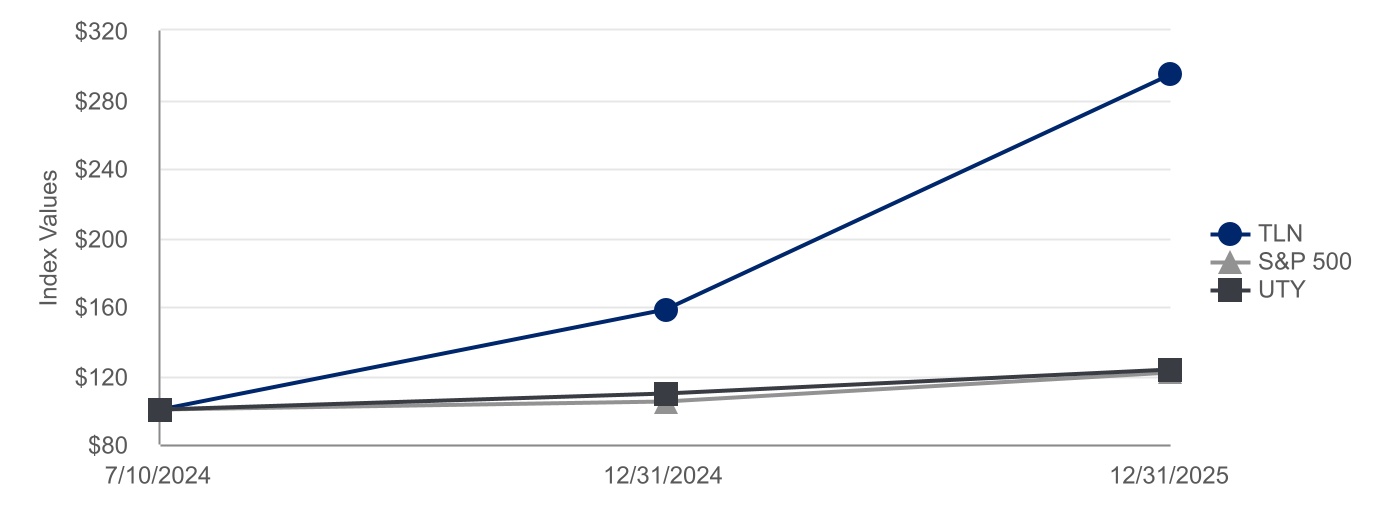
Value of Investment | ||||||||||||||||||||
| 7/10/2024 | 12/31/2024 | 12/31/2025 | ||||||||||||||||||
TLN | $ | 100 | $ | 158 | $ | 294 | ||||||||||||||
S&P 500 | 100 | 104 | 122 | |||||||||||||||||
S&P Utility | 100 | 109 | 123 | |||||||||||||||||
The information in this “Stock Performance Graph” section is being furnished solely pursuant to Item 201(e) of Regulation S-K and shall not be deemed “filed” for the purpose of Section 18 of the Exchange Act, or otherwise subject to the liabilities of that Section. Such information shall not be incorporated by reference into any registration statement or other filings with the SEC, whether made before or after the date hereof, regardless of any general incorporation language in such filing.
32
Dividends
The holders of shares of our common stock are entitled to receive dividends and other distributions (payable in cash, property, or capital stock of the Company) when, as, and if declared thereon by the Board of Directors from time-to-time out of any assets or funds of the Company legally available for the payment of dividends and shall share equally on a per share basis in such dividends and distributions. Any future determination regarding the declaration and payment of dividends will be at the discretion of our Board of Directors and will depend on then-existing conditions, including our financial condition, results of operations, contractual restrictions, capital requirements, business prospects, and other factors our Board of Directors may deem relevant. In addition, our ability to pay dividends may be restricted by agreements governing TES’s indebtedness, which place certain limitations on TES’s ability to pay dividends to TEC, and by other agreements we may enter into in the future. See “Item 1A. Risk Factors—Financial and Equity Risks—TEC is a holding company; its ability to obtain funds from its subsidiaries is structurally subordinated to existing and future liabilities and preferred equity of its subsidiaries, and the agreements governing TES’s indebtedness contain certain restrictions on distributions to TEC.”
Issuer Purchases of Equity Securities
Our Board of Directors approved the SRP in October 2023, initially authorizing the Company to repurchase up to $300 million of the Company’s shares of common stock. In May 2024, the Board of Directors approved an increase in the then-remaining SRP capacity to $1 billion through the end of 2025. In September 2024, the Board of Directors approved an increase in the then-remaining capacity to $1.25 billion through the end of 2026. In September 2025, the Board of Directors again approved an increase in the then-remaining capacity to $2 billion through the end of 2028.
Repurchases under the SRP may be made from time-to-time, at the Company’s discretion, in open market transactions at prevailing market prices, in negotiated transactions, or by other means in accordance with federal securities laws, and may be repurchased pursuant to a Rule 10b5-1 trading plan. The Company intends to fund repurchases under the SRP from cash on hand. Repurchases will be subject to a number of factors, including the market price of TEC’s common stock, alternative uses of capital, general market and economic conditions, and applicable legal requirements, and the SRP may be suspended, modified, or discontinued by the Board of Directors at any time without prior notice. The Company has no obligation to repurchase any amount of its common stock under the SRP. See Note 15 to the Annual Financial Statements for additional information on the SRP.
There were no share repurchases, including under the SRP, during the three months ended December 31, 2025. As of December 31, 2025, there was $2 billion of remaining capacity under the SRP.
ITEM 6. RESERVED
Not Applicable.
ITEM 7. MANAGEMENT’S DISCUSSION AND ANALYSIS OF FINANCIAL CONDITION AND RESULTS OF OPERATIONS
The following Management’s Discussion and Analysis of Financial Condition and Results of Operations (“MD&A”) should be read in conjunction with the Annual Financial Statements and the accompanying notes included elsewhere in this Report.
This MD&A discusses activity for the years ended December 31, 2025 (Successor) and December 31, 2024 (Successor). The operating results for the period from May 18 through December 31, 2023 (Successor) and for the period from January 1 through May 17, 2023 (Predecessor) are not comparable with the operating results for the years presented in this MD&A due to the application of fresh start accounting after our Emergence from Restructuring in May 2023. See “Item 7. Management’s Discussion and Analysis of Financial Condition and Results of Operations” in our 2024 Annual Report on Form 10-K, filed with the SEC on February 28, 2025, for a discussion of the activities and results of operations for each of these periods.
The discussion contains forward-looking statements as well as estimates regarding market and industry data, which involve risks, uncertainties, and assumptions. See “Cautionary Note Regarding Forward-Looking Information” and “Market and Industry Data” for additional information. Dollars are in millions, unless otherwise noted.
Recent Developments
Cornerstone Acquisition
On January 15, 2026, we entered into the Cornerstone Merger Agreement to acquire from affiliates of Energy Capital Partners (“ECP”) the 875 MW Waterford Energy Center and 456 MW Darby Generating Station, both located in Ohio, and the 1,120 MW Lawrenceburg Power Plant located in Indiana, for an aggregate purchase price of $3.45 billion, consisting of $2.55 billion in cash, subject to working capital and other customary adjustments, and 2,400,000 shares of Talen common stock, valued at approximately $900 million at the time of the entry into the Cornerstone Merger Agreement. The Company expects the cash portion of the purchase price to be funded from the proceeds of new indebtedness. The stock consideration will be subject to lock-ups of 90 days on 50% of the stock consideration and 180 days on the remaining stock consideration.
33
The addition of these assets to Talen’s portfolio will increase generation capacity by approximately 2.5 GW of natural gas generation, substantially expanding Talen’s presence in the western PJM market and adding additional efficient baseload generation assets to its fleet.
In connection with the stock consideration, at the closing of the Cornerstone Acquisition, we intend to enter into the Cornerstone RRA with certain parties thereto substantially in the form attached to this Report as Exhibit 4.16. Pursuant to the terms of the Cornerstone RRA, the Company will agree to use its commercially reasonable efforts to file a registration statement on Form S-3 under the Securities Act of 1933, as amended, to register the TEC common stock issued pursuant to the Cornerstone Merger Agreement with the SEC within three business days (and in any event within five business days) after issuance. See also “Item 1A. Risk Factors—Financial and Equity Risks—A number of factors could adversely affect the market price or trading volume of our common stock, even if our business is doing well, including but not limited to substantial sales of our common stock by existing shareholders, future issuances of equity or debt securities by us, and (or) research or reports published by financial analysts.”
The proposed Cornerstone Acquisition is subject to regulatory approvals and the satisfaction of other customary closing conditions, and is expected to close early in the second half of 2026.
See Note 17 to the Annual Financial Statements for additional information on the Cornerstone Acquisition and “Item 1A. Risk Factors—Risks Related to the Cornerstone Acquisition” of this Report for a discussion of the associated risks.
The foregoing description of the Cornerstone Merger Agreement and the transaction contemplated thereby is only a summary, does not purport to be complete, and is qualified in its entirety by reference to the full text of the Cornerstone Merger Agreement, a copy of which is incorporated by reference as Exhibit 2.1 to this Report. The Cornerstone Merger Agreement is being filed only to provide investors with information regarding their terms and are not intended to provide any other factual information about the parties thereto. Investors should not rely on the representations, warranties, or covenants in the Cornerstone Merger Agreement, which may be subject to important limitations and qualifications, and which may change after the date of the Cornerstone Merger Agreement, as characterizations of the actual state of facts or condition of the Company, the sellers, or any of their respective subsidiaries or affiliates.
PJM 2027/2028 Base Residual Auction
In December 2025, PJM announced the results of the 2027/2028 PJM BRA. Talen cleared 8,745 MW at a price of $333.44/MWd.
See “—Factors Affecting Our Financial Condition and Results of Operations—Capacity Markets” for additional information.
Closing of the Freedom and Guernsey Acquisitions
In November 2025, the Company consummated the Freedom and Guernsey Acquisitions for an aggregate $3.8 billion which is subject to certain post-closing adjustments for net working capital and other customary items. The Freedom and Guernsey Acquisitions were funded from the proceeds of the Unsecured Notes and the TLB-3. Additionally, TES increased its RCF (including its revolving LC capacity) from $700 million to $900 million and increased its LCF from $900 million to $1.1 billion and extended its maturity from December 2026 to December 2027.
Issuance of Senior Notes. In October 2025, TES issued (i) $1.4 billion in aggregate principal amount of 6.25% Senior Unsecured Notes due 2034, and (ii) $1.3 billion in aggregate principal amount of 6.50% Senior Unsecured Notes due 2036.
See Notes 10 and 17 to the Annual Financial Statements for additional information on the financing transactions and issuance of the Unsecured Notes, and the Freedom and Guernsey Acquisitions, respectively.
Factors Affecting Our Financial Condition and Results of Operations
Earnings in future periods are subject to various uncertainties and risks. See “Cautionary Note Regarding Forward-Looking Information,” “Item 1A. Risk Factors,” and Notes 2 and 9 to the Annual Financial Statements for additional information on our risks.
Commodity Markets
During 2025, PJM experienced weather-related volatility, as extreme winter and summer temperatures over certain days contributed to increased load demand and higher settled on-peak power prices during the year. TETCO M-3 natural gas prices settled higher in the period due to the effect of increased electric demand despite elevated storage levels that exceeded the five-year average.
34
The weighted average settled on-peak power prices and natural gas prices for the PJM market for the years ended December 31, were:
| 2025 | 2024 | 2023 | ||||||||||||||||||
| PJM West Hub Day Ahead Peak - $/MWh | $ | 60.30 | $ | 40.91 | $ | 39.22 | ||||||||||||||
| PJM PPL Zone Day Ahead Peak - $/MWh | 47.40 | 31.51 | 29.59 | |||||||||||||||||
| TETCO M-3 - $/MMBtu | 3.69 | 2.07 | 1.90 | |||||||||||||||||
As of December 31, 2025 (Successor), the weighted average forward market prices for the following years were:
| 2026 | 2027 | |||||||||||||
| PJM West Hub ATC - $/MWh | $ | 55.60 | $ | 59.29 | ||||||||||
| TETCO M-3 - $/MMBtu | 3.69 | 4.04 | ||||||||||||
PJM West Hub ATC Spark Spreads - $/MWh (a) | 29.76 | 31.00 | ||||||||||||
__________________
(a)Spark spreads are computed based on day-ahead PJM West Hub ATC prices, TETCO M-3 natural gas prices, and a heat rate of 7 MMBtu/MWh.
As of December 31, 2024 (Successor), the weighted average forward market prices for the following years were:
2025 (a) | 2026 | 2027 | ||||||||||||||||||
| PJM West Hub ATC - $/MWh | $ | 47.43 | $ | 51.16 | $ | 54.34 | ||||||||||||||
| TETCO M-3 - $/MMBtu | 3.45 | 3.73 | 3.72 | |||||||||||||||||
PJM West Hub ATC Spark Spreads - $/MWh (b) | 23.25 | 25.07 | 28.27 | |||||||||||||||||
__________________
(a)Represents forward prices for 2025 as of December 31, 2024 (Successor). See weighted average settled prices table above for 2025 realized prices.
(b)Spark spreads are computed based on day-ahead PJM West Hub ATC prices, TETCO M-3 natural gas prices, and a heat rate of 7 MMBtu/MWh.
Capacity Markets
Our generation facilities are located primarily in markets with capacity products, which are intended to ensure long-term grid reliability for customers by securing sufficient power supply resources to meet predicted future demand. Capacity prices are affected by supply and demand fundamentals, such as generation facility additions and retirements, capacity imports from and exports to adjacent markets, generation facility retrofit costs, non-performance risk premium penalties, demand response products, power demand forecasts, reserve margin targets and, in PJM, adjustments to the PJM market seller offer cap as determined by the PJM independent market monitor. Additionally, capacity prices may be affected by regulatory proceedings and (or) interventions by government stakeholders.
PJM Capacity Auctions. Under the PJM Reliability Pricing Model, when held on schedule, the PJM BRA is required to be conducted in the month of May three years prior to the start of the applicable PJM Capacity Year in order for PJM to secure commitments from capacity resources. The results of each PJM BRA impact our capacity revenues expected to be earned for the specific PJM Capacity Year.
Recently, PJM has delayed its auctions, which has resulted in less than 3 years between each auction and the start of the relevant PJM Capacity Year. The PJM BRA for the 2027/2028 PJM Capacity Year was held in December 2025. The capacity market construct provides generation owners some opportunity for revenue visibility on a multiyear basis and is intended to provide a price signal for new generation to be built in the future. See Note 9 to the Annual Financial Statements for additional information on the PJM capacity market, systemic risks, auction delays, and related legal actions.
Capacity Prices. The following table displays the cleared capacity prices for completed PJM BRAs for the markets and zones in which we primarily operate:
| 2027/2028 | 2026/2027 | 2025/2026 | 2024/2025 | 2023/2024 | ||||||||||||||||||||||||||||
PJM Capacity Performance ($/MWd) (a) | ||||||||||||||||||||||||||||||||
| MAAC | $ | 333.44 | $ | 329.17 | $ | 269.92 | $ | 49.49 | $ | 49.49 | ||||||||||||||||||||||
| PPL | 333.44 | 329.17 | 269.92 | 49.49 | 49.49 | |||||||||||||||||||||||||||
(a)Displayed prices are from the applicable market publications.
For the 2027/2028 PJM Capacity Year, the Company cleared 8,745 MW at a price of $333.44/MWd.
35
Nuclear Production Tax Credit
The Nuclear PTC program, established by the Inflation Reduction Act, provides qualified nuclear power generation facilities with a transferable tax credit for electricity produced and sold to an unrelated party during each tax year. The credit provides support beginning when annual gross receipts decline below an equivalent $44.60/MWh, increases ratably up to $3/MWh when annual gross receipts are equivalent to $26/MWh, and is subject to potential adjustments including inflation escalators and a five-times increase in value (up to $15/MWh) for meeting prevailing wage requirements (which we expect to meet). Electricity produced and sold by Susquehanna to third parties from December 31, 2023 through December 31, 2032 will be eligible for the credit. Susquehanna earned Nuclear PTC revenue during the year ended December 31, 2024 (Successor). However, as prevailing market prices exceeded the PTC recognition threshold during the year ended December 31, 2025 (Successor), no such tax credits were earned for the period. See Notes 3 and 4 to the Annual Financial Statements for additional information on Nuclear PTC revenue recognized and the tax impact.
Seasonality/Scheduled Maintenance
The demand for and market prices of electricity and natural gas are affected considerably by weather and, as a result, our operating results may fluctuate significantly on a seasonal basis. In general, below-average temperatures in the winter and above-average temperatures in the summer tend to increase electricity demand, energy prices, and revenues. Alternatively, moderate temperatures tend to decrease electricity demand and may adversely affect resulting energy margins, particularly in PJM. In addition, our operating expenses typically fluctuate geographically on a seasonal basis, with peak power generation and expenses during the winter in the Mid-Atlantic. We ordinarily perform planned facility maintenance during milder non-peak demand periods in the spring and fall to ensure reliability during peak periods. The pattern of fluctuations in our operating results varies depending on the type and location of the facilities being serviced, the capacity markets served, the maintenance requirements of our facilities, and the terms of bilateral contracts to purchase or sell electricity. We maintain our fossil generation fleet through a combination of self-service and contracted maintenance activity (including long-term service agreements at certain facilities). Our largest recurring maintenance project is the annual spring refueling outage at Susquehanna. See also “Item 1A. Risk Factors—Industry and Market Risks—Our business is subject to physical, market, economic, and regulatory risks relating to weather conditions and extreme weather events.”
Results of Operations
The results of operations presented below are prepared in accordance with GAAP and should be reviewed in conjunction with the Annual Financial Statements and the related notes in this Report. The following discussion provides an analysis of the changes in our results of operations for the year ended December 31, 2025 (Successor), compared to the year ended December 31, 2024 (Successor).
In the explanations below, “Energy and other revenues” and “Fuel and energy purchases” are evaluated collectively because the price for power is generally determined by the variable operating cost of the next marginal generator dispatched to meet demand. “Energy and other revenues” relate to sales to an RTO or ISO, sales under wholesale bilateral contracts, realized hedges, Bitcoin revenue, and Nuclear PTC revenue. “Fuel and energy purchases” includes costs for fuel to generate electricity and settlements of financial and physical transactions related to fuel and energy purchases.
Unrealized gains (losses) on derivative instruments resulting from changes in fair value during the periods are presented separately as revenues within “Operating Revenues” and expenses within “Energy Expenses.” We evaluate them collectively because they represent the changes in fair value of our economic hedging activities.
36
Results for the Years Ended December 31, 2025 (Successor) and 2024 (Successor)
The following table and subsequent sections display the results of operations:
| Successor | Favorable (Unfavorable) Variance | |||||||||||||||||||
| Year Ended December 31, | ||||||||||||||||||||
| 2025 | 2024 | |||||||||||||||||||
| Energy and other revenues | $ | 2,141 | $ | 1,881 | $ | 260 | ||||||||||||||
| Capacity revenues | 485 | 192 | 293 | |||||||||||||||||
| Unrealized gain (loss) on derivative instruments (Note 2) | (45) | 42 | (87) | |||||||||||||||||
| Operating Revenues (Note 3) | 2,581 | 2,115 | 466 | |||||||||||||||||
| Fuel and energy purchases | (908) | (694) | (214) | |||||||||||||||||
| Nuclear fuel amortization | (97) | (123) | 26 | |||||||||||||||||
| Unrealized gain (loss) on derivative instruments (Note 2) | (61) | 20 | (81) | |||||||||||||||||
| Energy Expenses | (1,066) | (797) | (269) | |||||||||||||||||
| Operating Expenses | ||||||||||||||||||||
| Operation, maintenance and development | (620) | (592) | (28) | |||||||||||||||||
General and administrative (includes stock-based compensation of $(526) and $(33)) (Note 13) | (624) | (163) | (461) | |||||||||||||||||
| Depreciation, amortization and accretion (Note 7) | (279) | (298) | 19 | |||||||||||||||||
| Impairments (Note 7) | — | (1) | 1 | |||||||||||||||||
| Other operating income (expense), net | (82) | (38) | (44) | |||||||||||||||||
| Operating Income (Loss) | (90) | 226 | (316) | |||||||||||||||||
| Nuclear decommissioning trust funds gain (loss), net (Note 6) | 182 | 178 | 4 | |||||||||||||||||
| Interest expense and other finance charges (Note 10) | (302) | (238) | (64) | |||||||||||||||||
| Gain (loss) on sale of assets, net (Note 17) | 34 | 884 | (850) | |||||||||||||||||
| Other non-operating income (expense), net | 10 | 61 | (51) | |||||||||||||||||
| Income (Loss) Before Income Taxes | (166) | 1,111 | (1,277) | |||||||||||||||||
| Income tax benefit (expense) (Note 4) | (53) | (98) | 45 | |||||||||||||||||
| Net Income (Loss) | (219) | 1,013 | (1,232) | |||||||||||||||||
| Less: Net income (loss) attributable to noncontrolling interest | — | 15 | 15 | |||||||||||||||||
| Net Income (Loss) Attributable to Stockholders (Successor) | $ | (219) | $ | 998 | $ | (1,217) | ||||||||||||||
Year Ended December 31, 2025 (Successor) compared to Year Ended December 31, 2024 (Successor)
Net Income (Loss) Attributable to Stockholders decreased by $(1.2) billion, primarily driven by the factors discussed below.
•Operating Revenues, net of Energy Expenses. $197 million favorable increase, primarily due to the following:
◦Energy and other revenues, net of Fuel and energy purchases. $46 million favorable increase. This is primarily related to the effects of a $519 million increase in margin associated with electric generation and ancillary revenue, primarily due to higher realized prices at Susquehanna and our dispatchable generation facilities, and higher generation volumes at our dispatchable generation facilities. Such amounts are partially offset by (i) $(318) million decrease in digital revenue and Nuclear PTC revenue, coupled with (ii) $(155) million decrease in realized hedge results.
◦Capacity revenues. $293 million favorable increase. This is primarily driven by higher cleared capacity prices, partially offset by a decrease to lower cleared volumes through the PJM 2025/2026 BRA compared to the PJM 2024/2025 BRA.
◦Unrealized gain (loss) on derivative instruments, net. $(168) million unfavorable decrease. This is primarily related to the combined effects of: (i) $(82) million lower volume of hedge positions executed in the current period and (ii) $(45) million decrease in net short positions resulting from higher forward power prices, coupled with (iii) $(42) million unrealized losses from the reversal of positions previously recognized as mark-to-market assets which settled during the period.
◦Nuclear fuel amortization. $26 million favorable decrease. This is primarily related to a decrease in the amortization of intangible assets related to certain nuclear fuel supply contracts which have expired.
37
•Operation, maintenance and development. $(28) million unfavorable increase. This is primarily due to increased maintenance costs, including the incremental maintenance at Susquehanna performed during its extended planned Unit 2 refueling outage in the spring of 2025, partially offset by lower maintenance costs at ERCOT and development costs at Cumulus Digital, both of which were sold in 2024.
•General and administrative. $(461) million unfavorable increase. This primarily consisted of a $(493) million increase of stock-based compensation expense primarily due to a change in accounting for certain stock-based awards. See Note 13 to the Annual Financial Statements for additional information. This was offset by a $32 million decrease in other compensation.
•Depreciation, amortization and accretion. $19 million favorable decrease. This is primarily due to a decrease in amortization and depreciation because of the derecognition of Nautilus assets in June 2025. See Note 7 to the Annual Financial Statements for additional information.
•Other operating income (expense), net. $(44) million unfavorable increase. This is primarily related to transaction costs for the Freedom and Guernsey Acquisitions and the loss resulting from the sale of Nuclear PTCs.
•Interest expense and other finance charges. $(64) million unfavorable increase. This primarily consisted of: (i) a $(34) million increase in cash interest expense on the Unsecured Notes, TLB-2, and TLB-3, partially offset by the absence of interest expense on the TLC and lower interest expense on the TLB-1, and (ii) a $(30) million increase in non-cash interest expense resulting from changes in unrealized positions on interest rate swaps and increases in deferred finance cost amortization. See Note 10 to the Annual Financial Statements for additional information on activity related to the above debt instruments.
•Gain (loss) on sale of assets, net. $(850) million unfavorable decrease. This primarily consisted of: (i) $564 million gain from the ERCOT Sale and (ii) $324 million gain from the AWS Data Campus Sale, both of which closed in 2024; and (iii) a $22 million gain from the sale of the Camden and Dartmouth in September 2025. See Note 17 to the Annual Financial Statements for additional information.
•Other non-operating income (expense), net. $(51) million unfavorable decrease. This primarily consisted of lower interest income on cash deposits in 2025 due to the release of restricted cash in 2024 after refinancing the TLC, combined with additional debt restructuring fees in 2025. See Note 19 to the Annual Financial Statements for additional information.
•Income tax benefit (expense). $45 million favorable decrease. This is primarily due to a decrease in pre-tax income for the year ended December 31, 2025 (Successor), the absence of valuation adjustments and the tax benefit associated with the Nuclear PTC recognized in 2024, and changes in nondeductible and other items. See the reconciliation of the effective tax rate in Note 4 to the Annual Financial Statements for additional information.
Liquidity and Capital Resources
Our liquidity and capital requirements are generally a function of: (i) debt service requirements; (ii) capital expenditures; (iii) maintenance activities; (iv) liquidity requirements for our hedging activities including cash collateral and other forms of credit support; (v) the settlement of, or forms of credit in support of, legacy asset retirement and (or) environmental obligations; (vi) other working capital requirements; and (or) (vii) discretionary expenditures, including share repurchase activities.
Our primary sources of liquidity and capital include available cash deposits, cash flows from operations, amounts available under our debt and credit facilities, and potential incremental financing proceeds. Generating sufficient cash flows for our business is primarily dependent on capacity revenue, the production and sale of power at margins sufficient to cover fixed and variable expenses, hedging strategies to manage price risk exposure, and the ability to access a wide range of capital market financing options.
Our hedging strategy is focused on maintaining appropriate risk tolerances with an emphasis on protecting cash flows across our generation fleet. Our strong balance sheet provides ample capacity and counterparty appetite for lien-based hedging, which limits the use of margin posting requirements. Specifically, our hedging strategy prioritizes a first lien-based hedging program, in which hedging counterparties are granted a lien in the same collateral securing our first-lien debt obligations, while minimizing exchange-based hedging and the associated margin requirements. Additionally, the stability provided by contracted cash flows associated with long-term contracts lowers our overall hedging requirements.
We are partially exposed to financial risks arising from natural business exposures including commodity price and interest rate volatility. Within the bounds of our risk management program and policies, we use a variety of derivative instruments to enhance the stability of future cash flows to maintain sufficient financial resources for working capital, debt service, capital expenditures, debt covenant compliance, and (or) other needs.
See the following Notes to the Annual Financial Statements for additional information on liquidity topics discussed below: Note 2 for derivatives and hedging, Note 8 for AROs and environmental obligations, Note 10 for long-term debt and credit facilities, and Note 16 for supplemental cash flow information.
38
Liquidity and Letter of Credit Capacity
| Successor | ||||||||||||||
| December 31, 2025 | December 31, 2024 | |||||||||||||
| Cash and cash equivalents, unrestricted | $ | 689 | $ | 328 | ||||||||||
Unutilized RCF capacity (a) | 900 | 700 | ||||||||||||
Total available liquidity | $ | 1,589 | $ | 1,028 | ||||||||||
Additional unutilized LC capacity (b) | $ | 652 | $ | 526 | ||||||||||
__________________
(a)RCF committed capacity can be used for direct cash borrowings and (or) LCs.
(b)Includes LC capacity under the LCF and excludes LC capacity available under the RCF.
Based on current and anticipated levels of operations, industry conditions, and market environments in which we transact, we believe available liquidity from financing activities, cash on hand, and cash flows from operations (including changes in working capital) will be adequate to meet working capital, debt service, capital expenditures, and (or) other future requirements for the next twelve months and beyond. See Note 10 to the Annual Financial Statements for additional information on the RCF and LCF.
Financial Performance Assurances
TES has provided financial performance assurances in the form of surety bonds to third parties on behalf of certain subsidiaries for obligations including but not limited to environmental obligations and AROs. Surety bond providers generally have the right to request additional collateral to backstop surety bonds.
| Successor | ||||||||||||||
| December 31, 2025 | December 31, 2024 | |||||||||||||
| Outstanding surety bonds | $ | 228 | $ | 234 | ||||||||||
In May 2025, the Company elected to replace a surety provider and, as of December 31, 2025 (Successor), the replacement surety bonds issued by the new provider were outstanding. However, an aggregate $6 million of replaced surety bonds (included in the total above) continued to be outstanding as their release was not yet completed as of December 31, 2025 (Successor).
Forecasted Uses of Cash
Indebtedness. See Note 10 to the Annual Financial Statements and “—Recent Developments” above for additional information on our indebtedness.
Capital Expenditures. Capital expenditure plans are revised periodically for changes in operational needs, market conditions, regulatory requirements, and cost projections. Accordingly, the expected cash requirements for capital expenditures are subject to revision.
| 2026 | 2027 | |||||||||||||
| Nuclear fuel | $ | 122 | $ | 137 | ||||||||||
| PJM nuclear generation facility | 53 | 46 | ||||||||||||
| PJM fossil generation facilities | 118 | 73 | ||||||||||||
| Other | 25 | 12 | ||||||||||||
Total (a) | $ | 318 | $ | 268 | ||||||||||
__________________
(a)Expected capitalized interest on capital expenditures is a non-material amount in 2026 and 2027.
Projected ARO and Accrued Environmental Liability Cash Flows. Certain of our subsidiaries have legal obligations to perform significant decommissioning and remediation activities associated with current operations and (or) at former generation facility sites. We believe the NDT, which was established to fund the Company’s proportionate share of Susquehanna’s ARO decommissioning costs, will be adequate when decommissioning commences at the expiration of Susquehanna’s licenses.
39
Non-nuclear AROs and accrued environmental costs are expected to be funded with available cash on hand. The majority of these obligations relate to ash impoundments at Colstrip, Brunner Island, and Montour. Based on the scope of work, a significant portion of the Colstrip and Brunner Island obligations are expected to be settled through 2030 as remediation activities are scheduled for completion. Settlements thereafter are forecasted to continue at reduced levels for several decades. No assurance can be provided as to the timing or amount of ARO and (or) accrued environmental cost settlements. Projections are subject to revision based on changes to the scope of work, estimated inflation rates, changes in the estimated timing of settling AROs, escalating retirement costs, and (or) other projections. Additionally, projections do not contemplate settlements for conditional AROs, which are AROs not presented on the consolidated balance sheets as they cannot be determined. See Note 8 to the Annual Financial Statements for additional information on AROs and Note 9 for additional information on the EPA CCR Rule.
As of December 31, 2025 (Successor), the expected undiscounted payments of non-nuclear AROs are estimated to be:
| 2026 | 2027 | 2028 | 2029 | 2030 | Thereafter | Total | ||||||||||||||||||||||||||||||||||||||
| Accrued environmental costs | $ | 3 | $ | 3 | $ | 4 | $ | 4 | $ | 3 | $ | 13 | $ | 30 | ||||||||||||||||||||||||||||||
Non-nuclear AROs (a) | 40 | 53 | 47 | 56 | 38 | 255 | 489 | |||||||||||||||||||||||||||||||||||||
__________________
(a)Certain obligations are: (i) partially supported by surety bonds, some of which have been collateralized with cash and (or) LCs; or (ii) partially prefunded under phased installment agreements.
Cash Flow Activities
Net cash provided by (used in) operating, investing, and financing activities for the periods was:
| Successor | Favorable (Unfavorable) Variance | |||||||||||||||||||
| Year Ended December 31, | ||||||||||||||||||||
| 2025 | 2024 | |||||||||||||||||||
| Operating activities | $ | 704 | $ | 256 | $ | 448 | ||||||||||||||
| Investing activities | (4,003) | 1,171 | (5,174) | |||||||||||||||||
| Financing activities | 3,686 | (1,963) | 5,649 | |||||||||||||||||
Operating activities
A change of $448 million in net cash provided by (used in) operating activities is generally aligned with results from operations combined with working capital changes in the normal course of business. See “—Results of Operations” for additional information.
Investing activities
A change of $(5.2) billion in net cash provided by (used in) investing activities was primarily due to: (i) $(3.8) billion used to finance the Freedom and Guernsey Acquisitions in 2025; (ii) a $(635) million decrease in proceeds from the AWS Data Campus Sale in 2024; and (iii) a $(763) million decrease in proceeds from the ERCOT Sale in 2024. See Note 17 to the Annual Financial Statements for additional information on acquisitions and divestitures.
Financing activities
A change of $5.6 billion in net cash provided by (used in) financing activities was primarily due to: (i) $3.9 billion in new debt from the TLB-3 and the Unsecured Notes raised in 2025; (ii) $(370) million of net debt issuances in 2024; (iii) $182 million repayment of the Cumulus Digital TLF and (iv) $125 million purchase of noncontrolling interest in Cumulus Digital, both of which closed in 2024; and (v) a $1.9 billion decrease in share repurchases.
Non-GAAP Financial Measure
Adjusted EBITDA, which we use as a measure of our performance, is not a financial measure prepared under GAAP. Non-GAAP financial measures do not have definitions under GAAP and may be defined and calculated differently by, and not be comparable to, similarly titled measures used by other companies. Non-GAAP measures are not intended to replace the most comparable GAAP measures as indicators of performance. Generally, a non-GAAP financial measure is a numerical measure of financial performance, financial position, or cash flows that excludes (or includes) amounts that are included in (or excluded from) the most directly comparable measure calculated and presented in accordance with GAAP. Management cautions readers not to place undue reliance on the following non-GAAP financial measure, but to also consider it along with its most directly comparable GAAP financial measure. Non-GAAP measures have limitations as analytical tools and should not be considered in isolation or as a substitute for analyzing our results as reported under GAAP.
40
Adjusted EBITDA
We use Adjusted EBITDA to: (i) assist in comparing operating performance and readily view operating trends on a consistent basis from period to period without certain items that may distort financial results; (ii) plan and forecast overall expectations and evaluate actual results against such expectations; (iii) communicate with our Board of Directors, shareholders, creditors, analysts, and the broader financial community concerning our financial performance; (iv) set performance metrics for our annual short-term incentive compensation; and (v) assess compliance with our indebtedness.
Adjusted EBITDA is computed as net income (loss) adjusted, among other things, for certain: (i) nonrecurring charges; (ii) non-recurring gains; (iii) non-cash and other items; (iv) unusual market events; (v) any depreciation, amortization, or accretion; (vi) mark-to-market gains or losses; (vii) gains and losses on the NDT; (viii) gains and losses on asset sales, dispositions, and asset retirement; (ix) impairments, obsolescence, and net realizable value charges; (x) interest expense; (xi) income taxes; (xii) legal settlements, liquidated damages, and contractual terminations; (xiii) development expenses; (xiv) noncontrolling interests, except where otherwise noted; and (xv) other adjustments. Such adjustments are computed consistently with the provisions of our indebtedness to the extent that they can be derived from the financial records of the business. Pursuant to TES’s debt agreements, Cumulus Digital contributes to Adjusted EBITDA beginning in the first quarter 2024, following termination of the Cumulus Digital TLF and associated cash flow sweep.
Additionally, we believe investors commonly adjust net income (loss) information to eliminate the effect of nonrecurring restructuring expenses and other non-cash charges, which can vary widely from company to company and from period to period and impair comparability. We believe Adjusted EBITDA is useful to investors and other users of our financial statements to evaluate our operating performance because it provides an additional tool to compare business performance across companies and between periods. Adjusted EBITDA is widely used by investors to measure a company’s operating performance without regard to such items described above. These adjustments can vary substantially from company to company and period to period depending upon accounting policies, book value of assets, capital structure, and the method by which assets were acquired.
The following table presents a reconciliation of the GAAP financial measure of “Net Income (Loss)” presented on the Consolidated Statements of Operations to the non-GAAP financial measure of Adjusted EBITDA:
| Successor | Predecessor | ||||||||||||||||||||||||||||
| (Millions of Dollars) | Year Ended December 31, 2025 | Year Ended December 31, 2024 | May 18 through December 31, 2023 | January 1 through May 17, 2023 | |||||||||||||||||||||||||
| Net Income (Loss) | $ | (219) | $ | 1,013 | $ | 143 | $ | 465 | |||||||||||||||||||||
| Adjustments | |||||||||||||||||||||||||||||
| Interest expense and other finance charges | 302 | 238 | 176 | 163 | |||||||||||||||||||||||||
| Income tax (benefit) expense | 53 | 98 | 51 | 212 | |||||||||||||||||||||||||
Depreciation, amortization and accretion (a) | 266 | 281 | 157 | 200 | |||||||||||||||||||||||||
Nuclear fuel amortization (a) | 97 | 123 | 108 | 33 | |||||||||||||||||||||||||
Reorganization (income) expense, net (Note 20) (b) | — | — | — | (799) | |||||||||||||||||||||||||
| Unrealized (gain) loss on commodity derivative contracts | 106 | (62) | (52) | 63 | |||||||||||||||||||||||||
| Nuclear decommissioning trust funds (gain) loss, net | (182) | (178) | (108) | (57) | |||||||||||||||||||||||||
Stock-based and other long-term incentive compensation expense (Note 13) (b) | 535 | 54 | 21 | — | |||||||||||||||||||||||||
(Gain) loss on asset sales, net (Note 17) (b) | (34) | (884) | (7) | (50) | |||||||||||||||||||||||||
Non-cash impairments and other charges (c) | 11 | 24 | 15 | 438 | |||||||||||||||||||||||||
Legal settlements and litigation costs | 6 | 4 | (84) | 1 | |||||||||||||||||||||||||
Acquisition and divestiture activities (d) | 65 | 62 | — | — | |||||||||||||||||||||||||
Operational and other restructuring activities (e) | 21 | 9 | 30 | 19 | |||||||||||||||||||||||||
| Noncontrolling interest | — | (21) | (42) | (14) | |||||||||||||||||||||||||
| Other | 8 | 9 | 18 | 21 | |||||||||||||||||||||||||
| Total Adjusted EBITDA | $ | 1,035 | $ | 770 | $ | 426 | $ | 695 | |||||||||||||||||||||
__________________
(a)Includes the periodic amortization of fair value adjustments associated with acquired executory contracts and intangible assets.
(b)See the corresponding Note to the Annual Financial Statements for additional information.
(c)Includes impairments, net realizable value adjustments and other write-offs. See Note 7 to the Annual Financial Statements for additional information associated with the Brandon Shores impairment group recognized during the period of January 1 through May 17, 2023 (Predecessor).
(d)Includes the non-recurring: (i) advisory fees associated with completed acquisitions and divestitures; (ii) remaining settlements on contracts of divested assets; and (iii) non-recurring finance fees charged to the Consolidated Statement of Operations associated with acquisition financing fee arrangements.
(e)Non-recurring severance and retention costs and strategic initiative costs.
41
Critical Accounting Estimates
Financial statements prepared in conformity with GAAP require the application of appropriate accounting policies to form the basis of estimates utilizing methods, judgments, and (or) assumptions that materially affect: (i) the measurement and carrying values of assets and liabilities as of the date of the financial statements; (ii) the revenues recognized and expenses incurred during the presented reporting periods; and (iii) financial statement disclosures of commitments, contingencies, and other significant matters. Such judgments and assumptions may include significant subjectivity due to the inherent uncertainties of future events that exist to such an extent that there is a reasonable likelihood that materially different amounts would have been reported under different conditions or if different assumptions had been used. We believe the following areas contain the most significant accounting judgments, the highest levels of subjectivity, or relate to uncertain matters that are susceptible to material changes in estimates that are critical to understanding the Company’s financial results. Due to such inherent uncertainties, actual results may differ substantially from estimates and (or) estimates may change materially in periods where new information becomes known. Management develops these estimates based on best available information, historical experience, and subject matter experts.
See Note 1 to the Annual Financial Statements for accounting policies related to each of the following topics.
Business Combinations
The purchase price paid by the Company to acquire a business is allocated to the identifiable assets acquired and liabilities assumed based on their estimated fair values as of the acquisition date. If the purchase price exceeds the net fair value of the acquired business, the difference is recognized as goodwill on the consolidated balance sheet. Conversely, a bargain purchase gain is recognized on the consolidated statement of operations if the purchase price of an acquired business is below its net fair value.
Valuations of material long-term assets and (or) liabilities associated with an acquired business that lack quoted market prices contain the most significant fair value assumptions as they require substantial management judgment due to inherently uncertain future market, regulatory, and operational conditions. The Company engages third party specialists to assist with the preparation of fair value estimates as of the acquisition date utilizing present value techniques. The most significant factors influencing fair value measurements include: (i) the forecasted prices for capacity, wholesale power, and natural gas; (ii) volumetric assumptions; and (iii) discount rates. Although these inputs are believed to be consistent with reasonable market participant-based assumptions, the resulting fair value estimates are inherently unpredictable and uncertain. Changes to these assumptions may result in materially different fair value estimates, which in turn, could result in a different expense recognition pattern for future depreciation and amortization.
If the preliminary accounting for a business combination is incomplete by the end of the reporting period in which an acquisition occurs, purchase price allocation estimates are recognized on the consolidated balance sheet. Revisions to such estimates are permitted within one year from the acquisition date based on new information obtained that would have existed as of the acquisition date. Any adjustment that arises from information obtained that did not exist as of the acquisition date is recognized in the period in which the adjustment arises.
See Note 17 to the Annual Financial Statements for additional information on business combinations.
Nuclear Decommissioning Asset Retirement Obligations
We have significant legal obligations associated with Susquehanna’s decommissioning. Susquehanna’s Unit 1 and Unit 2 licenses, if not renewed, will expire in 2042 and 2044, respectively, at or before which time the units will be shut down.
Judgment is required to make reasonable ARO assumptions regarding the range of likely outcomes for cost estimates, as these obligations are not expected to be paid until years or decades in the future, and potentially many years after shutdown. Inflation rates and discount rates may be subject to revision until the ARO settlement date. As such, changes in assumptions to the range of likely outcomes could result in different cash outlay for AROs at the settlement date than the current carrying value of the ARO presented on the Consolidated Balance Sheets. Susquehanna periodically assesses its ARO through third-party engineering studies in order to determine expected scope, costs, and timing of decommissioning activities. Generally, its decommissioning cost study is updated approximately every seven years. As part of the cost study update process, we and the third-party engineering firm evaluate cost projections based on the latest engineering techniques and the latest information, which incorporates nuclear plant retirements in the industry. We use the results of the study along with our experience, knowledge, and professional judgment to update Susquehanna’s decommissioning plan and the related carrying value of the ARO.
AROs are recognized at fair value at the time of installation of the related asset and as an increase to PP&E. The income effect of AROs is generally presented as “Depreciation, amortization and accretion” on the Consolidated Statements of Operations through the expected ARO settlement date. However, for an asset that has a fully depreciated PP&E carrying value, revisions in ARO estimates have an immediate effect in earnings. Revisions to the estimated ARO are presented as “Other operating income (expense), net” on the Consolidated Statements of Operations.
See Note 8 to the Annual Financial Statements for additional information on AROs.
42
Derivative Instruments
Derivative instruments, which are deployed by our commercial organization to manage and (or) mitigate market and commodity price risk, are presented on the Consolidated Balance Sheets at fair value and are comprised primarily of power and natural gas commodity contracts. Derivative identification is challenging. While a conventional financially settled contract, such as a swap or option, generally contains standard terms that facilitate its identification as a derivative instrument, judgment is required to determine whether contracts to buy or sell commodities with physical delivery requirements, or contracts that contain certain embedded settlement or fluctuating price features, meet the definition of a derivative instrument. This judgment typically includes, among other things, an evaluation of the contract, its expected cash flows, and the activity levels of its principal market. Additionally, judgment is required to determine if a commodity contract intended for physical delivery meets an allowable exemption to account for its income effects under the accrual accounting method rather than at fair value. This typically includes assumptions regarding the probability of physical delivery and the quantities used in normal business activities.
As our derivative contracts generally settle within future time periods supportable by commodity exchange markets and the frequent occurrence of commercial transactions, our derivative contracts are valued using a market approach utilizing quoted prices in active markets or other observable market inputs to determine fair value. However, such prices are subject to volatility between periods based on weather, local market events, macroeconomic trends, and (or) other events and factors. Accordingly, changes in fair value for contracts identified as derivatives may result in material changes to unrealized gains or losses presented on the Consolidated Statements of Operations between periods. Changes in fair value of commodity derivatives are presented as “Unrealized gain (loss) on derivative instruments” as a component of either “Operating Revenues” or “Fuel and energy purchases” on the Consolidated Statements of Operations, in a consistent manner with the presentation of its realized net gains or losses.
See Note 2 to the Annual Financial Statements for additional information on derivative instruments.
Postretirement Benefit Obligations
Certain of our subsidiaries sponsor postemployment benefits that include defined benefit pension plans. Accounting for defined benefit pensions involves significant estimates to determine projected benefit obligations and company contribution requirements, which inherently require assumptions be made regarding many uncertainties. Such uncertainties include discount rates, expected return on assets, expected wages for participants at retirement, estimated retirement dates, and mortality rates. Over a period of time, we are required to fund all vested benefits for postretirement defined benefit pension plans through plan assets, investment returns, or contributions to the plans.
Actuarial assumptions required under GAAP to determine the projected benefit obligations and actuarial assumptions required under ERISA to determine contribution assumptions differ in their objectives. Actuarial assumptions regarding projected benefit obligations under GAAP affect the net periodic defined benefit cost presented within our Consolidated Statements of Operations. Actuarial assumptions used in the computation to estimate required contributions to the defined benefit plans affect funding requirements over a period of time.
We are responsible for the estimates regarding our postemployment benefits. However, we engage actuarial firms, who apply professional standards in the determination of the judgmental assumptions for plan contributions, to estimate both the contribution requirements for postemployment benefits and the associated projected benefit obligations under GAAP.
Projected benefit obligations are particularly sensitive to expected return on plan assets and the discount rate. The expected return on plan assets is the estimated long-term rates of return on plan assets that will be earned over the life of each plan. These projected returns reduce the net periodic defined benefit costs. The discount rate is used to compute the present value of benefits, which is based on projections of benefit payments to be made in the future. The objective in selecting the discount rate is to measure the single amount that, if invested at the measurement date in a portfolio of high-quality debt instruments, would provide the necessary future cash flows to pay the accumulated benefits when due. See Note 12 to the Annual Financial Statements for the weighted-average assumptions used for the discount rate and expected return on plan assets for all plans.
A variance in the discount rate or expected return on plan assets could have a significant impact on postretirement benefit obligations and annual net periodic pension costs. The following table displays the estimated increase (decrease) for defined benefit pension plans of a 1% increase and a 1% decrease in the discount rate and expected return on plan assets on the postretirement benefit obligation and net periodic pension cost as of December 31, 2025 (Successor).
| Sensitivity | ||||||||||||||
| Actuarial Assumption | 1% Increase | 1% Decrease | ||||||||||||
| Discount rate | ||||||||||||||
| Postretirement benefit obligation | $ | (106) | $ | 126 | ||||||||||
| Net periodic pension cost | 4 | (6) | ||||||||||||
| Expected return on plan assets | ||||||||||||||
| Net periodic pension cost | (10) | 10 | ||||||||||||
43
Income Taxes
Significant management estimates and judgments are involved to determine the provision for income taxes, deferred tax assets and liabilities, and valuation allowances.
An assessment is performed on a quarterly basis to determine the likelihood of realizing deferred tax assets. We assess the probability of realizing deferred tax assets by evaluating historical income after adjusting for certain nonrecurring items for purposes of projecting future income, our intent and ability to implement tax planning strategies, and performing scheduling of the reversal of temporary differences. We also evaluate negative evidence, such as the expiration of historical operating loss or tax credit carryforwards, that could indicate an inability to realize deferred tax assets. Based on the combined assessment, we recognize valuation allowances for deferred tax assets when it is more likely than not such benefit will not be realized in future periods.
Actual income taxes could vary from estimated amounts due to the future impacts of various items, including changes in income tax laws, forecasted financial conditions, and results of operations in future periods, as well as results of audits and examinations of filed tax returns by taxing authorities. See Note 4 to the Annual Financial Statements for additional information on income taxes.
Recent Accounting Pronouncements
See Note 1 to the Annual Financial Statements for a description of recently issued accounting pronouncements not yet adopted. There have been no recently adopted accounting pronouncements that had a material effect on the Company’s financials statements and (or) disclosures.
ITEM 7A. QUANTITATIVE AND QUALITATIVE DISCLOSURES ABOUT MARKET RISK
The forward-looking information presented below provides estimates of what may occur in the future, assuming certain adverse market conditions and model assumptions. Actual future results may differ materially from those presented. These disclosures are not precise indicators of expected future losses, but only indicators of possible losses under normal market conditions at a given confidence level.
Commodity Price Risk
Volatility in the wholesale power generation markets provides uncertainty in the future performance and cash flows of the business. The price risk Talen is exposed to includes the price variability associated with future sales and (or) purchases of power, natural gas, coal, uranium, oil products, environmental products and other energy commodities in competitive wholesale markets. Several factors influence price volatility, including: seasonal changes in demand; weather conditions; available regional load-serving supply; regional transportation and (or) transmission availability; market liquidity; and federal, regional, and state regulations.
Within the parameters of our risk policy, we generally utilize conventional exchange-traded, and over-the-counter traded derivative instruments and, in certain instances, structured products, to economically hedge the commodity price risk of the forecasted future sales and purchases of commodities associated with our generation portfolio.
Margin Sensitivities
The table below displays sensitivities for changes in projected margins based upon consistent changes in power prices across our entire portfolio. Actual price changes may differ by market and commodity, which could result in different results than displayed.
The base case for these sensitivities incorporates market prices, our economic hedge position, expected Nuclear PTC (to the extent applicable), and expected generation (including cost inputs and planned outages) as of December 31, 2025 (Successor):
| Sensitivity Range | 2026 Margin Effect (a) | 2027 Margin Effect (a) | |||||||||||||||||||||||||||
| Low | High | Low $ | High $ | Low $ | High $ | ||||||||||||||||||||||||
Change in power price per $/MWh (b) | $ | (5) | $ | 5 | $ | (50) | $ | 55 | $ | (185) | $ | 185 | |||||||||||||||||
__________________
(a)Margin price sensitivities hold constant certain microeconomic and macroeconomic factors that may impact our margin and the impact of changes in prices; value in millions, rounded to nearest $5 million, and includes expected value of Nuclear PTC.
(b)Power price sensitivities hold market heat rate constant for each month; therefore, natural gas prices are adjusted accordingly.
44
Interest Rate Risk
Interest rate risk represents the risk that changes in benchmark interest rates could adversely affect our financial condition, results of operations, and cash flows. We are exposed to interest rate risk as it relates to our long-term debt. Generally, as interest rates rise, periodic cash interest payments due on the Company’s variable rate long term debt increases while lower interest rates decrease such payments. Although the Company is provided with cash flow predictability because changes to benchmark interest rates do not affect the Company’s periodic cash fixed rate debt interest payments, this could result in the Company paying above prevailing market rates during periods of declining interest rates. Accordingly, the fair value associated with the Company’s fixed rate debt generally increases as benchmark interest rates decline and decreases during periods of rising rates.
Within the parameters of our risk policy, a portion of our variable rate long-term debt is hedged through the use of financial derivative instruments that is intended to mitigate the variability of cash flows associated with the changes in benchmark rates. Additionally, the Company proactively monitors market conditions which may result, at its election, accessing capital markets to refinance its long-term debt portfolio.
As of December 31, 2025 (Successor), the Company’s long term debt portfolio included approximately: (i) $4.0 billion of fixed rate debt, (ii) $2.9 billion of variable rate debt, and (iii) $990 million of aggregate interest rate swap notional that hedges variable rate exposure through 2029. The following table displays the estimated effect of a hypothetical 10% increase in benchmark interest rates:
Change to interest expense, net (a) | $ | 7 | ||||||
Change in fair value of long-term debt, net (b) | (151) | |||||||
(a)Estimated increase of variable rate long-term debt interest expense over the next twelve months, net of interest rate swap settlement.
(b)Estimated decrease in the fair value of fixed rate long-term debt as of December 31, 2025 (Successor).
Credit Risk
Credit risk is the risk of financial loss if a customer, counterparty, or financial institution is unable to perform or pay amounts due, causing a financial loss to us. Financial assets are considered credit-impaired when facts and circumstances reasonably indicate an event has occurred where the carrying value of the asset will not be recovered through cash settlement. Such events may include deterioration of a customer’s or counterparty’s financial health leading to a probable bankruptcy or reorganization, a breach of contract, or other economic reasons. Credit risk may impact accounts receivable, derivative instruments, cash and cash equivalents, and restricted cash and cash equivalents. The maximum amount of credit exposure associated with financial assets is equal to the carrying value. The carrying values of derivative instruments consider the probability that a counterparty will default when contracts are out of the money (from the counterparty’s standpoint). Additionally, a credit impairment is recognized on receivables when facts indicate a high probability that amounts owed to us will not be paid. Such allowances are presented as part of “Accounts receivable” on the Consolidated Balance Sheets. As of December 31, 2025 (Successor) and 2024 (Successor), there were no material credit impairments.
We maintain credit procedures with respect to counterparty credit (including requirements that counterparties maintain specified credit standards) and require other assurances in the form of credit support or collateral in certain circumstances in order to limit counterparty credit risk. However, we have concentrations of suppliers and customers among financial institutions, ISOs, and marketing and trading companies. These concentrations may impact our overall exposure to credit risk, positively or negatively, as counterparties may be similarly affected by changes in economic, regulatory, or other conditions.
See Note 2 in the Annual Financial Statements for additional information on credit risk.
Investment Price Risk
In accordance with certain NRC requirements, we maintain trust funds comprised of restricted assets that were established in order to fund our proportionate share of Susquehanna's future decommissioning obligations. As of December 31, 2025 (Successor), the NDT was invested primarily in domestic equity securities, fixed-rate, fixed-income securities, and short-term cash-equivalent securities and is presented as fair value on the Consolidated Balance Sheets. The mix of securities is intended to provide returns sufficient to fund our proportionate share of Susquehanna's decommissioning and to compensate for inflationary increases in decommissioning costs. However, the equity securities included in the NDT are exposed to price fluctuation in equity markets, and the values of fixed-rate, fixed-income securities are primarily exposed to changes in interest rates. We actively monitor the investment performance and periodically review the asset allocation in accordance with our nuclear decommissioning trust investment policy statement.
As of December 31, 2025 (Successor), the net estimated effect of a hypothetical 10% increase in interest rates and a 10% decrease in equity values was:
| Estimated increase (decrease) in the fair value of NDT assets | $ | (117) | ||||||
See Notes 6 and 11 to the Annual Financial Statements for additional information regarding the NDT.
45
ITEM 8. FINANCIAL STATEMENTS AND SUPPLEMENTARY DATA
TALEN ENERGY CORPORATION AND SUBSIDIARIES
ITEM 8. TABLE OF CONTENTS
| Page | ||||||||
46
REPORT OF INDEPENDENT REGISTERED PUBLIC ACCOUNTING FIRM
To the Board of Directors and Stockholders of Talen Energy Corporation
Opinions on the Financial Statements and Internal Control over Financial Reporting
We have audited the accompanying consolidated balance sheets of Talen Energy Corporation and its subsidiaries (Successor) (the "Company") as of December 31, 2025 and 2024, and the related consolidated statements of operations, of comprehensive income (loss), of equity and of cash flows for the years ended December 31, 2025 and 2024, and for the period from May 18, 2023 through December 31, 2023, including the related notes and financial statement schedule listed in the index appearing under Item 15(a)(2) (collectively referred to as the "consolidated financial statements"). We also have audited the Company's internal control over financial reporting as of December 31, 2025, based on criteria established in Internal Control - Integrated Framework (2013) issued by the Committee of Sponsoring Organizations of the Treadway Commission (COSO).
In our opinion, the consolidated financial statements referred to above present fairly, in all material respects, the financial position of the Company as of December 31, 2025 and 2024, and the results of its operations and its cash flows for the years ended December 31, 2025 and 2024, and for the period from May 18, 2023 through December 31, 2023 in conformity with accounting principles generally accepted in the United States of America. Also in our opinion, the Company maintained, in all material respects, effective internal control over financial reporting as of December 31, 2025, based on criteria established in Internal Control - Integrated Framework (2013) issued by the COSO.
Basis of Accounting
As discussed in Note 19 to the consolidated financial statements, the bankruptcy court confirmed the Company's Plan of Reorganization (the "plan") in December 2022. Confirmation of the plan resulted in the discharge of all claims against the Company that arose before May 2022 and substantially alters rights and interests of equity security holders as provided for in the plan. The plan was substantially consummated on May 17, 2023 and the Company emerged from bankruptcy. In connection with its emergence from bankruptcy, the Company adopted fresh start accounting as of May 17, 2023.
Basis for Opinions
The Company's management is responsible for these consolidated financial statements, for maintaining effective internal control over financial reporting, and for its assessment of the effectiveness of internal control over financial reporting, included in Management’s Report on Internal Control Over Financial Reporting appearing under Item 9A. Our responsibility is to express opinions on the Company’s consolidated financial statements and on the Company's internal control over financial reporting based on our audits. We are a public accounting firm registered with the Public Company Accounting Oversight Board (United States) (PCAOB) and are required to be independent with respect to the Company in accordance with the U.S. federal securities laws and the applicable rules and regulations of the Securities and Exchange Commission and the PCAOB.
We conducted our audits in accordance with the standards of the PCAOB. Those standards require that we plan and perform the audits to obtain reasonable assurance about whether the consolidated financial statements are free of material misstatement, whether due to error or fraud, and whether effective internal control over financial reporting was maintained in all material respects.
Our audits of the consolidated financial statements included performing procedures to assess the risks of material misstatement of the consolidated financial statements, whether due to error or fraud, and performing procedures that respond to those risks. Such procedures included examining, on a test basis, evidence regarding the amounts and disclosures in the consolidated financial statements. Our audits also included evaluating the accounting principles used and significant estimates made by management, as well as evaluating the overall presentation of the consolidated financial statements. Our audit of internal control over financial reporting included obtaining an understanding of internal control over financial reporting, assessing the risk that a material weakness exists, and testing and evaluating the design and operating effectiveness of internal control based on the assessed risk.
Our audits also included performing such other procedures as we considered necessary in the circumstances. We believe that our audits provide a reasonable basis for our opinions.
As described in Management’s Report on Internal Control Over Financial Reporting, management has excluded the Freedom and Guernsey entities from its assessment of internal control over financial reporting as of December 31, 2025, because they were acquired by the Company in a purchase business combination during 2025. We have also excluded the Freedom and Guernsey entities from our audit of internal control over financial reporting. The Freedom and Guernsey entities are wholly-owned subsidiaries whose total assets and total revenues excluded from management’s assessment and our audit of internal control over financial reporting collectively represent 20% and 6%, respectively, of the related consolidated financial statement amounts as of and for the year ended December 31, 2025.
47
Definition and Limitations of Internal Control over Financial Reporting
A company’s internal control over financial reporting is a process designed to provide reasonable assurance regarding the reliability of financial reporting and the preparation of financial statements for external purposes in accordance with generally accepted accounting principles. A company’s internal control over financial reporting includes those policies and procedures that (i) pertain to the maintenance of records that, in reasonable detail, accurately and fairly reflect the transactions and dispositions of the assets of the company; (ii) provide reasonable assurance that transactions are recorded as necessary to permit preparation of financial statements in accordance with generally accepted accounting principles, and that receipts and expenditures of the company are being made only in accordance with authorizations of management and directors of the company; and (iii) provide reasonable assurance regarding prevention or timely detection of unauthorized acquisition, use, or disposition of the company’s assets that could have a material effect on the financial statements.
Because of its inherent limitations, internal control over financial reporting may not prevent or detect misstatements. Also, projections of any evaluation of effectiveness to future periods are subject to the risk that controls may become inadequate because of changes in conditions, or that the degree of compliance with the policies or procedures may deteriorate.
Critical Audit Matters
The critical audit matters communicated below are matters arising from the current period audit of the consolidated financial statements that were communicated or required to be communicated to the audit committee and that (i) relate to accounts or disclosures that are material to the consolidated financial statements and (ii) involved our especially challenging, subjective, or complex judgments. The communication of critical audit matters does not alter in any way our opinion on the consolidated financial statements, taken as a whole, and we are not, by communicating the critical audit matters below, providing separate opinions on the critical audit matters or on the accounts or disclosures to which they relate.
Acquisition of Freedom and Guernsey - Valuation of Plant and Equipment and Fuel Supply Contract Liabilities
As described in Note 17 to the consolidated financial statements, on November 25, 2025, the Company purchased all the ownership interests of Freedom and Guernsey for an aggregate purchase price of $3.8 billion in cash. Of the acquired assets and liabilities assumed, $4,509 million related to property, plant and equipment, a majority of which relates to plant and equipment, and $667 million of fuel supply contract liabilities were recorded. Fair value of plant and equipment was determined by management using the income approach and involved the use of significant assumptions including the forecasted prices for capacity, wholesale power, and natural gas, volumetric assumptions, and discount rates. The fair values of fuel supply contract liabilities were estimated by management using the income approach and involved the use of significant assumptions including forecasted prices for wholesale power and natural gas, volumetric assumptions, and discount rates.
The principal considerations for our determination that performing procedures relating to the valuation of plant and equipment acquired and fuel supply contract liabilities assumed in the acquisition of Freedom and Guernsey is a critical audit matter are (i) the significant judgment by management when developing the fair value estimate of the plant and equipment acquired and the fuel supply contract liabilities assumed; (ii) a high degree of auditor judgment, subjectivity, and effort in performing procedures and evaluating management’s significant assumptions related to (a) forecasted prices for capacity, wholesale power, and natural gas, volumetric assumptions, and discount rates for plant and equipment acquired and (b) forecasted prices for wholesale power and natural gas, volumetric assumptions, and discount rates for fuel supply contract liabilities assumed; and (iii) the audit effort involved the use of professionals with specialized skill and knowledge.
Addressing the matter involved performing procedures and evaluating audit evidence in connection with forming our overall opinion on the consolidated financial statements. These procedures included testing the effectiveness of controls relating to the acquisition accounting, including controls over management’s valuation of the plant and equipment acquired and fuel supply contract liabilities assumed. These procedures also included, among others (i) reading the purchase agreements and the fuel supply agreements; (ii) testing management’s process for developing the fair value estimate of the plant and equipment acquired and the fuel supply contract liabilities assumed; (iii) evaluating the appropriateness of the income approach used by management; (iv) testing the completeness and accuracy of the underlying data used in the income approach; and (v) evaluating the reasonableness of the significant assumptions used by management related to (a) forecasted prices for capacity, wholesale power, and natural gas, volumetric assumptions, and discount rates for plant and equipment acquired and (b) forecasted prices for wholesale power and natural gas, volumetric assumptions, and discount rates for fuel supply contract liabilities assumed. Evaluating management’s assumptions related to (a) forecasted prices for capacity, wholesale power, and natural gas, and volumetric assumptions for plant and equipment and (b) forecasted prices for wholesale power and natural gas and volumetric assumptions for fuel supply contract liabilities involved considering (i) the current and past performance of Freedom and Guernsey; (ii) the consistency with external market and industry data; and (iii) whether the assumptions were consistent with evidence obtained in other areas of the audit. Professionals with specialized skill and knowledge were used to assist in evaluating (i) the appropriateness of the income approach and (ii) the reasonableness of the discount rates assumption for plant and equipment acquired and fuel supply contract liabilities assumed.
48
Commodity Derivatives Valuation
As described in Notes 1, 2, and 11 to the consolidated financial statements, the Company’s commodity derivatives had a fair value net derivative asset position of $60 million and a fair value net derivative liability position of $156 million as of December 31, 2025. The Company utilizes exchange-traded and over the-counter traded derivative instruments, and in certain instances, structured products, to economically hedge the commodity price risk of the forecasted future sales and purchases of commodities associated with their generation portfolio. As disclosed by management, commodity derivative contracts are valued using a market approach which utilizes inputs and assumptions such as contractual volumes, delivery location, forward commodity prices, commodity price volatility, discount rates, and credit worthiness of counterparties.
The principal considerations for our determination that performing procedures relating to commodity derivatives valuation is a critical audit matter are (i) the significant judgment by management when developing the estimated fair value of commodity derivatives; (ii) a high degree of auditor judgment and effort in performing procedures and evaluating management’s significant assumptions related to the forward commodity prices and commodity price volatility; and (iii) the audit effort involved the use of professionals with specialized skill and knowledge.
Addressing the matter involved performing procedures and evaluating audit evidence in connection with forming our overall opinion on the consolidated financial statements. These procedures included testing the effectiveness of controls relating to the commodity derivatives valuation, including controls over the development of significant assumptions. These procedures also included, among others (i) testing management’s process for developing the estimated fair value of commodity derivatives; (ii) evaluating the appropriateness of management’s market approach; (iii) testing, on a sample basis, the completeness and accuracy of the underlying contract terms and the accounting treatment conclusions; and (iv) evaluating, on a sample basis, the reasonableness of the significant assumptions used by management related to forward commodity prices and commodity price volatility. Professionals with specialized skill and knowledge were used to assist in evaluating the reasonableness of forward commodity prices and commodity price volatility assumptions.
/s/ PricewaterhouseCoopers LLP
February 26, 2026
We have served as the Company’s auditor since 2017.
49
REPORT OF INDEPENDENT REGISTERED PUBLIC ACCOUNTING FIRM
To the Board of Managers and Members of Talen Energy Supply, LLC
Opinion on the Financial Statements
We have audited the consolidated statements of operations, comprehensive income (loss), equity and cash flows of Talen Energy Supply, LLC and its subsidiaries (Predecessor) (the “Company”) for the period from January 1, 2023 through May 17, 2023, including the related notes (collectively referred to as the “consolidated financial statements”). In our opinion, the consolidated financial statements present fairly, in all material respects, the results of operations and cash flows of the Company for the period from January 1, 2023 through May 17, 2023 in accordance with accounting principles generally accepted in the United States of America.
Basis of Accounting
As discussed in Note 19 to the consolidated financial statements, the Company filed a petition in May 2022 with the bankruptcy court for reorganization under the provisions of Chapter 11 of the Bankruptcy Code. The Company’s Plan of Reorganization was substantially consummated on May 17, 2023 and the Company emerged from bankruptcy. In connection with its emergence from bankruptcy, the Company adopted fresh start accounting.
Basis for Opinion
These consolidated financial statements are the responsibility of the Company’s management. Our responsibility is to express an opinion on the Company’s consolidated financial statements based on our audits. We are a public accounting firm registered with the Public Company Accounting Oversight Board (United States) (PCAOB) and are required to be independent with respect to the Company in accordance with the U.S. federal securities laws and the applicable rules and regulations of the Securities and Exchange Commission and the PCAOB.
We conducted our audits of these consolidated financial statements in accordance with the standards of the PCAOB and in accordance with auditing standards generally accepted in the United States of America. Those standards require that we plan and perform the audit to obtain reasonable assurance about whether the consolidated financial statements are free of material misstatement, whether due to error or fraud.
Our audits included performing procedures to assess the risks of material misstatement of the consolidated financial statements, whether due to error or fraud, and performing procedures that respond to those risks. Such procedures included examining, on a test basis, evidence regarding the amounts and disclosures in the consolidated financial statements. Our audits also included evaluating the accounting principles used and significant estimates made by management, as well as evaluating the overall presentation of the consolidated financial statements. We believe that our audits provide a reasonable basis for our opinion.
/s/ PricewaterhouseCoopers LLP
Houston, Texas
March 14, 2024
We have served as the Company’s auditor since 2017.
50
TALEN ENERGY CORPORATION AND SUBSIDIARIES
CONSOLIDATED STATEMENTS OF OPERATIONS
| Successor | Predecessor | ||||||||||||||||||||||||||||
| (Millions of Dollars, except share data) | Year Ended December 31, 2025 | Year Ended December 31, 2024 | May 18 through December 31, 2023 | January 1 through May 17, 2023 | |||||||||||||||||||||||||
| Energy and other revenues | $ | $ | $ | $ | |||||||||||||||||||||||||
| Capacity revenues | |||||||||||||||||||||||||||||
| Unrealized gain (loss) on derivative instruments (Note 2) | ( | ||||||||||||||||||||||||||||
| Operating Revenues (Note 3) | |||||||||||||||||||||||||||||
| Fuel and energy purchases | ( | ( | ( | ( | |||||||||||||||||||||||||
| Nuclear fuel amortization | ( | ( | ( | ( | |||||||||||||||||||||||||
| Unrealized gain (loss) on derivative instruments (Note 2) | ( | ( | ( | ||||||||||||||||||||||||||
| Energy Expenses | ( | ( | ( | ( | |||||||||||||||||||||||||
| Operating Expenses | |||||||||||||||||||||||||||||
| Operation, maintenance and development | ( | ( | ( | ( | |||||||||||||||||||||||||
General and administrative (Includes stock-based compensation of $( | ( | ( | ( | ( | |||||||||||||||||||||||||
| Depreciation, amortization and accretion (Note 7) | ( | ( | ( | ( | |||||||||||||||||||||||||
| Impairments (Note 7) | ( | ( | ( | ||||||||||||||||||||||||||
| Other operating income (expense), net | ( | ( | ( | ( | |||||||||||||||||||||||||
| Operating Income (Loss) | ( | ( | |||||||||||||||||||||||||||
| Nuclear decommissioning trust funds gain (loss), net (Note 6) | |||||||||||||||||||||||||||||
| Interest expense and other finance charges (Note 10) | ( | ( | ( | ( | |||||||||||||||||||||||||
| Reorganization income (expense), net (Note 20) | |||||||||||||||||||||||||||||
| Gain (loss) on sale of assets, net (Note 17) | |||||||||||||||||||||||||||||
| Other non-operating income (expense), net | |||||||||||||||||||||||||||||
| Income (Loss) Before Income Taxes | ( | ||||||||||||||||||||||||||||
| Income tax benefit (expense) (Note 4) | ( | ( | ( | ( | |||||||||||||||||||||||||
| Net Income (Loss) | ( | ||||||||||||||||||||||||||||
| Less: Net income (loss) attributable to noncontrolling interest | ( | ||||||||||||||||||||||||||||
| Net Income (Loss) Attributable to Stockholders (Successor) / Member (Predecessor) | $ | ( | $ | $ | $ | ||||||||||||||||||||||||
| Per Common Share | |||||||||||||||||||||||||||||
| Net Income (Loss) Attributable to Stockholders - Basic | $ | ( | $ | $ | N/A | ||||||||||||||||||||||||
| Net Income (Loss) Attributable to Stockholders - Diluted | $ | ( | $ | $ | N/A | ||||||||||||||||||||||||
| Weighted-Average Number of Common Shares Outstanding - Basic (in thousands) | N/A | ||||||||||||||||||||||||||||
| Weighted-Average Number of Common Shares Outstanding - Diluted (in thousands) | N/A | ||||||||||||||||||||||||||||
The accompanying Notes to the Annual Financial Statements are an integral part of the financial statements.
51
TALEN ENERGY CORPORATION AND SUBSIDIARIES
CONSOLIDATED STATEMENTS OF COMPREHENSIVE INCOME (LOSS)
| Successor | Predecessor | ||||||||||||||||||||||||||||
| (Millions of Dollars) | Year Ended December 31, 2025 | Year Ended December 31, 2024 | May 18 through December 31, 2023 | January 1 through May 17, 2023 | |||||||||||||||||||||||||
| Net Income (Loss) | $ | ( | $ | $ | $ | ||||||||||||||||||||||||
| Other Comprehensive Income (Loss) | |||||||||||||||||||||||||||||
| Available-for-sale securities unrealized gain (loss), net (Note 6) | ( | ||||||||||||||||||||||||||||
| Postretirement benefit actuarial (gain) loss, net (Note 12) | ( | ||||||||||||||||||||||||||||
| Postretirement benefit prior service (credits) costs, net (Note 12) | |||||||||||||||||||||||||||||
| Income tax benefit (expense) | ( | ( | |||||||||||||||||||||||||||
| Gains (losses) arising during the period, net of tax | ( | ||||||||||||||||||||||||||||
| Available-for-sale securities unrealized (gain) loss, net (Note 6) | ( | ||||||||||||||||||||||||||||
| Qualifying derivatives unrealized (gain) loss, net | ( | ||||||||||||||||||||||||||||
| Postretirement benefit prior service (credits) costs, net (Note 12) | ( | ( | |||||||||||||||||||||||||||
| Postretirement benefit actuarial (gain) loss, net (Note 12) | ( | ||||||||||||||||||||||||||||
| Income tax (benefit) expense | ( | ( | ( | ||||||||||||||||||||||||||
| Reclassifications from AOCI, net of tax | ( | ( | |||||||||||||||||||||||||||
| Total Other Comprehensive Income (Loss) | ( | ||||||||||||||||||||||||||||
| Comprehensive Income (Loss) | ( | ||||||||||||||||||||||||||||
| Less: Comprehensive income (loss) attributable to noncontrolling interest | ( | ||||||||||||||||||||||||||||
| Comprehensive Income (Loss) Attributable to Stockholders (Successor) / Member (Predecessor) | $ | ( | $ | $ | $ | ||||||||||||||||||||||||
The accompanying Notes to the Annual Financial Statements are an integral part of the financial statements.
52
TALEN ENERGY CORPORATION AND SUBSIDIARIES
CONSOLIDATED BALANCE SHEETS
| Successor | ||||||||||||||
| (Millions of Dollars, except share data) | December 31, 2025 | December 31, 2024 | ||||||||||||
| Assets | ||||||||||||||
| Cash and cash equivalents | $ | $ | ||||||||||||
| Restricted cash and cash equivalents (Note 16) | ||||||||||||||
| Accounts receivable (Note 3) | ||||||||||||||
| Inventory, net (Note 5) | ||||||||||||||
| Derivative instruments (Notes 2 and 11) | ||||||||||||||
| Other current assets | ||||||||||||||
| Total current assets | ||||||||||||||
| Property, plant and equipment, net (Note 7) | ||||||||||||||
| Nuclear decommissioning trust funds (Notes 6 and 11) | ||||||||||||||
| Derivative instruments (Notes 2 and 11) | ||||||||||||||
| Other noncurrent assets | ||||||||||||||
| Total Assets | $ | $ | ||||||||||||
| Liabilities and Equity | ||||||||||||||
| Long-term debt, due within one year (Notes 10 and 11) | $ | $ | ||||||||||||
| Accrued interest | ||||||||||||||
| Accounts payable and other accrued liabilities | ||||||||||||||
| Derivative instruments (Notes 2 and 11) | ||||||||||||||
| Stock-based compensation liabilities (Note 13) | ||||||||||||||
| Other current liabilities | ||||||||||||||
| Total current liabilities | ||||||||||||||
| Long-term debt (Notes 10 and 11) | ||||||||||||||
| Derivative instruments (Notes 2 and 11) | ||||||||||||||
| Postretirement benefit obligations (Note 12) | ||||||||||||||
| Asset retirement obligations and accrued environmental costs (Note 8) | ||||||||||||||
| Deferred income taxes (Note 4) | ||||||||||||||
| Acquired fuel supply contract liabilities (Note 17) | ||||||||||||||
| Other noncurrent liabilities | ||||||||||||||
| Total Liabilities | $ | $ | ||||||||||||
| Commitments and Contingencies (Note 9) | ||||||||||||||
| Stockholders' Equity (Note 15) | ||||||||||||||
Common stock ($ | $ | $ | ||||||||||||
| Additional paid-in capital | ||||||||||||||
| Accumulated retained earnings (deficit) | ( | ( | ||||||||||||
| Accumulated other comprehensive income (loss) | ( | ( | ||||||||||||
| Total Stockholders' Equity | $ | $ | ||||||||||||
| Total Liabilities and Stockholders' Equity | $ | $ | ||||||||||||
__________________
(a)45,687,828 45,961,910
The accompanying Notes to the Annual Financial Statements are an integral part of the financial statements.
53
TALEN ENERGY CORPORATION AND SUBSIDIARIES
CONSOLIDATED STATEMENTS OF CASH FLOWS
| Successor | Predecessor | ||||||||||||||||||||||||||||
| (Millions of Dollars) | Year Ended December 31, 2025 | Year Ended December 31, 2024 | May 18 through December 31, 2023 | January 1 through May 17, 2023 | |||||||||||||||||||||||||
| Operating Activities | |||||||||||||||||||||||||||||
| Net Income (Loss) | $ | ( | $ | $ | $ | ||||||||||||||||||||||||
| Non-cash reconciliation adjustments: | |||||||||||||||||||||||||||||
| Stock-based compensation (Note 13) | |||||||||||||||||||||||||||||
| Depreciation, amortization and accretion (Note 16) | |||||||||||||||||||||||||||||
| Nuclear decommissioning trust funds (gain) loss, net (excluding interest and fees) (Note 6) | ( | ( | ( | ( | |||||||||||||||||||||||||
| Unrealized (gains) losses on derivative instruments (Note 2) | ( | ( | |||||||||||||||||||||||||||
| Deferred income taxes | ( | ||||||||||||||||||||||||||||
| Nuclear fuel amortization (Note 7) | |||||||||||||||||||||||||||||
| (Gain) loss on sales of assets, net (Note 17) | ( | ( | ( | ||||||||||||||||||||||||||
| (Gain) loss on AWS Data Campus Sale and ERCOT Sale (Note 17) | ( | ||||||||||||||||||||||||||||
| Reorganization (income) expense, net (Note 20) | ( | ||||||||||||||||||||||||||||
| Impairments (Note 7) | |||||||||||||||||||||||||||||
| Other (Note 16) | ( | ( | |||||||||||||||||||||||||||
| Changes in assets and liabilities: | |||||||||||||||||||||||||||||
| Accounts receivable | ( | ||||||||||||||||||||||||||||
| Inventory, net | ( | ||||||||||||||||||||||||||||
| Other assets | ( | ||||||||||||||||||||||||||||
| Accounts payable and accrued liabilities | ( | ( | ( | ( | |||||||||||||||||||||||||
| Accrued interest | ( | ( | |||||||||||||||||||||||||||
| Collateral received (posted), net | ( | ( | |||||||||||||||||||||||||||
| Other liabilities | ( | ( | |||||||||||||||||||||||||||
| Net cash provided by (used in) operating activities | |||||||||||||||||||||||||||||
| Investing Activities | |||||||||||||||||||||||||||||
| Freedom and Guernsey Acquisitions, net (Note 17) | ( | ||||||||||||||||||||||||||||
| Nuclear decommissioning trust funds investment purchases (Note 6) | ( | ( | ( | ( | |||||||||||||||||||||||||
| Nuclear decommissioning trust funds investment sale proceeds (Note 6) | |||||||||||||||||||||||||||||
| Nuclear fuel expenditures (Note 7) | ( | ( | ( | ( | |||||||||||||||||||||||||
| Property, plant and equipment expenditures (Note 7) | ( | ( | ( | ( | |||||||||||||||||||||||||
| Proceeds from AWS Data Campus Sale and ERCOT Sale (Note 17) | |||||||||||||||||||||||||||||
| Proceeds from the sale of assets | |||||||||||||||||||||||||||||
| Other | ( | ( | ( | ||||||||||||||||||||||||||
| Net cash provided by (used in) investing activities | ( | ( | ( | ||||||||||||||||||||||||||
54
TALEN ENERGY CORPORATION AND SUBSIDIARIES
CONSOLIDATED STATEMENTS OF CASH FLOWS
| Successor | Predecessor | ||||||||||||||||||||||||||||
| (Millions of Dollars) | Year Ended December 31, 2025 | Year Ended December 31, 2024 | May 18 through December 31, 2023 | January 1 through May 17, 2023 | |||||||||||||||||||||||||
| Financing Activities | |||||||||||||||||||||||||||||
| Debt issuances (Note 10) | |||||||||||||||||||||||||||||
| Share repurchases (Note 15) | ( | ( | |||||||||||||||||||||||||||
| Deferred financing costs | ( | ( | ( | ( | |||||||||||||||||||||||||
| Revolving credit facility borrowings (Note 10) | |||||||||||||||||||||||||||||
| Revolving credit facility repayments (Note 10) | ( | ||||||||||||||||||||||||||||
| Debt repayments (Note 10) | ( | ( | |||||||||||||||||||||||||||
| Cumulus Digital TLF repayment | ( | ( | |||||||||||||||||||||||||||
| Repurchase of noncontrolling interest | ( | ( | |||||||||||||||||||||||||||
| Cash settlement of restricted stock units | ( | ||||||||||||||||||||||||||||
| Exercise or repurchase of warrants | ( | ( | |||||||||||||||||||||||||||
| LMBE-MC TLB payments | ( | ( | |||||||||||||||||||||||||||
| TLB-1 proceeds, net | |||||||||||||||||||||||||||||
| Repayment of prepetition secured indebtedness | ( | ||||||||||||||||||||||||||||
| Financing proceeds at Emergence, net of discount | |||||||||||||||||||||||||||||
| Contributions from member | |||||||||||||||||||||||||||||
| Payment of make-whole premiums on prepetition secured indebtedness | ( | ||||||||||||||||||||||||||||
| Derivatives with financing elements | ( | ||||||||||||||||||||||||||||
| Other | ( | ||||||||||||||||||||||||||||
| Net cash provided by (used in) financing activities | ( | ( | ( | ||||||||||||||||||||||||||
| Net increase (decrease) in cash and cash equivalents and restricted cash and cash equivalents | ( | ( | |||||||||||||||||||||||||||
| Beginning of period cash and cash equivalents and restricted cash and cash equivalents | |||||||||||||||||||||||||||||
| End of period cash and cash equivalents and restricted cash and cash equivalents | $ | $ | $ | $ | |||||||||||||||||||||||||
See Note 16 for supplemental cash flow information.
The accompanying Notes to the Annual Financial Statements are an integral part of the financial statements.
55
TALEN ENERGY CORPORATION AND SUBSIDIARIES
CONSOLIDATED STATEMENTS OF EQUITY
| (Millions of Dollars, except share data) | Common stock shares (a) | Additional paid-in capital | Accumulated earnings (deficit) | AOCI | Treasury stock | Member's Equity | Non controlling Interest | Total Equity | ||||||||||||||||||||||||||||||||||||||||||
| December 31, 2022 (Predecessor) | — | $ | — | $ | — | $ | — | $ | — | $ | ( | $ | $ | ( | ||||||||||||||||||||||||||||||||||||
| Net income (loss) | — | — | — | — | — | ( | ||||||||||||||||||||||||||||||||||||||||||||
| Other comprehensive income (loss) | — | — | — | — | — | — | ||||||||||||||||||||||||||||||||||||||||||||
Cancellation of member’s equity (b) | — | — | — | — | — | — | ||||||||||||||||||||||||||||||||||||||||||||
Issuance of member’s equity (b) | — | — | — | — | — | — | ||||||||||||||||||||||||||||||||||||||||||||
Issuance of warrants (b) | — | — | — | — | — | — | ||||||||||||||||||||||||||||||||||||||||||||
| Common equity from member’s equity exchange | — | — | — | ( | — | |||||||||||||||||||||||||||||||||||||||||||||
Non-cash contributions (c) | — | — | — | — | — | — | ||||||||||||||||||||||||||||||||||||||||||||
Non-cash distributions (d) | — | — | — | — | — | — | ( | ( | ||||||||||||||||||||||||||||||||||||||||||
| May 17, 2023 (Predecessor) | $ | $ | $ | $ | $ | $ | $ | |||||||||||||||||||||||||||||||||||||||||||
| May 18, 2023 (Successor) | $ | $ | $ | $ | $ | $ | $ | |||||||||||||||||||||||||||||||||||||||||||
| Net income (loss) | — | — | — | — | — | |||||||||||||||||||||||||||||||||||||||||||||
| Other comprehensive income (loss) | — | — | — | ( | — | — | — | ( | ||||||||||||||||||||||||||||||||||||||||||
Purchase of noncontrolling interest (e) | — | — | — | — | — | ( | ( | |||||||||||||||||||||||||||||||||||||||||||
| Cash contribution | — | — | — | — | — | — | ||||||||||||||||||||||||||||||||||||||||||||
Non-cash distributions (d) | — | — | — | — | — | — | ( | ( | ||||||||||||||||||||||||||||||||||||||||||
| Equity incentive plans | — | — | — | — | — | — | ||||||||||||||||||||||||||||||||||||||||||||
| Other | — | — | — | — | — | |||||||||||||||||||||||||||||||||||||||||||||
| December 31, 2023 (Successor) | $ | $ | $ | ( | $ | $ | $ | $ | ||||||||||||||||||||||||||||||||||||||||||
| Net income (loss) | — | — | — | — | — | |||||||||||||||||||||||||||||||||||||||||||||
| Other comprehensive income (loss) | — | — | — | — | — | — | ||||||||||||||||||||||||||||||||||||||||||||
| Share repurchases | ( | — | — | — | ( | — | — | ( | ||||||||||||||||||||||||||||||||||||||||||
| Retirement of treasury stock | — | ( | ( | — | — | — | ||||||||||||||||||||||||||||||||||||||||||||
Purchase of noncontrolling interest (e) | — | ( | — | — | — | — | ( | ( | ||||||||||||||||||||||||||||||||||||||||||
| Cash settlement of restricted stock units | — | ( | — | — | — | — | — | ( | ||||||||||||||||||||||||||||||||||||||||||
| Exercise of warrants | ( | — | — | — | — | — | ( | |||||||||||||||||||||||||||||||||||||||||||
Cash distributions (f) | — | — | — | — | — | — | ( | ( | ||||||||||||||||||||||||||||||||||||||||||
Non-cash distributions (g) | — | — | — | — | — | — | ( | ( | ||||||||||||||||||||||||||||||||||||||||||
| Equity incentive plans | — | — | — | — | — | — | ||||||||||||||||||||||||||||||||||||||||||||
| December 31, 2024 (Successor) | $ | $ | ( | $ | ( | $ | $ | $ | $ | |||||||||||||||||||||||||||||||||||||||||
| Net income (loss) | — | — | ( | — | — | — | — | ( | ||||||||||||||||||||||||||||||||||||||||||
| Other comprehensive income (loss) | — | — | — | — | — | — | ||||||||||||||||||||||||||||||||||||||||||||
| Share repurchases | ( | — | — | — | ( | — | — | ( | ||||||||||||||||||||||||||||||||||||||||||
| Retirement of treasury stock | — | ( | ( | — | — | — | ||||||||||||||||||||||||||||||||||||||||||||
Equity incentive plans (h) | — | — | — | — | — | |||||||||||||||||||||||||||||||||||||||||||||
| December 31, 2025 (Successor) | $ | $ | ( | $ | ( | $ | $ | $ | $ | |||||||||||||||||||||||||||||||||||||||||
__________________
(a)Shares in thousands.
(b)Pursuant to the Plan of Reorganization: (i) existing equity interests were canceled; and (ii) new equity interests and equity-classified warrants were issued.
(c)Related to contributions of cryptocurrency miners by TeraWulf to Nautilus.
(d)Related primarily to distribution of Bitcoin to TeraWulf.
(e)TES acquisition of remaining noncontrolling interests in Cumulus Digital and Nautilus.
(f)Distributions to noncontrolling interest owners of Cumulus Digital and Nautilus.
(g)Related primarily to distribution of Bitcoin and cryptocurrency miners to TeraWulf.
(h)Includes cash payments for tax withholdings on vested stock-based awards of $26 million and impact of modification of certain awards from equity to liability.
The accompanying Notes to the Annual Financial Statements are an integral part of the financial statements.
56
TALEN ENERGY CORPORATION AND SUBSIDIARIES
NOTES TO THE ANNUAL FINANCIAL STATEMENTS
Capitalized terms and abbreviations appearing in these notes to the Annual Financial Statements are defined in the glossary. Dollars are in millions, unless otherwise noted.
“TEC” refers to Talen Energy Corporation. “TES” refers to Talen Energy Supply, LLC. For periods after May 17, 2023, the terms “Talen,” the “Company,” “we,” “us,” and “our” refer to TEC and its consolidated subsidiaries (including TES), unless the context clearly indicates otherwise. This presentation has been applied where identification of subsidiaries is not material to the matter being disclosed, and to conform narrative disclosures to the presentation of financial information on a consolidated basis. When identification of a subsidiary is considered important to understanding the matter being disclosed, the specific entity’s name is used. Each disclosure referring to a subsidiary also applies to TEC insofar as such subsidiary’s financial information is included in TEC’s consolidated financial information. TEC and each of its subsidiaries and affiliates are separate legal entities and, except by operation of law, are not liable for the debts or obligations of one another absent an express contractual undertaking to the contrary.
1. Business, Basis of Presentation, and Summary of Significant Accounting Policies
Organization and Operations
Talen is a leading independent power producer and energy infrastructure company dedicated to powering the future. We own and operate approximately 13.1 GW of power infrastructure in the United States, including 2.2 GW of nuclear power and a significant dispatchable fossil fleet. We produce and sell electricity, capacity, and ancillary services into wholesale U.S. power markets, with our generation fleet principally located in the Mid-Atlantic, Ohio, and Montana. Talen is headquartered in Houston, Texas.
Basis of Presentation and Principles of Consolidation
Emergence from Restructuring, Fresh Start Accounting, and Reverse Acquisition. In May 2022, TES and 71 of its subsidiaries voluntarily commenced the Restructuring under Chapter 11 of the U.S. Bankruptcy Code. TEC joined the Restructuring in December 2022. The Plan of Reorganization was approved by the requisite parties and confirmed by the bankruptcy court in late 2022, and was consummated and became effective in May 2023, when TEC, TES, and the other debtors emerged from the Restructuring.
Upon commencement of the Restructuring, TES was deconsolidated from TEC for financial reporting purposes because TEC no longer controlled TES. TEC regained control of TES at Emergence, which resulted in TEC’s reconsolidation of TES. The combination was accounted for as a reverse acquisition in which TEC was the legal acquirer and TES was the accounting acquirer. Accordingly, these Annual Financial Statements are issued under the name of TEC, the legal parent of TES and accounting acquiree, but represent the continuation of the financial statements of TES, the accounting acquirer.
After Emergence, TES applied fresh start accounting, which resulted in a new basis of accounting, as the Company became a new financial reporting entity. As a result of the application of fresh start accounting and the implementation of the Plan of Reorganization, our financial position and results of operations beginning after Emergence are not comparable to our financial position or results of operations prior to that date. The financial results are presented for: (i) the Predecessor period from January 1 through May 17, 2023 (Predecessor); and (ii) the Successor periods from May 18 through December 31, 2023 (Successor) and the years ended December 31, 2024 (Successor) and December 31, 2025 (Successor). These Annual Financial Statements and notes hereto have been presented with a black line division to delineate the lack of comparability between the Predecessor and Successor.
See Note 19 for additional information on the Restructuring and Note 20 for additional information on fresh start accounting.
57
Summary of Significant Accounting Policies
Reclassifications. Certain amounts in the prior period financial statements were reclassified to conform to the current period’s presentation. The reclassifications did not affect operating income, net income, total assets, total liabilities, net equity, or cash flows.
Use of Estimates. The preparation of financial statements in conformity with GAAP requires management to make estimates and assumptions that affect the reported amounts of assets and liabilities, the disclosure of contingent liabilities at the date of the financial statements, and the reported amounts of revenues and expenses during the reporting period. Actual results could differ from those estimates.
Restructuring Effects. Income, expenses, gains, or losses that were incurred or realized as a direct result of the Restructuring since entering bankruptcy proceedings are presented as “Reorganization income (expense), net” on the Consolidated Statements of Operations.
See Notes 19 and 20 for additional information on the Restructuring and fresh start accounting, respectively.
Business Combinations. The purchase price paid by the Company to acquire a business is allocated to the identifiable assets acquired and liabilities assumed based on their estimated fair values as of the acquisition date. If the initial accounting for a business combination is incomplete by the end of the reporting period in which the combination occurs, provisional amounts are reported. Provisional amounts can be adjusted prospectively during a measurement period not to exceed one year from the acquisition date. If the purchase price exceeds the net fair value of the acquired business, the difference is recognized as goodwill on the consolidated balance sheets. Conversely, a bargain purchase gain is recognized on the consolidated statements of operations if the purchase price of an acquired business is below its net fair value.
See Note 17 for additional information on recent business combinations.
Fair Value of Financial Instruments and Hierarchy. The portion of our assets and liabilities carried at fair value are measured as of a reporting date using an exit price (i.e., the price that would be received to sell an asset or paid to transfer a liability). An exit price may be developed under a market approach utilizing market transactions, an income approach utilizing present value techniques, or a replacement cost approach. The exit prices are disclosed according to the quality of valuation inputs under a three-tiered hierarchy comprised of:
(i)Level 1 inputs that are quoted prices (unadjusted) in active markets for identical assets or liabilities;
(ii)Level 2 inputs that are other than quoted prices that are directly or indirectly observable; and
(iii)Level 3 inputs that are unobservable inputs for assets or liabilities.
The classification of an asset or liability is based on the lowest level of input significant to its fair value. Those initially classified as Level 3 are subsequently reported as Level 2 when the fair value derived from unobservable inputs is inconsequential to the overall fair value, or if corroborated market data becomes available. Those initially classified as Level 2 are subsequently reported as Level 3 if corroborated market data is no longer available. Transfers occur at the end of a reporting period. For qualifying investments without readily determinable fair values, NAV is elected as a practical expedient to determine the fair values based on firm quotes of NAV per share.
58
The following is a description of the Company’s fair value hierarchy associated with assets and liabilities presented on the Consolidated Balance Sheets as “Derivative instruments,” “Long-term Debt,” “Nuclear decommissioning trust funds,” and pension and other postretirement plan asset investments within “Postretirement benefit obligations” or “Other noncurrent assets.”
| Fair Value Hierarchy | Description | ||||
| Level 1 | Derivative instruments: Commodity and interest rate futures and/or options. NDT funds: Equity securities and U.S. Government debt securities, which include U.S. Treasury bills, notes and (or) bonds. Pension plan asset investments: Alternative and other investments, which include U.S. Treasury futures contracts. Other postretirement plan asset investments: U.S. Government debt securities, which include U.S. Treasury bills, notes, and/or bonds. | ||||
| Level 2 | Derivative instruments: Over-the-counter swaps, options and forward purchase and sale contracts that are valued using adjusted exchange prices, prices provided by brokers, or pricing service companies that are all corroborated by market data. NDT funds: U.S. government debt securities, municipal debt securities and corporate debt securities are valued using pricing provided by brokers or pricing service companies and corroborated by market data. Long-term debt: The reported fair value of fixed and variable rate debt is valued using prices provided by brokers or pricing service companies and corroborated by market data. The carrying value of certain other short-term indebtedness approximates fair value. Other postretirement plan asset investments: Corporate debt securities are valued using pricing provided by brokers or pricing service companies and corroborated by market data. | ||||
| Level 3 | There are no material assets or liabilities valued utilizing such inputs. | ||||
| Net Asset Value (NAV) | NDT funds: ▪Cash equivalents consist of short-term investment funds and commingled cash equivalent funds that can be redeemed daily. ▪Equity securities consist of commingled fixed income funds that can be redeemed daily and real estate investment trusts that can be redeemed quarterly, subject to investment manager approval. Pension plan asset investments: ▪Cash equivalent funds consist of short-term investment funds and commingled cash equivalent funds that can be redeemed daily. ▪Commingled equity securities consist of large and small cap U.S. and international funds that can be redeemed daily. ▪Commingled debt securities consist of funds that invest in investment-grade intermediate and long-duration corporate and government fixed-income securities that can be redeemed daily. ▪Alternative and other investments primarily consist of fund investments in real estate, private equity, hedge funds, and infrastructure, which have redemption limitations subject to the respective general partner’s approval. Other postretirement plan asset investments: ▪Cash equivalent funds consist of short-term investment funds and commingled cash equivalent funds that can be redeemed daily. ▪Commingled equity securities consist of investments in a passively-managed equity index fund that invests in securities and a combination of other collective funds that can be redeemed daily. ▪Commingled debt securities consist of investments in funds that invest in a diversified portfolio of investment-grade fixed income securities that can be redeemed daily. | ||||
See Notes 2, 6, 11, and 12 for disclosures on fair value measurements and fair value levels.
Operating Revenues and Revenue Recognition. Operating revenues on the Consolidated Statements of Operations are primarily comprised of items presented as: (i) “Capacity revenues;” (ii) “Energy and other revenues;” and (iii) “Unrealized gain (loss) on derivative instruments” for certain electricity contracts.
Capacity revenues. Include amounts earned from auctions in ISOs and RTOs and under bilateral contracts to provide available generation capacity that is needed to satisfy system reliability and integrity requirements. Capacity revenues are recognized ratably over the PJM Capacity Year by Talen-owned generation facilities that participate in the auctions and stand ready to deliver generated power. Capacity revenues are based on invoiced amounts corresponding directly to the value provided over a specific time interval.
Energy and other revenues.
Energy revenues primarily include: (i) amounts earned from sales to ISOs and RTOs for electric generation and ancillary services products that support transmission and grid operations; (ii) amounts earned for wholesale and retail electricity and other energy-related product sales to bilateral counterparties; and (iii) realized gains and losses on commodity derivative instruments.
Sales of each electric generation and ancillary services to ISOs and RTOs represent performance obligations recognized over time based on volumes delivered or services performed at contractually agreed upon day-ahead or real-time market prices.
59
Sales of wholesale electricity to bilateral counterparties represent performance obligations recognized over a contractually agreed period of time based on volumes delivered at the contractually agreed price.
Such sales are recognized based on invoiced amounts, which correspond directly with the value provided over a specific time interval. Accrued and unbilled revenues are estimated at the end of each reporting period.
Realized gains and losses on commodity derivative instruments include the settlements of financial and physical power transactions utilized for the Company’s commercial risk management objectives. Realized settlements of these derivative instruments are recognized and presented net within “Energy and other revenues” on the Consolidated Statements of Operations based on the delivery period of the underlying contract at contractually agreed prices. See “Energy Expenses” below for additional information on realized gains and losses of derivative instruments presented as “Fuel and energy purchases” on the Consolidated Statements of Operations.
Other revenues primarily include: (i) Nuclear PTC revenues; and (ii) Nautilus revenues from Bitcoin mining.
The Nuclear PTC provides qualified nuclear power generation facilities with transferable credits for electricity produced and sold to an unrelated party during each tax year. These credits, which are accounted for by analogy to income-based grants under international accounting standards for government grants and disclosure of government assistance, are recognized when there is reasonable assurance that the Company will comply with the applicable conditions and that the credit will be received, which is generally over the period of production. As the credits that are generated each tax year are based on annual gross receipts and production volumes, the measurement of the credit value is estimated at each period until the final value can be determined at the end of the year, which may be different than the estimated amount. The credit value includes a five -times multiplier (up to $15 per MWh) for meeting prevailing wage requirements. Accordingly, Nuclear PTCs are recognized based on production volumes generated during the period and measured at the credit value for the tax year. See Note 3 for amounts recognized, which are presented as “Energy and other revenues” on the Consolidated Statements of Operations and “Other current assets” on the Consolidated Balance Sheets. Credits that are utilized to reduce federal income taxes payable are presented as a reduction of “Other current liabilities” on the Consolidated Balance Sheets. Additional guidance expected to be issued from the U.S. Treasury and IRS may impact the credit value recognized.
Prior to its suspension of operations in October 2024, the primary output of Nautilus’s ordinary business activities was providing hash calculation services to solve complex cryptographic algorithms in support of blockchain mining. Nautilus was party to a mining pool arrangement to provide an unspecified amount of its available hash calculations to an unaffiliated mining pool operator. Nautilus was entitled to an enforceable right to compensation from the mining pool operator only for the duration of time over which Nautilus provides its hash calculations.
In exchange for providing hash calculation services to the mining pool operator, Nautilus was entitled to consideration, whether or not the mining pool operator successfully solves a block, based on a ‘full-pay-per-share’ payout methodology. Nautilus’s only performance obligation was to provide hash calculations to the mining pool operator. If Nautilus did not provide hash calculations to the mining pool operator, no consideration was earned by Nautilus nor did Nautilus incur any penalties from the mining pool operator. The Bitcoin earned by Nautilus was all variable noncash consideration. Accordingly, Nautilus recognized revenue that was measured at fair value using the quoted price for Bitcoin in Nautilus’s principal market at the beginning of each day (Coordinated Universal Time). Nautilus operations were suspended in October 2024 and no Bitcoin mining revenues have been generated since that time.
Unrealized gain (loss) on derivative instruments. Includes unrealized gains and losses resulting from changes in the fair value of certain power contracts that qualify as derivative instruments. See “Derivative Instruments” below for the recognition criteria of unrealized gains and losses on commodity derivative instruments. See “Energy Expenses” below for additional information on unrealized gains and losses of derivative instruments presented as “Energy Expenses” on the Consolidated Statements of Operations.
See Note 3 for additional information on revenue.
Energy Expenses. Energy expenses on the Consolidated Statements of Operations are primarily comprised of items presented as: (i) “Fuel and energy purchases;” (ii) “Nuclear fuel amortization;” and (iii) “Unrealized gain (loss) on derivative instruments” for certain commodity purchase contracts.
Fuel and energy purchases. Primarily includes: (i) fuel costs; (ii) environmental product costs; and (iii) realized gain (loss) on commodity derivative instruments.
Fuel costs include: (i) the costs incurred by Talen-owned generation facilities for the conversion of natural gas, coal, and (or) oil products to electricity, and (ii) the periodic amortization (through contract expiry) of the acquisition date fair value of acquired executory fuel supply contracts. Fuel for electric generation from natural gas purchases are recognized at the agreed price for natural gas delivered to the applicable generation facility over a contractually agreed period of time. Fuel for electric generation from coal and oil product inventories are recognized at the applicable weighted average inventory cost of volumes consumed.
60
Environmental product costs primarily include RGGIs and other emission product compliance costs that are mandated by certain states. The estimated cost of compliance is accrued at the time an obligation under the applicable terms of each state's environmental compliance program arises.
Realized gains and losses on commodity derivative instruments primarily include the settlements of financial and physical fuel contracts utilized for the Company’s commercial risk management objectives. Realized settlements of these derivative instruments are recognized and presented net within “Fuel and energy purchases” on the Consolidated Statements of Operations based on the delivery period of the underlying contract at contractually agreed prices. See “Operating Revenues and Revenue Recognition” above for additional information on realized gains and losses on derivative instruments presented as “Energy and other revenues” on the Consolidated Statements of Operations.
Nuclear fuel amortization. Nuclear fuel-related costs, including procurement of uranium, conversion, enrichment, fabrication and assemblies, are capitalized and presented as “Property, plant and equipment, net” on the Consolidated Balance Sheets and presented as a cash outflow within the investing activities section on the Consolidated Statements of Cash Flows. Such costs are amortized as the fuel is consumed using the units-of-production method and presented as “Nuclear fuel amortization” on the Consolidated Statements of Operations.
Unrealized gain (loss) on derivative instruments. Includes unrealized gains and losses resulting from changes in the fair value of certain fuel contracts and environmental product contracts that qualify as derivative instruments. See “Derivative Instruments” below for the recognition criteria of unrealized gains and losses on commodity derivative instruments. See “Operating Revenues and Revenue Recognition” above for additional information on unrealized gains and losses of derivative instruments presented as “Operating Revenues” on the Consolidated Statements of Operations.
Derivative Instruments. The fair value of derivative contracts required to be measured at fair value are presented as “Derivative instruments” within assets or liabilities on the Consolidated Balance Sheets. The primary type of derivative instruments utilized are commodity derivatives. Commodity derivative contracts are valued using inputs and assumptions such as contractual volumes, delivery location, forward commodity prices, commodity price volatility, discount rates, and credit worthiness of counterparties. For derivatives that trade in liquid markets, such as generic forwards, swaps, and options, the inputs and assumptions are generally observable.
In most instances, master netting agreements govern derivative transactions between parties and contain certain provisions for setoff rights. The fair value of derivative instruments is presented net of setoff rights and cash collateral deposits. The fair value of commercial contracts that are not subject to netting and (or) collateral provisions is presented gross. Prior to Emergence, the fair value of derivative instruments presented on the Consolidated Balance Sheets was presented gross of setoff rights and cash collateral deposits exchanged between parties under such arrangements.
Unrealized gains or losses associated with a derivative instrument that economically hedges certain risks but where qualified cash flow hedge accounting is not elected or not met are presented on the Consolidated Statements of Operations in the period when such gains or losses arise. As there are no derivatives where qualified hedge accounting has been elected, changes in the fair value of commodity derivatives are presented as “Unrealized gain (loss) on derivative instruments,” as a component of either “Operating Revenues” or “Energy Expenses” on the Consolidated Statements of Operations in a manner consistent with the presentation of net realized gains and losses. See “Operating Revenues” and “Energy Expenses” above for a discussion of net realized gains and losses on commodity derivatives. The cumulative net gains or losses for interest rate contracts are presented as “Interest expense and other finance charges” on the Consolidated Statements of Operations.
See Notes 2 and 11 for additional information on the presentation of derivative contracts and fair value measurements, respectively.
Operation, Maintenance and Development. The costs of removal, repairs, maintenance, and other operating costs, pre-commercial development activities, and salaries and benefits for operations personnel that each do not meet capitalization criteria are recognized as an expense when incurred. Materials and supplies inventories are recognized as an expense at the weighted average cost of materials consumed as they are used for repairs and maintenance. Costs for pre-commercial development stages of certain projects that are not capitalized as “Property, plant and equipment, net” on the Consolidated Balance Sheets and recurring operational and maintenance activities are each presented as “Operation, maintenance and development” on the Consolidated Statements of Operations. Development expenses incurred were primarily related to pre-commercial activities at Nautilus and hyperscale construction activities at Cumulus Digital.
61
Stock-Based Compensation. TEC grants performance stock units (“PSUs”) and restricted stock units (“RSUs”) to certain employees and non-employee directors. The fair value of PSUs is estimated on the grant date utilizing a Monte Carlo Valuation Model, which contains significant unobservable inputs that are believed to be consistent with those used by principal market participants. The fair value of RSUs is derived from the closing price of TEC common stock at the grant date. Forfeitures are recognized as they occur. Unvested PSUs and RSUs are entitled to dividends or dividend equivalents, which are accrued and distributed to award recipients at the time such awards vest. Dividends and dividend equivalents are subject to the same vesting and forfeiture provisions as the underlying awards. Liability classified awards that settle in cash, or include an election to be settled in cash, are remeasured at fair value through settlement or maturity and presented as “Stock-based compensation liabilities” on the Consolidated Balance Sheets. Stock-based compensation expense is recognized for both graded and cliff vesting awards on a straight-line basis over the requisite service period for the entire award. Stock-based compensation expense is presented as “General and administrative” on the Consolidated Statements of Operations.
See Note 13 for additional information on stock-based compensation.
Income Taxes. TEC and its subsidiaries file a consolidated U.S. federal income tax return. Income taxes are accounted for under the asset and liability method. Deferred tax assets and liabilities are recognized for the future tax consequences attributable to differences between the financial statement carrying values of existing assets and liabilities and their respective tax basis, tax credits and NOL carryforwards. Deferred tax assets and liabilities are measured using enacted tax rates expected to apply to taxable income in the years in which temporary differences are expected to be recovered or settled. The effect on deferred tax assets and liabilities due to a change in tax rates is recognized as income in the period that includes the enactment date. Valuation allowances are recognized to reduce deferred tax assets to the extent necessary to result in an amount that is more likely than not to be realized. Disproportionate income tax effects are removed from AOCI when the circumstance upon which they are premised ceases to exist.
The financial statement effect of a tax position is recognized when it is more-likely-than-not, based on the technical merits, that the position will be sustained upon examination. A tax position that meets the more-likely-than-not recognition threshold is measured as the largest amount of tax benefit that is greater than 50% likely of being realized upon ultimate settlement with a taxing authority. A previously recognized tax position is reversed in the first period in which it is no longer more-likely-than-not that the tax position would be sustained upon examination. Interest and penalties from tax uncertainties are presented as “Income tax benefit (expense)” on the Consolidated Statements of Operations.
See Note 4 for additional information on income taxes.
Concentrations of Credit Risk. Concentrations of credit risk exist primarily within cash and cash equivalents, receivables, and commodity derivative assets. Cash and cash equivalents are generally held in accounts where the amounts deposited exceed the maximum deposit insurance provided by the Federal Deposit Insurance Corporation. Cash and cash equivalents and restricted cash balances are primarily deposited in accounts with major financial institutions with investment grade credit ratings. In certain instances, funds are invested in highly liquid U.S. Treasury securities or other obligations with original maturities of less than 90 days that are issued by or guaranteed by the U.S. Government. Concentrations of credit risk for receivables are primarily attributable to entities that reimburse Talen for certain capital expenditures and operating costs associated with jointly owned facilities. Concentrations of credit risk for commodity derivative assets are primarily attributable to unaffiliated investment grade counterparties which engage in energy marketing activities with Talen Energy Marketing. See Note 2 for additional information on concentrations of credit risk.
Cash and Cash Equivalents. Bank deposits, liquid investments, and other similar assets with original maturities of three months or less. Cash and cash equivalents, including cash deposits supporting the Company’s commodity exchange activities, that are contractually restricted are presented as “Restricted cash and cash equivalents” on the Consolidated Balance Sheets.
See Note 16 for additional information.
Accounts Receivable. Receivables primarily consist of amounts due from customers or other contract counterparties, net of any collection allowances. Uncollected receivables greater than 30 days past due are assessed for collectability based on a variety of factors that include, but are not limited to, customer credit worthiness, duration receivables are outstanding, and (or) historical collection experience. Management continuously assesses and considers current economic trends that might impact the amount of future credit losses. If it becomes known that a specific customer may not have the ability to settle its obligation that is not yet past due, such receivables are assessed for collectability. If these assessments indicate a receivable collection is remote, its carrying value is reduced through an allowance for doubtful accounts measured at management’s best estimate, and a charge is presented on the Consolidated Statements of Operations. If any portion of the original carrying value of the receivable is recovered, the allowance and the associated charge are reversed in the period of collection.
Inventory. Inventory consists of fuel for generation (primarily coal and fuel oil), materials and supplies, and environmental products each of which are valued at the lower of weighted average cost or net realizable value. See Note 5 for additional information on inventory.
62
Investments in Debt and Equity Securities. The NDT holds investments in available-for-sale debt securities and equity securities, which are carried at fair value and presented as “Nuclear decommissioning trust funds” on the Consolidated Balance Sheets.
Unrealized gains and losses, net of income tax, on available-for-sale debt securities are presented as “Other Comprehensive Income (Loss)” on the Consolidated Statements of Comprehensive Income in the period when such gains and losses arise. Realized gains and losses on available-for-sale debt securities are transferred from AOCI to “Nuclear decommissioning trust funds gain (loss), net” on the Consolidated Statements of Operations in the period when the sale of the security occurs. The specific identification method is used to calculate realized gains and losses on debt and equity securities. If an available-for-sale debt security's fair value declines below cost and the decline is determined to be other-than-temporary, the unrealized loss is recognized on the Consolidated Statements of Comprehensive Income in the period when such determination arises.
See Notes 6 and 11 for additional information on investments in debt and equity securities.
Property, Plant and Equipment. Expenditures for land, the construction of facilities, the addition or refurbishment of major equipment, and commercially viable new development projects are capitalized at cost. Such capitalized amounts include interest costs, where appropriate. Facilities, land, and other equipment acquired in a business combination are recognized at acquisition date fair value. In each case, such amounts are presented as “Property, plant and equipment, net” on the Consolidated Balance Sheets. Reductions in the carrying value of PP&E are accumulated over the estimated useful life of each depreciable unit using group or straight-line depreciation methods. Such periodic reduction is presented as a charge to “Depreciation, amortization and accretion” on the Consolidated Statements of Operations. Generally, upon normal retirement of PP&E under the group depreciation method, the costs of such assets are retired against accumulated depreciation in the period of the retirement and no gain or loss is recognized. Any remaining carrying value of PP&E at its retirement date that depreciated under the straight-line depreciation method is presented as a loss within “Other operating income (expense), net” on the Consolidated Statements of Operations. Any remaining carrying value of PP&E at its sale date and any proceeds from the disposition are presented as a gain or loss net on the Consolidated Statements of Operations.
See Note 17 for information on recent business combinations.
See Note 7 for additional information on PP&E.
Impairment. PP&E used in operations are assessed for impairment when changes in facts and circumstances indicate the carrying value of the asset group may not be recoverable. Indicators of impairment may include changes in the economic environment, negative financial trends, physical damage to assets or management’s decisions regarding strategic initiatives. Where applicable, individual assets are grouped for impairment analysis purposes at the lowest level for which there are identifiable cash flows that are largely independent of the cash flows of other assets and liabilities. If there is an indication the carrying value of an asset group may not be recoverable, management reviews the expected future cash flows of the asset group. If the sum of the undiscounted pre-tax cash flows is less than the carrying value of the asset group, the carrying value of the asset group is written down to its estimated fair value. Impairment charges are presented as “Impairments” on the Consolidated Statements of Operations in the period in which the impairment condition arises. If facts and circumstances indicate that the carrying value of an asset under construction will have no future economic benefit, such amounts are presented on the Consolidated Statements of Operations in the period in which such projects are abandoned, canceled, or management otherwise determines the costs to be unrecoverable.
See Note 7 for information on impairments.
63
Asset Retirement Obligations. A liability for an ARO or conditional ARO exists when a legal obligation arises from laws, regulations or other contractual requirements for the retirement of tangible long-lived assets. When an ARO liability is incurred, which is typically at asset construction or through assumption of the liability in connection with a business combination, it is initially recognized at fair value. Fair value measurements are estimated under a present value technique and are discounted using a credit-adjusted risk-free rate. Additionally, given the inherent uncertainty in estimating the amount of cash flows to settle an ARO liability or its settlement date, fair value estimates include a market risk premium and a range of possible cash flow outcomes, where applicable. At the initial recognition, the effects on the Consolidated Balance Sheets include: (i) an increase to “Asset retirement obligations and accrued environmental costs” for the portion of ARO to be settled after one year and (or) “Other current liabilities” for the portion of the ARO to be settled within one year; and (ii) an offsetting increase to “Property, plant and equipment, net” for the asset retirement capitalized cost. Estimated future ARO cash expenditures and settlement dates are reviewed periodically to identify any required amendments to the carrying value of each ARO liability.
ARO liabilities increase through the recognition of accretion expense to recognize changes in the obligation due to the passage of time. The asset retirement capitalized cost is depreciated at a rate consistent with the useful life of the associated long-lived asset. The depreciation of the asset retirement capitalized cost and the accretion of the ARO liability are each presented as “Depreciation, amortization and accretion” on the Consolidated Statements of Operations. An ARO liability amendment associated with a long-lived asset that is not fully impaired or depreciated is recognized through an adjustment to the ARO liability and the asset retirement capitalized cost. Any revision to the asset retirement capitalized cost is generally depreciated over the remaining life of the associated long-lived asset. An ARO liability amendment associated with a fully impaired or depreciated asset is presented as “Other operating income (expense), net” on the Consolidated Statements of Operations. At settlement, a gain or loss will arise if the cash expenditures to settle the ARO liabilities are different than the carrying values. Such gains or losses are presented as “Other operating income (expense), net” on the Consolidated Statements of Operations.
A conditional ARO refers to an entity’s legal obligation to perform an asset retirement activity in which the timing or method of settlement is conditional on a future event that may or may not be within the entity’s control, including legal or regulatory requirements. There may also be instances when there is no available information regarding the ultimate ARO settlement timing or the fair value of the obligation may not be reasonably estimable. If sufficient information becomes available to reasonably estimate the fair value of the liability for an ARO or a conditional ARO, a liability is recognized in the period in which it is determined.
See Note 8 for additional information on AROs.
Contingencies. Potential loss contingencies may result from environmental remediation, litigation claims, regulatory penalties or other events. Potential losses are accrued when: (i) information is available that indicates it is probable (i.e., likely to occur) that a loss has been incurred, given the likelihood of the uncertain future events; and (ii) the amount of the loss can be reasonably estimated. Loss contingencies are recognized at management's best estimate, which may be discounted, where appropriate. Loss contingencies exclude estimates for any legal fees, which are recognized as incurred when the legal services are performed. Additionally, pursuant to federal and state legislation, the Company assesses the funding associated with certain legacy health care benefit plans for retired mine workers and recognizes expected funding shortfall, if any, as a contingent liability. See Note 9 for additional information on loss contingencies.
Business interruption insurance proceeds are considered gain contingencies and not recognized until realized.
Debt. Proceeds received on the issuance of new term loans, secured notes, unsecured notes, bonds, and similar indebtedness are presented as “Long-term debt” or “Long-term debt, due within one year” on the Consolidated Balance Sheets. Interest incurred as paid-in-kind, whether accrued or capitalized as additional principal are presented as “Long-term debt” with the associated outstanding amounts of indebtedness. Costs incurred to issue new indebtedness and any original issuance discounts or premiums are deferred at issuance on the Consolidated Balance Sheets and presented together with the associated outstanding principal amounts of indebtedness.
Interest accrues on outstanding principal amounts of indebtedness based on contractually determined rates during each period. Costs incurred for the issuance of indebtedness and any original issuance discounts or premiums are subsequently amortized through the expected maturity date of the associated indebtedness under the effective interest rate method and are presented as “Interest expense and other finance charges” on the Consolidated Statements of Operations.
Gains and losses on the: (i) early redemption of indebtedness; or (ii) early termination and (or) reduction of revolving credit facility committed capacity are presented as a gain or loss on the Consolidated Statements of Operations. Such amounts include the proportional derecognition of any deferred financing costs, fees, discounts, and (or) premiums associated with the indebtedness.
Direct cash borrowings under secured lines of credit, revolving credit facilities, and similar indebtedness are presented as a current liability on the Consolidated Balance Sheets. Costs incurred to issue new arrangements are deferred and presented as “Other current assets” or “Other noncurrent assets” on the Consolidated Balance Sheets. Interest accrues on direct cash borrowings and LCs based on contractually determined rates during each period.
64
Costs incurred to issue new arrangements are subsequently amortized through the expected expiration of the associated arrangement under the straight-line method. Commitment fees on available but unused credit facility capacity are expensed as incurred. Such costs are presented as “Interest expense and other finance charges” on the Consolidated Statements of Operations.
See Note 10 for additional information on debt.
Postretirement Benefit Obligations. Certain Talen subsidiaries sponsor various defined benefit pension plans and other postretirement benefit plans. Gains and losses, net of income tax, that arise and are not a component of net periodic defined benefit costs are presented as “Other Comprehensive Income (Loss)” on the Consolidated Statements of Comprehensive Income. Service cost is presented as “Operation, maintenance and development” while the other components of net periodic defined benefit cost (credit) for pension and other postretirement plans are presented as “Other non-operating income (expense), net” on the Consolidated Statements of Operations.
Following Emergence, actuarial gains and losses in excess of the greater of 10% of the plan's projected benefit obligation or the market-related value of plan assets are amortized over (i) the expected average remaining service period of active plan participants for active plans; or (ii) the average future remaining lifetime of the plan participants of frozen plans. Prior to Emergence, Talen used an accelerated amortization method for the recognition of gains and losses for defined benefit pension plans: (i) actuarial gains and losses in excess of 30% of the plan's projected benefit obligation are amortized on a straight-line basis over one-half of the expected average remaining service of active plan participants; and (ii) actuarial gains and losses in excess of 10% of the greater of the plan's projected benefit obligation or the market-related value of plan assets and less than 30% of the plan's projected benefit obligation are amortized on a straight-line basis over the expected average remaining service period of active plan participants.
Following Emergence, a spot rate curve that represents a portfolio of high-quality corporate bonds is used to develop the discount rate utilized to measure the projected benefit obligations and service costs for benefit plans. Prior to Emergence, a bond matching methodology was utilized, based on a specific portfolio of bonds that closely match the overall cash flow timing and duration of the benefit plans.
See Note 12 for additional information on the plans and the accounting for defined benefits.
Treasury Stock and Retirement of Treasury Shares. Share repurchases are accounted for under the cost method, which recognizes the entire cost of the acquired stock, including transaction costs and excise tax, as a reduction in additional paid-in-capital and are presented as “Treasury stock” on the Consolidated Balance Sheets. Share repurchases are recognized on a trade date basis when we are contractually obligated to purchase the shares. Treasury shares are retired on the settlement date of the transaction. At retirement, the common stock balance is reduced for the par value of the shares. The excess of the acquisition cost of repurchased shares over the par value is recognized in additional paid-in capital (up to the amount credited to additional paid-in capital upon original issuance of the shares), with any remaining cost deducted from retained earnings.
Recently Adopted Accounting Pronouncements
There have been no recently adopted accounting pronouncements that had a material effect on the Company’s financials statements and (or) disclosures.
Recent Accounting Pronouncements Not Yet Adopted
ASU 2024-03. In November 2024, the FASB issued ASU 2024-03, Expense Disaggregation Disclosures (Subtopic 220-40): Disaggregation of Income Statement Expenses. This ASU requires public companies to disclose, in the notes to financial statements, specified information about certain costs and expenses at each interim and annual reporting period. This ASU is effective for annual reporting periods beginning after December 15, 2026. Early adoption is permitted. The Company is evaluating the disclosure impact of this ASU and expects to adopt it in the required period.
ASU 2025-11. In December 2025, the FASB issued ASU 2025-11, Interim Reporting (Topic 270): Narrow-Scope Improvements. This ASU provides clarification to certain elements of Topic 270, but does not change the fundamental nature of interim reporting or expand or reduce current interim disclosure requirements. This ASU is effective for annual periods beginning after December 15, 2027, and interim periods within those annual periods. Early adoption is permitted. The Company is evaluating the disclosure impact of this ASU and expects to adopt it in the required period.
65
2. Risk Management, Derivative Instruments and Hedging Activities
Risk Management Objectives
We are exposed to risks arising from our business, including but not limited to market and commodity price risk, credit and liquidity risk, and interest rate risk. The hedging strategies deployed by our commercial and treasury organizations manage and (or) balance these risks within a structured risk management program in order to minimize near-term future cash flow volatility. Our risk management committee, comprised of certain senior management members across the organization, oversees the management of these risks in accordance with our risk policy. In turn, the risk management committee is overseen by the risk committee of the Board of Directors.
The Board of Directors, including the risk committee, and management have established procedures to monitor, measure, and manage hedging activities and credit risk in accordance with the risk policy.
Key risk control activities, which are designed to ensure compliance with the risk policy, include, among other activities, credit review and approval, validation of transactions and market prices, verification of risk and transaction limits, portfolio stress tests, analysis and monitoring of margin at risk, and daily portfolio reporting.
Market and Commodity Price Risk. Volatility in the wholesale power markets provides uncertainty in the future earnings and cash flows of the business. The price risk Talen is exposed to includes the price variability associated with future sales and (or) purchases of power, natural gas, coal, uranium, oil products, environmental products, and other energy commodities in competitive wholesale markets. Several factors influence price volatility, including: (i) seasonal changes in demand; (ii) weather conditions; (iii) available regional load-serving supply; (iv) regional transportation and (or) transmission availability; (v) market liquidity; and (vi) federal, regional, and state regulations.
Within the parameters of our risk policy, we generally utilize exchange-traded and over-the-counter traded derivative instruments and, in certain instances, structured products, to economically hedge the commodity price risk of the forecasted future sales and purchases of commodities associated with our generation portfolio.
Open commodity purchase (sales) derivatives range in maturity through 2027. The net notional volumes of commodity derivatives were:
| Successor | ||||||||||||||
December 31, 2025 (a) | December 31, 2024 (a) | |||||||||||||
| Power (MWh) | ( | ( | ||||||||||||
| Natural gas (MMBtu) | ||||||||||||||
| Emission allowances (tons) | ||||||||||||||
__________________
(a)The volumes may be different than the contractual volumes, as the probability that option contracts will be exercised is considered in the volumes displayed.
Interest Rate Risk. Talen is exposed to interest rate risk from the possibility that changes in interest rates will affect future cash flows associated with existing floating rate debt issuances. To reduce interest rate risk, derivative instruments are utilized to economically hedge the interest rates for a predetermined contractual notional amount, which results in a cash settlement between counterparties. To the extent possible, first lien interest rate fixed-for-floating swaps are utilized to hedge this risk.
Open interest rate derivatives range in maturity through 2029. The net notional volumes of open interest rate derivatives were:
| Successor | ||||||||||||||
| December 31, 2025 | December 31, 2024 | |||||||||||||
Interest rate (in millions) | $ | $ | ||||||||||||
Credit Risk. Credit risk, which is the risk of financial loss if a customer, counterparty, or financial institution is unable to perform or pay amounts due, is applicable to cash and cash equivalents, restricted cash and cash equivalents, accounts receivable, and derivative instruments. The maximum amount of credit exposure associated with financial assets is equal to the carrying value of such assets. Credit risk, which cannot be completely eliminated, is managed through a number of practices such as ongoing reviews of counterparty creditworthiness, prepayment, inclusion of termination rights in contracts which are triggered by certain events of default, and executing master netting arrangements that permit amounts between parties to be offset. Additionally, credit enhancements such as cash deposits, LCs, and credit insurance may be employed to mitigate credit risk.
66
Cash and cash equivalents are placed in depository accounts or high-quality, short-term investments with major international banks and financial institutions. Individual counterparty exposure from over-the-counter derivative instruments is managed within predetermined credit limits and includes the use of master netting arrangements and cash-call margins, when appropriate, to reduce credit risk. Exchange-traded commodity contracts, which are executed through futures commission merchants, have minimal credit risk because they are subject to mandatory margin requirements and are cleared with an exchange. However, Talen is exposed to the credit risk of the futures commission merchants arising from daily variation margin cash calls. Restricted cash and cash equivalents deposited to meet initial margin requirements are held by futures commission merchants in segregated accounts for the benefit of Talen.
Outstanding accounts receivable include those from sales of capacity, generated electricity, and ancillary services through contracts directly with ISOs and RTOs and realized settlements of physical and financial derivative instruments with commodity marketers. Additionally, Talen carries accounts receivable due from joint owners for their portion of operating and capital costs for certain jointly owned facilities that are operated by the Company. The majority of outstanding receivables, which are continually monitored, have customary payment terms. The allowance for doubtful accounts was a non-material amount as of December 31, 2025 (Successor) and 2024 (Successor).
As of December 31, 2025 (Successor), Talen’s aggregate credit exposure, which excludes the effects of netting arrangements, cash collateral, LCs, and any allowances for doubtful collections, was $652 million and its credit exposure including such netting effects was $47 million. Excluding ISO and RTO counterparties, whose accounts receivable settlements and congestion products are subject to applicable market controls, the ten largest single net credit exposures account for 83 % of Talen’s total net credit exposure, which are primarily with entities assigned investment grade credit ratings.
Certain derivative instruments contain credit risk-related contingent features, which may require us to provide cash collateral, LCs, or guarantees from a creditworthy entity if the fair value of a liability eclipses a certain threshold or upon a decline in Talen’s credit rating. The fair values of derivative instruments in a net liability position, and that contain credit risk-related contingent features, were non-material as of December 31, 2025 (Successor) and 2024 (Successor).
Derivative Instrument Presentation
Balance Sheets Presentation. The fair value of derivative instruments presented within assets and liabilities on the Consolidated Balance Sheets were:
| Successor | ||||||||||||||||||||||||||
| December 31, 2025 | December 31, 2024 | |||||||||||||||||||||||||
| Assets | Liabilities | Assets | Liabilities | |||||||||||||||||||||||
| Commodity contracts | $ | $ | $ | $ | ||||||||||||||||||||||
| Interest rate contracts | ||||||||||||||||||||||||||
| Total current derivative instruments | ||||||||||||||||||||||||||
| Commodity contracts | ||||||||||||||||||||||||||
| Interest rate contracts | ||||||||||||||||||||||||||
| Total non-current derivative instruments | $ | $ | $ | $ | ||||||||||||||||||||||
All commodity and interest rate derivatives are economic hedges where the changes in fair value are presented immediately in income as unrealized gains and losses. Changes in the fair value and realized settlements on commodity derivative instruments are presented as separate components of “Energy and other revenues” and “Fuel and energy purchases” on the Consolidated Statements of Operations. Changes in the fair value and realized settlements on interest rate derivative instruments are presented as “Interest expense and other finance charges” on the Consolidated Statements of Operations. See Note 11 for additional information on fair value of commodity and interest rate derivatives.
Effect of Netting. Generally, the right of setoff within master netting arrangements permits the fair value of derivative assets to be offset with derivative liabilities. As an election, derivative assets and derivative liabilities are presented on the Consolidated Balance Sheets with the effect of such permitted netting as of December 31, 2025 (Successor) and 2024 (Successor).
67
The net amounts of “Derivative instruments” presented as assets and liabilities on the Consolidated Balance Sheets considering the effect of permitted netting and where cash collateral is pledged in accordance with the underlying agreement were:
| Gross Derivative Instruments | Eligible for Offset | Net Derivative Instruments | Collateral (Posted) Received | Net Amounts | ||||||||||||||||||||||||||||
| December 31, 2025 (Successor) | ||||||||||||||||||||||||||||||||
| Assets | $ | $ | ( | $ | $ | $ | ||||||||||||||||||||||||||
| Liabilities | ( | ( | ||||||||||||||||||||||||||||||
| December 31, 2024 (Successor) | ||||||||||||||||||||||||||||||||
| Assets | $ | $ | ( | $ | $ | ( | $ | |||||||||||||||||||||||||
| Liabilities | ( | ( | ||||||||||||||||||||||||||||||
Statements of Operations Presentation. The location and pre-tax effect of “Derivative instruments” presented on the Consolidated Statements of Operations for the periods were:
| Successor | Predecessor | ||||||||||||||||||||||||||||
| Year Ended December 31, 2025 | Year Ended December 31, 2024 | May 18 through December 31, 2023 | January 1 through May 17, 2023 | ||||||||||||||||||||||||||
| Realized gain (loss) on commodity contracts | |||||||||||||||||||||||||||||
Energy revenues (a) | $ | $ | $ | $ | |||||||||||||||||||||||||
Fuel and energy purchases (a) | ( | ( | ( | ( | |||||||||||||||||||||||||
| Unrealized gain (loss) on commodity contracts | |||||||||||||||||||||||||||||
Operating revenues (b) | ( | ||||||||||||||||||||||||||||
Energy expenses (b) | ( | ( | ( | ||||||||||||||||||||||||||
| Realized and unrealized gain (loss) on interest rate contracts | |||||||||||||||||||||||||||||
| Interest expense and other finance charges | ( | ( | |||||||||||||||||||||||||||
__________________
(a)Does not include those derivative instruments that settle through physical delivery.
(b)Presented as “Unrealized gain (loss) on derivative instruments” on the Consolidated Statements of Operations.
3. Revenue
The components of operating revenues for the periods were:
| Successor | Predecessor | ||||||||||||||||||||||||||||
| Year Ended December 31, 2025 | Year Ended December 31, 2024 | May 18 through December 31, 2023 | January 1 through May 17, 2023 | ||||||||||||||||||||||||||
| Electricity sales and ancillary services, ISO/RTO | $ | $ | $ | $ | |||||||||||||||||||||||||
| Capacity revenues | |||||||||||||||||||||||||||||
| Physical electricity sales, bilateral contracts, other | |||||||||||||||||||||||||||||
| Other revenue from customers | |||||||||||||||||||||||||||||
| Total revenue from contracts with customers | |||||||||||||||||||||||||||||
| Realized and unrealized gain (loss) on derivative instruments | |||||||||||||||||||||||||||||
| Nuclear PTC | |||||||||||||||||||||||||||||
| Other revenue | |||||||||||||||||||||||||||||
| Operating revenues | $ | $ | $ | $ | |||||||||||||||||||||||||
Accounts Receivable
“Accounts receivable” presented on the Consolidated Balance Sheets were:
| Successor | ||||||||||||||
| December 31, 2025 | December 31, 2024 | |||||||||||||
| Customer accounts receivable | $ | $ | ||||||||||||
| Other accounts receivable | ||||||||||||||
| Accounts receivable | $ | $ | ||||||||||||
68
During the years ended December 31, 2025 (Successor), and 2024 (Successor), there were no significant changes in accounts receivable other than normal receivable recognition and collection transactions. See Note 2 for additional information on Talen’s credit risk on the carrying value of its receivables.
Future Performance Obligations
Talen’s estimated future fixed fee performance obligations primarily include capacity volumes awarded, net of capacity repurchases by the Company, through PJM BRAs and incremental PJM capacity auctions. See Note 9 for additional information on the PJM BRAs.
As of December 31, 2025 (Successor), future performance obligations that were unsatisfied or partially unsatisfied were:
| 2026 | 2027 | 2028 (a) | 2029 (a) | 2030 (a) | ||||||||||||||||||||||||||||
| Future performance obligations | $ | $ | $ | $ | $ | |||||||||||||||||||||||||||
__________________
(a)As PJM BRAs have not yet occurred for periods after the 2027/2028 PJM Capacity Year, there are no future performance obligations after May 31, 2028.
Brandon Shores and H.A. Wagner RMR Agreements
In May 2025, the FERC approved each of the Brandon Shores and H.A. Wagner RMR agreements, under which: (i) Talen will operate the generation facilities in accordance with such arrangements from June 1, 2025 through May 31, 2029, or until such time as the necessary third-party transmission upgrades are placed into service; (ii) Brandon Shores will earn annual fixed-cost payments of $145 million ($312 /MWd), inclusive of a $5 million per year unit performance “hold back;” (iii) H.A. Wagner will earn annual fixed-cost payments of $35 million ($137 /MWd), inclusive of a $2.5 million per year unit performance “hold back;” and (iv) each facility will receive separate reimbursement for variable costs and approved project investments. In August 2025, the Maryland Office of People’s Counsel filed an appeal of the FERC’s order approving the Brandon Shores and H.A. Wagner RMR agreements. Talen has intervened in that proceeding and plans to participate.
4. Income Taxes
The components of “Income tax benefit (expense)” for the periods were:
| Successor | Predecessor | ||||||||||||||||||||||||||||
| Year Ended December 31, 2025 | Year Ended December 31, 2024 | May 18 through December 31, 2023 | January 1 through May 17, 2023 | ||||||||||||||||||||||||||
| Federal | $ | $ | ( | $ | $ | ( | |||||||||||||||||||||||
| State | ( | ( | |||||||||||||||||||||||||||
| Current income taxes | ( | ( | |||||||||||||||||||||||||||
| Federal | ( | ( | ( | ||||||||||||||||||||||||||
| State | ( | ( | |||||||||||||||||||||||||||
| Deferred income taxes | ( | ( | ( | ||||||||||||||||||||||||||
| Income tax benefit (expense) | $ | ( | $ | ( | $ | ( | $ | ( | |||||||||||||||||||||
| Income (loss) before income taxes | ( | ||||||||||||||||||||||||||||
| Effective income tax rate | ( | % | % | % | % | ||||||||||||||||||||||||
Current tax receivable presented as “Other current assets” on the Consolidated Balance Sheets were $35 million as of December 31, 2025 (Successor) and non-material as of December 31, 2024 (Successor). Current tax liabilities presented as “Other current liabilities” on the Consolidated Balance Sheets were non-material as of December 31, 2025 (Successor) and $53 million as of December 31, 2024 (Successor).
69
Effective Tax Rate Reconciliations
The following table presents required disclosures pursuant to ASU 2023-09 and reconciles the U.S. federal statutory tax amount and rate to our effective tax amount and rate for the year ended December 31, 2025 (Successor):
| Successor | ||||||||||||||
| Year Ended December 31, 2025 | ||||||||||||||
| Federal income tax at statutory tax rate | $ | |||||||||||||
State income taxes, net of federal benefit (a) | ||||||||||||||
| Nontaxable or nondeductible items: | ||||||||||||||
| Stock-based compensation | ( | ( | ||||||||||||
| Nuclear PTC | ( | ( | ||||||||||||
| Other permanent differences | ( | ( | ||||||||||||
| Changes in valuation allowances | ( | ( | ||||||||||||
| Other adjustments: | ||||||||||||||
| Return to provision | ||||||||||||||
| Tax on NDT | ( | ( | ||||||||||||
| Income tax benefit (expense) | $ | ( | ( | |||||||||||
__________________
(a)Pennsylvania state income taxes comprised the majority of the tax effect in this category.
The following table presents the required disclosures prior to our adoption of ASU 2023-09 and reconciles the income tax benefit (expense) at our statutory rate to the income tax benefit (expense) at our effective rate for the following periods:
| Successor | Predecessor | ||||||||||||||||||||||
| Year Ended December 31, 2024 | May 18 through December 31, 2023 | January 1 through May 17, 2023 | |||||||||||||||||||||
Income tax benefit (expense) computed at the federal income tax statutory tax rate of | $ | ( | $ | ( | $ | ( | |||||||||||||||||
| Income tax increase (decrease) due to: | |||||||||||||||||||||||
| Change in valuation allowance | ( | ||||||||||||||||||||||
| State income taxes, net of federal benefit | ( | ( | |||||||||||||||||||||
| Nuclear PTC | |||||||||||||||||||||||
| Nuclear decommissioning trust taxes | ( | ( | ( | ||||||||||||||||||||
| Reorganization adjustments | ( | ||||||||||||||||||||||
| Return to provision | |||||||||||||||||||||||
| Permanent differences | ( | ||||||||||||||||||||||
| Other | ( | ||||||||||||||||||||||
| Income tax benefit (expense) | $ | ( | $ | ( | $ | ( | |||||||||||||||||
70
Deferred Taxes
The components of deferred tax liabilities and deferred tax assets were:
| Successor | ||||||||||||||
| December 31, 2025 | December 31, 2024 | |||||||||||||
| Property, plant and equipment, net | $ | $ | ||||||||||||
| Nuclear decommissioning trust | ||||||||||||||
| Unrealized gain on qualifying derivatives | ||||||||||||||
| Other | ||||||||||||||
| Deferred tax liabilities | ||||||||||||||
| Less: | ||||||||||||||
| Federal net operating loss carryforwards | ||||||||||||||
| Interest limitation carryforward | ||||||||||||||
Acquired fuel supply contract liabilities (a) | ||||||||||||||
| Accrued liabilities | ||||||||||||||
| Accrued pension costs | ||||||||||||||
| State net operating loss carryforwards | ||||||||||||||
| Unrealized loss on qualifying derivatives | ||||||||||||||
| Other | ||||||||||||||
| Deferred tax assets | ||||||||||||||
| Valuation allowance | ( | |||||||||||||
| Deferred tax liabilities, net | $ | $ | ||||||||||||
__________________
| Successor | ||||||||||||||
| December 31, 2025 | December 31, 2024 | |||||||||||||
Federal, indefinite expiration, limited to annual utilization of 80% | $ | $ | ||||||||||||
| State, expirations 2026 - 2041 | ||||||||||||||
See “Emergence from Restructuring” below for information on limitations on our NOLs.
Income Taxes Paid Net of Refunds
The amounts of income taxes paid, net of refunds, were:
| Successor | ||||||||
| Year Ended December 31, 2025 | ||||||||
| US Federal - Corporate | $ | |||||||
| US Federal - NDT | ||||||||
| Total federal tax | ||||||||
| Pennsylvania | ||||||||
Other states (a) | ||||||||
| Total state tax | ||||||||
Total | $ | |||||||
__________________
(a)Consists primarily of New Jersey, Maryland, and Texas.
Unrecognized Tax Benefits
Unrecognized tax benefits as of December 31, 2025 (Successor) and 2024 (Successor) were a non-material amount. All tax returns filed for years December 31, 2022 and forward are open to examination by the relevant taxing authorities.
71
Emergence from Restructuring
The Company evaluated, including the change in control resulting from its Emergence from bankruptcy, the tax impact of its Restructuring as described in Note 19. As part of the Restructuring, a substantial portion of the Company’s prepetition debt was extinguished, resulting in cancellation of debt income (“CODI”). A taxpayer emerging from bankruptcy may exclude CODI from taxable income but must first reduce its tax attributes by the amount of CODI realized. The Company realized CODI of $1.2 billion, which resulted in a partial reduction in tax basis in PP&E assets.
Upon Emergence, the Company experienced an ownership change under Section 382 of the Internal Revenue Code of 1986, as amended (the “Code”). The Code’s Sections 382 and 383 impose limitations on the ability of a company to utilize tax attributes after experiencing an ownership change. States generally have similar tax attribute limitation rules following an ownership change. The Company also applied fresh start accounting. As a result, deferred tax assets and liabilities were adjusted based on the Successor GAAP financial statements. See Note 20 for additional information on fresh start accounting.
Valuation Allowance
Management assesses the available positive and negative evidence to estimate whether it is more likely than not that sufficient future taxable income will be generated to permit the use of existing deferred tax assets. Negative evidence in the form of cumulative losses are no longer present as the Company has returned to profitability. The existence of objective positive evidence allows for consideration of other subjective evidence, including (but not limited to) Talen’s projections for future income which would allow for utilization of all net operating losses and interest limitation carryforwards.
As a result of the assessment, it was determined that it is more likely than not that all federal and most state deferred tax assets will be fully utilized by future taxable income. As of December 31, 2025 (Successor), the Company’s valuation allowance was non-material.
As of December 31, 2024 (Successor), it was more likely than not that federal and state deferred tax assets would be fully utilized by future taxable income. The entire federal and state valuation allowances were released, resulting in a $128 million tax benefit. For the period from May 18 through December 31, 2023 (Successor), a $43 million tax expense was recognized for the increase in federal and state valuation allowances based on the realizability of deferred tax assets. For the period from January 1 through May 17, 2023 (Predecessor), a $129 million benefit was recognized for the reduction in federal and state valuation allowances. The change in valuation allowance estimates was the result of tax attribute reduction from the cancellation of debt income that was realized upon Emergence.
Sale of Nuclear Production Tax Credits
In September 2025, Nuclear PTCs with an aggregate carrying value of $202 million were sold to an unaffiliated third party for cash consideration of $191 million. The $11 million difference between the carrying value and the sales price resulted in loss presented in “Other operating income (expense), net” on the Consolidated Statements of Operations. The Company’s Nuclear PTCs remaining after the sale were utilized in reducing federal income taxes payable.
One Big Beautiful Bill Act
5. Inventory
| Successor | ||||||||||||||
| December 31, 2025 | December 31, 2024 | |||||||||||||
| Coal | $ | $ | ||||||||||||
| Oil products | ||||||||||||||
| Fuel inventory for electric generation | ||||||||||||||
| Materials and supplies, net | ||||||||||||||
| Environmental products | ||||||||||||||
| Inventory, net | $ | $ | ||||||||||||
Inventory net realizable value and obsolescence charges on coal and fuel oil inventories are presented as “Other operating income (expense), net” on the Consolidated Statements of Operations. Such non-cash charges were non-material for the year ended December 31, 2025 (Successor), the year ended December 31, 2024 (Successor), the period from May 18 through December 31, 2023 (Successor), and $37 million for the period from January 1 through May 17, 2023 (Predecessor).
72
During the period from January 1 through May 17, 2023 (Predecessor), $24 million of adjustments were related to Brandon Shores coal and materials and supplies inventories. See Note 7 for additional information on the Brandon Shores recoverability assessment.
6. Nuclear Decommissioning Trust Funds
| Successor | ||||||||||||||||||||||||||||||||||||||||||||||||||
| December 31, 2025 | December 31, 2024 | |||||||||||||||||||||||||||||||||||||||||||||||||
| Amortized Cost | Unrealized Gains | Unrealized Losses | Fair Value | Amortized Cost | Unrealized Gains | Unrealized Losses | Fair Value | |||||||||||||||||||||||||||||||||||||||||||
| Cash equivalents | $ | $ | — | $ | — | $ | $ | $ | — | $ | — | $ | ||||||||||||||||||||||||||||||||||||||
| Equity securities | ( | ( | ||||||||||||||||||||||||||||||||||||||||||||||||
| Debt securities | ( | ( | ||||||||||||||||||||||||||||||||||||||||||||||||
| Receivables (payables), net | — | — | — | — | ||||||||||||||||||||||||||||||||||||||||||||||
| NDT Funds | $ | $ | $ | ( | $ | $ | $ | $ | ( | $ | ||||||||||||||||||||||||||||||||||||||||
See Note 11 for additional information on the NDT fair value. There were no available-for-sale debt securities with credit losses as of December 31, 2025 (Successor) and 2024 (Successor).
As of December 31, 2025 (Successor), there was no intent to sell available-for-sale debt securities with unrealized losses, and it is not more likely than not that each of these investments will be required to be sold before the recovery of its amortized cost. The aggregate fair value of available-for-sale debt securities with unrealized losses as of December 31, 2025 (Successor) was:
| Fair Value | Unrealized Losses | |||||||||||||
| Corporate debt securities | $ | $ | ( | |||||||||||
| Municipal debt securities | ( | |||||||||||||
| U.S. Government debt securities | ( | |||||||||||||
| Debt securities in unrealized loss position | $ | $ | ( | |||||||||||
As of December 31, 2025 (Successor), the aggregate fair value of debt securities in a loss position for a duration of one year or longer were $101 million and the unrealized losses were non-material.
The contractual maturities for available-for-sale debt securities presented on the Consolidated Balance Sheets were:
| Successor | ||||||||||||||
| December 31, 2025 | December 31, 2024 | |||||||||||||
| Maturities within one year | $ | $ | ||||||||||||
| Maturities within two to five years | ||||||||||||||
| Maturities thereafter | ||||||||||||||
| Debt securities, fair value | $ | $ | ||||||||||||
The sales proceeds, gains, and losses for available-for-sale debt securities for the periods were:
| Successor | Predecessor | ||||||||||||||||||||||||||||
| Year Ended December 31, 2025 | Year Ended December 31, 2024 | May 18 through December 31, 2023 | January 1 through May 17, 2023 | ||||||||||||||||||||||||||
Sales proceeds of NDT funds investments (a) | $ | $ | $ | $ | |||||||||||||||||||||||||
| Gross realized gains | |||||||||||||||||||||||||||||
| Gross realized losses | ( | ( | ( | ( | |||||||||||||||||||||||||
__________________
(a)Sales proceeds are used to pay income taxes and trust management fees. Remaining proceeds are reinvested in the NDT.
73
The net unrealized gains and losses recognized associated with equity securities still held at the end of the reporting periods were:
| Successor | Predecessor | ||||||||||||||||||||||||||||
| Year Ended December 31, 2025 | Year Ended December 31, 2024 | May 18 through December 31, 2023 | January 1 through May 17, 2023 | ||||||||||||||||||||||||||
| Equity securities, unrealized gains (losses) | $ | $ | $ | $ | |||||||||||||||||||||||||
7. Property, Plant and Equipment
| Successor | ||||||||||||||||||||||||||||||||||||||||||||
| December 31, 2025 | December 31, 2024 | |||||||||||||||||||||||||||||||||||||||||||
| Estimated Useful Life (years) | Gross Value | Accumulated Depreciation | Carrying Value | Gross Value | Accumulated Depreciation | Carrying Value | ||||||||||||||||||||||||||||||||||||||
| Electric generation | $ | $ | ( | $ | $ | $ | ( | $ | ||||||||||||||||||||||||||||||||||||
| Nuclear fuel | ( | ( | ||||||||||||||||||||||||||||||||||||||||||
| Other property and equipment | ( | ( | ||||||||||||||||||||||||||||||||||||||||||
| Capitalized software | ( | ( | ||||||||||||||||||||||||||||||||||||||||||
| Construction work in progress | — | — | ||||||||||||||||||||||||||||||||||||||||||
| Property, plant and equipment, net | $ | $ | ( | $ | $ | $ | ( | $ | ||||||||||||||||||||||||||||||||||||
The components of “Depreciation, amortization and accretion” presented on the Consolidated Statements of Operations for the periods were:
| Successor | Predecessor | ||||||||||||||||||||||||||||
| Year Ended December 31, 2025 | Year Ended December 31, 2024 | May 18 through December 31, 2023 | January 1 through May 17, 2023 | ||||||||||||||||||||||||||
Depreciation expense (a) | $ | $ | $ | $ | |||||||||||||||||||||||||
Amortization expense (b) | |||||||||||||||||||||||||||||
Accretion expense (c) | |||||||||||||||||||||||||||||
| Other | ( | ||||||||||||||||||||||||||||
| Depreciation, amortization and accretion | $ | $ | $ | $ | |||||||||||||||||||||||||
__________________
(a)Electric generation and other property and equipment.
(b)Intangible assets and capitalized software.
(c)ARO and accrued environmental cost accretion. See Note 8 for additional information.
The cost of nuclear fuel and the amortization of nuclear fuel intangible assets are presented as “Nuclear fuel amortization” on the Consolidated Statements of Operations.
Amortization expense related to nuclear fuel contract intangible assets was non-material for the year ended December 31, 2025 (Successor), $33 million for the year ended December 31, 2024 (Successor), and $53 million for the period from May 18 through December 31, 2023 (Successor). The carrying value of nuclear fuel contract intangible assets was non-material as of December 31, 2025 (Successor) and 2024 (Successor).
Jointly Owned Facilities
Certain of Talen's subsidiaries own undivided interests in jointly owned electric generation facilities and related assets. These generation facilities and other assets are maintained and operated pursuant to their joint ownership participation and operating agreements. Under such arrangements, each participant is responsible for funding its proportionate share of costs and is entitled to its proportionate share of electric generation and (or) other attributes of the relevant jointly owned facilities. Talen's proportionate share of revenues and expenses for its undivided interests is presented within the Consolidated Statements of Operations.
Talen owns undivided interest of 90 % in Susquehanna, 22.22 % in Conemaugh, and 12.34 % in Keystone. See below for information regarding the ownership of Colstrip in Montana. The carrying values of Colstrip, Conemaugh, and Keystone were non-material as of December 31, 2025 (Successor) and 2024 (Successor).
74
The proportionate share of “Property, plant and equipment, net” related to Susquehanna presented on the Consolidated Balance Sheets was:
| Successor | ||||||||||||||
| December 31, 2025 | December 31, 2024 | |||||||||||||
| Ownership interest | ||||||||||||||
| Electric generation | $ | $ | ||||||||||||
| Nuclear fuel | ||||||||||||||
| Other property and equipment | ||||||||||||||
| Capitalized software | ||||||||||||||
| Construction work in progress | ||||||||||||||
| Proportionate property, plant and equipment, cost | ||||||||||||||
| Less: accumulated depreciation and amortization | ||||||||||||||
| Proportionate property, plant and equipment, net | $ | $ | ||||||||||||
Talen Montana. Talen Montana owns 30 % of Colstrip Unit 3 and does not own any portion of Colstrip Unit 4. However, it is a participant in a joint-owner sharing agreement which governs each party’s responsibilities and rights whereby Talen Montana is responsible for 15 % of the total operating costs and expenditures of Colstrip Unit 3 and 15 % of Colstrip Unit 4. Accordingly, it is entitled to 15 % of the available generation from each of these units. In January 2020, Talen Montana and the other co-owner of Colstrip Units 1 and 2 permanently retired the units. Talen Montana is responsible for 50
Equity Method Investments
Talen holds equity interests in Conemaugh Fuels and Keystone Fuels equal to its respective undivided ownership interests in Conemaugh and Keystone. Conemaugh Fuels and Keystone Fuels were formed to purchase coal and sell it to Conemaugh and Keystone. Additionally, they may sell coal to any entity that manufactures or produces synthetic fuel from coal for resale to Conemaugh and Keystone. The aggregate affiliated fuel purchases by Talen from Conemaugh Fuels and Keystone Fuels is presented as “Fuel and energy purchases” on the Consolidated Statements of Operations. Talen’s aggregate fuel purchases for Conemaugh and Keystone Fuels were $48 million for the year ended December 31, 2025 (Successor), $35 million for the year ended December 31, 2024 (Successor), $23 million for the period from May 18 through December 31, 2023 (Successor) and $14 million for the period from January 1 through May 17, 2023 (Predecessor).
Nautilus Derecognition
In connection with the revisions to the AWS PPA (i) in June 2025, the Company agreed to cease use of the Nautilus facility, and (ii) in September 2025, the facility lease between the Company and AWS, and the related submetering and supply agreements, were terminated and AWS took possession of the existing facility structures. Accordingly, during the year ended December 31, 2025 (Successor), the Company derecognized approximately: (i) $15 million of structures and buildings presented as “Property, plant and equipment, net;” (ii) an aggregate $44 million of contract intangible assets and lease right-of-use assets presented as “Other noncurrent assets;” (iii) $10 million of lease liabilities presented as “Other current liabilities;” and (iv) an aggregate $57 million contractual obligations and lease obligations presented as “Other noncurrent liabilities.” The resulting net gain of $8 million is presented as “Other operating income (expense), net” on the Consolidated Statements of Operations.
Brandon Shores Impairment
Brandon Shores Asset Group. In the first quarter 2023, Talen canceled its plan to convert Brandon Shores to an oil combustion facility due to an increase in expected conversion costs. This decision triggered a recoverability assessment of the carrying value of the Brandon Shores asset group.
The recoverability analysis indicated that the Brandon Shores asset group carrying value exceeded its future estimated undiscounted cash flows, which required an impairment charge to amend the asset group’s carrying value of its PP&E to its estimated fair value. The estimated fair value of the asset group was determined by a discounted cash flow technique that utilized significant unobservable inputs including an 11 % discount rate. We believe that the utilized discount rate and other discounted cash flow assumptions are consistent with those used by principal market participants. Such assumptions consider available evidence regarding the prospects of future cash flows for the Brandon Shores asset group, including but not limited to estimated available future generation volumes and useful lives, capacity prices, energy prices, operating costs, capital expenditures, and environmental costs. Accordingly, for the period from January 1 through May 17, 2023 (Predecessor), a $361 million non-cash pre-tax impairment charge on the asset group’s undepreciated PP&E is presented as “Impairments” on the Consolidated Statements of Operations.
In May 2025, Brandon Shores and H.A. Wagner consummated RMR agreements which requires the facilities to operate until certain third-party transmission upgrades are placed into service. See Note 3 for additional information on the Brandon Shores and H.A. Wagner RMR agreements.
75
8. Asset Retirement Obligations and Accrued Environmental Costs
Certain subsidiaries of the Company have legal retirement obligations for the decommissioning and environmental remediation costs associated with our current and former generation. Most of these obligations, except remediation of some ash impoundments, are not expected to be paid until several years, or decades, in the future. The Company’s most significant obligations are associated with the: (i) decommissioning of Susquehanna, which the NDT is expected to fund; and (ii) coal ash disposal units of legacy coal-fired generation facilities which, for certain obligations, the Company has posted surety bonds (some of which have been collateralized with LCs). The carrying value of these AROs include assumptions of estimated future retirement and remediation cash expenditures, cost escalation rates, probabilistic cash flow models, and discount rates.
The Company may be required to revise or recognize new AROs as a result of regulatory changes by the NRC, EPA, Montana Department of Environmental Quality (the “MDEQ”) or other regulatory entities. Additionally, revisions may result from scope of work amendments to remediation activities as well as changes to remediation costs and other assumptions. If the assumptions underlying any ARO estimates do not materialize as expected, actual cash expenditures and costs could be materially different than currently estimated.
| Successor | ||||||||||||||
| December 31, 2025 | December 31, 2024 | |||||||||||||
| Asset retirement obligations | $ | $ | ||||||||||||
| Accrued environmental costs | ||||||||||||||
| Total asset retirement obligations and accrued environmental costs | ||||||||||||||
Less: asset retirement obligations and accrued environmental costs due within one year (a) | ||||||||||||||
| Asset retirement obligations and accrued environmental costs due after one year | $ | $ | ||||||||||||
__________________
(a)Presented as “Other current liabilities” on the Consolidated Balance Sheets.
The changes of the ARO carrying value during the period were:
| Successor | ||||||||||||||
| 2025 | 2024 | |||||||||||||
| Carrying value January 1, | $ | $ | ||||||||||||
| Obligations settled | ( | ( | ||||||||||||
| Accretion expense | ||||||||||||||
| Changes in estimates and (or) settlement dates | ( | ( | ||||||||||||
| Obligations incurred | ||||||||||||||
| Carrying value, December 31, | $ | $ | ||||||||||||
The disaggregation of ARO carrying values on the Consolidated Balance Sheets was:
| Successor | ||||||||||||||
| December 31, 2025 | December 31, 2024 | |||||||||||||
Nuclear (a) | $ | $ | ||||||||||||
Non-nuclear (b) | ||||||||||||||
| Carrying value | $ | $ | ||||||||||||
__________________
(a)Obligations are expected to be settled with available funds in the NDT at the time of decommissioning. See Note 6 for additional information on the NDT.
(b)Certain obligations are: (i) partially supported by surety bonds, some of which have been collateralized with LCs; or (ii) partially prefunded under phased installment agreements.
Nuclear AROs
Each joint owner of Susquehanna is obligated to fund their proportionate share of Susquehanna's ARO. Talen’s proportionate share of decommissioning activities will be funded from the NDT when decommissioning commences in connection with the expiration of Susquehanna’s licenses. The licenses for Susquehanna Unit 1 and Unit 2 expire in 2042 and 2044, respectively, and can be extended subject to NRC approval. The NRC has jurisdiction over the decommissioning of nuclear power generation facilities and requires minimum decommissioning funding based upon a formula. Under the most recent calculation in 2024, the NDT exceeds the NRC's minimum funding requirements. Each joint owner of Susquehanna is obligated to fund their proportionate decommissioning costs if their respective nuclear decommissioning trusts do not contain sufficient funds. We believe the NDT will be adequate to fund the Company’s proportionate share of decommissioning costs. As of December 31, 2025 (Successor), the fair value of the NDT was $1.9 billion and the carrying value the Company’s proportionate share of the Susquehanna ARO, which is discounted under a present value technique, was $272 million. See Note 1 for additional information on the measurement of AROs.
76
Non-nuclear AROs
Non-nuclear AROs are primarily comprised of remediation activities associated with legacy coal-fired generation facilities, particularly Colstrip, Brunner Island, and Montour and includes activities, among others, such as remediation of coal piles, wastewater basins, and ash impoundments and structure removal.
Talen Montana. Talen Montana’s has significant AROs associated with its proportionate share of remediation, closure and decommissioning costs for coal ash impoundments at Colstrip. Due to the expected timing and scope of anticipated remediation activities, actual cash expenditures associated with these obligations are expected to be material over the next several years and then at a reduced spending level for several decades. Talen Montana, along with the other co-owners of Colstrip, periodically work with the MDEQ to update the scope of required remediation, the scope of closure and decommissioning activities, and the associated estimate of the costs, including the amount of necessary financial assurance necessary to backstop these obligations. Talen Montana's decommissioning and environmental remediation is expected to be paid by funds available to Talen Montana at the time of decommissioning.
Future adjustments may be required to the Talen Montana ARO estimates due to the ongoing remediation requirements under MDEQ obligations and the EPA CCR Rule. See Note 9 for information on Talen Montana’s requirement to provide financial assurance for certain environmental decommissioning and remediation liabilities related to Colstrip. Talen Montana's estimate of its proportionate share of the AROs, discounted using a credit adjusted risk-free rate, was $90 million and $98 million as of December 31, 2025 (Successor) and 2024 (Successor), respectively.
Conditional AROs. As of December 31, 2025 (Successor), the fair values of certain AROs as a result of the EPA CCR Rule cannot be determined. See Note 9 for additional information on the EPA CCR Rule and the regulatory timeline that is expected to determine the associated scope of work.
Certain subsidiaries of the Company have legal retirement obligations associated with the removal, disposal, and (or) monitoring of asbestos-containing material at certain generation facilities. Given that the ultimate volume of asbestos-containing material is not yet known, the fair value of these obligations cannot be reasonably estimated. These obligations will be recognized upon a change in economic events or other circumstances which enables the fair value to be estimable.
Accrued Environmental Costs
Under the Pennsylvania Clean Streams Law, a Talen subsidiary is obligated to remediate acid mine drainage at a former mine site and may be required to take additional steps to prevent acid mine drainage at this site. Liabilities related to the remediation were $20 million and $21 million as of December 31, 2025 (Successor) and 2024 (Successor), respectively, and were presented as “” and “Asset retirement obligations and accrued environmental costs” on the Consolidated Balance Sheets. Such liabilities were discounted based on a credit adjusted risk-free rate that was in existence at the time of initial liability recognition of 8.4 %. The undiscounted amount of the liabilities was $30 million and $32 million as of December 31, 2025 (Successor) and 2024 (Successor), respectively.
9. Commitments and Contingencies
Legal, Regulatory, and Environmental Matters
We are regularly subject to various legal, regulatory, and environmental matters in connection with our business. While we believe we have meritorious positions and will continue to vigorously defend our positions in these matters, we may not be successful in our efforts, and we cannot predict the effect of an adverse outcome of any such matter. If an unfavorable outcome is probable and can be reasonably estimated, a liability is recognized. In the event of an unfavorable outcome, the liability may be in excess of amounts currently accrued. Because of the inherently unpredictable nature of legal, regulatory, and environmental matters and the wide range of potential outcomes for any such matter, no estimate of the possible losses in excess of amounts accrued, if any, can be made at this time regarding any matter specifically described below. As a result, additional losses actually incurred in excess of amounts accrued could be substantial. Unless otherwise disclosed below, we are unable to predict the outcome of any matter discussed below or reasonably estimate the amount of any associated costs and (or) potential liabilities. Additionally, it is possible that the outcome of any such matter, including market modifications, could materially impact our business, financial condition, results of operations, cash flows, and (or) liquidity.
Legal Matters
We are involved in various legal and administrative proceedings, investigations, claims, and litigation from time to time in the course of our business. Such matters may include, but are not limited to, those relating to employment and benefits, commercial disputes, personal injury, property damage, regulatory matters, environmental matters, and various other claims for injuries and (or) damages. While we believe we have meritorious positions and will continue to appropriately respond to all legal matters, because of the inherently unpredictable nature of legal proceedings, there is a wide range of potential outcomes for any such matter.
77
Brunner Island CCR Litigation. In April 2025, the Center for Biological Diversity (the “CBD”) filed a citizen suit in the U.S. District Court for the Middle District of Pennsylvania alleging that the Company and its subsidiary, Brunner Island, LLC, have failed to comply with groundwater monitoring and corrective action requirements at Brunner Island’s Ash Basin 5 and have therefore violated the RCRA and the EPA CCR Rule. The complaint seeks declaratory and injunctive relief. Talen believes the alleged claims are without merit and that the CBD’s factual and legal conclusions are incorrect. Talen filed a motion to dismiss the lawsuit which was followed by an amicus brief from the Utility Solid Waste Activities Group in support of Talen’s motion; briefing on the motion to dismiss was completed on June 30, 2025. No assurance can be provided as to the outcome of the litigation or its impacts on Talen’s operations.
ERCOT Weather Event (Winter Storm Uri) Lawsuits. In connection with the ERCOT Sale, the Company retained certain potential liabilities relating to claims filed from 2021 onward against its former Texas subsidiaries seeking unspecified damages for alleged losses caused by the defendants’ failure to provide sufficient power to the grid during Winter Storm Uri. The claims also allege similar liability against numerous other ERCOT power market participants. In December 2023, five multi-district litigation (“MDL”) bellwether lawsuits, which were selected by the MDL court as representative of all 58 cases filed in the Uri litigation, were dismissed by the MDL court, a ruling subsequently upheld by the Texas First Court of Appeals. In January and February 2025, the plaintiffs (in two
Spent Nuclear Fuel Litigation. Federal law requires the U.S. government to provide for the permanent disposal of commercial spent nuclear fuel (“SNF”), but the government has not yet done so. Until May 2014, the DOE required nuclear generation facility operators to contribute to a fund intended to pay for the transportation and disposal of SNF, and Talen cannot predict if or when the government will reinstate any such fee in the future. In May 2023, an existing settlement agreement between Susquehanna and the U.S. government was extended through the end of 2025. The settlement agreement requires the government to reimburse Susquehanna for certain SNF storage costs through 2025 and requires Susquehanna to waive certain claims against the government relating to temporary SNF storage. In July 2025, the Company reached an agreement with the DOE for a reimbursement of $14 million (reflecting Talen’s 90 % share) related to the 2023-2024 period and received the reimbursement in August 2025.
Regulatory Matters
We are subject to regulation by federal and state agencies and other bodies that exercise regulatory authority in the various regions where we conduct business, including but not limited to the FERC; the DOE; the NRC; NERC; the Federal Communications Commission; and state public utility commissions. In addition, the RTOs and ISOs in the regions in which we conduct business inherently have complex rules that are intended to balance the interests of market stakeholders. Proposed market structure modifications may lead to disputes among stakeholders that might not be resolved for a period of time as a result of regulatory and (or) legal proceedings. Accordingly, we are subject to uncertainty with respect to: (i) new or amended regulations issued by regulatory agencies; and (ii) changes in market design, tariff structure, capacity auctions, and (or) pricing rules.
PJM Capacity Market Reform. In June 2023, the FERC accepted a request by PJM to delay certain PJM Base Residual Auctions in order for PJM to propose market reforms. PJM filed its market reform proposals with the FERC in October 2023. In early 2024, the FERC accepted portions of PJM’s proposed market changes and PJM scheduled certain PJM BRAs on a delayed basis. In September 2024, the Sierra Club and other organizations filed a complaint at the FERC challenging PJM’s rules establishing must-offer exceptions for PJM BRA participation by RMR resources. In October 2024, PJM announced it had concerns about the FERC considering the Sierra Club’s complaints about RMR resources in isolation and therefore intended to file a Section 205 proceeding under the Federal Power Act seeking the FERC’s approval of to-be-determined market reforms, including but not limited to potential revisions to the treatment of RMR resources. As a result, in October 2024, PJM formally requested, which the FERC approved, six-month delays to the scheduled PJM BRAs for the 2028/2029, and 2029/2030 PJM Capacity Years to June 2026, and December 2026, respectively. Currently, the auction for the 2030/2031 PJM Capacity Year in May 2027 is scheduled on a non-delayed basis. Talen can provide no assurance that these or any scheduled PJM BRAs will be held on such dates or at all.
A series of filings aimed at reforming the PJM capacity market were filed at the FERC. In November 2024, the Joint Consumer Advocates, comprised of consumer advocacy groups and government entities from Illinois, Maryland, New Jersey, Ohio, and the District of Columbia filed a complaint against PJM asking the FERC to find that PJM’s existing capacity market rules are unjust and unreasonable and to issue an order requiring certain short-term and longer-term changes to PJM’s capacity market rules.
78
In response, PJM made two FERC filings in December 2024 to address what they perceive as capacity market design issues (the “PJM Capacity Market 205 Proceeding”). PJM proposed to retain the dual fuel combustion turbine as the reference resource and to implement a uniform non-performance charge throughout the RTO for the 2026/2027 and 2027/2028 PJM Capacity Years, and to administratively include RMR units that meet certain criteria as price takers in the capacity auctions for the next delivery years and will not assess penalties or pay bonuses to these RMR units. PJM’s filing also clarifies that being excused from being required to offer into the capacity market is no defense to exercising market power by electing not to offer. Further, PJM proposed to make changes to the capacity market mitigation rules. This proposal will eliminate the must-offer exception for intermittent and limited duration resources that are eligible to participate in the capacity market and will allow market sellers to incorporate a risk component in their capacity market offers. In February 2025, the FERC accepted PJM’s proposals in the PJM Capacity Market 205 Proceeding and as a result, the changes to the PJM BRA parameters described above as part of that proceeding were adopted for the 2026/2027 and 2027/2028 PJM Capacity Years.
In December 2024, the Pennsylvania Governor filed a complaint against PJM at the FERC to address alleged elevated costs to consumers from the PJM capacity market in the 2026/2027 and 2027/2028 PJM Capacity Years and proposed, among other things, a lower capacity price cap. As a result of a subsequent agreement between the State of Pennsylvania and PJM that resolved the Governor’s complaint, the Governor withdrew the complaint in February 2025. In April 2025, the FERC accepted PJM’s proposals reflecting its agreement with the Commonwealth of Pennsylvania. As a result, the PJM BRA imposed a price collar with an approximate minimum and maximum price of $175 /MWd and $325 /MWd, respectively, which was effective for the 2026/2027 PJM BRA in July 2025 and for the 2027/2028 PJM BRA in December 2025. It is uncertain whether price collars will be in effect for future PJM BRAs.
In February 2025, the FERC initiated a technical conference docket to consider broad resource adequacy issues across all RTOs, with the initial proceedings taking place in June 2025. The Company has intervened in the new technical conference docket and is closely monitoring those proceedings.
Interconnection of Large Loads. In October 2025, DOE directed the FERC to consider reforms to expedite and facilitate how large loads interconnect to the interstate transmission system. DOE stated that the Federal Power Act permits the FERC to exert jurisdiction over load interconnections even though it has not historically done so. DOE provided a draft advance notice of proposed rulemaking (“ANOPR”) and directed the FERC to initiate rulemaking procedures. In November 2025, the FERC requested public comment on the ANOPR, and the Company provided comments. DOE directed the FERC to take final action by the end of April 2026.
In August 2025, PJM began an accelerated process known as a Critical Issue Fast Path (“CIFP”) process with stakeholders to address how to integrate large load customers quickly and reliably. The CIFP stakeholders represented a wide range of views about resource allocations, costs, and how the addition of large loads like data centers to PJM should be managed in the context of the capacity market. The Company was an active participant in the CIFP process and submitted a joint proposal amongst itself, Constellation, Calpine, Amazon, Microsoft, and Google representing the group’s collective views on the best approach to large load additions. Neither the joint proposal nor any of the other proposals submitted received broad stakeholder support during voting. Nevertheless, PJM had planned to make a filing at the FERC in January 2026 containing PJM’s ultimate proposal to be in place for the 2028/2029 PJM BRA.
In December 2025, however, the FERC issued an order in a show cause proceeding on large loads co-located with generation. The FERC directed PJM to submit an informational report containing, among other items, all of the CIFP proposals. The FERC also found that the PJM tariff was unjust and unreasonable as to the interconnection of co-located loads. The FERC requested tariff revisions be submitted over the next 30-60 days and established a hearing schedule, which begins in February 2026, to establish rates, terms, and conditions of several new transmission services.
In January 2026, the National Energy Dominance Council (“NEDC”) and the Governors from each of the 13 states in PJM issued a “Statement of Principles” for PJM. Among other things, the statement calls for PJM to conduct a reliability backstop auction for new baseload capacity with 15-year contracts by September 2026. It also urges PJM to extend the existing price collar for the next two BRAs. Hours after the NEDC/Governors’ principles were released, the PJM Board of Managers issued a Board Decisional Letter — the final step in the Large Load Addition CIFP process. The Board’s Decisional Letter adopted specific elements of various proposals, including load forecasting improvements, voluntary bring your own generation paired with an expedited interconnection track, a holistic review in the coming year of investment incentives in PJM’s markets, and immediate initiation of a reliability backstop procurement. PJM also requested feedback on an extension of the price collar for the next two BRAs.
79
Environmental Matters
Extensive federal, state, and local environmental laws and regulations are applicable to our business, including those related to air emissions, water discharges, hazardous substances, and solid waste management. From time to time, in the ordinary course of our business, Talen may be: (i) subject to environmental remediation work at its facilities; (ii) involved in other environmental matters; or (iii) become subject to other, new or revised environmental statutes, regulations, or requirements. It may be necessary for us to modify, curtail, replace, or cease operation of certain facilities or performance of certain operations to comply with statutes, regulations, and other requirements imposed by regulatory bodies, courts, or environmental groups. We may incur significant costs to comply with these requirements, including increased capital expenditures or operation and maintenance expenses, monetary fines, remediation costs, penalties, or other restrictions. Legal challenges to environmental rules or permits add to the uncertainty of estimating future compliance costs. In addition, in January 2025, President Trump issued executive orders directing the heads of all federal agencies to identify and begin the processes to suspend, revise, or rescind all agency actions, including existing regulations, that are unduly burdensome on the identification, development, or use of domestic energy resources. Consequently, in March 2025, the EPA announced that it will reconsider and potentially roll back 31 regulations and policies, many of which directly impact Talen, and various executive actions were taken in April 2025 to further encourage deregulation. The EPA’s reconsiderations for many of these regulations and policies remain ongoing, and certain executive orders have subsequently been challenged by states and individual plaintiffs. Future provisions, implementation, and enforcement of these executive actions and the environmental rules continue to be uncertain. Further, costs may increase significantly if the requirements or scope of environmental laws or regulations, or similar rules, are expanded or changed in other ways.
EPA CSAPR and Nitrogen Oxides (“NOx”) Requirements. Coal-fired generation facilities, including those in which Talen has ownership, have been the subject of EPA regulations and efforts by certain states and other parties to strengthen applicable NOx emission limits under the Clean Air Act. In 2015, the EPA revised the 8-hour ozone National Ambient Air Quality Standards for ground-level ozone to 70 parts per billion (the “EPA 2015 Ozone Standard”). This action triggered updates to state-specific compliance requirements as well as provisions that are intended to limit cross-state emissions. In June 2023, the EPA published a rule in connection with the EPA 2015 Ozone Standard updating the EPA CSAPR ozone season NOx allowance trading program for 2023 and beyond (the “Good Neighbor Plan”). Talen’s facilities in Maryland, Pennsylvania, and New Jersey were subject to the new rule; however, the entire rule was challenged by multiple parties, and subsequently the Good Neighbor Plan was stayed in its entirety by the U.S. Supreme Court in June 2024 pending a complete review of the rule by the D.C. Circuit Court of Appeals. In November 2024, the EPA issued an interim final rule indicating it plans to provide NOx allocations and budgets from the previously applicable and less restrictive Revised CSAPR Update Rule until the Good Neighbor Plan matter is resolved. After initially denying the EPA’s request in February 2025, the D.C. Circuit Court of Appeals in April 2025, granted the EPA’s motion requesting the Good Neighbor Plan litigation be held in abeyance pending the EPA’s review of the stayed rule and further orders by the court. As a result, future implementation and enforcement of the Good Neighbor Plan has continued to be uncertain.
In January 2026, the EPA proposed Phase 1 of its reconsideration of the Good Neighbor Plan. In its proposal, the EPA proposes to approve state implementation plan submissions governing interstate emissions from eight states (Alabama, Arizona, Kentucky, Minnesota, Mississippi, Nevada, New Mexico, and Tennessee). If finalized, these states would no longer be subject to Good Neighbor Plan requirements. Although Talen does not operate in any of the states identified in the proposed rule, EPA in its proposal states that it intends to undertake a separate action to address interstate transport obligations for the remaining states covered under the Good Neighbor Plan.
EPA MATS Rule. In May 2024, the EPA published a rule that requires coal-fired generation facilities to reduce particulate matter emissions by the middle of 2027 (or 2028, if an extension is approved) (the “2024 EPA MATS Rule”). In February 2026, however, the EPA issued a subsequent final rule repealing the lower particulate matter standards set in the 2024 amendments and reverting to particulate matter standards promulgated in the 2012 EPA MATS Rule (the “MATS Repeal Rule”). Challenges to the 2024 EPA MATS Rule were filed in the D.C. Circuit Court of Appeals, including by Talen and 23 states. The appeal on the merits of the 2024 rule remains pending in the D.C. Circuit Court of Appeals, but the litigation has been held in abeyance since February 2025, while the EPA reconsidered the rule. As a result of the EPA’s MATS Repeal Rule, the litigation over the 2024 EPA MATS Rule will likely be deemed moot. However, challenges to the MATS Repeal Rule are expected. No assurance can be provided as to whether the MATS Repeal Rule will survive judicial challenge and when such challenges will be resolved. Colstrip was not expected to meet the 2024 particulate matter standard without substantial upgrades to its control equipment. As a result, if the MATS Repeal Rule is vacated by a court or reconsidered by the EPA in the future, Talen Montana and the other Colstrip co-owners will face the decision either to invest in new cost-prohibitive control equipment or retire the Colstrip facility. Such a decision must be evaluated in conjunction with other compliance requirements.
80
In March 2025, the EPA formally announced that it was reconsidering the 2024 EPA MATS Rule as part of its deregulation agenda. Concurrently, the Trump administration announced it was considering a two-year exemption from compliance obligations via Section 112(i)(4) of the Clean Air Act for affected power plants while the EPA reconsidered the rule. Talen applied for the exemption, which was granted in April 2025. This authorization affords more time for the Colstrip owners to consider the operational future of Colstrip. Environmental groups filed separate lawsuits in the D.C. Circuit Court of Appeals and the U.S. District Court for D.C., challenging the presidential exemptions issued to Colstrip and other fossil fuel-fired power plants. On August 5, 2025, the EPA filed a motion in each case requesting the courts hold the litigation in abeyance for six months pending the EPA’s efforts to repeal the 2024 EPA MATS Rule. Talen filed motions to intervene in both cases on August 8, 2025. On September 3, 2025, the U.S. District Court for D.C. granted the EPA’s motion to hold the case in abeyance for six months and also granted Talen’s motion to intervene. Plaintiffs filed a motion asking the court to reconsider its decision to hold the case in abeyance. The U.S. District Court for D.C. denied that motion in November 2025. The D.C. Circuit Court of Appeals granted the EPA’s motion for an abeyance and Talen’s motion to intervene in October 2025. The litigation may be deemed moot as a result of the EPA’s MATS Repeal Rule, but no assurance can be provided as to the outcome of this litigation at this time. The Company could be forced to make operating decisions about the future of Colstrip before clarity is obtained on legal challenges regarding the MATS Repeal Rule and the presidential exemption litigation.
EPA GHG Rule. In May 2024, the EPA published a rule that establishes carbon dioxide limits for new electric generating units (“EGUs”) and greenhouse gas (“GHG”) guidelines for certain existing EGUs. Under the guidelines, if existing coal-fired EGUs operate beyond 2031, GHG reductions, such as those achieved by the addition of carbon capture and sequestration (“CCS”), are required to be implemented by the end of 2031. Colstrip is not expected to meet the new rules without substantial technology upgrades and pipeline infrastructure build-out. As a result, Talen Montana and the other Colstrip co-owners face the decision either to invest in new cost-prohibitive controls (e.g., CCS technology) or retire the Colstrip facility by the end of 2031. Such a decision must be evaluated in conjunction with compliance requirements under the May 2024 EPA MATS Rule. Petitions have been filed in the D.C. Circuit Court of Appeals, including by coalitions representing 27 states and an ad hoc coalition of power producers of which Talen is a member, requesting a review of the EPA GHG Rule. Stay motions were denied by the D.C. Circuit Court of Appeals in July 2024 and the U.S. Supreme Court in October 2024. Appeals of the EPA GHG Rule remain pending in the D.C. Circuit Court of Appeals.
The D.C. Circuit Court of Appeals has held the litigation in abeyance since February 2025 to allow the EPA to reconsider the rule. No assurance can be provided as to when the challenges to the EPA GHG Rule will be resolved or whether such challenges will be resolved in the Company’s favor. In June 2025, the EPA released a proposed rule to repeal all GHG emission standards for fossil fuel-fired power plants. As an alternative, the EPA is proposing a narrow repeal of GHG standards, which would eliminate all emissions guidelines and standards for existing power plants and the Phase 2 GHG emissions standards that would apply to new combustion turbines beginning in 2032. Under the alternative proposal, Phase 1 GHG emissions standards applicable to new and reconstructed baseload fossil fuel-fired stationary combustion turbines would be retained. The public comment period on the proposal expired on August 7, 2025. No assurance can be provided as to whether the rule will be finalized and whether a final rule will survive judicial challenge. The EPA has also in the past stated its intent to develop GHG regulations for existing natural gas combustion turbines; however, no rule has been proposed, and no recent statements have been made. Operating decisions about the future of Colstrip are highly dependent on the fate of the EPA GHG Rule as well as the EPA MATS Rule. Given the legal and regulatory uncertainties with both rules, it is possible the Company will be required to make decisions about Colstrip’s future before it has clarity about the outcome of litigation and (or) the EPA’s regulations.
GHG Endangerment Finding. In February 2026, the EPA issued a final rule rescinding its 2009 finding that GHG emissions endanger public health and welfare and repealing all GHG emissions standards for light-, medium-, and heavy-duty vehicles and engines. The EPA made the 2009 endangerment finding in order to promulgate GHG emission standards for new motor vehicles under Section 202(a) of the Clean Air Act and has subsequently relied on this finding as a basis to regulate other sources of GHGs. In the final rule, EPA states it must rescind the endangerment finding because it lacks the statutory authority to regulate GHG emissions from vehicles in response to global climate changes concerns. The EPA does not explicitly state how the rescission impacts its authority to regulate GHG emissions from stationary sources. However, the final rule acknowledges that EPA has relied on the endangerment finding “to extend the GHG regulatory program to new and existing stationary source performance standards and guidelines for power plants under CAA section 111.” Citizen groups have challenged the final rule in the D.C. Circuit Court of Appeals. No assurance can be provided as to whether the rule will survive judicial challenge.
Pennsylvania RGGI. In October 2019, the then-Governor of Pennsylvania signed an executive order directing the Pennsylvania Department of Environmental Protection (the “PADEP”) to draft regulations establishing a cap-and-trade program with the intent of enabling Pennsylvania to join the RGGI, a multi-state regional cap-and-trade program comprised of several Eastern U.S. states. In April 2022, Pennsylvania entered the RGGI program, with compliance set to begin on July 1, 2022. However, in November 2023, the Commonwealth Court of Pennsylvania ruled RGGI was an invalid tax and voided the rulemaking. The PADEP appealed this decision to the Pennsylvania Supreme Court and filed notice with the court that the RGGI program would not be implemented while the appeal is pending. In July 2024, the Pennsylvania Supreme Court permitted certain non-profit environmental groups to intervene in the case. Oral argument in the case took place in May 2025. In November 2025, the Pennsylvania legislature passed a budget that included provisions requiring Pennsylvania to withdraw from RGGI. As a result, the PADEP filed an application to the Pennsylvania Supreme Court requesting to discontinue its appeal. The Pennsylvania Supreme Court granted the application and dismissed the case on January 6, 2026.
81
EPA ELG Rule. In November 2015, the EPA revised the effluent limitation guidelines (“ELGs”) for certain power generation facilities, which imposed more stringent standards for wastewater streams as facility discharge permits are renewed. In 2020, the EPA issued changes that would exempt coal generation facility operators from meeting certain wastewater standards if the facility would commit to cease coal-fired generation by the end of 2028, which Talen elected for its wholly owned coal operations. In May 2024, the EPA published revisions to the EPA ELG Rule, which imposed additional requirements for legacy wastewater and combustion residual leachate. These revisions impact Talen’s active generation facilities that have both CCR units and hold National Pollutant Discharge Elimination System (“NPDES”) discharge permits. These sites include Brandon Shores, Brunner Island, Montour, and potentially Martins Creek. Talen is evaluating what: (i) potential discharge limits may apply; (ii) treatment may be required; and (iii) the implementation timeline may be. Obligations for installing any new wastewater treatment equipment, if necessary, will not be known until each applicable state where the active generation facilities operate makes its own determination with respect to NPDES permit renewals with new limits and associated timing. As a result of the future permit conditions, additional capital expenditures and (or) AROs may be required, which may have a material impact on Talen’s operations and (or) financial condition.
Multiple challenges, including stay requests, to the EPA ELG Rule have been filed in various U.S. Courts of Appeal by parties that include 15 states, environmental groups, and industry groups, including the Utility Water Act Group (“UWAG”), of which Talen is a member. The appeals have been consolidated in the U.S. Court of Appeals for the Eighth Circuit, which denied requests to stay the rule in October 2024. At the EPA’s request, the Eighth Circuit has held the consolidated challenges in abeyance since February 2025 to allow the EPA to reconsider the rule. In March 2025, the EPA announced that it will revise the EPA ELG Rule as part of its deregulation agenda while considering immediate relief from some of the existing leachate requirements. In June 2025, the EPA announced that it will issue a proposal in 2025 to extend compliance deadlines under the 2024 EPA ELG Rule and seek information to potentially inform further rulemaking. In September 2025, the EPA issued a direct final rule extending a short-term deadline and a companion proposal extending many compliance deadlines for the 2024 EPA ELG Rule and providing some flexibility relating to some deadlines in the 2020 ELG Rule. In November 2025, the EPA issued a notice withdrawing the direct final rule due to the receipt of adverse comments. The EPA finalized its proposal in December 2025. Among other things, the final rule extends zero-discharge compliance deadlines established in the 2024 EPA ELG Rule by five years from December 31, 2029 to December 31, 2034. The extension rule has been legally challenged by environmental groups. These challenges have been consolidated in the U.S. Court of Appeals for the Second Circuit. UWAG has filed a motion to intervene in the consolidated litigation. In the final rule, the EPA also stated it is considering further rulemaking to revise the regulatory standards in the 2024 EPA ELG Rule. No assurance can be provided as to whether the EPA’s final rule will be challenged, when the challenges to the EPA ELG Rule merits will be resolved, or whether such changes and challenges will be resolved in the Company’s favor.
EPA CCR Rule. In April 2015, the EPA established regulations under the RCRA to identify CCRs as nonhazardous solid waste and provided CCR management and siting requirements. The 2015 rule was modified in 2020 after a 2018 D.C. Circuit Court of Appeals ruling found that, among other things, the EPA did not adequately regulate unlined impoundments. In its 2020 rulemaking, the EPA specified procedures for owners to extend the operating timeline of certain unlined impoundments. Talen submitted an extension request under this process for an unlined impoundment at Montour, which was withdrawn in December 2024, following the end of basin operations and the initiation of basin closure. The 2018 D.C. Circuit Court of Appeals ruling also found that the EPA did not properly address legacy surface impoundments in the 2015 CCR rule. As a result of the finding, in May 2024, the EPA finalized additional federal CCR regulations effective in November 2024 (the “Legacy CCR Rule”), which provided new requirements for legacy CCR surface impoundments and new requirements for other CCR disposal and management areas at active power plants (“CCR Management Units” or “CCRMUs”). This rule has been challenged in the D.C. Circuit Court of Appeals by multiple parties, including two industry groups of which Talen is a member. In December 2024, the U.S. Supreme Court denied a requested stay of the Legacy CCR Rule. At the EPA’s request, the D.C. Circuit Court of Appeals has held the case in abeyance since February 2025 to allow the EPA to reconsider the rule. Additionally, the EPA is being challenged by other industry parties on new regulatory interpretations that could be consequential to CCR unit closure practices and costs.
In March 2025, the EPA announced that it will prioritize the coal ash program by expediting state permit reviews. The EPA has also announced it will reform the federal CCR Rule and provided in the Legacy CCR Rule litigation proceeding that CCR Rule reforms will be completed in 2026. As an initial reform step, in February 2026, the EPA issued a final rule extending compliance deadlines for elements in the Legacy CCR Rule, including required applicability assessments, the initiation of new groundwater monitoring detection, and the initiation of unit closure. No assurance can be provided as to when and how federal CCR regulations will change further, when the legal challenges to the Legacy CCR Rule, how the EPA’s interpretations or further CCR Rule reforms will be resolved, or whether such challenges will be decided in the Company’s favor.
Talen continues to review the Legacy CCR Rule provisions that went into effect in 2024, perform the required applicability assessments, and await additional CCR Rule reforms. As a result of the EPA’s February 2026 CCRMU Extension Rule, initial facility evaluation reports to identify CCR areas which may become regulated and subject to the rule’s requirements are now due in February 2027. Following that, site investigation may be required to further investigate applicability, and a subsequent facility report is due in February 2028. The Company has initiated reviews under the facility evaluation report requirements at locations with ash impoundments that have long since ceased coal operations as well as at locations with current coal operations to meet these deadlines. No assurance can be provided as to whether any specific ash impoundments owned by the Company may or may not be within scope of the updated Legacy CCR Rule until the Company completes its assessments within the regulatory timeframe.
82
As of December 31, 2025 (Successor), the Company has recognized cost estimates in complying with the Legacy CCR Rule’s initial compliance requirements and deadlines, including the initial groundwater monitoring requirements. The Company does not yet have sufficient information available to estimate costs for the future compliance obligations under the rule. As the Company continues its applicability evaluations and site assessments to determine the scope of work on its properties imposed by the new rule, additional new AROs and (or) revisions could be required. It is expected estimates will be available, under the timeline provided for by the regulations, as described above, at the completion of the initial facility evaluation reports or at the completion of a subsequent site investigation. Such AROs or ARO changes could be material and, as a result, may have a material impact on Talen’s operations and (or) financial condition.
In April 2025, a citizen suit was filed in the U.S. District Court for the Middle District of Pennsylvania alleging that the Company and its subsidiary, Brunner Island, LLC, are in violation of RCRA and the EPA CCR Rule. See the “Legal Matters” section above for additional information.
Certain Resolved Matters
PPL/Talen Montana Litigation. In December 2023, a settlement was reached in litigation between Talen and PPL regarding Talen’s claim that a $733 million distribution paid to PPL in 2014 left Talen Montana insolvent. Under the terms of the settlement, PPL paid Talen Montana $115 million in exchange for a full release of claims, with $11 million of that amount remitted to the general unsecured creditors trust established under the Plan of Reorganization. As a result, a $104 million net gain is presented as “Other non-operating income (expense), net” on the Consolidated Statements of Operations for the period May 18 through December 31, 2023 (Successor).
Guarantees and Other Assurances
In the normal course of business, the Company enters into agreements to provide financial performance assurance to third parties on behalf of certain subsidiaries. These agreements primarily support or enhance the stand-alone creditworthiness attributed to a subsidiary or facilitate the commercial activities in which these subsidiaries engage. Such agreements may include guarantees, stand-by LCs, and (or) surety bonds. Additionally, they may include customary indemnifications to third parties related to asset sales and other transactions. The probability of expected material payment and (or) performance for these assurance agreements is believed to be remote.
Surety Bonds. Surety bonds provide financial performance assurance to third parties on behalf of certain Company subsidiaries for obligations including but not limited to environmental obligations and AROs. In the event of nonperformance by the applicable subsidiary, the beneficiary would make a claim to the surety, and the Company would be required to reimburse any payment by the surety. Talen’s liability with respect to any particular surety bond is released once the obligations secured by the surety bond are performed. Surety bond providers generally have the right to request additional collateral or request that such bonds be replaced by alternate surety providers. As of December 31, 2025 (Successor) and 2024 (Successor), the aggregate amount of surety bonds outstanding was $228 million and $234 million, respectively, including surety bonds posted on behalf of Talen Montana as discussed below.
Talen Montana Financial Assurance. Pursuant to the Colstrip Administrative Order on Consent (the “Colstrip AOC”), Talen Montana, in its capacity as the Colstrip operator, is obligated to close and remediate coal ash disposal impoundments at Colstrip. The Colstrip AOC specifies an evaluation process between Talen Montana and the Montana Department of Environmental Quality (the “MDEQ”) on the scope of remediation and closure activities, requires the MDEQ to approve such scope, and requires financial assurance to be provided to the MDEQ on approved plans. Each of the co-owners of Colstrip has provided its proportionate share of financial assurance to the MDEQ for estimates of coal ash disposal impoundments remediation and closure activities approved by the MDEQ.
The aggregate amount of surety bonds posted to the MDEQ on behalf of Talen Montana’s proportionate share of such activities was $114 million and $125 million as of December 31, 2025 (Successor) and 2024 (Successor), respectively. Talen Montana’s surety bond requirements may increase due to scope changes, cost revisions, and (or) other factors when the MDEQ conducts annual reviews of approved remediation and closure plans as required under the Colstrip AOC. The surety bond requirements are expected to decrease as Colstrip’s coal ash impoundments remediation and closure activities are completed. See Note 8 for additional information on Colstrip AROs.
Other Commitments and Contingencies
Nuclear Insurance. The Price-Anderson Act is a federal law that governs liability-related issues and ensures the availability of funds for public liability claims arising from a nuclear incident at any U.S. licensed nuclear facility. It also seeks to limit the liability of nuclear reactor owners for such claims from any single incident. As of December 31, 2025 (Successor), the liability limit per incident is $16.3 billion for such claims, which is funded by insurance coverage from American Nuclear Insurers ($500 million in coverage), with the remainder covered by an industry retrospective assessment program.
As of December 31, 2025 (Successor), under the industry retrospective assessment program, in the event of a nuclear incident at any of the reactors covered by the Price-Anderson Act, Susquehanna could be assessed deferred premiums of up to $332 million per incident, payable at a maximum of $49 million per year.
83
Additionally, Susquehanna purchases property insurance programs from Nuclear Electric Insurance Limited (“NEIL”), an industry mutual insurance company of which Susquehanna is a member. As of December 31, 2025 (Successor), facilities at Susquehanna are insured against nuclear property damage losses up to $2 billion and non-nuclear property damage losses up to $1 billion. Susquehanna also purchases an insurance program that provides coverage for the cost of replacement power during prolonged outages of nuclear units caused by certain specified conditions.
Under the NEIL property and replacement power insurance programs, Susquehanna could be assessed retrospective premiums in the event of the insurers’ adverse loss experience. The maximum assessment for this premium is $50 million as of December 31, 2025 (Successor). Talen has additional coverage that, under certain conditions, may reduce this exposure.
Talen Montana Fuel Supply. Talen Montana purchases coal from a mine owned by Westmoreland Rosebud Mining, LLC (the “Rosebud Mine”) for its interest in Colstrip Units 3 and 4 under a full requirements contract with the mine operator. Several lawsuits have been brought against the Rosebud Mine challenging permits and approvals to expand its operations. Talen Montana is not party to these lawsuits but is monitoring the progress of each to assess the impact to its operations. In the first lawsuit, the Montana Supreme Court in 2023 affirmed a lower court’s ruling to vacate a mining permit and require the Montana Board of Environmental Review to perform an additional review of the permit. In the second lawsuit, the Montana Federal District Court ordered a branch of the U.S. Department of the Interior to complete an updated Environmental Impact Statement (“EIS”) for a separate expansion project. In August 2025, the U.S. Department of Interior issued a supplemental EIS and approved an expansion of operations to authorize the mining of federal coal through 2039. In the third lawsuit, plaintiffs challenged a water pollution permit authorizing a separate expansion to the mine in 2023. In September 2025, a Montana State District Court upheld the permit. Plaintiffs appealed that ruling to the Montana Supreme Court in November 2025. At this time, Talen cannot predict the effect that an adverse outcome of these lawsuits to Rosebud Mine would have on: (i) Talen Montana’s ability to source fuel for its share of Colstrip operations; or (ii) Talen Montana’s operations, results of operations, or liquidity.
10. Long-Term Debt and Other Credit Facilities
TES is the borrower/issuer under all the Company’s debt and credit facilities. As of December 31, 2025 (Successor), TES was not in default under any of its debt or credit agreements.
Long-Term Debt
| Successor | ||||||||||||||||||||
Interest Rate (a) | December 31, 2025 | December 31, 2024 | ||||||||||||||||||
TLB-1 | $ | $ | ||||||||||||||||||
| TLB-2 | ||||||||||||||||||||
| TLB-3 | ||||||||||||||||||||
| Secured Notes | ||||||||||||||||||||
| 2034 Unsecured Notes | ||||||||||||||||||||
| 2036 Unsecured Notes | ||||||||||||||||||||
PEDFA 2009B Bonds | ||||||||||||||||||||
PEDFA 2009C Bonds | ||||||||||||||||||||
| Total principal | ||||||||||||||||||||
| Unamortized deferred financing costs and original issuance discounts | ( | ( | ||||||||||||||||||
| Total carrying value | ||||||||||||||||||||
| Less: long-term debt, due within one year | ||||||||||||||||||||
| Long-term debt | $ | $ | ||||||||||||||||||
__________________
(a)Computed interest rate as of December 31, 2025 (Successor).
Long-term debt maturities as of December 31, 2025 (Successor) were:
| 2026 | 2027 | 2028 | 2029 | 2030 | Thereafter | Total | ||||||||||||||||||||||||||||||||||||||
| Principal debt maturities | $ | $ | $ | $ | $ | $ | $ | |||||||||||||||||||||||||||||||||||||
84
Revolving Credit and Other Facilities
| Successor | ||||||||||||||||||||||||||||||||
| December 31, 2025 | ||||||||||||||||||||||||||||||||
| Maturity | Committed Capacity (a) | Direct Cash Borrowings | LCs Issued | Unused Capacity | ||||||||||||||||||||||||||||
RCF | December 2029 | $ | $ | $ | $ | |||||||||||||||||||||||||||
| LCF | December 2027 | — | ||||||||||||||||||||||||||||||
| Total | $ | $ | $ | $ | ||||||||||||||||||||||||||||
__________________
(a)RCF committed capacity can be used for direct cash borrowings and (or) LCs. Direct cash borrowings are not permitted under the LCF, which can only be used for LCs.
Long-Term Debt, Revolving Credit, and Other Facilities
Certain key terms of our indebtedness include:
| Maturity: | Index: | Rate, Applicable Margin, and Amortization: | Prepayment Penalty: | |||||||||||
| Secured Notes | June 2030 | None | No applicable margin No amortization | Prior to June 1, 2026: Redeemable at par plus a customary “make-whole” premium. On or after June 1 of the following years: 2026: | ||||||||||
| 2034 Unsecured Notes | February 2034 | None | No applicable margin No amortization | Prior to October 15, 2028: Redeemable at par plus a customary “make-whole” premium. On or after October 15 of the following years: 2028: | ||||||||||
| 2036 Unsecured Notes | February 2036 | None | No applicable margin No amortization | Prior to October 15, 2030: Redeemable at par plus a customary “make-whole” premium. On or after October 15 of the following years: 2030: | ||||||||||
| TLB-1 | May 2030 | Term SOFR | Amortization | Currently none | ||||||||||
| TLB-2 | December 2031 | Term SOFR | Same as TLB-1 | Currently none | ||||||||||
| TLB-3 | November 2032 | Term SOFR | Amortization | |||||||||||
| RCF | December 2029 | Term SOFR | Cash borrowings: LCs: LC fee equal to applicable margin above + fronting fee of Unused commitments: No amortization | None | ||||||||||
| LCF | December 2027 | None | LCs: Same as RCF Unused commitments: Same as RCF | None | ||||||||||
| PEDFA Bonds | 2009B: December 2038 2009C: December 2037 | None | No applicable margin No amortization | Prior to June 1, 2026: Par plus a customary “make-whole” premium On or after June 1, 2026: Par | ||||||||||
85
Credit Agreement. The Credit Agreement governs the RCF, TLB-1, TLB-2, TLB-3, and LCF. The Credit Agreement contains customary negative covenants including but not limited to limitations on incurrence of liens and additional indebtedness, making investments, payment of dividends, and asset sales. The Credit Agreement also contains customary affirmative covenants. Solely with respect to the RCF and LCF, and solely during a compliance period (i.e., when RCF cash borrowings exceed 50 % of revolving commitments on the last day of a fiscal quarter), the Credit Agreement requires TES’s consolidated first lien net leverage ratio not to exceed 4.25 x. This financial covenant does not apply to the TLB-1, TLB-2, or TLB-3. The Credit Agreement also contains customary representations and warranties, events of default, and remedies (including acceleration of amounts due and (or) termination of commitments).
Secured Notes. Interest on the Secured Notes is payable semi-annually on June 1 and December 1 of each year and at maturity. The Secured Notes are subject to customary negative covenants for secured notes, including but not limited to certain limitations on incurrence of liens and additional indebtedness, making investments, payment of dividends, and transactions involving the Susquehanna assets, but do not contain any financial covenants. The Secured Notes also contain customary affirmative covenants, events of default, and remedies (including acceleration).
Unsecured Notes. Interest on the Unsecured Notes is payable semi-annually on February 1 and August 1 of each year and at maturity. The Unsecured Notes are subject to customary negative covenants for unsecured notes, including but not limited to certain limitations on incurrence of liens and transactions involving the Susquehanna assets, but do not contain any financial covenants. The Unsecured Notes also contain customary affirmative covenants, events of default, and remedies (including acceleration).
PEDFA Bonds. The PEDFA 2009B and 2009C Bonds were issued by the PEDFA on behalf of TES, and TES then received the proceeds under corresponding back-to-back exempt facilities loan agreements with the PEDFA. Corresponding TES unsecured promissory notes for each series contain the applicable principal, interest, and prepayment provisions. The PEDFA Bonds bear interest at a fixed rate until the end of the current term rate period on June 1, 2027, at which time they are subject to mandatory remarketing during which TES may elect a different interest rate mode. Aside from principal amount and final maturity, the terms of the PEDFA 2009B Bonds and 2009C Bonds are substantially identical. The PEDFA Bonds are subject to customary affirmative and negative covenants appropriate for such tax-exempt facilities, including but not limited to limitations on incurrence of liens (but not unsecured indebtedness), and asset sales. The PEDFA Bonds are also subject customary events of default and remedies (including acceleration).
Secured ISDAs. Talen Energy Marketing is party to certain Secured ISDAs, under which TES and the Subsidiary Guarantors provide the applicable counterparties with a first priority lien on and security interest (which ranks pari passu with the liens securing the Credit Facilities and the Secured Notes) in certain assets in lieu of posting collateral in the form of cash equivalents or LCs. The secured obligations under the Secured ISDAs were $269 million as of December 31, 2025 (Successor).
Security Interests, Guarantees, Cross-Defaults, and Restrictions on Dividends
Secured Obligations. The obligations under the Credit Facilities, Secured Notes, and Secured ISDAs are secured by a first-priority lien on and security interest in substantially all of the assets of TES and the Subsidiary Guarantors. The Subsidiary Guarantors guarantee TES’s obligations under the Credit Facilities and the Secured Notes. TES and the Subsidiary Guarantors guarantee Talen Energy Marketing’s obligations under the Secured ISDAs. The amount for which TES and the Subsidiary Guarantors may be liable is equal to the amount of obligations outstanding under such agreements and may also include unpaid interest, premiums, penalties, and (or) other fees and expenses. An event of default under the Credit Facilities, Secured Notes, or Secured ISDAs, if not cured or waived, may result in a cross acceleration of amounts due and (or) cross termination across all these agreements.
Restrictions on Dividends. Agreements governing TES’s indebtedness restrict the ability of TES and the Subsidiary Guarantors to pay dividends or distributions or otherwise transfer assets to TEC, subject to certain exceptions. Notable exceptions include the ability to pay dividends or distributions: (1) in an amount not to exceed the greater of $420 million and 40 % of TES’s consolidated adjusted EBITDA, (2) in an unlimited amount so long as TES’s pro forma consolidated total net leverage ratio is less than or equal to 2.5 to 1.0, and (3) in an amount not to exceed the sum of: (a) the greater of $525 million and 50 % of TES’s consolidated adjusted EBITDA, (b) TES’s consolidated adjusted EBITDA minus 140 % of TES’s consolidated interest expense, in each case, for the period from June 1, 2023 through the most recent fiscal quarter (subject to compliance with either (x) a pro forma consolidated total net leverage ratio of less than or equal to 3.75 to 1.0 or (y) a fixed charge coverage ratio greater than or equal to 2.0 to 1.0), (c) equity contributions to TES, and (d) other customary “builder basket” components.
As of December 31, 2025 (Successor), substantially all net assets of TES and the Subsidiary Guarantors were subject to restrictions on dividends.
86
Unsecured Obligations. The Unsecured Notes and the PEDFA Bonds are senior unsecured obligations of TES that are effectively subordinated to TES’s secured obligations, including the Credit Facilities, Secured Notes, and Secured ISDAs, to the extent of the value of the assets securing those obligations. The Subsidiary Guarantors guarantee TES’s obligations under the Unsecured Notes and certain of the Subsidiary Guarantors also guarantee TES’s obligations under the PEDFA Bonds. These guarantees are the general unsecured obligations of such Subsidiary Guarantors, rank equally with all of their other senior unsecured indebtedness, and are effectively subordinated to their secured obligations, including guarantees under the Credit Facilities, Secured Notes, and Secured ISDAs, to the extent of the value of the assets securing those obligations.
2025 Financing Transactions
Freedom and Guernsey Acquisitions Financing. In October and November 2025, TES completed several financing transactions and used the proceeds from the Unsecured Notes and the TLB-3 to finance the Freedom and Guernsey Acquisitions.
•Unsecured Notes. Issued: (i) $1.4 billion in aggregate principal amount of the 2034 Unsecured Notes and (ii) $1.3 billion in aggregate principal amount of the 2036 Unsecured Notes.
•TLB-3. Drew in full the $1.2 billion senior secured term loan B credit facility (the TLB-3), which constitutes a new tranche of term loans separate from TLB-1 and TLB-2.
•RCF. Increased its existing RCF (including its revolving LC capacity) from $700 million to $900 million.
•LCF. Increased its existing $900 million LCF to $1.1 billion and extended the maturity from December 2026 to December 2027.
Additionally, in November 2025, in connection with the closing of the Freedom and Guernsey Acquisitions, the Company entered into the Fifth Supplemental Indenture to the Secured Notes Indenture and First Supplemental Indentures to each of the Unsecured Notes Indentures to add certain entities as Subsidiary Guarantors of the Secured Notes and Unsecured Notes, respectively.
See Note 17 for additional information on the Freedom and Guernsey Acquisitions.
2024 Financing Transactions
Credit Facilities. In December 2024, TES completed several refinancing transactions:
•TLB-2. Issued a new $850 million TLB-2, the proceeds of which were used, together with cash on hand, to repurchase shares of our outstanding common stock from Rubric.
•TLB-1. Repriced the existing $857 million TLB-1 to reduce the current interest rate margin by 100 basis points (to SOFR plus 250 basis points, with further leverage-based step downs available) to align pricing with the new TLB-2.
•RCF. Repriced the existing $700 million RCF to reduce the current interest rate margin by 100 basis points (to SOFR plus 200 basis points, with further leverage-based step downs available), increased revolving LC capacity from $475 million to $700 million, and extended the maturity from May 2028 to December 2029.
•LCF. Issued a new $900 million standalone secured LCF to transition LCs from the TLC LCF and Bilateral LCF. LCs issued under the LCF are subject to an LC fee of 2.00 % per annum (with leverage-based step downs available) plus a fronting fee of 0.125 % per annum.
•TLC/TLC LCF. Repaid in full the $470 million TLC utilizing the restricted cash collateralizing the TLC LCF, and terminated the TLC and associated $470 million TLC LCF.
•Bilateral LCF. Terminated the $75 million Bilateral LCF.
In connection with these transactions, the requisite lenders under the Credit Agreement also consented to certain amendments, among other things, increasing the Company’s flexibility for restricted payments, investments, and dispositions under the Credit Facilities. As a result of these transactions, the Company derecognized the carrying value of the extinguished TLC and presents the carrying value of the newly issued TLB-2 on the Consolidated Balance Sheet.
In May 2024, TES repriced the TLB-1 and TLC, and the lenders, as part of these debt modifications, agreed to waive mandatory prepayment obligations related to the ERCOT Sale. See Note 17 for additional information on the ERCOT Sale. Additionally, the lenders under the TLB-1, TLC, and RCF consented to certain other covenant improvements.
87
PEDFA Bonds. In June 2024, TES completed the remarketing of its outstanding $50 million in PEDFA 2009B Bonds and $81 million in PEDFA 2009C Bonds. As part of the remarketing, (i) the PEDFA Bonds were transitioned from a variable daily interest rate to a fixed term rate of 5.25 133 million of TES LCs that had previously supported the PEDFA Bonds were terminated; (iii) mandatory repurchase and optional redemption provisions were modified; and (iv) certain covenants relating to changes of control, incurrence of liens, and asset sales were amended and became operative. The remarketing transaction is excluded from the Consolidated Statements of Cash Flows as a non-cash item.
Cumulus Digital TLF Repayment. In connection with the AWS Data Campus Sale, the Cumulus Digital TLF was paid in full in March 2024, together with all accrued interest and other outstanding amounts, and related liens, guarantees, and LCs were released and terminated. See Note 17 for additional information on the AWS Data Campus Sale.
11. Fair Value
Recurring Fair Value Measurements
Financial assets and liabilities reported at fair value on a recurring basis primarily include energy commodity derivatives, interest rate derivatives, and investments held within the NDT. See Note 1 for additional descriptions on fair value levels.
The classifications of recurring fair value measurements within the fair value hierarchy were:
| Successor | ||||||||||||||||||||||||||||||||||||||||||||||||||||||||||||||
| December 31, 2025 | December 31, 2024 | |||||||||||||||||||||||||||||||||||||||||||||||||||||||||||||
| Level 1 | Level 2 | NAV | Netting (a) | Total | Level 1 | Level 2 | NAV | Netting (a) | Total | |||||||||||||||||||||||||||||||||||||||||||||||||||||
| Assets | ||||||||||||||||||||||||||||||||||||||||||||||||||||||||||||||
| Cash equivalents | $ | $ | $ | $ | — | $ | $ | $ | $ | $ | — | $ | ||||||||||||||||||||||||||||||||||||||||||||||||||
Equity securities (b) | — | — | ||||||||||||||||||||||||||||||||||||||||||||||||||||||||||||
| U.S. government debt securities | — | — | ||||||||||||||||||||||||||||||||||||||||||||||||||||||||||||
| Municipal debt securities | — | — | ||||||||||||||||||||||||||||||||||||||||||||||||||||||||||||
| Corporate debt securities | — | — | ||||||||||||||||||||||||||||||||||||||||||||||||||||||||||||
Receivables (payables), net (c) | — | — | — | — | — | — | — | — | ||||||||||||||||||||||||||||||||||||||||||||||||||||||
| NDT funds | — | — | ||||||||||||||||||||||||||||||||||||||||||||||||||||||||||||
| Commodity derivatives | ( | ( | ||||||||||||||||||||||||||||||||||||||||||||||||||||||||||||
| Interest rate derivatives | — | — | ||||||||||||||||||||||||||||||||||||||||||||||||||||||||||||
| Total assets | $ | $ | $ | $ | ( | $ | $ | $ | $ | $ | ( | $ | ||||||||||||||||||||||||||||||||||||||||||||||||||
| Liabilities | ||||||||||||||||||||||||||||||||||||||||||||||||||||||||||||||
Commodity derivatives | $ | $ | $ | $ | ( | $ | $ | $ | $ | $ | ( | $ | ||||||||||||||||||||||||||||||||||||||||||||||||||
| Interest rate derivatives | — | — | ||||||||||||||||||||||||||||||||||||||||||||||||||||||||||||
| Total liabilities | $ | $ | $ | $ | ( | $ | $ | $ | $ | $ | ( | $ | ||||||||||||||||||||||||||||||||||||||||||||||||||
(a)Amounts represent netting pursuant to master netting arrangements and cash collateral held or placed with the same counterparty.
(b)Includes fixed income funds and real estate investment trusts.
(c)Represents: (i) interest and dividends earned but not received; and (ii) net sold or purchased investments, but not settled.
There were no recurring fair value measurements classified as Level 3 as of December 31, 2025 (Successor) and 2024 (Successor).
88
Nonrecurring Fair Value Measurements
See Note 7 for nonrecurring fair value measurements during the year ended December 31, 2025 that are associated with the derecognition of certain Nautilus assets and liabilities. There were no material fair value measurements related to impairments of long-lived assets during the year ended December 31, 2024 (Successor), and for the period from May 18 through December 31, 2023 (Successor) See Note 7 for information on the nonrecurring fair value measurement of Brandon Shores and Note 20 for information on the nonrecurring fair value measurements resulting in the application of fresh start accounting during the period from January 1 through May 17, 2023 (Predecessor).
Reported Fair Value
The carrying value of certain financial assets and liabilities on the Consolidated Balance Sheets, including “Cash and cash equivalents,” “Restricted cash and cash equivalents,” “Accounts receivable,” and “Accounts payable and other accrued liabilities” approximate fair value.
The carrying value and fair value of indebtedness presented on the Consolidated Balance Sheets were:
| Successor | ||||||||||||||||||||||||||
| December 31, 2025 | December 31, 2024 | |||||||||||||||||||||||||
| Carrying Value | Fair Value | Carrying Value | Fair Value | |||||||||||||||||||||||
Long-term debt (a) | $ | $ | $ | $ | ||||||||||||||||||||||
__________________
(a)Aggregate value of “Long-term debt” and “Long-term debt, due within one year” presented on the Consolidated Balance Sheets.
12. Postretirement Benefit Obligations
TES and certain subsidiaries sponsor postemployment benefits which include defined benefit pension plans, health and welfare postretirement plans (other postretirement benefit plans), and a defined contribution plan.
Pension and Other Postretirement Defined Benefit Plans
Obligations under the defined benefit pension and other postretirement plans are generally based on factors, among others, such as age of the participants, years of service, and compensation. The pension and other postretirement plans are closed to new participants. Effective December 31, 2018, all participants ceased accruing additional benefits in the TERP, the Company’s largest defined benefit pension plan.
Funded Status. The net fair value of underfunded defined benefit pension and other postretirement plans are presented as “Postretirement benefit obligations” on the Consolidated Balance Sheets. The Talen Montana sponsored defined benefit pension plan was overfunded by a non-material amount as of December 31, 2025 (Successor). Certain other postretirement plans were overfunded by $39 million and $36 million as of December 31, 2025 (Successor) and 2024 (Successor), respectively. Overfunded balances are presented as “Other noncurrent assets” on the Consolidated Balance Sheets. The current portion of certain unfunded postretirement obligations were non-material.
89
The aggregate funded status and the weighted average assumptions for the periods were:
| Pension Benefits | ||||||||||||||
| Successor | ||||||||||||||
| Year Ended December 31, 2025 | Year Ended December 31, 2024 | |||||||||||||
| Change in benefit obligation | ||||||||||||||
| Benefit obligation beginning balance | $ | $ | ||||||||||||
| Service cost | ||||||||||||||
| Interest cost | ||||||||||||||
| Actuarial (gain) loss | ( | |||||||||||||
| Actual benefits paid | ( | ( | ||||||||||||
| Resolved litigation settlement and other charges | ||||||||||||||
| Benefit obligation ending balance | $ | $ | ||||||||||||
| Change in plan assets | ||||||||||||||
| Plan assets fair value beginning balance | ||||||||||||||
| Actual return on plan assets | ( | |||||||||||||
| Employer contributions | ||||||||||||||
| Actual benefits paid | ( | ( | ||||||||||||
| Plan assets fair value ending balance | $ | $ | ||||||||||||
| Funded status | $ | ( | $ | ( | ||||||||||
| Accumulated benefit obligation | $ | $ | ||||||||||||
| Aggregate amounts of underfunded plans | ||||||||||||||
| Benefit obligation/Accumulated benefit obligation | $ | $ | ||||||||||||
| Fair value of plan assets | ||||||||||||||
| Amounts recognized in accumulated other comprehensive income | ||||||||||||||
| Net (gain) loss | ||||||||||||||
| Total accumulated other comprehensive income | $ | $ | ||||||||||||
| Assumptions | ||||||||||||||
| Discount rate | % | % | ||||||||||||
| Interest crediting rate | % | % | ||||||||||||
| Rate of compensation increase | % | % | ||||||||||||
90
During the year ended December 31, 2025 (Successor), the decrease in postretirement benefit obligations was primarily attributable to employer contributions and actual returns being higher than expected returns on plan assets.
| Other Postretirement Benefits | ||||||||||||||
| Successor | ||||||||||||||
| Year Ended December 31, 2025 | Year Ended December 31, 2024 | |||||||||||||
| Change in benefit obligation | ||||||||||||||
| Benefit obligation beginning balance | $ | $ | ||||||||||||
| Service cost | ||||||||||||||
| Interest cost | ||||||||||||||
| Plan amendments | ( | ( | ||||||||||||
| Actuarial (gain) loss | ( | |||||||||||||
| Plan participant contributions | ||||||||||||||
| Actual benefits paid | ( | ( | ||||||||||||
| Benefit obligation ending balance | $ | $ | ||||||||||||
| Change in plan assets | ||||||||||||||
| Plan assets fair value beginning balance | ||||||||||||||
| Actual return on plan assets | ||||||||||||||
| Employer contributions | ||||||||||||||
| Plan participant contributions | ||||||||||||||
| Actual benefits paid | ( | ( | ||||||||||||
| Plan assets fair value ending balance | $ | $ | ||||||||||||
| Funded status | $ | $ | ||||||||||||
| Aggregate amounts of underfunded plans | ||||||||||||||
| Benefit obligation / Accumulated benefit obligation | $ | $ | ||||||||||||
| Fair value of plan assets | ||||||||||||||
| Amounts recognized in accumulated other comprehensive income | ||||||||||||||
| Net (gain) loss | ( | ( | ||||||||||||
| Prior service cost (credit) | ( | ( | ||||||||||||
| Total accumulated other comprehensive income | $ | ( | $ | ( | ||||||||||
| Assumptions | ||||||||||||||
| Discount rate | % | % | ||||||||||||
| Rate of compensation increase | % | % | ||||||||||||
91
Net Periodic Benefit Cost and Amounts Recognized in OCI. The components of net periodic benefit cost (credit), the amounts recognized in OCI and the associated weighted average assumptions for pension and other postretirement plans for the periods were:
| Pension Benefits | |||||||||||||||||||||||||||||
| Successor | Predecessor | ||||||||||||||||||||||||||||
| Year Ended December 31, 2025 | Year Ended December 31, 2024 | May 18 through December 31, 2023 | January 1 through May 17, 2023 | ||||||||||||||||||||||||||
| Net periodic benefit costs (credits): | |||||||||||||||||||||||||||||
| Service cost | $ | $ | $ | $ | |||||||||||||||||||||||||
| Interest cost | |||||||||||||||||||||||||||||
| Expected return on plan assets | ( | ( | ( | ( | |||||||||||||||||||||||||
| Amortization of net (gain) loss | |||||||||||||||||||||||||||||
| Resolved litigation settlement and other charges | |||||||||||||||||||||||||||||
| Net periodic defined benefit cost (credit) | ( | ( | |||||||||||||||||||||||||||
| Net actuarial (gain) loss | ( | ( | |||||||||||||||||||||||||||
| Reclassifications due to settlement and (or) curtailment: | |||||||||||||||||||||||||||||
| Amortization of net (gain) loss | |||||||||||||||||||||||||||||
| Total recognized in OCI | $ | ( | $ | ( | $ | $ | |||||||||||||||||||||||
| Total recognized in net periodic costs and OCI | $ | ( | $ | $ | $ | ||||||||||||||||||||||||
| Assumptions | |||||||||||||||||||||||||||||
| Discount rate | % | % | % | % | |||||||||||||||||||||||||
| Rate of compensation increase | % | % | % | % | |||||||||||||||||||||||||
| Expected return on plan assets | % | % | % | % | |||||||||||||||||||||||||
| Other Postretirement Benefits | |||||||||||||||||||||||||||||
| Successor | Predecessor | ||||||||||||||||||||||||||||
| Year Ended December 31, 2025 | Year Ended December 31, 2024 | May 18 through December 31, 2023 | January 1 through May 17, 2023 | ||||||||||||||||||||||||||
| Net periodic benefit costs (credits): | |||||||||||||||||||||||||||||
| Service cost | $ | $ | $ | $ | |||||||||||||||||||||||||
| Interest cost | |||||||||||||||||||||||||||||
| Expected return on plan assets | ( | ( | ( | ( | |||||||||||||||||||||||||
| Amortization of prior service cost (credit) | ( | ( | |||||||||||||||||||||||||||
| Amortization of net (gain) loss | ( | ||||||||||||||||||||||||||||
| Net periodic defined benefit cost (credit) | ( | ( | |||||||||||||||||||||||||||
| Net actuarial (gain) loss | ( | ( | |||||||||||||||||||||||||||
| Prior service credit | ( | ( | |||||||||||||||||||||||||||
| Reclassifications due to settlement and (or) curtailment: | |||||||||||||||||||||||||||||
| Amortization of prior service cost (credit) | |||||||||||||||||||||||||||||
| Amortization of net (gain) loss | |||||||||||||||||||||||||||||
| Total recognized in OCI | $ | $ | ( | $ | ( | $ | |||||||||||||||||||||||
| Total recognized in net periodic costs and OCI | $ | ( | $ | ( | $ | $ | |||||||||||||||||||||||
| Assumptions | |||||||||||||||||||||||||||||
| Discount rate | % | % | % | % | |||||||||||||||||||||||||
| Rate of compensation increase | % | % | % | % | |||||||||||||||||||||||||
| Expected return on plan assets | % | % | % | % | |||||||||||||||||||||||||
Health care grading trend rates (a) | |||||||||||||||||||||||||||||
(a)Trend rates based on a 7 year grading period.
In September 2024, the Company approved a plan amendment for certain other postretirement benefit plans, resulting in the recognition of prior service credits of $21 million and presented as “Postretirement benefit prior service (credits) costs, net” on the Consolidated Statements of Comprehensive Income (Loss).
92
The expected long-term rates of return for pension and other postretirement plans are based on management's projections using a best-estimate of expected returns, volatilities, and correlations for each asset class. Each plan’s specific current and expected asset allocations are also considered in developing a reasonable return assumption.
Contributions and Payments. TES contributed $62 million and $43 million to the TES sponsored pension plan during the years ended December 31, 2025 (Successor) and 2024 (Successor), respectively. Talen Montana contributed $8 million and $10 million of discretionary contributions to the Talen Montana sponsored pension plan during the years ended December 31, 2025 (Successor) and 2024 (Successor), respectively.
TES expects to contribute $26 million to the TES sponsored pension plan in 2026. Talen Montana expects to contribute a non material amount to the Talen Montana sponsored pension plan in 2026.
The aggregate benefits paid to pension and other postretirement plan participants was $102 million for year ended December 31, 2025 (Successor) and $114 million for the year ended December 31, 2024 (Successor).
The forecasted undiscounted benefit payments to plan participants as of December 31, 2025 (Successor) were:
| 2026 | 2027 | 2028 | 2029 | 2030 | 2031-2035 | |||||||||||||||||||||||||||||||||
| Pension plans | $ | $ | $ | $ | $ | $ | ||||||||||||||||||||||||||||||||
| Other postretirement plans | ||||||||||||||||||||||||||||||||||||||
Pension plan assets. Pension plan assets are held in external trusts, including a master trust, which includes a 401(h) account that is restricted for certain other postretirement benefit obligations of Talen Energy Supply. The plans’ investment policies outline investment objectives.
The risk management framework categorizes the plan assets within three sub-portfolios: growth, immunizing, and liquidity. The trust investments within these portfolios are routinely monitored to seek a risk-adjusted return on a mix of assets that, in combination with our funding policy, will provide sufficient assets to provide long-term growth and liquidity for benefit payments, match asset duration with the expected liability duration, and mitigate concentrations of risk with asset diversification.
The weighted-average target asset allocations for the pension plan assets as of December 31, 2025 (Successor) were:
| Equity securities | % | |||||||
| Debt securities | % | |||||||
| Other | % | |||||||
| Growth portfolio | % | |||||||
| Debt securities | % | |||||||
| Other | % | |||||||
| Immunizing portfolio | % | |||||||
| Liquidity portfolio | % | |||||||
| Total | % | |||||||
See Note 1 for additional descriptions on fair value levels. The classifications of pension plan asset fair value measurements within the fair value hierarchy were:
| Successor | ||||||||||||||||||||||||||
| December 31, 2025 | December 31, 2024 | |||||||||||||||||||||||||
| Level 1 | NAV | Total | Level 1 | NAV | Total | |||||||||||||||||||||
| Cash equivalents | $ | $ | $ | $ | $ | $ | ||||||||||||||||||||
| Commingled equity securities | ||||||||||||||||||||||||||
| Commingled debt securities | ||||||||||||||||||||||||||
| Alternative and other investments | ( | ( | ||||||||||||||||||||||||
Receivables (payables), net (a) | — | — | ||||||||||||||||||||||||
| Total plan assets | $ | ( | $ | $ | $ | ( | $ | $ | ||||||||||||||||||
__________________
(a) Represents: (i) interest and dividends earned but not received; and (ii) net sold or purchased investments, but not settled.
93
Other postretirement benefit plan assets. The investment strategy with respect to most of the other postretirement benefit obligations is to fund VEBA or similar trusts with voluntary contributions, when appropriate, and to invest in a tax efficient manner. Other postretirement benefit plans are invested in a mix of assets for long-term growth with an objective of earning returns that provide liquidity as required for benefit payments. These plans benefit from diversification of asset types, investment fund strategies and investment fund managers, and therefore, have no significant concentration of risk. Equity securities include investments in domestic large-cap commingled funds. Ownership interests in commingled funds that invest entirely in debt securities are classified as equity securities but treated as debt securities for asset allocation and target allocation purposes. Ownership interests in money market funds are treated as cash and cash equivalents for asset allocation and target allocation purposes.
The target asset allocations for other postretirement benefit assets were:
Successor | ||||||||
| December 31, 2025 | ||||||||
| Cash and cash equivalents | % | |||||||
| Equity securities | % | |||||||
| Debt securities | % | |||||||
| Total | % | |||||||
See Note 1 for additional descriptions on fair value levels. The classifications of other postretirement benefit plan asset fair value measurements within the fair value hierarchy were:
| Successor | ||||||||||||||||||||||||||||||||
| December 31, 2025 | December 31, 2024 | |||||||||||||||||||||||||||||||
| Level 1 | Level 2 | NAV | Total | Level 1 | Level 2 | NAV | Total | |||||||||||||||||||||||||
| Cash equivalents | $ | $ | $ | $ | $ | $ | $ | $ | ||||||||||||||||||||||||
| Commingled equity securities | ||||||||||||||||||||||||||||||||
| U.S. Government debt securities | ||||||||||||||||||||||||||||||||
| Corporate debt securities | ||||||||||||||||||||||||||||||||
| Commingled debt securities | — | — | — | — | ||||||||||||||||||||||||||||
| Total plan assets | $ | $ | $ | $ | $ | $ | $ | $ | ||||||||||||||||||||||||
Defined Contribution Plan
Substantially all Company employees are eligible to participate in the Company’s 401(k) deferred savings plans. Employer contributions to the plans were $29 million for the year ended December 31, 2025 (Successor), $25 million for the year ended December 31, 2024 (Successor), $9 million for the period from May 18 through December 31, 2023 (Successor), and $10 million for the period from January 1 through May 17, 2023 (Predecessor).
13. Stock-Based Compensation
In June 2023, TEC began granting performance stock units (“PSUs”) and restricted stock units (“RSUs”) to certain employees and non-employee directors under the Company’s 2023 Equity Incentive Plan (the “Equity Plan”). The aggregate number of shares authorized for issuance under the Equity Plan is 7,083,461 shares of common stock.
Equity to Liability Modification
In December 2025, certain executive officers executed agreements providing for certain PSU and RSU awards that are scheduled to vest in 2026 to be partially settled in cash. Generally, the cash settlement amount will be equal up to 60 % of the net after-tax value on the vesting date of each such award. However, the cash settlement amount is subject to a cap. Additionally, all non-employee directors are expected to be offered the ability to net-settle (to account for income taxes) all of their PSUs and RSUs. Accordingly, the portion of each participant’s applicable awards that are expected to be settled in cash and all non-employee director awards were reclassified from equity to liability. As a result of the modification, a $501 million liability was recognized and presented as “Stock-based compensation liabilities” on the Consolidated Balance Sheets and was measured based on the closing share price of Talen’s common stock of $374.84 as of December 31, 2025 (Successor).
94
Performance Stock Units
PSUs have three-year or two-year cliff vesting schedules or vest upon consummation of a change in control event based on the satisfaction of a continued employment condition and the achievement of certain market conditions over a performance period. Participants will be awarded additional PSUs if market conditions exceed targets at the time of vesting. If the Company declares any cash dividends while the PSUs are outstanding, participants will be credited a dividend, payable at the time of vesting, based on the number of shares of common stock underlying the PSUs.
Changes in non-vested PSUs during the year ended December 31, 2025 (Successor) were:
| Liability-Classified PSUs | Equity-Classified PSUs | Total PSUs | Weighted-Average Grant Date Fair Value per Unit | |||||||||||||||||||||||
| Non-vested as of December 31, 2024 (Successor) | $ | |||||||||||||||||||||||||
Granted (a) | ||||||||||||||||||||||||||
| Forfeited | ( | ( | ||||||||||||||||||||||||
Equity to liability modification (b) | ( | |||||||||||||||||||||||||
Non-vested as of December 31, 2025 (Successor) (c) | $ | |||||||||||||||||||||||||
_____________
(a)The weighted-average grant date fair value per unit was $96.00 and $54.35 for the year ended December 31, 2024 (Successor) and for the period May 18 through December 31, 2023 (Successor), respectively.
(b)See description of December 2025 equity to liability modification above.
(c)Represents the target number of PSUs. Subject to the PSU award agreements, the actual amount of PSUs earned by participants at vesting can range from 0 % to 200 % of the target number of PSUs based on the Company’s stock price performance. In addition, certain of the PSUs are eligible to earn an additional amount of Talen shares based on the incremental Company stock price performance in excess of the PSU targets. Assuming all non-vested PSUs vested on December 31, 2025 (Successor) at the then current share price of the Company’s common stock the aggregate non-vested PSUs would be 1,268,275 .
| Successor | ||||||||||||||||||||
| Year Ended December 31, 2025 | Year Ended December 31, 2024 | May 18 through December 31, 2023 | ||||||||||||||||||
Volatility (a) | % | % | ||||||||||||||||||
| Expected term (in years) | ||||||||||||||||||||
Risk-free rate (b) | % | |||||||||||||||||||
(a) Derived from an option pricing method based on the average asset volatility of peer companies and the Company’s leverage ratio.
(b) Based on the U.S. constant maturity treasury rate with a term matching the expected time to the end of the performance measurement period.
Restricted Stock Units
RSUs have three-year ratable or two-year cliff vesting schedules beginning on the grant date, with restrictions on transferring settled shares prior to the final scheduled vesting date for the three-year awards. The fair value of RSUs granted is based on the closing price of TEC common stock on the grant date.
Changes in non-vested RSUs during the year ended December 31, 2025 (Successor) were:
Liability-Classified RSUs | Equity-Classified RSUs | Total RSUs | Weighted-Average Grant Date Fair Value per Unit | |||||||||||||||||||||||
| Non-vested as of December 31, 2024 (Successor) | $ | |||||||||||||||||||||||||
Granted (a) | ||||||||||||||||||||||||||
| Forfeited | ( | ( | ||||||||||||||||||||||||
| Vested | ( | ( | ||||||||||||||||||||||||
Equity to liability modification (b) | ( | |||||||||||||||||||||||||
Non-vested as of December 31, 2025 (Successor) | $ | |||||||||||||||||||||||||
(a)The weighted-average grant date fair value per unit was $121.89 and $48.46 for the year ended December 31, 2024 (Successor) and for the period May 18 through December 31, 2023 (Successor), respectively.
(b)See description of December 2025 equity to liability modification above.
95
Stock-based Compensation Expense
Stock-based compensation expense presented as “General and administrative” on the Consolidated Statement of Operations was:
| Successor | ||||||||||||||||||||
| Year Ended December 31, 2025 | Year Ended December 31, 2024 | May 18 through December 31, 2023 | ||||||||||||||||||
| Stock-based compensation expense, liability-classified awards | $ | $ | $ | |||||||||||||||||
| Stock-based compensation expense, equity-classified awards | ||||||||||||||||||||
| Income tax benefit | ( | ( | ( | |||||||||||||||||
| After-tax stock-based compensation expense | $ | $ | $ | |||||||||||||||||
Unrecognized stock-based compensation expense and related periods of recognition as of December 31, 2025 (Successor) were:
PSUs | RSUs | |||||||||||||||||||||||||
Equity-Classified | Liability-Classified | Equity-Classified | Liability-Classified | |||||||||||||||||||||||
Unrecognized stock-based compensation expense (a) | $ | $ | $ | $ | ||||||||||||||||||||||
| Weighted-average period of recognition (in years) | ||||||||||||||||||||||||||
__________________
(a) Stock-based compensation expense related to liability-classified awards is subject to variability due to changes in their value through the settlement date.
14. Earnings Per Share
Basic EPS is computed by dividing net income (loss) by the weighted average number of shares of common stock outstanding during the applicable period. Diluted EPS is computed by dividing income by the weighted-average number of shares of common stock outstanding, increased by incremental shares that would be outstanding if potentially dilutive non-participating securities were converted to common stock as calculated using the treasury stock method. EPS for the periods were:
| Successor | Predecessor | ||||||||||||||||||||||||||||
| Year Ended December 31, 2025 | Year Ended December 31, 2024 | May 18 through December 31, 2023 | January 1 through May 17, 2023 | ||||||||||||||||||||||||||
| Numerator: (Millions of Dollars) | |||||||||||||||||||||||||||||
| Net Income (Loss) | $ | ( | $ | $ | $ | ||||||||||||||||||||||||
| Less: | |||||||||||||||||||||||||||||
| Net income (loss) attributable to noncontrolling interest | ( | ||||||||||||||||||||||||||||
| Net Income (Loss) Attributable to Stockholders | $ | ( | $ | $ | $ | ||||||||||||||||||||||||
| Denominator: (Thousands) | |||||||||||||||||||||||||||||
| Weighted-Average Number of Common Shares Outstanding - Basic | |||||||||||||||||||||||||||||
| Warrants | |||||||||||||||||||||||||||||
| Restricted stock units | |||||||||||||||||||||||||||||
| Performance stock units | |||||||||||||||||||||||||||||
| Weighted-Average Number of Common Shares Outstanding - Diluted | |||||||||||||||||||||||||||||
| Earnings per Share - Basic | $ | ( | $ | $ | N/A | ||||||||||||||||||||||||
| Earnings per Share - Diluted | ( | N/A | |||||||||||||||||||||||||||
There were 151,505 RSUs and 1,631,614 PSUs excluded from dilutive EPS for the year ended December 31, 2025 (Successor) because the Company generated a net loss. No 134,798 PSUs were excluded from diluted EPS for the period from May 18 through December 31, 2023 (Successor) due to their anti-dilutive nature. These awards are excluded from the calculation of EPS because the performance conditions have not been met during the reporting period.
For the period from January 1 through May 17, 2023 (Predecessor), there were no outstanding shares of common stock.
96
15. Stockholders’ Equity
Share Repurchase Program
In September 2025, the Board of Directors approved an increase in the existing capacity of the Company’s SRP from $995 million to $2 billion and extended the expiration date from December 31, 2026 to December 31, 2028. These changes to the SRP became effective in November 2025 upon the completion of the Freedom and Guernsey Acquisitions. The remaining capacity under the SRP as of December 31, 2025 (Successor) was $2 billion.
As of December 31, 2025 (Successor), the Company had repurchased approximately 23 % of its outstanding shares of common stock for a total of approximately $2 billion, exclusive of transaction costs and excise taxes.
Summary of activity under the SRP:
| Successor | ||||||||||||||||||||||||||||||||||||||
| Year Ended December 31, 2025 | Year Ended December 31, 2024 | |||||||||||||||||||||||||||||||||||||
| Number of Shares | Share Price (a) | Total Amount | Number of Shares (b)(c) | Share Price (a) | Total Amount | |||||||||||||||||||||||||||||||||
| Share repurchases | $ | $ | $ | $ | ||||||||||||||||||||||||||||||||||
| Share retirements | ||||||||||||||||||||||||||||||||||||||
(a)Weighted average price per share, including transaction costs and excise taxes.
(b)Includes 7,307,300 shares repurchased from affiliates of Rubric in July 2024 and December 2024 at a weighted average price of $177.16 per share. Of the total shares repurchased by the Company, $850 million purchased from affiliates of Rubric were not under the SRP.
(c)Includes 5,275,862 shares repurchased as result of a tender offer in June 2024 at a weighted average price of $117.16 per share.
As of December 31, 2025 (Successor), all repurchased shares have been retired. See Note 1 for the accounting policy related to treasury stock and retirement of treasury stock.
Noncontrolling Interests
Purchase of Equity in Nautilus. In October 2024, the Company acquired TeraWulf’s 25 % equity interest in Nautilus in exchange for $85 million and the distribution by Nautilus of its Bitcoin mining equipment to TeraWulf. As a result of the transaction, the Company owns 100 % of the equity of Nautilus. In conjunction with the transaction, we suspended Bitcoin mining operations at the facility.
Purchase of Equity in Cumulus Digital. In March 2024, TES acquired all of the equity of Cumulus Digital held by affiliates of Orion Energy Partners and two former members of Talen senior management in exchange for an aggregate of $39 million in cash. Following these transactions, TES owns 100 % of the equity of Cumulus Digital.
Accumulated Other Comprehensive Income
Changes in AOCI for the periods were:
| Successor | Predecessor | ||||||||||||||||||||||||||||
| Year Ended December 31, 2025 | Year Ended December 31, 2024 | May 18 through December 31, 2023 | January 1 through May 17, 2023 | ||||||||||||||||||||||||||
| Beginning balance | $ | ( | $ | ( | $ | $ | ( | ||||||||||||||||||||||
Gains (losses) arising during the period | ( | ||||||||||||||||||||||||||||
Reclassifications to Consolidated Statements of Operations | ( | ||||||||||||||||||||||||||||
| Income tax benefit (expense) | ( | ( | ( | ||||||||||||||||||||||||||
| Other comprehensive income (loss) | ( | ||||||||||||||||||||||||||||
| Cancellation of equity at Emergence | |||||||||||||||||||||||||||||
| Accumulated other comprehensive income (loss) | $ | ( | $ | ( | $ | ( | $ | ||||||||||||||||||||||
97
The components of AOCI, net of tax, as of December 31, were:
| Successor | ||||||||||||||
| 2025 | 2024 | |||||||||||||
| Available-for-sale securities unrealized gain (loss), net | $ | $ | ( | |||||||||||
| Postretirement benefit prior service credits (costs), net | ||||||||||||||
| Postretirement benefit actuarial gain (loss), net | ( | ( | ||||||||||||
| Accumulated other comprehensive income (loss) | $ | ( | $ | ( | ||||||||||
Reclassification adjustments from AOCI to the Consolidated Statements of Operations were non-material amounts for the years ended December 31, 2025 (Successor) and 2024 (Successor).
The postretirement obligations components of AOCI are not presented in their entirety on the Consolidated Statements of Operations during the periods; rather, they are included in the computation of net periodic defined benefit costs (credits). See Note 12 for additional information.
16. Supplemental Cash Flow Information
Supplemental information for the Consolidated Statements of Cash Flows for the periods was:
| Successor | Predecessor | ||||||||||||||||||||||||||||
| Year Ended December 31, 2025 | Year Ended December 31, 2024 | May 18 through December 31, 2023 | January 1 through May 17, 2023 | ||||||||||||||||||||||||||
| Cash paid during the period | |||||||||||||||||||||||||||||
Interest and other finance charges, net of capitalized interest (a) | $ | $ | $ | $ | |||||||||||||||||||||||||
| Income taxes | |||||||||||||||||||||||||||||
| Unrealized (gain) loss on derivative instruments included on the Statements of Cash Flows | |||||||||||||||||||||||||||||
| Commodity contracts | $ | $ | ( | $ | ( | $ | |||||||||||||||||||||||
| Interest rate swap contracts (interest expense) | ( | ||||||||||||||||||||||||||||
| Unrealized (gain) loss on derivative instruments | $ | $ | ( | $ | ( | $ | |||||||||||||||||||||||
| Depreciation, amortization and accretion included on the Statements of Cash Flows | |||||||||||||||||||||||||||||
| Depreciation, amortization and accretion | $ | $ | $ | $ | |||||||||||||||||||||||||
| Other | ( | ( | |||||||||||||||||||||||||||
| Depreciation, amortization and accretion | $ | $ | $ | $ | |||||||||||||||||||||||||
| Reconciliation of other non-cash operating activities | |||||||||||||||||||||||||||||
| Derivative option premium amortization | $ | $ | $ | $ | |||||||||||||||||||||||||
| Bitcoin revenue | ( | ( | ( | ||||||||||||||||||||||||||
| Fair value adjustment on distribution of miners | |||||||||||||||||||||||||||||
| Other | |||||||||||||||||||||||||||||
Total | $ | $ | ( | $ | ( | $ | |||||||||||||||||||||||
| Non-cash investing activities | |||||||||||||||||||||||||||||
| Accrued PP&E additions not paid at period end | $ | $ | $ | $ | |||||||||||||||||||||||||
| Non-cash financing activities | |||||||||||||||||||||||||||||
| Non-cash increase to PP&E and decrease to other current assets for contribution of Bitcoin miners to Nautilus | $ | $ | $ | $ | |||||||||||||||||||||||||
| Non-cash decrease to PP&E and decrease to noncontrolling interest for distribution of Bitcoin miners to TeraWulf | |||||||||||||||||||||||||||||
| Non-cash increase to PP&E and increase to noncontrolling interest for contribution of Bitcoin miners by TeraWulf | |||||||||||||||||||||||||||||
(a)Capitalized interest was $4 million for the year ended December 31, 2025 (Successor), $5 million for the year ended December 31, 2024 (Successor), $10 for the period from May 18 through December 31, 2023 (Successor), and $12 for the period from January 1 through May 17, 2023 (Predecessor).
98
Cash and Restricted Cash
The following table provides a reconciliation of “Cash and cash equivalents” and “Restricted cash and cash equivalents” presented on the Consolidated Balance Sheets to such amounts shown on the Consolidated Statements of Cash Flows:
| Successor | ||||||||||||||
| December 31, 2025 | December 31, 2024 | |||||||||||||
| Cash and cash equivalents | $ | $ | ||||||||||||
Restricted cash and cash equivalents (a) | ||||||||||||||
Total | $ | $ | ||||||||||||
__________________
(a)Comprised of commodity exchange margin deposits.
17. Acquisitions and Divestitures
2026 Pending Acquisitions
Cornerstone Acquisition. On January 15, 2026, the Company entered into the Cornerstone Merger Agreement with affiliates of Energy Capital Partners to purchase (i) the Lawrenceburg Power Plant, a 1,120 MW natural gas fired combined cycle generation located in Lawrenceburg, Indiana, (ii) the Waterford Energy Center, a 875 MW natural gas fired combined cycle generation plant located in Waterford Township, Ohio; and (iii) the Darby Generating Station, a 456 MW natural gas combustion turbine plant located in Mount Sterling, Ohio, for a price of $3.45 billion, consisting of $2.55 billion in cash, subject to working capital and other customary adjustments, and 2,400,000 shares of Talen common stock, valued at approximately $900 million at the time of entry into the Cornerstone Merger Agreement. The Company expects the cash portion of the purchase price to be funded from the proceeds of new indebtedness. The acquisition will substantially expand Talen’s presence in the western PJM market and add additional efficient baseload generation assets to its fleet.
The transaction is expected to close early in the second half of 2026 and is subject to the satisfaction of customary closing conditions, including the expiration or termination of the waiting period pursuant to the Hart-Scott-Rodino Act of 1976, and regulatory approvals from the Federal Energy Regulatory Commission, Indiana Utility Regulatory Commission and other regulatory agencies.
2025 Acquisitions
Freedom and Guernsey Acquisitions. On November 25, 2025, the Company purchased all the ownership interests of Freedom and Guernsey, which increases the Company’s generating capacity by approximately 2.8 GW and provides efficient baseload generation and cash flow diversification. TES paid an aggregate purchase price of $3.8 billion in cash, paid transaction costs of $43 million presented as “Other operating income (expense), net” on the Consolidated Statements of Operations, and incurred deferred finance costs and original issuance discounts of $64 million presented as “Long-term debt” on the Consolidated Balance Sheets. See Note 10 for information on recent financing transactions related to the Freedom and Guernsey Acquisitions.
As the acquisition is a business combination, provisional fair value measurements were allocated to acquired assets and assumed liabilities with no resulting goodwill or bargain purchase adjustments. As such fair value measurements are provisional, revisions may occur up to one year from the date of acquisition as new information is obtained. The following table summarizes the provisional purchase price allocation for the identifiable assets acquired and liabilities assumed:
| November 25, 2025 | ||||||||
Cash and cash equivalents | $ | |||||||
| Accounts receivable | ||||||||
Other assets | ||||||||
Property, plant, and equipment | ||||||||
Fair value of assets acquired | $ | |||||||
| Accounts payable and other accrued liabilities | $ | |||||||
Derivative instruments | ||||||||
Other liabilities | ||||||||
Acquired fuel supply contract liabilities | ||||||||
Fair value of liabilities assumed | $ | |||||||
Aggregate purchase price | $ | |||||||
99
The fair values allocated to property, plant, and equipment were determined using the income approach valuation technique that discounted the projected future net cash flows expected to be generated by Freedom and Guernsey over their remaining economic lives utilizing market participant discount rates. Significant assumptions included the forecasted prices for capacity, wholesale power, and natural gas, volumetric assumptions, and discount rates.
Freedom and Guernsey are each party to long-term natural gas purchase agreements with third parties. Under the terms of the arrangements, the suppliers each provide a significant amount of the natural gas required to generate power at the facilities and expire in July 2028 for Freedom and February 2033 for Guernsey. The price paid for natural gas under each contract is variable based on changes to their respective market prices earned for electric generation. Accordingly, as the wholesale price of power at each facility increases or decreases, the prices paid for fuel under the long-term contracts result in corresponding changes. As the acquired fuel supply arrangements meet executory contract accounting requirements, their acquisition fair values were measured as of the acquisition date and presented as “Acquired fuel supply contract liabilities” on the Consolidated Balance Sheets. Such liabilities are expected to amortize as reductions to “Fuel and energy purchases” on the Consolidated Statement of Operations through expiry.
The fair values allocated to acquired fuel supply contracts were determined using the income approach valuation technique that discounted the projected future net cash flows expected to be paid under the long-term fuel contracts through their expiration dates utilizing market participant discount rates. Significant assumptions included the forecasted prices for wholesale power and natural gas, volumetric assumptions, and discount rates.
Impact of Freedom and Guernsey Acquisitions. The following table presents revenues and earnings included in the Consolidated Statements of Operations for Freedom and Guernsey since the acquisition date (November 25, 2025) through December 31, 2025 (Successor):
| Year ended December 31, 2025 | ||||||||
| Operating Revenues | $ | |||||||
| Net Income (Loss) Attributable to Stockholders | ||||||||
Pro Forma Financial Information. The following unaudited pro forma financial information for the years ended December 31, 2025 (Successor) and 2024 (Successor) assumes the Freedom and Guernsey Acquisitions occurred on January 1, 2024. The unaudited pro forma financial information is provided for information purposes only and is not necessarily indicative of the results of operations that would have occurred had the Freedom and Guernsey Acquisitions been completed on January 1, 2024, nor is the unaudited pro forma financial information indicative of future results of operations.
| Year ended December 31, 2025 | Year ended December 31, 2024 | |||||||||||||
| Operating Revenues | $ | $ | ||||||||||||
| Net Income (Loss) Attributable to Stockholders | ( | |||||||||||||
Amortization of Acquired Fuel Supply Contracts. The acquisition fair value of natural gas fuel supply contracts presented as “Acquired fuel supply contract liabilities” on the Consolidated Balance Sheets is subject to periodic amortization. Amortization associated with these contracts was $6 million for the year ended December 31, 2025 (Successor) and presented as a reduction to “Fuel and energy purchases.”
The estimated future amortization as of December 31, 2025 (Successor) is:
| 2026 | 2027 | 2028 | 2029 | 2030 | Thereafter (a) | Total | |||||||||||||||||||||||||||||||||||
Estimated amortization of acquired fuel supply contract liabilities | $ | $ | $ | $ | $ | $ | $ | ||||||||||||||||||||||||||||||||||
__________________
(a)Contracts expire in 2028 and 2033.
2025 Divestitures
Camden and Dartmouth Sales. In September 2025, we sold the Camden and Dartmouth generation facilities to an unaffiliated party for a combined as-adjusted purchase price of $25 million in cash, subject to further post-closing adjustments. A gain on sale of $22 million is presented as “Gain (loss) on sale of assets, net” on the Consolidated Statements of Operations for the year ended December 31, 2025 (Successor).
100
2024 Divestitures
ERCOT Sale. In May 2024, we sold our 1,710 MW Texas generation portfolio to CPS Energy for $785 million, subject to customary net working capital adjustments. A gain on sale of $564 million is presented as “Gain (loss) on sale of assets, net” on the Consolidated Statements of Operations for the year ended December 31, 2024 (Successor).
AWS Data Campus Sale. In March 2024, AWS purchased substantially all the assets related to the AWS Data Campus and certain other assets for gross proceeds of $650 million, of which $350 million were received at closing with the remaining $300 million held in escrow until August 2024. For the year ended December 31, 2024 (Successor), a $324 million gain on sale is presented as “Gain (loss) on sale of assets, net” on the Consolidated Statements of Operations. In connection with the AWS Data Campus Sale, the Company entered into the initial AWS PPA. In June 2025, the Company and AWS entered into a revised AWS PPA, under which the Company is expected to provide AWS with up to 1,920 MW of “front-of-the-meter” power through 2042. The transition to the revised AWS PPA is expected to occur in Spring 2026.
2023 Divestitures
Western Gas Book Divestiture. In April 2023, Talen sold certain contracts relating to the transportation of natural gas in the southwestern United States for $15 million. For the period from January 1 through May 17, 2023 (Predecessor), a $15 million gain was presented as “Gain (loss) on sale of assets, net” on the Consolidated Statements of Operations.
Pennsylvania Minerals Divestiture. In March 2023, Talen sold certain mineral interests located in Pennsylvania for $29 million, while preserving the right to certain royalty payments from existing and future producing natural gas wells. For the period from January 1 through May 17, 2023 (Predecessor), a $29 million gain was presented as “Gain (loss) on sale of assets, net” on the Consolidated Statements of Operations.
18. Segments
Talen’s operating segments are based on the market areas in which our generation facilities operate and reflect the manner in which our Chief Executive Officer, who is the chief operating decision maker (the “CODM”), reviews results. Adjusted EBITDA is the key profit metric used by the CODM to review segment performance and allocate resources as it provides a clearer view of segment profitability by focusing on operational performance. Total assets or other asset metrics are not considered a key metric or reviewed by the chief operating decision maker.
“PJM” is engaged in electricity generation, marketing activities, and commodity risk and fuel management within the PJM market and is comprised of Susquehanna and Talen’s natural gas and coal generation facilities in PJM.
“Other” represents an operating segment that includes the operating and marketing activities of Talen Montana’s proportionate share of Colstrip in the WECC market and other non-material operating and development activities. “Other” also includes the operating activities of Nautilus until Bitcoin mining operations were suspended in October 2024 and the operating activities of our Texas power generation facilities in the ERCOT market prior to their disposition in May 2024. We have determined it appropriate to aggregate results of Talen’s remaining non-reportable segments and other operating activities.
“Corporate and Eliminations” represents a non-reportable segment that includes: (i) general and administrative expenses incurred by our corporate function; (ii) interest expense and other corporate activities not allocated to our operating segments; and (iii) intercompany eliminations. This grouping is presented to reconcile the reportable segments to our consolidated results.
101
| PJM | Other | Corporate and Eliminations | Total | |||||||||||||||||||||||
| Year Ended December 31, 2025 (Successor) | ||||||||||||||||||||||||||
| Operating revenues | $ | $ | $ | ( | $ | |||||||||||||||||||||
Operation, maintenance and development expenses (a) | ||||||||||||||||||||||||||
| Interest expense and other finance charges | ||||||||||||||||||||||||||
Other segment items (b) | ||||||||||||||||||||||||||
Adjusted EBITDA | ||||||||||||||||||||||||||
| Capital expenditures | ||||||||||||||||||||||||||
| Year Ended December 31, 2024 (Successor) | ||||||||||||||||||||||||||
| Operating revenues | $ | $ | $ | ( | $ | |||||||||||||||||||||
Operation, maintenance and development expenses (a) | ||||||||||||||||||||||||||
| Interest expense and other finance charges | ||||||||||||||||||||||||||
Other segment items (b) | ||||||||||||||||||||||||||
Adjusted EBITDA | ||||||||||||||||||||||||||
| Capital expenditures | ||||||||||||||||||||||||||
| May 18 through December 31, 2023 (Successor) | ||||||||||||||||||||||||||
| Operating revenues | $ | $ | $ | ( | $ | |||||||||||||||||||||
Operation, maintenance and development expenses (a) | ||||||||||||||||||||||||||
| Interest expense and other finance charges | ||||||||||||||||||||||||||
Other segment items (b) | ||||||||||||||||||||||||||
Adjusted EBITDA | ||||||||||||||||||||||||||
| Capital expenditures | ||||||||||||||||||||||||||
| January 1 through May 17, 2023 (Predecessor) | ||||||||||||||||||||||||||
| Operating revenues | $ | $ | $ | ( | $ | |||||||||||||||||||||
Operation, maintenance and development expenses (a) | ||||||||||||||||||||||||||
| Interest expense and other finance charges | ||||||||||||||||||||||||||
Other segment items (b) | ||||||||||||||||||||||||||
Adjusted EBITDA | ||||||||||||||||||||||||||
| Capital expenditures | ||||||||||||||||||||||||||
__________________
(a)This significant segment expense category aligns with the segment-level information that is regularly provided to the CODM.
(b)Other segment items are primarily comprised of fuel and energy purchases.
102
Reconciliation of segment Adjusted EBITDA to Income (Loss) Before Income Taxes:
| Successor | Predecessor | ||||||||||||||||||||||||||||
| Year Ended December 31, 2025 | Year Ended December 31, 2024 | May 18 through December 31, 2023 | January 1 through May 17, 2023 | ||||||||||||||||||||||||||
| PJM Segment Adjusted EBITDA | $ | $ | $ | $ | |||||||||||||||||||||||||
| Reconciling Items: | |||||||||||||||||||||||||||||
| Interest expense and other finance charges | $ | ( | $ | ( | $ | ( | $ | ( | |||||||||||||||||||||
Depreciation, amortization and accretion (a) | ( | ( | ( | ( | |||||||||||||||||||||||||
Nuclear fuel amortization (a) | ( | ( | ( | ( | |||||||||||||||||||||||||
Reorganization income (expense), net (Note 20) (b) | |||||||||||||||||||||||||||||
| Unrealized gain (loss) on commodity derivative contracts | ( | ( | |||||||||||||||||||||||||||
| Nuclear decommissioning trust funds gain (loss), net | |||||||||||||||||||||||||||||
Stock-based and other long-term incentive compensation expense (Note 13) (b) | ( | ( | ( | ||||||||||||||||||||||||||
Gain (loss) on asset sales, net (Note 17) (b) | |||||||||||||||||||||||||||||
Non-cash impairments and other charges (c) | ( | ( | ( | ( | |||||||||||||||||||||||||
Legal settlements and litigation costs | ( | ( | ( | ||||||||||||||||||||||||||
Acquisition and divestiture activities (d) | ( | ( | |||||||||||||||||||||||||||
Operational and other restructuring activities (e) | ( | ( | ( | ( | |||||||||||||||||||||||||
| "Other" operating segment | |||||||||||||||||||||||||||||
| Noncontrolling interest | |||||||||||||||||||||||||||||
| Corporate and Eliminations | ( | ( | ( | ( | |||||||||||||||||||||||||
| Other items | ( | ( | ( | ( | |||||||||||||||||||||||||
| Income (Loss) Before Income Taxes | $ | ( | $ | $ | $ | ||||||||||||||||||||||||
__________________
(a)Includes the periodic amortization of fair value adjustments associated with acquired executory contracts and intangible assets.
(b)See the corresponding Note to the Annual Financial Statements for additional information.
(c)Includes impairments, net realizable value adjustments and other write-offs. See Note 7 for additional information associated with the Brandon Shores impairment group recognized during the period of January 1 through May 17, 2023 (Predecessor).
(d)Includes the non-recurring: (i) advisory fees associated with completed acquisitions and divestitures; (ii) remaining settlements on contracts of divested assets; and (iii) non-recurring finance fees charged to the Consolidated Statement of Operations associated with acquisition financing fee arrangements.
(e)Non-recurring severance and retention costs and strategic initiative costs.
19. Emergence from Restructuring
Voluntary Reorganization Under Chapter 11 of the U.S. Bankruptcy Code
In May 2022, TES and 71 of its subsidiaries voluntarily commenced the Restructuring under Chapter 11 of the U.S. Bankruptcy Code. TEC joined the Restructuring in December 2022. The Plan of Reorganization was approved by the requisite parties and confirmed by the bankruptcy court in late 2022, and was consummated and became effective in May 2023, when TEC, TES, and the other debtors emerged from the Restructuring.
Prior to and during the Restructuring, TES and its debtor subsidiaries reached a number of settlements with various stakeholders (including certain holders of claims under TES’s prepetition indebtedness, certain affiliates Riverstone Holdings, LLC (“Riverstone”) (which then held all of the equity in TEC), TEC, and the Official Committee of Unsecured Creditors), the terms of which were incorporated into the Plan of Reorganization. Under the settlements, the Company agreed to conduct a common equity rights offering, which certain holders of prepetition unsecured notes agreed to backstop in exchange for subscription rights to purchase 30 % of the new equity issued plus a backstop premium payment in the form of cash and (or) new equity.
Restructuring Transactions and Emergence
The Restructuring transactions were completed, and the Company emerged from the Restructuring, on May 17, 2023. Pursuant to the Plan of Reorganization, among other things:
•Claims against TEC were paid in full in cash or reinstated. All existing equity interests in TEC were extinguished, and new equity interests in TEC were issued as follows:
•Holders of unsecured claims under TES’s prepetition indebtedness (including the backstopping holders) received: (i) TEC equity; and (ii) subscription rights to purchase additional TEC equity in the equity rights offering.
103
•The equity rights offering was consummated, resulting in $1.4 billion in net cash proceeds to the Company. The backstopping holders (i) fully exercised their subscription rights; (ii) were required to purchase additional unsubscribed-for TEC equity; and (iii) were paid the remaining portion of the backstop premium in the form of TEC equity.
•Riverstone received: (i) 1 % of the equity in TEC; (ii) a contingent right to receive additional TEC equity or cash upon certain conditions following Emergence; and (iii) warrants to purchase additional TEC equity. In the third quarter 2023, Riverstone surrendered the warrants and waived its contingent right to additional TEC equity or cash in exchange for $40 million in cash.
•The existing intercompany ownership structure of the debtors remained in place and intercompany claims were extinguished.
•The Company consummated its exit financings, comprised of the RCF, TLB-1, TLC, TLC LCF, Bilateral LCF, and Secured Notes. The PEDFA 2009B and 2009C Bonds remained outstanding following the Restructuring.
•The proceeds of the equity rights offering and the exit financings, together with cash on hand, were used to fully repay the Company’s debtor-in-possession credit facilities and to pay $3.1 billion relating to other secured claims.
•Holders of other unsecured claims received interests in a designated $26 million pool of cash, to which Talen Montana subsequently contributed an additional $11 million from proceeds of the PPL/Talen Montana settlement. See Note 9 for additional information on the PPL/Talen Montana settlement.
20. Fresh Start Accounting
At Emergence, TES adopted fresh start accounting as: (i) the holders of existing voting shares before the consummation of the Plan of Reorganization received less than 50 % of the voting shares of the Successor; and (ii) the reorganization value of TES’s assets immediately prior to confirmation of the Plan of Reorganization of $7.8 billion was less than the total of post-petition liabilities and allowed claims of $9.8 billion. Accordingly, TES allocated its reorganization value to its individual assets based on their estimated fair values.
Reorganization Value
Reorganization value is derived from an estimate of enterprise value, or the fair value of the Company’s interest-bearing debt and member’s equity. As negotiated in the Plan of Reorganization and related disclosure statement approved by the Bankruptcy Court, the enterprise value as of Emergence was $4.5 billion. Management engaged third-party valuation advisors to assist in estimating the enterprise value and allocating the enterprise value to the assets and liabilities for financial reporting purposes as of Emergence. Enterprise value assumptions incorporated: (i) economic and industry information relevant to the business; (ii) internal financial information and operating data; (iii) historical financial information; and (iv) financial projections and other applicable assumptions. The valuation techniques used to estimate the enterprise value as of Emergence included the income approach, market approach, and cost approach, with consideration of the exit market and nature of the applicable asset or liability subject to valuation.
The Company’s principal assets are generation facilities whose values were determined by a discounted cash flow analysis based on management’s latest outlook of the business through the end of their expected useful lives. The forward-looking projections considered: (i) company-specific factors, such as unit characteristics, plant dispatch, operating expenses, capital expenditures and estimated economic useful lives; and (ii) macroeconomic factors, such as capacity prices, energy prices, fuel prices, market supply and demand factors, inflation factors, and environmental regulations. Commodity prices used to estimate future cash flows in observable periods were primarily based on adjusted exchange prices, prices provided by brokers, or prices provided by price service companies that are corroborated by market data. Commodity prices for future unobservable periods used third party pricing services that incorporate industry standard methodologies that may consider the historical relationships among various commodities, modeled market prices, inflation assumptions, and other relevant economic measures. Future estimates for capital expenditures and operating expenses, such as major maintenance and employee compensation were estimated considering unit operating experience, recent historical financial information, and expected operating performance. The expected useful lives of the generation facilities were estimated through 2050 and incorporated expectations regarding the economic prospects of each unit, permitting and licensing, regulatory requirements, and (or) other considerations. The cash flow estimates incorporated a federal effective tax rate of 21% and the applicable state tax rate based on the location of each generation facility. The present value of expected future cash flows utilized a weighted average cost of capital discount rate that ranged from 8.5 % to 46.5 %. The discount rate utilized for nuclear generation was 8.5 % and certain natural gas generation facilities were estimated near the low end of the range. Certain coal and natural gas generation units were estimated near the high end of the range. Discount rates for each generation facility considered, among other things, unit characteristics, fuel type, and market location.
104
The assumptions used to estimate the reorganization value considered all available evidence as of Emergence and are believed to be consistent with those used by the principal market participants and outlook for each generation facility and represent management’s best estimate of reorganization value. However, such assumptions are inherently uncertain and require judgment. Accordingly, changes to sensitive assumptions, which primarily include commodity prices and discount rates, would have a reasonable possibility of significantly affecting the measurement of the reorganization value. See below under “Fresh Start Adjustments” for additional information regarding assumptions used in the measurement of the Company’s various other significant assets and liabilities.
Upon the application of fresh start accounting, the Company preliminarily allocated the reorganization value to its individual assets based on their estimated fair values. The following table reconciles the Company’s enterprise value to the estimated reorganization value at Emergence:
| May 17, 2023 | ||||||||
Enterprise value (a) | $ | |||||||
Plus: Cash and cash equivalents and Restricted cash and cash equivalents (b) | ||||||||
| Plus: Current liabilities excluding long-term debt due within one year | ||||||||
| Plus: Non-current liabilities excluding long-term debt and liability-classified warrants | ||||||||
| Plus: Fair value of noncontrolling interest | ||||||||
| Reorganization value to be allocated | $ | |||||||
__________________
(a)Excludes any value associated with noncontrolling interest.
(b)Excludes $52 million for payment of professional fees.
The following table reconciles TES’s enterprise value to the estimated fair value at Emergence:
| May 17, 2023 | ||||||||
Enterprise value (a) | $ | |||||||
Plus: Cash and cash equivalents and Restricted cash and cash equivalents (b) | ||||||||
| Less: Fair value of debt | ( | |||||||
| Less: Liability-classified warrants | ( | |||||||
Fair value of member’s equity (c) | ||||||||
| Plus: Fair value of noncontrolling interest | ||||||||
| Fair value of equity | $ | |||||||
__________________
(a)Excludes any value associated with noncontrolling interest.
(b)Excludes $52 million for payment of professional fees.
(c)Issued in accordance with the Plan of Reorganization. Includes 59,028,843 shares of TEC common stock and $8 million of equity-classified warrants.
105
Consolidated Balance Sheet
The “Reorganization Adjustments” on the fresh start Consolidated Balance Sheet as of Emergence present the aggregate effect of the transactions contemplated by the Plan of Reorganization. The “Fresh Start Adjustments” present the preliminary fair value and other required adjustments as a result of applying fresh start accounting. The explanatory notes provide additional information related to the adjustments, the methods used to determine fair values, and significant assumptions.
| May 17, 2023 | ||||||||||||||||||||||||||
| Assets | Predecessor | Reorganization Adjustments (a) | Fresh Start Adjustments | Successor | ||||||||||||||||||||||
| Cash and cash equivalents | $ | $ | ( | (b) | $ | $ | ||||||||||||||||||||
| Restricted cash and cash equivalents | (c) | ( | (q) | |||||||||||||||||||||||
| Accounts receivable, net | ( | (d) | ||||||||||||||||||||||||
| Inventory, net | ( | (r) | ||||||||||||||||||||||||
| Derivative instruments | ( | (q) | ||||||||||||||||||||||||
| Other current assets | ( | (s) | ||||||||||||||||||||||||
| Total current assets | ( | ( | ||||||||||||||||||||||||
| Property, plant and equipment, net | ( | (t) | ||||||||||||||||||||||||
| Nuclear decommissioning trust funds | ||||||||||||||||||||||||||
| Derivative instruments | ( | (q) | ||||||||||||||||||||||||
| Other noncurrent assets | ( | (e) | (u) | |||||||||||||||||||||||
| Total Assets | $ | $ | ( | $ | ( | $ | ||||||||||||||||||||
| Liabilities and Equity | ||||||||||||||||||||||||||
| Revolving credit facilities | $ | $ | ( | (f) | $ | $ | ||||||||||||||||||||
| Long-term debt, due within one year | ( | (g) | ||||||||||||||||||||||||
| Accrued interest | ( | (h) | ||||||||||||||||||||||||
| Accounts payable and other accrued liabilities | (i) | |||||||||||||||||||||||||
| Derivative instruments | ( | (q) | ||||||||||||||||||||||||
| Other current liabilities | ( | (j) | (v) | |||||||||||||||||||||||
| Total current liabilities | ( | ( | ||||||||||||||||||||||||
| Long-term debt | (k) | (w) | ||||||||||||||||||||||||
| Liabilities subject to compromise | ( | (l) | ||||||||||||||||||||||||
| Derivative instruments | ( | (q) | ||||||||||||||||||||||||
| Postretirement benefit obligations | ( | (m) | (x) | |||||||||||||||||||||||
| Asset retirement obligations and accrued environmental costs | (m) | ( | (y) | |||||||||||||||||||||||
| Deferred income taxes | (n) | ( | (z) | |||||||||||||||||||||||
| Other noncurrent liabilities | (o) | (aa) | ||||||||||||||||||||||||
| Total Liabilities | ( | ( | ||||||||||||||||||||||||
| Member’s equity | ( | (p) | ( | (bb) | ||||||||||||||||||||||
| Noncontrolling interests | ( | (cc) | ||||||||||||||||||||||||
| Total Equity | ( | ( | ||||||||||||||||||||||||
| Total Liabilities and Equity | $ | $ | ( | $ | ( | $ | ||||||||||||||||||||
Reorganization Adjustments
The reorganization adjustments required in connection with the application of fresh start accounting and the allocation of the enterprise value were:
(a)Emergence adjustments for the implementation of the Plan of Reorganization. Such adjustments include: (i) settlement of prepetition liabilities subject to compromise; (ii) payment of certain prepetition indebtedness; (iii) issuances of member’s equity; (iv) recognition of new indebtedness and related restricted cash; and (v) other items.
106
(b)The uses of “Cash and cash equivalents” at Emergence resulting from the implementation of the Plan of Reorganization were:
| Proceeds from rights offering | $ | |||||||
| Proceeds from TLB-1 and TLC | ||||||||
| Proceeds from Secured Notes | ||||||||
| Release of restricted cash | ||||||||
| Payment of claims under prepetition senior secured revolving credit facility | ( | |||||||
| Payment of claims under other prepetition secured indebtedness | ( | |||||||
| Payment of debtor-in-possession term loan | ( | |||||||
| Restriction of cash relating to TLC LCF | ( | |||||||
| Payment of debt issuance costs on exit financing (TLB-1, TLC, and Secured Notes) | ( | |||||||
| Funding of professional fees escrow account | ( | |||||||
| Payment of hedge rejections | ( | |||||||
| Payment to general unsecured creditors trust | ( | |||||||
| Payment of professional fees | ( | |||||||
Other (a) | ||||||||
| Total uses of Cash and cash equivalents | $ | ( | ||||||
__________________
(a)Includes $1 million of proceeds from Riverstone for payment to general unsecured creditors trust.
(c)“Restricted cash and cash equivalents” net change:
| Restriction of cash relating to TLC LCF | $ | |||||||
| Funding of professional fees escrow account | ||||||||
| Release of restricted cash | ( | |||||||
| Payment of professional fees | ( | |||||||
| Net change in Restricted cash and cash equivalents | $ | |||||||
(d)“Accounts receivable, net” net change related to settlement of affiliate receivables.
(e)“Other noncurrent assets” net change:
| Write-off of debt issuance costs associated with prepetition senior secured revolving credit facility | $ | ( | ||||||
| Reclassification of previously capitalized debt issuance costs to Long-term debt | ( | |||||||
| Capitalization of debt issuance costs | ||||||||
| Net change in Other noncurrent assets | $ | ( | ||||||
(f)Payment of principal amounts owed under prepetition senior secured revolving credit facility.
(g)Repayment of debtor-in-possession credit facilities.
(h)“Accrued interest” net change:
| Payment of accrued interest on prepetition senior secured revolving credit facility | $ | ( | ||||||
| Payment of accrued interest on other prepetition secured indebtedness | ( | |||||||
| Payment of accrued interest on debtor-in-possession credit facilities | ( | |||||||
| Net change in Accrued interest | $ | ( | ||||||
(i)“Accounts payable and other accrued liabilities” net change:
| Payment of hedge contract rejections | $ | ( | ||||||
| Payment of professional fees | ( | |||||||
| Reinstatement of liabilities subject to compromise | ||||||||
| Accrual for professional fees incurred at Emergence | ||||||||
| Net change in Accounts payable and other accrued liabilities | $ | |||||||
107
(j)“Other current liabilities” net change:
| Issuance of equity for backstop premium | $ | ( | ||||||
| Reinstatement of liabilities subject to compromise | ||||||||
| Net change in Other current liabilities | $ | ( | ||||||
(k)“Long-term debt” net change:
| Payment of claims under prepetition secured indebtedness | $ | ( | ||||||
Borrowings of $ | ||||||||
Borrowings of $ | ||||||||
Borrowings of $ | ||||||||
Reinstatement of PEDFA 2009B Bonds and PEDFA 2009C Bonds (d) | ||||||||
| Write-off of prepetition secured indebtedness issuance costs | ||||||||
| Net change in Long-term debt | $ | |||||||
______________
(a)Net of an aggregate initial purchaser discount and debt issuance costs of $21 million.
(b)Net of an aggregate original issue discount and debt issuance costs of $32 million.
(c)Net of an aggregate original issue discount and debt issuance costs of $24 million.
(d)Includes recognition of $4 million of interest expense.
(l)“Liabilities subject to compromise” settled or reinstated at Emergence in accordance with the Plan of Reorganization:
| Liabilities subject to compromise prior to Emergence | ||||||||
| Debt | $ | |||||||
| Termination of retail contracts | ||||||||
| Postretirement benefit obligations | ||||||||
| Asset retirement obligations and accrued environmental costs | ||||||||
| Other liabilities | ||||||||
| Deferred tax liabilities | ||||||||
| Accounts payable and accrued liabilities | ||||||||
| Accrued interest | ||||||||
| Total | ||||||||
| Reinstatement and settlements of certain Liabilities subject to compromise | ||||||||
Reinstatement of liabilities subject to compromise (a) | ( | |||||||
| Excess fair value ascribed to lenders participating in rights offering | ( | |||||||
| Issuance of member’s equity to holders of claims under prepetition unsecured notes and PEDFA 2009A Bonds | ( | |||||||
| Payment to general unsecured creditors trust | ( | |||||||
| Total | ( | |||||||
Gain on derecognition of certain Liabilities subject to compromise (b) | $ | |||||||
______________
(a)Primarily includes postretirement benefit obligations, AROs, and deferred income taxes.
(b)Represents liabilities subject to compromise that were discharged in accordance with the Plan of Reorganization.
(m)Reinstatement of “Liabilities subject to compromise.”
(n)“Deferred income taxes” net change:
| Increase in deferred tax liabilities primarily due to estimated tax attribute reduction from the recognition of cancellation of debt income, partially offset by change in valuation allowance | $ | |||||||
| Reinstatement of liabilities subject to compromise | ||||||||
| Net change in Deferred income taxes | $ | |||||||
108
(o)“Other noncurrent liabilities” net change:
| Issuance of liability-classified warrants | $ | |||||||
| Reinstatement of liabilities subject to compromise | ||||||||
| Net change in Other noncurrent liabilities | $ | |||||||
The estimated fair value of liability-classified warrants was determined using a Black-Scholes Option Pricing Model with the following assumptions at Emergence:
| Expected volatility | % | |||||||
| Expected term (years) | ||||||||
| Expected dividend yield | % | |||||||
| Risk-free interest rate | % | |||||||
| Strike price per share | $ | |||||||
| Fair value per share | $ | |||||||
(p)“Member’s equity” net change:
| Gain on settlement of liabilities subject to compromise | $ | |||||||
| Other losses attributable to gain on debt discharge | ( | |||||||
| Gain on debt discharge | ||||||||
| Write-off of deferred financing cost | ( | |||||||
| Professional fees expensed at Emergence | ( | |||||||
| Restructuring-related compensation expense | ( | |||||||
| Total reorganization items from reorganization adjustments | ||||||||
| Interest expense incurred at Emergence | ( | |||||||
| Income from reorganization adjustments before income taxes | ||||||||
| Income tax expense | ( | |||||||
| Net income from reorganization adjustments | ||||||||
| Issuance of member’s equity in connection with rights offering | ||||||||
| Issuance of member’s equity for backstop premium | ||||||||
| Issuance of member’s equity to holders of claims under prepetition unsecured notes and PEDFA 2009A Bonds | ||||||||
| Issuance of equity-classified warrants | ||||||||
| Issuance of liability-classified warrants | ( | |||||||
Other (a) | ( | |||||||
| Net change in Member’s equity | $ | |||||||
______________
(a)Includes $1 million of proceeds from Riverstone for payment to general unsecured creditors trust.
Fresh Start Adjustments
(q)Net presentation of derivatives on the Consolidated Balance Sheets. See Note 1 for additional information on the related accounting policy.
(r)“Inventory, net” fair value adjustments:
| Coal | $ | ( | ||||||
| Oil products | ||||||||
| Materials and supplies | ( | |||||||
| Environmental products | ||||||||
| Total adjustment to Inventory, net | $ | ( | ||||||
The fair values for oil, coal and environmental products were estimated using current market prices. The fair values of materials and supplies were estimated using an indirect cost approach. The cost approach estimates fair value by considering the amount required to construct or purchase a new asset of equal utility at current prices, with adjustments for asset function, age, physical deterioration, and obsolescence.
(s)“Other current assets” primarily represents miscellaneous fair value adjustments.
109
(t)“Property, plant and equipment, net” fair value adjustments:
| Electric generation | $ | ( | ||||||
| Other property and equipment | ( | |||||||
| Intangible assets | ( | |||||||
| Capitalized software | ( | |||||||
| Construction work in progress | ||||||||
| Total adjustment to Property, plant and equipment, net | $ | ( | ||||||
The fair value of “Property, plant and equipment, net” was estimated using the income approach, market approach and cost approach, as applicable. The fair value of land was estimated utilizing the market approach, which considered comparable market-based transactions within a defined area based on size, use and utility.
(u)“Other noncurrent assets” fair value adjustments:
Favorable supply contracts (a) | $ | |||||||
| Fair value adjustment to equity method investments | ||||||||
| Eliminate debt issuance costs associated with debtor-in-possession credit facilities | ( | |||||||
| Fair value reduction to other miscellaneous assets | ( | |||||||
| Total adjustment to Other noncurrent assets | $ | |||||||
__________________
(a)The fair value of supply contracts was determined utilizing the present value of the after-tax difference between the pricing of actual contracts in place and a current market benchmark.
(v)“Other current liabilities” fair value adjustments, primarily related to short-term AROs.
(w)“Long-term debt” fair value adjustments:
| Eliminate debt issuance costs associated with prepetition secured notes, prepetition TLB and LMBE-MC TLB | $ | |||||||
| Fair value adjustment to Cumulus Digital TLF | ||||||||
| Fair value adjustment to LMBE-MC TLB | ( | |||||||
| Total adjustment to Long-term debt | $ | |||||||
Fair value adjustments to “Long-term debt” were determined using a lattice model, given that the debt can be prepaid by the borrower prior to the maturity date.
(x)Change in accounting policy for discount rates used to estimate postretirement obligations from a bond-matching model to yield curve approach.
(y)Adjustment to present at fair value AROs using assumptions as of Emergence, including an inflation factor of 2 %-3 % and an estimated 5 - to 20 -year credit-adjusted risk-free rate of 8 %-12 % based on timing of cash flows for each underlying obligation.
(z)Adjustment to “Deferred income taxes” for the change in financial reporting basis of assets and liabilities as a result of the adoption of fresh start accounting.
(aa)Fair value adjustments primarily related to unfavorable supply contracts of $13 million and the recognition of unfavorable lease liabilities. The fair value of supply contracts was determined utilizing the present value of the after-tax difference between the pricing of actual contracts in place and current market benchmarks.
(bb)Cumulative impact of fresh start accounting adjustments presented herein.
110
Liabilities Subject to Compromise
As of December 31, 2022 (Predecessor), prepetition liabilities and obligations whose treatment and satisfaction were dependent on the outcome of the Restructuring were presented as “Liabilities subject to compromise” on the Consolidated Balance Sheets. The carrying value of prepetition liabilities that were subject to compromise are presented at the best estimate of the claim amount permitted by the Bankruptcy Court. Such amounts presented as “Liabilities subject to compromise” on the Consolidated Balance Sheets were subject to adjustments depending on bankruptcy court actions, developments with respect to disputed claims, determination of secured status of certain claims, the determination as to the value of any collateral securing claims, proof of claims and (or) other events.
| Predecessor | ||||||||
| December 31, 2022 | ||||||||
Debt (a) | $ | |||||||
| Termination of retail power and other contracts | ||||||||
Postretirement benefit obligations (a) | ||||||||
Asset retirement obligations and accrued environmental costs (a) | ||||||||
Other liabilities (a) | ||||||||
| Deferred tax liabilities | ||||||||
| Accounts payable and accrued liabilities | ||||||||
| Accrued interest | ||||||||
Derivatives (a) | ||||||||
| Liabilities Subject to Compromise | $ | |||||||
__________________
(a)Includes both current and noncurrent amounts.
Reorganization Income (Expense), net
“Reorganization income (expense), net” for the relevant periods were:
| Predecessor | ||||||||||||||
| January 1 through May 17, 2023 | Year Ended December 31, 2022 | |||||||||||||
| Backstop premium | $ | ( | $ | ( | ||||||||||
| Gain (loss) on debt discharge | ||||||||||||||
| Gain (loss) on revaluation adjustments | ( | |||||||||||||
| Professional fees | ( | ( | ||||||||||||
| Make-whole premiums and accrued interest on certain indebtedness | ( | ( | ||||||||||||
| Professional fees incurred to obtain the debtor-in-possession credit facilities | ( | |||||||||||||
| Write-off of deferred financing cost and original issue discount | ( | ( | ||||||||||||
| Other | ( | ( | ||||||||||||
| Reorganization Income (Expense), net | $ | $ | ( | |||||||||||
In the preceding table, make-whole premiums and accrued interest on certain indebtedness primarily represents charges recognized by the debtors for estimates related to make-whole premiums and accrued interest, where applicable, on the prepetition senior secured revolving credit facility and certain other prepetition secured indebtedness. As of the bankruptcy petition date, the debtors ceased recognizing interest expense on certain outstanding unsecured or under-secured prepetition indebtedness. Contractual interest expense represented amounts due under the terms of outstanding prepetition indebtedness. The charges are presented as “Reorganization income (expense), net” on the Consolidated Statements of Operations and included in “Accrued interest” on the Consolidated Balance Sheets.
Cash paid for certain reorganization expenses was $308 million for the period from January 1 through May 17, 2023 (Predecessor)
ITEM 9. CHANGES IN AND DISAGREEMENTS WITH ACCOUNTANTS ON ACCOUNTING AND FINANCIAL DISCLOSURE
None.
111
ITEM 9A. CONTROLS AND PROCEDURES
Evaluation of Disclosure Controls and Procedures
We have evaluated, under the supervision and with the participation of management, including our principal executive officer and principal financial officer, the effectiveness of our disclosure controls and procedures (as defined in Rules 13a-15(e) and 15d-15(e) under the Exchange Act). Based on that evaluation, our principal executive officer and principal financial officer concluded that our disclosure controls and procedures were effective as of December 31, 2025.
Changes in Internal Control Over Financial Reporting
During the three months ended December 31, 2025, management was in the process of integrating the internal controls of recently-acquired entities, Freedom and Guernsey, into the Company's existing operations. Other than additional controls associated with the Freedom and Guernsey Acquisitions, there were no changes in our internal control over financial reporting that occurred during the three months ended December 31, 2025 that materially affected, or are reasonably likely to materially affect, our internal control over financial reporting.
Management’s Report on Internal Control Over Financial Reporting
The management of Talen Energy Corporation is responsible for establishing and maintaining adequate internal control over financial reporting, as defined in Rules 13a-15(f) and 15d-15(f) under the Exchange Act, for the Company. Internal control over financial reporting is designed to provide reasonable assurance regarding the reliability of financial reporting and the preparation of financial statements for external purposes in accordance with generally accepted accounting principles. Because of its inherent limitations, internal control over financial reporting may not prevent or detect misstatements. Also, projections of any evaluation of effectiveness to future periods are subject to the risk that controls may become inadequate because of changes in condition or the deterioration of compliance with procedures or policies.
The management of Talen Energy Corporation performed an evaluation of the effectiveness of the Company's internal control over financial reporting as of December 31, 2025 based on the criteria described in Committee of Sponsoring Organizations of the Treadway Commission's (COSO's) Internal Control - Integrated Framework (2013). Based on the evaluation performed, management concluded that as of December 31, 2025, Talen Energy Corporation's internal control over financial reporting was effective.
As permitted by SEC Staff Guidance, management’s assessment of the effectiveness of internal control over financial reporting did not include the internal controls of the entities acquired in the Freedom and Guernsey Acquisitions on November 25, 2025. The Freedom and Guernsey entities are wholly-owned subsidiaries whose total assets and total revenues excluded from management’s assessment of internal control over financial reporting represented 20% of the Company's total assets as of December 31, 2025 and 6% of the Company's total revenues for the year ended December 31, 2025.
The effectiveness of our internal control over financial reporting as of December 31, 2025 has been audited by PricewaterhouseCoopers LLP, an independent registered public accounting firm, as stated in their report included in “Item 8. Financial Statements and Supplementary Data”.
ITEM 9B. OTHER INFORMATION
During the three months ended December 31, 2025 (Successor), none of our directors or “officers” (as such term is defined in Rule 16(a)-1(f) under the Exchange Act) adopted terminated
ITEM 9C. DISCLOSURE REGARDING FOREIGN JURISDICTIONS THAT PREVENT INSPECTIONS
Not applicable.
112
PART III.
ITEM 10. DIRECTORS, EXECUTIVE OFFICERS, AND CORPORATE GOVERNANCE
Code of Business Conduct and Ethics
We have adopted a code of ethics called the “Talen Energy Corporation Code of Business Conduct and Ethics” that applies to all of our directors, officers, and employees, including our principal executive officer, principal financial officer, principal accounting officer, and persons performing similar functions. It can be accessed under the “Governance” tab on the “Investor Relations” section of our website at https://ir.talenenergy.com. A copy will also be made available in print to any stockholder who requests it. We also intend to satisfy the disclosure requirement under Item 5.05 of Form 8-K regarding any amendment to, or waiver from, a provision of our code of ethics applicable to those individuals by posting such information on our website. We will disclose the required information within four business days, and such information will remain available on our website for at least a 12-month period. There have not been any waivers granted to any of our officers or employees to date. Information contained on or accessible from our website is not, and shall not be deemed to be, incorporated by reference into this Report or any other filings with the SEC.
Insider Trading Policy
We have adopted an Insider Trading Policy governing the purchase, sale and other dispositions of the Company’s securities that applies to the Company and its directors, officers and employees. We believe that the Insider Trading Policy is reasonably designed to promote compliance with insider trading laws, rules and regulations, and listing standards applicable to the Company. A copy of the Insider Trading Policy is filed as Exhibit 19.1 to this Report.
The other information required pursuant to this item is incorporated by reference into our 2026 Proxy Statement to be filed with the SEC within 120 days of the fiscal year ended December 31, 2025.
ITEM 11. EXECUTIVE COMPENSATION
The information required pursuant to this item is incorporated by reference into our 2026 Proxy Statement to be filed within 120 days of the fiscal year ended December 31, 2025.
ITEM 12. SECURITY OWNERSHIP OF CERTAIN BENEFICIAL OWNERS AND MANAGEMENT AND RELATED STOCKHOLDER MATTERS
Equity Compensation Plan Information
The following table presents information as of December 31, 2025 with respect to compensation plans under which shares of our common stock may be issued. Such equity compensation plans include our Equity Plan and additional securities that are subject to the ESPP.
| Plan Category | (a) Number of Securities to be Issued upon Exercise of Outstanding Options, Warrants and Rights | (b) Weighted-Average Exercise Price of Outstanding Options, Warrants and Rights | (c) Number of Securities Remaining Available for Future Issuance Under Equity Compensation Plans (Excluding Securities Reflected in Column (a)) | ||||||||||||||||||||||||||
| Plans Approved by Our Security Holders | — | — | 3,486,513 | ||||||||||||||||||||||||||
Plans Not Approved by Our Security Holders (1) | 2,457,321 | (2) | — | (3) | 4,461,579 | ||||||||||||||||||||||||
| Total | 2,457,321 | — | 7,948,092 | (4) | |||||||||||||||||||||||||
__________________
(1) The formation of our Equity Plan was approved by the United States Bankruptcy Court for the Southern District of Texas (Houston Division) as part of the Joint Chapter 11 Plan of Reorganization upon our emergence from restructuring.
(2) Includes 340,653 RSUs and 2,116,668 PSUs outstanding under the Equity Plan as of December 31, 2025 (assuming all awards are issued 100% in equity). The number of PSUs included represents the maximum level of performance (or 200%).
(3) No options were outstanding as of December 31, 2025, and neither RSUs nor PSUs have an exercise price.
(4) Includes 3,486,513 shares of common stock remaining available under the ESPP and 4,461,579 shares available under the Equity Plan as of December 31, 2025.
The other information required pursuant to this item is incorporated by reference into our 2026 Proxy Statement to be filed with the SEC within 120 days of the fiscal year ended December 31, 2025.
ITEM 13. CERTAIN RELATIONSHIPS AND RELATED TRANSACTIONS, AND DIRECTOR INDEPENDENCE
The information required pursuant to this item in incorporated by reference into our 2026 Proxy Statement to be filed with the SEC within 120 days of the fiscal year ended December 31, 2025.
ITEM 14. PRINCIPAL ACCOUNTANT FEES AND SERVICES
The information required pursuant to this item in incorporated by reference into our 2026 Proxy Statement to be filed with the SEC within 120 days of the fiscal year ended December 31, 2025.
113
PART IV.
ITEM 15. EXHIBITS AND FINANCIAL STATEMENT SCHEDULES
(a) The following documents are filed as a part of this Report:
(1) Financial Statements: The Annual Financial Statements are included with a separate index in “Item 8. Financial Statements and Supplementary Data” of this Report.
(2) Financial Statement Schedules: Schedule I—Condensed Financial Information of Registrant for the year ended December 31, 2025 (Successor) and the year ended December 31, 2024 (Successor) is included below in subsection (c) of this “Item 15. Exhibits and Financial Statement Schedules.” All other schedules are omitted because they are not applicable or because the required information is already contained in the Annual Financial Statements.
(3) Exhibits:
Incorporated by Reference | ||||||||||||||||||||||||||||||||
| Exhibit No. | Description | Form | File Number | Date of Filing | Exhibit Number | |||||||||||||||||||||||||||
2.1#^* | — | — | — | — | ||||||||||||||||||||||||||||
2.2#^ | 10-Q | 001-37388 | August 7, 2025 | 2.1 | ||||||||||||||||||||||||||||
2.3#^ | 10-Q | 001-37388 | August 7, 2025 | 2.2 | ||||||||||||||||||||||||||||
| 3.1 | S-1 | 333-280341 | June 20, 2024 | 3.1 | ||||||||||||||||||||||||||||
| 3.2 | S-1 | 333-280341 | June 20, 2024 | 3.2 | ||||||||||||||||||||||||||||
| 4.1 | 10-K | 001-37388 | February 28, 2025 | 4.1 | ||||||||||||||||||||||||||||
4.2# | S-1 | 333-280341 | June 20, 2024 | 4.2 | ||||||||||||||||||||||||||||
4.3# | S-1 | 333-280341 | June 20, 2024 | 4.1 | ||||||||||||||||||||||||||||
| 4.4 | S-1 | 333-280341 | June 20, 2024 | 10.5 | ||||||||||||||||||||||||||||
| 4.5 | S-1 | 333-280341 | June 20, 2024 | 10.6 | ||||||||||||||||||||||||||||
| 4.6 | S-1 | 333-280341 | June 20, 2024 | 10.7 | ||||||||||||||||||||||||||||
| 4.7 | 10-K | 001-37388 | February 28, 2025 | 4.7 | ||||||||||||||||||||||||||||
| 4.8 | 8-K | 001-37388 | January 14, 2025 | 4.1 | ||||||||||||||||||||||||||||
| 4.9 | 8-K | 001-37388 | November 25, 2025 | 4.3 | ||||||||||||||||||||||||||||
| 4.10 | 8-K | 001-37388 | October 27, 2025 | 4.1 | ||||||||||||||||||||||||||||
| 4.11 | 8-K | 001-37388 | October 27, 2025 | 4.2 | ||||||||||||||||||||||||||||
| 4.12 | 8-K | 001-37388 | November 25, 2025 | 4.2 | ||||||||||||||||||||||||||||
114
Incorporated by Reference | ||||||||||||||||||||||||||||||||
| Exhibit No. | Description | Form | File Number | Date of Filing | Exhibit Number | |||||||||||||||||||||||||||
| 4.13 | 8-K | 001-37388 | October 27, 2025 | 4.3 | ||||||||||||||||||||||||||||
| 4.14 | 8-K | 001-37388 | October 27, 2025 | 4.4 | ||||||||||||||||||||||||||||
| 4.15 | 8-K | 001-37388 | November 25, 2025 | 4.2 | ||||||||||||||||||||||||||||
4.16* | — | — | — | — | ||||||||||||||||||||||||||||
10.1# | Credit Agreement, dated as of May 17, 2023, by and among Talen Energy Supply, LLC, the lending institutions from time to time parties thereto, Citibank, N.A., as administrative agent and collateral agent, and Citibank, N.A., BMO Capital Markets Corp., Deutsche Bank Securities Inc., Goldman Sachs Bank USA, RBC Capital Markets, LLC, MUFG Bank, Ltd., Credit Suisse Loan Funding LLC and Morgan Stanley Senior Funding, Inc., as joint lead arrangers and joint bookrunners. | S-1 | 333-280341 | June 20, 2024 | 10.1 | |||||||||||||||||||||||||||
| 10.2 | Amendment No. 1 to Credit Agreement, dated as of August 9, 2023, by and among Talen Energy Supply, LLC, as borrower, the subsidiary guarantors party thereto, the persons identified on the signature pages thereto as a 2023-1 Incremental Term B Lender and Citibank, N.A., as administrative agent and as collateral agent. | S-1 | 333-280341 | June 20, 2024 | 10.2 | |||||||||||||||||||||||||||
10.3# | S-1 | 333-280341 | June 20, 2024 | 10.3 | ||||||||||||||||||||||||||||
| 10.4 | 8-K | 001-37388 | December 13, 2024 | 10.1 | ||||||||||||||||||||||||||||
| 10.5 | 8-K | 001-37388 | December 20, 2025 | 10.1 | ||||||||||||||||||||||||||||
| 10.6 | 8-K | 001-37388 | November 25, 2025 | 10.1 | ||||||||||||||||||||||||||||
10.7† | S-8 | 333-283230 | November 14, 2024 | 10.1 | ||||||||||||||||||||||||||||
10.8† | 10-Q | 001-37388 | May 8, 2025 | 10.1 | ||||||||||||||||||||||||||||
10.9† | S-1 | 333-280341 | June 20, 2024 | 10.9 | ||||||||||||||||||||||||||||
10.10† | S-1 | 333-280341 | June 20, 2024 | 10.12 | ||||||||||||||||||||||||||||
10.11† | S-1 | 333-280341 | June 20, 2024 | 10.13 | ||||||||||||||||||||||||||||
10.12† | S-1 | 333-280341 | June 20, 2024 | 10.14 | ||||||||||||||||||||||||||||
10.13† | S-1 | 333-280341 | June 20, 2024 | 10.15 | ||||||||||||||||||||||||||||
10.14† | S-1 | 333-280341 | June 20, 2024 | 10.10 | ||||||||||||||||||||||||||||
10.15† | S-1 | 333-280341 | June 20, 2024 | 10.11 | ||||||||||||||||||||||||||||
10.16† | 10-Q | 001-37388 | May 8, 2025 | 10.2 | ||||||||||||||||||||||||||||
10.17† | 10-Q | 001-37388 | May 8, 2025 | 10.3 | ||||||||||||||||||||||||||||
10.18† | 10-Q | 001-37388 | May 8, 2025 | 10.4 | ||||||||||||||||||||||||||||
10.19† | S-1 | 333-280341 | June 20, 2024 | 10.8 | ||||||||||||||||||||||||||||
10.20†^ | S-1 | 333-280341 | June 20, 2024 | 10.18 | ||||||||||||||||||||||||||||
115
Incorporated by Reference | ||||||||||||||||||||||||||||||||
| Exhibit No. | Description | Form | File Number | Date of Filing | Exhibit Number | |||||||||||||||||||||||||||
10.21†^ | 8-K | 001-37388 | December 15, 2025 | 10.1 | ||||||||||||||||||||||||||||
10.22†^ | 8-K | 001-37388 | December 15, 2025 | 10.2 | ||||||||||||||||||||||||||||
10.23†^ | 8-K | 001-37388 | December 15, 2025 | 10.3 | ||||||||||||||||||||||||||||
10.24†^ | 8-K | 001-37388 | December 15, 2025 | 10.4 | ||||||||||||||||||||||||||||
10.25†* | — | — | — | — | ||||||||||||||||||||||||||||
10.26†^ | 8-K | 001-37388 | December 15, 2025 | 10.5 | ||||||||||||||||||||||||||||
| 10.27 | 10-K | 001-37388 | February 28, 2025 | 10.23 | ||||||||||||||||||||||||||||
| 19.1 | 10-K | 001-37388 | February 28, 2025 | 19.1 | ||||||||||||||||||||||||||||
21.1* | — | — | — | — | ||||||||||||||||||||||||||||
23.1* | — | — | — | — | ||||||||||||||||||||||||||||
24.1* | Power of Attorney (included on signature page hereto). | — | — | — | — | |||||||||||||||||||||||||||
| 31.1* | — | — | — | — | ||||||||||||||||||||||||||||
| 31.2* | — | — | — | — | ||||||||||||||||||||||||||||
| 32.1** | — | — | — | — | ||||||||||||||||||||||||||||
| 97.1 | 10-K | 001-37388 | February 28, 2025 | 97.1 | ||||||||||||||||||||||||||||
| 101.INS* | Inline XBRL Instance Document. | — | — | — | — | |||||||||||||||||||||||||||
| 101.SCH* | Inline XBRL Taxonomy Extension Schema Document. | — | — | — | — | |||||||||||||||||||||||||||
| 101.CAL* | Inline XBRL Taxonomy Extension Calculation Linkbase Document. | — | — | — | — | |||||||||||||||||||||||||||
| 101.DEF* | Inline XBRL Taxonomy Extension Definition Linkbase Document. | — | — | — | — | |||||||||||||||||||||||||||
| 101.LAB* | Inline XBRL Taxonomy Extension Label Linkbase Document. | — | — | — | — | |||||||||||||||||||||||||||
| 101.PRE* | Inline XBRL Taxonomy Extension Presentation Linkbase Document. | — | — | — | — | |||||||||||||||||||||||||||
| 104* | Cover Page Interactive Data File (embedded within the Inline XBRL document). | — | — | — | — | |||||||||||||||||||||||||||
________________
* Filed herewith.
** Furnished herewith.
# Certain of the schedules and attachments to the exhibit have been omitted pursuant to Item 601(a)(5) of Regulation S-K. A copy of any omitted schedule or attachment will be furnished to the SEC upon request.
^ Certain private and immaterial portions of the exhibit have been redacted pursuant to Item 601(a)(6) of Regulation S-K.
† Management contract or compensatory plan or arrangement.
116
(c) Schedule I—Condensed Financial Information of Registrant
TALEN ENERGY CORPORATION
SCHEDULE I—CONDENSED FINANCIAL INFORMATION OF REGISTRANT
CONDENSED UNCONSOLIDATED STATEMENTS OF COMPREHENSIVE INCOME
SCHEDULE I—CONDENSED FINANCIAL INFORMATION OF REGISTRANT
CONDENSED UNCONSOLIDATED STATEMENTS OF COMPREHENSIVE INCOME
| Successor | ||||||||||||||||||||
| (Millions of Dollars, except share data) | Year Ended December 31, 2025 | Year Ended December 31, 2024 | May 18 through December 31, 2023 | |||||||||||||||||
| Operating Revenue | $ | $ | $ | |||||||||||||||||
| Operating Expenses | ||||||||||||||||||||
| Operating Income | ||||||||||||||||||||
| Equity in earnings of TES | ( | |||||||||||||||||||
| Income (Loss) Before Income Taxes | ( | |||||||||||||||||||
| Income tax benefit (expense) | ||||||||||||||||||||
| Net Income (Loss) | ( | |||||||||||||||||||
| Other comprehensive income (loss) | ( | |||||||||||||||||||
| Comprehensive Income (Loss) | $ | ( | $ | $ | ||||||||||||||||
| Earnings Per Share of Common Stock: | ||||||||||||||||||||
| Net Income (Loss) Attributable to Stockholders - Basic | $ | ( | $ | $ | ||||||||||||||||
| Net Income (Loss) Attributable to Stockholders - Diluted | $ | ( | $ | $ | ||||||||||||||||
| Weighted-Average Number of Common Shares Outstanding - Basic (in thousands) | ||||||||||||||||||||
| Weighted-Average Number of Common Shares Outstanding - Diluted (in thousands) | ||||||||||||||||||||
The accompanying Notes to the Condensed Unconsolidated Financial Statements are an integral part of the financial statements.
TALEN ENERGY CORPORATION
SCHEDULE I—CONDENSED FINANCIAL INFORMATION OF REGISTRANT
CONDENSED UNCONSOLIDATED BALANCE SHEETS
SCHEDULE I—CONDENSED FINANCIAL INFORMATION OF REGISTRANT
CONDENSED UNCONSOLIDATED BALANCE SHEETS
| Successor | ||||||||||||||
| (Millions of Dollars, except share data) | December 31, 2025 | December 31, 2024 | ||||||||||||
| Assets | ||||||||||||||
| Investment in TES | $ | $ | ||||||||||||
| Total Assets | $ | $ | ||||||||||||
| Total Liabilities | $ | $ | ||||||||||||
| Stockholders’ Equity | ||||||||||||||
Common stock ($ | $ | $ | ||||||||||||
| Additional paid-in capital | ||||||||||||||
| Accumulated retained earnings (deficit) | ( | ( | ||||||||||||
| Accumulated other comprehensive income (loss) | ( | ( | ||||||||||||
| Stockholders’ Equity | $ | $ | ||||||||||||
| Total Liabilities and Stockholders’ Equity | $ | $ | ||||||||||||
__________________
(a)Shares issued and outstanding were 45,687,828 45,961,910
The accompanying Notes to the Condensed Unconsolidated Financial Statements are an integral part of the financial statements.
117
TALEN ENERGY CORPORATION
SCHEDULE I—CONDENSED FINANCIAL INFORMATION OF REGISTRANT
NOTES TO CONDENSED UNCONSOLIDATED FINANCIAL STATEMENTS
SCHEDULE I—CONDENSED FINANCIAL INFORMATION OF REGISTRANT
NOTES TO CONDENSED UNCONSOLIDATED FINANCIAL STATEMENTS
1. Basis of Presentation
Talen Energy Corporation is a holding company whose only material businesses and properties are held through its direct and wholly owned subsidiary, Talen Energy Supply. Certain of TES’s debt agreements include covenants that restrict the payment of dividends or other distributions to TEC, restricting in excess of 25 % of TEC’s consolidated net assets. Accordingly, these condensed unconsolidated financial statements and related footnotes have been prepared in accordance with Sections 5-04 and 12-04 of Regulation S-X. These statements are not the general-purpose financial statements of TEC and should be read in conjunction with the Annual Financial Statements.
In May 2023, TEC and the majority of its subsidiaries emerged from the Restructuring and adopted fresh start accounting. See Notes 1, 19, and 20 to the Annual Financial Statements for additional information regarding the Restructuring and related accounting. Unconsolidated financial results are presented for TEC for the Successor periods for the years ended December 31, 2025 and December 31, 2024, and for the period from May 18, 2023 through December 31, 2023. Because the results presented in the Annual Financial Statements for the Predecessor period (prior to May 18, 2023) represent the operating results TES, such results are not repeated here. TEC held no cash nor had any cash activity during the years ended December 31, 2025 and December 31, 2024, and for the period from May 18, 2023 through December 31, 2023; therefore, a statement of cash flows has not been included.
Pursuant to the Internal Revenue Code, TEC and TES are each taxable entities. TEC files a consolidated U.S. federal income tax return on behalf of all its subsidiaries. The provision for income taxes and the effect of any recognition and (or) remeasurement are recognized as if: (i) TES and its subsidiaries file a consolidated income tax return; and (ii) TEC files a standalone income tax return. Additionally, the Company has elected to present accrued excise tax liabilities as a result of the repurchase of TEC common stock on the TES consolidated balance sheets. Accordingly, substantially all income taxes are recognized at TES.
2. TEC Indebtedness
For a general description of the material terms of TES’s indebtedness, see Note 10 to the Annual Financial Statements.
The agreements governing TES’s indebtedness restrict the ability of TES and the Subsidiary Guarantors to pay dividends or distributions or otherwise transfer assets to TEC, subject to certain exceptions. Notable exceptions include the ability to pay dividends or distributions: (1) in an amount not to exceed the greater of $420 million and 40 % of TES’s consolidated adjusted EBITDA, (2) in an unlimited amount so long as TES’s pro forma consolidated total net leverage ratio is less than or equal to 2.5 to 1.0, and (3) in an amount not to exceed the sum of: (a) the greater of $525 million and 50 % of TES’s consolidated adjusted EBITDA, (b) TES’s consolidated adjusted EBITDA minus 140 % of TES’s consolidated interest expense, in each case, for the period from June 1, 2023 through the most recent fiscal quarter (subject to compliance with either (x) a pro forma consolidated total net leverage ratio of less than or equal to 3.75 to 1.0 or (y) a fixed charge coverage ratio greater than or equal to 2.0 to 1.0), (c) equity contributions to TES, and (d) other customary “builder basket” components.
TEC does not have any separate indebtedness, other long-term obligations, or mandatory dividend or redemption requirements of redeemable stocks.
As of December 31, 2025, no cash dividends have been paid to TEC in the last three fiscal years by any other entity.
3. Commitments and Contingencies
See Note 9 to the Annual Financial Statements for commitments and contingencies of TEC.
ITEM 16. FORM 10-K SUMMARY
None.
118
GLOSSARY OF TERMS AND ABBREVIATIONS
Adjusted EBITDA. Net income (loss) adjusted, among other things, for certain: (i) nonrecurring charges; (ii) non-recurring gains; (iii) non-cash and other items; (iv) unusual market events; (v) any depreciation, amortization, or accretion; (vi) mark-to-market gains or losses; (vii) gains and losses on the NDT; (viii) gains and losses on asset sales, dispositions, and asset retirement; (ix) impairments, obsolescence, and net realizable value charges; (x) interest expense; (xi) income taxes; (xii) legal settlements, liquidated damages, and contractual terminations; (xiii) development expenses; (xiv) noncontrolling interests, except where otherwise noted; and (xv) other adjustments. Such adjustments are computed consistently with the provisions of our indebtedness to the extent that they can be derived from the financial records of the business. Pursuant to TES’s Credit Agreement, Cumulus Digital contributes to Adjusted EBITDA beginning in the first quarter 2024, following termination of the Cumulus Digital TLF and associated cash flow sweep.
Annual Financial Statements. The audited consolidated balance sheets of TEC as of December 31, 2025 (Successor) and December 31, 2024 (Successor); the related audited consolidated statements of operations, statements of comprehensive income, statements of cash flows, and statements of equity for the years ended December 31, 2025 (Successor) and December 31, 2024 (Successor), for the period from May 18, 2023 through December 31, 2023 (Successor), and for the period from January 1, 2023 through May 17, 2023 (Predecessor); and the related notes.
AOCI. Accumulated other comprehensive income or loss, which is a component of stockholders’ equity on the Consolidated Balance Sheets.
ARO. Asset retirement obligation.
AWS. Amazon Web Services, Inc. and its affiliates.
AWS Data Campus. The data center campus initially developed by a subsidiary of Cumulus Digital adjacent to Susquehanna. See Note 17 to the Annual Financial Statements for information on the AWS Data Campus Sale.
AWS Data Campus Sale. The Company’s sale of the AWS Data Campus to AWS in March 2024 to AWS for gross proceeds of $650 million. See Note 17 to the Annual Financial Statements for additional information.
AWS PPA. The March 2024 (as revised in June 2025) power purchase agreement between the Company and AWS pursuant to which, among other things, the Company agreed to supply up to 960 MW of long-term power to the AWS Data Campus from Susquehanna. In June 2025, the Company and AWS entered into a revised AWS PPA, under which the Company is expected to provide AWS with up to 1,920 MW of power in a “front-of-the-meter” model through 2042. The transition to the revised AWS PPA is expected to occur in spring 2026.
Bilateral LCF. The $75 million senior secured bilateral LC facility provided by Barclays Bank PLC. The Bilateral LCF was terminated in December 2024.
Board of Directors. The board of directors of Talen Energy Corporation.
Brandon Shores. A Talen-owned and operated generation facility in Curtis Bay, Maryland.
Brunner Island. A Talen-owned and operated generation facility in York Haven, Pennsylvania.
Capacity Performance. The sole class of capacity product that electricity providers within PJM can offer to satisfy PJM’s capacity obligation and thereby receive capacity payments from PJM. Auctions for this opportunity, generally referred to as capacity auctions, are scheduled by PJM periodically, up to three years in advance of the applicable PJM Capacity Year and in accordance with the terms of PJM’s Tariff and the FERC’s orders. Capacity Performance providers assume higher performance requirements during system emergencies and are subject to penalties for non-performance.
CCR. Coal Combustion Residuals, including but not limited to fly ash, bottom ash, and gypsum, that are produced from coal-fired electric generation facilities.
Colstrip. A generation facility comprised of four coal-fired generation units located in Colstrip, Montana. Talen Montana operates Colstrip, owns an undivided interest in Colstrip Unit 3, and has an economic interest in Colstrip Unit 4. Colstrip Units 1 and 2 were permanently retired in January 2020. See Note 7 to the Annual Financial Statements for additional information on jointly owned facilities and Talen Montana’s ownership interests in Colstrip.
Cornerstone Acquisition. Our pending acquisition of the 875 MW Waterford Energy Center and 456 MW Darby Generating Station in Ohio and the 1,120 MW Lawrenceburg Power Plant in Indiana from Energy Capital Partners. See Note 17 to the Annual Financial Statements for additional information.
Cornerstone Merger Agreement. Agreement and Plan of Merger, dated January 15, 2026, to acquire Energy Capital Partners’ 875 MW Waterford Energy Center and 456 MW Darby Generating Station, both located in Ohio, and the 1,120 MW Lawrenceburg Power Plant located in Indiana.
119
Cornerstone RRA. A registration rights agreement that the Company intends to enter into with certain parties affiliated with Energy Capital Partners at the closing of the pending Cornerstone Acquisition in connection with the issuance of stock consideration.
Credit Agreement. The Credit Agreement, dated as of May 17, 2023, by and among TES, as borrower, the lending institutions from time to time parties thereto, Citibank, N.A., as administrative agent and collateral agent, and the joint lead arrangers and joint bookrunners parties thereto, which governs the RCF, TLB-1, TLB-2, TLB-3, and LCF, as the same may be amended, amended and restated, supplemented, or otherwise modified from time-to-time.
Credit Facilities. Collectively, the RCF, TLB-1, TLB-2, TLB-3 and LCF.
Cumulus Digital. Cumulus Digital Holdings LLC, a subsidiary of TES that, through its subsidiaries, (i) initially developed the AWS Data Campus; and (ii) holds the Company’s interest in Nautilus.
Cumulus Digital TLF. The term loan facility under which a subsidiary of Cumulus Digital borrowed $175 million to support the development of Nautilus and the AWS Data Campus. The Cumulus Digital TLF was repaid in full and terminated in March 2024.
DOE. U.S. Department of Energy.
Emergence. May 17, 2023, the date that the Plan of Reorganization became effective in accordance with the terms thereof and TEC, TES, and the other debtors emerged from the Restructuring.
EPA. U.S. Environmental Protection Agency.
EPA CCR Rule. The national regulatory standards required by the EPA for the management of coal combustion residuals in landfills and surface impoundments.
EPA CSAPR. The Cross-State Air Pollution Rule, a federal program that aims to reduce power plant emissions that cross state lines and contribute to ground-level ozone and fine particle pollution in other states. A cap-and-trade system for both annual and ozone season periods is used to reduce the target pollutants—sulfur dioxide and nitrogen oxides. CSAPR regulations have been changed over time, and different versions of the regulations have been referred to as the “CSAPR Update,” the “Revised CSAPR Update,” and the “Good Neighbor Plan.”
EPA ELG Rule. The effluent limitation guidelines, which are national regulatory standards required by the EPA for wastewater discharged from specific industrial categories, including but not limited to coal-fired electric generation facilities, to surface waters and municipal sewage treatment plants.
EPA GHG Rule. An EPA rule that establishes carbon dioxide limits for new electric generating units and GHG guidelines for certain existing electric generating units.
EPA MATS Rule. The Mercury and Air Toxics Standards, EPA technology-based emissions standards for mercury and other hazardous air pollutants emitted by generation units with a capacity of more than 25 MW.
EPS. Earnings per share.
ERCOT. The Electric Reliability Council of Texas, operator of the electricity transmission network and electricity energy market in most of Texas.
ERCOT Sale. The sale of our Texas fleet to CPS Energy in May 2024.
ESPP. Talen Energy Corporation 2025 Employee Stock Purchase Plan, which was amended and restated in 2025.
Exchange Act. The Securities Exchange Act of 1934, as amended.
FERC. U.S. Federal Energy Regulatory Commission.
Freedom. A Talen-owned and operated generation facility in Salem Township, Luzerne County, Pennsylvania.
Freedom and Guernsey Acquisitions. Our acquisitions of the Freedom Generating Station in Pennsylvania and the Guernsey Power Station in Ohio from affiliates of Caithness Energy, which closed in November 2025. See Note 17 to the Annual Financial Statements for additional information.
GAAP. Generally Accepted Accounting Principles in the United States.
Guernsey. A Talen-owned and operated generation facility in Byesville, Ohio.
GW. Gigawatt.
H.A. Wagner. A Talen-owned and operated generation facility in Curtis Bay, Maryland.
120
Inflation Reduction Act. The Inflation Reduction Act of 2022, which was signed into law in August 2022. The Inflation Reduction Act’s provisions included, among other things, amendments to the Internal Revenue Code of 1986, as amended, to create a nuclear production tax credit program.
ISA. Interconnection Service Agreement.
ISO. Independent System Operator.
LC. Letter of credit.
LCF. The $1.1 billion stand-alone letter of credit facility established under the Credit Agreement.
LMBE-MC TLB. The term loan B facility under which certain subsidiaries holding the Lower Mt. Bethel and Martins Creek facilities borrowed $290 million from affiliates of MUFG. The LMBE-MC TLB was repaid in full and terminated in August 2023.
Lower Mt. Bethel. A Talen-owned and operated generation facility in Bangor, Pennsylvania.
Martins Creek. A Talen-owned and operated generation facility in Bangor, Pennsylvania.
MMBtu. One million British Thermal Units.
Montour. A Talen-owned and operated generation facility in Washingtonville, Pennsylvania.
MW. Megawatt.
MWd. Megawatt-day.
MWh. Megawatt-hour.
Nautilus. Nautilus Cryptomine LLC, a cryptocurrency project that was previously a joint venture between the Company and TeraWulf. The Company purchased TeraWulf’s interest in October 2024 and owns 100% of Nautilus. In June 2025, the Company ceased use of the Nautilus facility and related assets and obligations were derecognized.
NAV. Net asset value.
NDT. Nuclear facility decommissioning trust that is expected to fund Talen’s proportionate costs associated with the future decommissioning activities of Susquehanna.
NERC. North American Electric Reliability Corporation.
NRC. U.S. Nuclear Regulatory Commission.
Nuclear PTC. The nuclear production tax credit under the Inflation Reduction Act.
PEDFA Bonds. The following series of Pennsylvania Economic Development Financing Authority (“PEDFA”) Exempt Facilities Revenue Refunding Bonds: Series 2009A, due December 2038 (“PEDFA 2009A Bonds”); Series 2009B, due December 2038 (“PEDFA 2009B Bonds”); and Series 2009C, due December 2037 (“PEDFA 2009C Bonds”). The PEDFA 2009A Bonds were extinguished at emergence from bankruptcy in 2023; the PEDFA 2009B Bonds and PEDFA 2009C Bonds remain outstanding and are guaranteed by certain of the Subsidiary Guarantors.
PJM. PJM Interconnection, L.L.C., the RTO that coordinates the movement of wholesale electricity in all or parts of Pennsylvania, New Jersey, Maryland, 10 other states, and the District of Columbia.
PJM BRA (or “BRA”). PJM Base Residual Auction, a component of PJM’s capacity market intended to secure power supply resources from market participants in advance of the PJM Capacity Year. It is usually held during the month of May three years prior to the start of the PJM Capacity Year. Under PJM’s “pay-for-performance” model, generation resources are required to deliver on demand during system emergencies or owe a payment for non-performance.
PJM Capacity Year. PJM capacity revenues for each delivery year covering the period from June 1 to May 31.
PJM Reliability Pricing Model. PJM’s capacity market, or the Reliability Pricing Model, formed under PJM’s Open Access Transmission Tariff, which is intended to ensure long-term grid reliability by securing the appropriate amount of power supply resources needed to meet predicted energy demand in the future. Under PJM’s “pay-for-performance” model, generation resources are required to deliver on demand during system emergencies or owe a payment for non-performance.
Plan of Reorganization. The Joint Chapter 11 Plan of Reorganization of Talen Energy Supply, LLC and Its Affiliated Debtors (Docket No. 1206), as subsequently amended, supplemented, or otherwise modified, and any exhibits or schedules thereto.
PP&E. Property, plant and equipment.
121
Predecessor. Relates to the financial position or results of operations of Talen Energy Supply for periods prior to Emergence, or May 17, 2023.
RCF. The senior secured revolving credit facility that provides $900 million in aggregate revolving loan and LC commitments under the Credit Agreement.
RCRA. The Resource Conservation and Recovery Act, a federal law enacted in 1976 giving the EPA authority to control hazardous and non-hazardous solid waste from its creation to its disposal.
Restructuring. The voluntary cases commenced by TEC, TES, and the other debtors under Chapter 11 of the U.S. Bankruptcy Code, together with the related financial restructuring of the existing debt, existing equity interests, and certain other obligations pursuant to the Plan of Reorganization.
RGGI. The Regional Greenhouse Gas Initiative, a mandatory market-based program among certain states, including Maryland, New Jersey and Massachusetts, to cap and reduce carbon dioxide emissions from the power sector. RGGI requires certain electric power generators to hold allowances equal to their carbon dioxide emissions over a three-year control period. Pennsylvania has proposed joining this program.
RMR. A generation unit that is otherwise slated to be retired but agrees with PJM to remain operational beyond its requested deactivation date as a reliability-must-run resource to mitigate reliability concerns until necessary upgrades can be established.
RTO. Regional Transmission Organization.
Secured ISDAs. Certain bilateral secured International Swaps and Derivatives Association (“ISDA”) agreements and Base Contracts for Sale and Purchase of Natural Gas as published by the North American Energy Standards Board (“NAESB”) of Talen.
Secured Notes. The 8.625% Senior Secured Notes, due 2030, issued by Talen Energy Supply.
Secured Notes Indenture. The Indenture, dated as of May 12, 2023, as supplemented by the First Supplemental Indenture, dated as of May 17, 2023, the Second Supplemental Indenture, dated as of October 6, 2023, the Third Supplemental Indenture, dated as of June 22, 2024, the Fourth Supplemental Indenture, dated as of January 13, 2025, and the Fifth Supplemental Indenture, dated as of November 25, 2025, each between TES, the Subsidiary Guarantors and Wilmington Savings Fund Society, FSB, as trustee, which governs the Secured Notes, as the same may be further amended, amended and restated, supplemented or otherwise modified from time-to-time.
SNF. Spent nuclear fuel.
SOFR. Secured Overnight Financing Rate, a broad measure of the cost of borrowing cash overnight collateralized by U.S. Treasury securities.
SRP. The share repurchase program, under which the Board of Directors has authorized the Company to repurchase shares of TEC’s outstanding common stock.
Subsidiary Guarantors. The subsidiaries of TES that guarantee: (i) the obligations of TES under the Credit Facilities, the Secured Notes, and the Unsecured Notes; and (ii) the obligations of Talen Energy Marketing under the Secured ISDAs.
Successor. Relates to the financial position or results of operations of Talen Energy Corporation for periods after Emergence, or May 18, 2023.
Susquehanna. A nuclear-powered generation facility located near Berwick, Pennsylvania. A subsidiary of Talen Energy Supply operates and owns a 90% undivided interest in Susquehanna.
Talen (or the “Company,” “we,” “us,” or “our”). (i) for periods after May 17, 2023, Talen Energy Corporation and its consolidated subsidiaries, unless the context clearly indicates otherwise; and (ii) for periods on or before May 17, 2023, Talen Energy Supply and its consolidated subsidiaries, unless the context clearly indicates otherwise.
Talen Energy Corporation (or “TEC”). Talen Energy Corporation, the parent company of Talen Energy Supply and its consolidated subsidiaries.
Talen Energy Marketing. Talen Energy Marketing, LLC, a direct subsidiary of Talen Energy Supply that provides energy management services to Talen-owned and operated generation facilities and engages in wholesale commodity marketing activities.
Talen Energy Supply (or “TES”). Talen Energy Supply, LLC, a direct subsidiary of Talen Energy Corporation that, thorough subsidiaries, indirectly holds all of Talen’s assets and operations.
Talen Montana. Talen Montana, LLC, a Talen subsidiary that operates Colstrip, owns an undivided interest in Colstrip Unit 3, and is party to a contractual economic sharing agreement for Colstrip Units 3 and 4.
122
TeraWulf. TeraWulf (Thales) LLC, a wholly owned subsidiary of TeraWulf Inc. and an unaffiliated third party.
TERP. The Talen Energy Retirement Plan, Talen’s principal defined-benefit pension plan.
TLB-1. The $580 million (subsequently increased to $870 million) senior secured term loan B facility, due May 2030, under the Credit Agreement.
TLB-2. The $850 million senior secured term loan B facility, due December 2031, under the Credit Agreement.
TLB-3. The $1.2 billion senior secured term loan B facility, due November 2032, under the Credit Agreement.
TLC. The $470 million senior secured term loan C facility under the Credit Agreement, the proceeds of which were used to cash collateralize TLC LCF. The TLC was repaid in full and terminated in December 2024.
TLC LCF. The $470 million cash collateralized LC facility under the Credit Agreement. The TLC LCF was terminated in December 2024.
TWh. Terawatt-hour.
Unsecured Notes. Collectively, TES’s 6.250% Senior Unsecured Notes due 2034, and 6.500% Senior Unsecured Notes due 2036.
Unsecured Notes Indenture. The indentures, each dated as of October 27, 2025, as each supplemented by the First Supplemental Indenture, dated as of December 15, 2025, each among TES, the Subsidiary Guarantors and Citibank, N.A., as Trustee, which govern the Unsecured Notes, as the same may be further amended, amended and restated, supplemented or otherwise modified from time-to-time.
WECC. The Western Electricity Coordinating Council, a non-profit corporation that assures a reliable and secure bulk electric system in the Western Interconnection, covering all or parts of Montana, 13 other U.S. States, Canada, and Mexico.
123
SIGNATURES
Pursuant to the requirements of Section 13 or 15(d) of the Securities Exchange Act of 1934, the registrant has duly caused this Report to be signed on its behalf by the undersigned, thereunto duly authorized, on February 26, 2026.
| TALEN ENERGY CORPORATION | |||||
| By: | /s/ Mark A. McFarland | ||||
| Mark A. McFarland | |||||
Chief Executive Officer and Director | |||||
POWER OF ATTORNEY
KNOW ALL BY THESE PRESENTS, that each person whose signature appears below hereby constitutes and appoints Mark A. McFarland and Terry L. Nutt and each of them, as his or her true and lawful agents, proxies, and attorneys-in-fact, with full power of substitution and re-substitution, for him or her and in his or her name, place, and stead, in any and all capacities, to act on, sign, and file with the Securities and Exchange Commission any and all documents relating to this Report, including any amendments, exhibits, and supplements hereto and other documents in connection herewith or therewith, granting to each of them full power and authority to take any and all actions which may be necessary or appropriate to be done, as fully for all intents and purposes as he might or could do in person, hereby approving, ratifying and confirming that each that such agent, proxy, and attorney-in-fact or any of his substitutes may lawfully do or cause to be done by virtue hereof.
Pursuant to the requirements of the Securities Exchange Act of 1934, this Report has been signed below by the following persons on behalf of the registrant and in the capacities indicated on February 26, 2026.
| Signature | Title | |||||||
| /s/ Mark A. McFarland | Chief Executive Officer and Director (Principal Executive Officer) | |||||||
| Mark A. McFarland | ||||||||
| /s/ Terry L. Nutt | President (Principal Financial Officer) | |||||||
| Terry L. Nutt | ||||||||
| /s/ Tony Plagens | Chief Accounting Officer (Principal Accounting Officer) | |||||||
| Tony Plagens | ||||||||
| /s/ Stephen Schaefer | Chairperson of the Board and Director | |||||||
| Stephen Schaefer | ||||||||
| /s/ Gizman Abbas | Director | |||||||
| Gizman Abbas | ||||||||
| /s/ Anthony Horton | Director | |||||||
| Anthony Horton | ||||||||
| /s/ Karen Hyde | Director | |||||||
| Karen Hyde | ||||||||
| /s/ Joseph Nigro | Director | |||||||
| Joseph Nigro | ||||||||
| /s/ Christine Benson Schwartzstein | Director | |||||||
| Christine Benson Schwartzstein | ||||||||
124
Exhibit 2.1
AGREEMENT AND PLAN OF MERGER
by and among
CORNERSTONE GENERATION HOLDINGS, LP,
ECP CORNERSTONE GENERATION HOLDINGS GP, LLC,
ECP V-B (AG IP) BLOCKER CORP,
ECP V-C (AG IP) BLOCKER CORP,
ECP V-D (AG IP) BLOCKER CORP,
ECP V-D, LP, as the representative of the Acquired Company Equityholders,
ECP GP V, LP, solely for the limited purposes set forth in Section 6.12,
TALEN ENERGY CORPORATION,
BUCKEYE CG HOLDINGS, LLC,
BUCKEYE CG HOLDINGS MERGER SUB, LP,
BUCKEYE CG HOLDINGS GP MERGER SUB, LLC,
BUCKEYE BLOCKER V-B MERGER SUB, INC.,
BUCKEYE BLOCKER V-C MERGER SUB, INC.
and
BUCKEYE BLOCKER V-D MERGER SUB, INC.
Dated as of January 15, 2026
KE 131812947
TABLE OF CONTENTS
| Page | ||||||||
| Section 1.01 | Certain Definitions | 1 | ||||||
| Section 1.02 | Other Definitional Provisions | 28 | ||||||
| ARTICLE II THE MERGERS; CLOSING | 30 | |||||||
| Section 2.01 | The Mergers | 30 | ||||||
| Section 2.02 | Effects of the Mergers. | 32 | ||||||
| Section 2.03 | Closing; Effective Time. | 33 | ||||||
| Section 2.04 | Organizational Documents of the Surviving Entities. | 34 | ||||||
| Section 2.05 | Managers, Directors and Officers of the Surviving Entities. | 35 | ||||||
| Section 2.06 | Effect of the Mergers on Acquired Company Equity Interests. | 36 | ||||||
| Section 2.07 | Preliminary Cash Merger Consideration | 39 | ||||||
| Section 2.08 | Closing Deliveries; Payment of Preliminary Cash Merger Consideration. | 41 | ||||||
| Section 2.09 | Exchange Agent. | 42 | ||||||
| Section 2.10 | Post-Closing Purchase Price Adjustment | 43 | ||||||
| Section 2.11 | Withholding | 45 | ||||||
| Section 2.12 | Allocation | 46 | ||||||
| Section 2.13 | Pre-Closing Redemption. | 47 | ||||||
| ARTICLE III REPRESENTATIONS AND WARRANTIES AS TO BLOCKERS | 47 | |||||||
| Section 3.01 | Organization and Standing | 47 | ||||||
| Section 3.02 | No Conflicts | 47 | ||||||
| Section 3.03 | Governmental Consents | 48 | ||||||
| Section 3.04 | Authority; Execution and Delivery; Enforceability | 48 | ||||||
| Section 3.05 | Blocker Capitalization | 48 | ||||||
| Section 3.06 | Brokerage Fees | 49 | ||||||
| Section 3.07 | Taxes | 49 | ||||||
| Section 3.08 | Assets, Liabilities and Business | 50 | ||||||
| ARTICLE IV REPRESENTATIONS AND WARRANTIES AS TO THE CORNERSTONE ENTITIES | 51 | |||||||
| Section 4.01 | Organization and Standing; Authority. | 51 | ||||||
| Section 4.02 | No Conflicts | 51 | ||||||
| Section 4.03 | Governmental Consents | 52 | ||||||
| Section 4.04 | Equity Interests of the Cornerstone Entities | 52 | ||||||
| Section 4.05 | Financial Statements | 53 | ||||||
| Section 4.06 | Undisclosed Liabilities | 54 | ||||||
| Section 4.07 | Absence of Changes | 54 | ||||||
| Section 4.08 | Proceedings; Orders | 54 | ||||||
| Section 4.09 | Environmental Matters | 54 | ||||||
| Section 4.10 | Material Contracts | 55 | ||||||
| Section 4.11 | Real Property | 59 | ||||||
| Section 4.12 | Personal Property | 59 | ||||||
| Section 4.13 | Employee Matters | 60 | ||||||
| Section 4.14 | Tax Matters | 62 | ||||||
| Section 4.15 | Compliance with Laws | 63 | ||||||
| Section 4.16 | Brokerage Fees | 63 | ||||||
| Section 4.17 | Insurance | 63 | ||||||
| Section 4.18 | Permits | 64 | ||||||
| Section 4.19 | Intellectual Property | 64 | ||||||
| Section 4.20 | Data Privacy | 66 | ||||||
| Section 4.21 | Regulatory Status | 67 | ||||||
| Section 4.22 | Sufficiency of Assets | 67 | ||||||
| Section 4.23 | Unlawful Payments; Anti-Money Laundering and Sanctions | 67 | ||||||
| Section 4.24 | Directors and Officers | 68 | ||||||
| Section 4.25 | Bank Accounts | 68 | ||||||
| Section 4.26 | Existing Credit Facility | 68 | ||||||
| ARTICLE V REPRESENTATIONS AND WARRANTIES OF BUYER PARTIES | 68 | |||||||
| Section 5.01 | Organization and Standing | 68 | ||||||
| Section 5.02 | No Conflicts | 69 | ||||||
| Section 5.03 | Governmental Consents | 69 | ||||||
| Section 5.04 | Proceedings; Orders | 69 | ||||||
| Section 5.05 | Authority; Execution and Delivery; Enforceability | 69 | ||||||
| Section 5.06 | Investment | 70 | ||||||
| Section 5.07 | Financial Ability; Source of Funds | 70 | ||||||
| Section 5.08 | Solvency | 70 | ||||||
| Section 5.09 | Investigation | 71 | ||||||
| Section 5.10 | No Regulatory Impediment | 72 | ||||||
| Section 5.11 | Brokerage Fees | 72 | ||||||
| Section 5.12 | SEC Reports; Financial Statements; Internal Controls. | 72 | ||||||
| Section 5.13 | Capitalization and Valid Issuance. | 73 | ||||||
| Section 5.14 | Merger Subs’ Activities | 74 | ||||||
| ARTICLE VI COVENANTS | 74 | |||||||
| Section 6.01 | Confidentiality | 74 | ||||||
| Section 6.02 | Conduct of the Business | 75 | ||||||
| Section 6.03 | R&W Insurance Policy | 80 | ||||||
| Section 6.04 | Access | 81 | ||||||
| Section 6.05 | Efforts to Close; Consents | 82 | ||||||
| Section 6.06 | Regulatory Approvals | 83 | ||||||
| Section 6.07 | Tax Matters | 85 | ||||||
| Section 6.08 | Intercompany Accounts | 89 | ||||||
| Section 6.09 | D&O Indemnified Parties | 89 | ||||||
| Section 6.10 | Post-Closing Access to Books and Records | 90 | ||||||
| Section 6.11 | Press Releases and Communications | 90 | ||||||
| Section 6.12 | Pre-Closing Reorganization | 91 | ||||||
| Section 6.13 | Financing Cooperation | 91 | ||||||
| Section 6.14 | Financial Statement Cooperation | 93 | ||||||
| Section 6.15 | Credit Support Replacement | 96 | ||||||
| Section 6.16 | Casualty and Condemnation | 97 | ||||||
| Section 6.17 | Post-Closing Access to Management | 98 | ||||||
| Section 6.18 | Listing Application | 98 | ||||||
| Section 6.19 | Use of Names | 98 | ||||||
| Section 6.20 | Employee Matters | 99 | ||||||
| Section 6.21 | Insurance | 100 | ||||||
| Section 6.22 | PJM Marketing ID | 100 | ||||||
| Section 6.23 | Interim Period Cooperation. | 101 | ||||||
| ARTICLE VII CONDITIONS TO CLOSING | 102 | |||||||
| Section 7.01 | Conditions to All Parties’ Obligations | 102 | ||||||
ii
| Section 7.02 | Conditions to Buyer’s Obligations | 102 | ||||||
| Section 7.03 | Conditions to the Acquired Companies’ Obligations | 103 | ||||||
| ARTICLE VIII SURVIVAL AND REMEDIES | 103 | |||||||
| Section 8.01 | Survival | 103 | ||||||
| Section 8.02 | Exclusive Remedy; Disclaimer | 104 | ||||||
| ARTICLE IX TERMINATION | 105 | |||||||
| Section 9.01 | Termination | 105 | ||||||
| Section 9.02 | Effect of Termination | 106 | ||||||
| Section 9.03 | Termination Fee | 107 | ||||||
| ARTICLE X MISCELLANEOUS | 107 | |||||||
| Section 10.01 | Notices | 108 | ||||||
| Section 10.02 | Assignment | 109 | ||||||
| Section 10.03 | Severability | 110 | ||||||
| Section 10.04 | Disclosure Schedules | 110 | ||||||
| Section 10.05 | Amendment and Waiver | 111 | ||||||
| Section 10.06 | Entire Agreement | 111 | ||||||
| Section 10.07 | Counterparts | 111 | ||||||
| Section 10.08 | Governing Law | 112 | ||||||
| Section 10.09 | Consent to Jurisdiction and Service of Process | 112 | ||||||
| Section 10.10 | WAIVER OF JURY TRIAL | 112 | ||||||
| Section 10.11 | Expenses | 113 | ||||||
| Section 10.12 | No Third-Party Beneficiaries | 113 | ||||||
| Section 10.13 | Remedies | 113 | ||||||
| Section 10.14 | No Recourse | 114 | ||||||
| Section 10.15 | Release | 114 | ||||||
| Section 10.16 | The Holder Representative | 115 | ||||||
| Section 10.17 | Conflict Waiver | 117 | ||||||
| Section 10.18 | Further Assurance | 118 | ||||||
| Section 10.19 | Financing Sources | 118 | ||||||
| Section 10.20 | No Right of Setoff | 118 | ||||||
iii
EXHIBITS
| Exhibit A-1 | Company Certificate of Merger | ||||
| Exhibit A-2 | GP Certificate of Merger | ||||
| Exhibit A-3 | Blocker B Certificate of Merger | ||||
| Exhibit A-4 | Blocker C Certificate of Merger | ||||
| Exhibit A-5 | Blocker D Certificate of Merger | ||||
| Exhibit B | Escrow Agreement | ||||
| Exhibit C | Registration Rights Agreement | ||||
| Exhibit D | Letter of Transmittal | ||||
SCHEDULES
| Company Disclosure Schedules | |||||
| Buyer Disclosure Schedules | |||||
| Schedule A | Distribution Methodology | ||||
| Schedule B | Sample Closing Statement | ||||
| Schedule C | Consents | ||||
| Schedule D | Pre-Closing Reorganization | ||||
iv
AGREEMENT AND PLAN OF MERGER
This AGREEMENT AND PLAN OF MERGER (this “Agreement”) is made as of January 15, 2026 (the “Execution Date”), by and among (a) Cornerstone Generation Holdings, LP, a Delaware limited partnership (the “Company”), (b) ECP Cornerstone Generation Holdings GP, LLC, a Delaware limited liability company (“Cornerstone GP”), (c) ECP V-B (AG IP) Blocker Corp, a Delaware corporation (“Blocker B”), (d) ECP V-C (AG IP) Blocker Corp, a Delaware corporation (“Blocker C”), (e) ECP V-D (AG IP) Blocker Corp, a Delaware corporation (“Blocker D” and, together with Blocker B and Blocker C, each, a “Blocker” and, collectively, the “Blockers”, and the Blockers, together with the Company, Cornerstone GP and their respective Subsidiaries (as defined below), the “Acquired Companies”), (f) ECP V-D, LP, a Delaware limited partnership, as the representative of the Acquired Company Equityholders (the “Holder Representative”), (g) solely for the limited purposes set forth in Section 6.12 of this Agreement, ECP GP V, LP, a Delaware limited partnership (“ECP GP V”), (h) Talen Energy Corporation, a Delaware corporation (“Parent”), (i) Buckeye CG Holdings, LLC, a Delaware limited liability company (“Buyer”), (j) Buckeye CG Holdings Merger Sub, LP, a Delaware limited partnership (“Company Merger Sub”), (k) Buckeye CG Holdings GP Merger Sub, LLC, a Delaware limited liability company (“GP Merger Sub”), (l) Buckeye Blocker V-B Merger Sub, Inc., a Delaware corporation (“Blocker B Merger Sub”), (m) Buckeye Blocker V-C Merger Sub, Inc., a Delaware corporation (“Blocker C Merger Sub”), and (n) Buckeye Blocker V-D Merger Sub, Inc., a Delaware corporation (“Blocker D Merger Sub”, and, together with Company Merger Sub, GP Merger Sub, Blocker B Merger Sub, and Blocker C Merger Sub, each, a “Merger Sub” and collectively, the “Merger Subs”). The Company, Cornerstone GP, the Blockers, the Holder Representative, Parent, Buyer, and the Merger Subs are sometimes referred to herein, collectively, as the “Parties,” and each of them is sometimes referred to herein, individually, as a “Party.”
RECITALS
WHEREAS, on the terms and subject to the conditions herein, Buyer desires to directly and indirectly acquire all of the issued and outstanding Equity Interests of the Company, Cornerstone GP and the Blockers through a series of mergers as contemplated by this Agreement (the “Acquisition”);
WHEREAS, during the Interim Period, Cornerstone GP, the Company and certain of their respective Affiliates desire to consummate the Pre-Closing Reorganization (as defined below), following which the Blockers will directly hold limited partnership interests in the Company and limited liability company interests in Cornerstone GP;
WHEREAS, in order to effect the Acquisition, on the Closing Date and following the consummation of the Pre-Closing Reorganization, (a) Company Merger Sub shall merge with and into the Company, with the Company as the surviving partnership (the “Company Merger”), (b) immediately following the Company Merger, GP Merger Sub shall merge with and into Cornerstone GP, with Cornerstone GP as the surviving company (the “GP Merger”), (c) immediately following the GP Merger, Blocker B Merger Sub shall merge with and into Blocker B, with Blocker B as the surviving corporation (the “Blocker B Merger”),
1
(d) immediately following the Blocker B Merger, Blocker C Merger Sub shall merge with and into Blocker C, with Blocker C as the surviving corporation (the “Blocker C Merger”) and (e) immediately following the Blocker C Merger, Blocker D Merger Sub shall merge with and into Blocker D, with Blocker D as the surviving corporation (the “Blocker D Merger” and, together with the Company Merger, the GP Merger, the Blocker B Merger and the Blocker C Merger, each, a “Merger” and, collectively, the “Mergers”), following which the Company, Cornerstone GP and the Blockers will be direct and indirect wholly-owned Subsidiaries of Buyer;
WHEREAS, the general partner, board of managers, or board of directors, as applicable, of each of the Company, Cornerstone GP and the Blockers have (a) determined that the Mergers are fair to, and in the best interests of, the Company, Cornerstone GP and the Blockers, respectively (and their respective equityholders, and have declared it advisable to enter into this Agreement), (b) approved the execution, delivery and performance by the Company, Cornerstone GP and the Blockers of this Agreement and the consummation of the Transactions, including the Mergers, and (c) resolved to recommend adoption of this Agreement and approval of the Transactions, including the Mergers, by the Acquired Company Equityholders that are entitled to approve the applicable Mergers;
WHEREAS, the board of managers or equivalent governing body of Buyer and the general partner, board of managers or equivalent governing body of the Merger Subs have (a) determined that the Mergers are fair to and in the best interests, of Buyer and the Merger Subs, respectively, and their respective owners, and have declared it advisable to enter into this Agreement, (b) approved the execution, delivery and performance by Buyer and the Merger Subs, respectively, of this Agreement and the consummation of the Transactions, including the Mergers, and (c) resolved to recommend the adoption of the Agreement and approval of the Transactions, including the Mergers, by their respective equityholders;
WHEREAS, prior to or concurrently with the execution and delivery of this Agreement, the limited partners of the Company holding not less than the minimum number of votes required to approve the Company Merger in accordance with the Partnership Act and the Company LPA executed and delivered to the Company (a copy of which the Company has delivered to Buyer) a written consent pursuant to the Partnership Act, effective as of the execution and delivery of this Agreement, adopting and approving this Agreement and the Transactions, including the Company Merger, all in accordance with the Partnership Act and the Company LPA (such adoption and approval, the “Required Limited Partner Approval”);
WHEREAS, prior to or concurrently with the execution and delivery of this Agreement, the sole member of Cornerstone GP has executed and delivered to the Company (a copy of which the Company has delivered to Buyer) a written consent pursuant the LLC Act, effective as of the execution and delivery of this Agreement, adopting and approving this Agreement and the Transactions, including the GP Merger, all in accordance with the LLC Act and the GP LLCA (such adoption and approval, the “Required Member Approval”); and
WHEREAS, concurrently with the execution and delivery of this Agreement, as a material inducement to the Company’s willingness to enter into this Agreement, Parent is
2
entering into a guarantee (the “Buyer Parent Guaranty”) for the benefit of the Company, Cornerstone GP and the Blockers, pursuant to which Parent is guaranteeing the obligations of Buyer hereunder on the terms and subject to the conditions set forth in the Buyer Parent Guaranty.
AGREEMENT
NOW, THEREFORE, in consideration for the promises, representations and warranties and mutual covenants contained herein and for other good and valuable consideration, the receipt and sufficiency of which are hereby acknowledged, and intending to be legally bound, the Parties hereby agree as follows:
ARTICLE I
DEFINITIONS
DEFINITIONS
Section 1.01Certain Definitions. For purposes of this Agreement, the following terms, when used herein with initial capital letters, shall have the respective meanings set forth below:
“2026 Budget” means the budget of the Cornerstone Entities for calendar year 2026 (which, for the avoidance of doubt, includes scheduled major maintenance and capital expenditures including critical spares), as set forth on Section 1.01(a) of the Company Disclosure Schedules.
“2027 Budget” has the meaning set forth in Section 6.02(f).
“Accounting Principles” means GAAP as modified by those accounting practices, methodologies, procedures, calculations, classifications, adjustments and principles set forth on the Sample Closing Statement.
“Acquired Companies” has the meaning set forth in the preamble hereof.
“Acquired Company Equityholder Payment Information” has the meaning set forth in Section 2.07(a).
“Acquired Company Equityholder Related Party” means each Acquired Company Equityholder, its Affiliates or any of their respective current, future or former stockholders, partners, members, assignees or Representatives.
“Acquired Company Equityholders” means all direct equityholders (other than the Blockers and Cornerstone GP) of the Acquired Interests immediately prior to the Company Effective Time, GP Effective Time, Blocker B Effective Time, Blocker C Effective Time and Blocker D Effective Time, respectively, after giving effect to the Pre-Closing Reorganization.
“Acquired Interests” means, collectively the Company Units, the GP Units and all of the issued and outstanding shares of capital stock of the Blockers.
“Acquisition” has the meaning set forth in the recitals hereof.
“Additional Liabilities” has the meaning set forth in Section 9.03(c).
3
“Adjustment Escrow Amount” means $17,500,000.
“Affiliate” means, with respect to any Person, any other Person Controlling, Controlled by, or under common Control with such Person; provided, that except to the extent used in clause (d) of the definition of “Company Transaction Expenses”, Section 6.02, Section 6.08, Section 10.14 and Section 10.15, (a) no portfolio company (as such term is understood in the private equity industry) of Energy Capital Partners Holdings, LP, ECP ControlCo LLC or any of their respective Affiliates (including any investment fund, continuation fund or other vehicle or account sponsored by the foregoing or by Energy Capital Partners Management, LP) (other than, prior to the Closing, the Cornerstone Entities) and (b) none of Bridgepoint Group plc or any of its Affiliates or their respective portfolio companies (as such term is understood in the private equity industry), in each case of the foregoing clauses (a) and (b), will be considered an “Affiliate” of any Acquired Company, any Cornerstone Entity, or the Holder Representative.
“Affiliate Contracts” means any Contract between (a) any Acquired Company, on the one hand, and (b)(i) any Acquired Company Equityholder or any of its Affiliates (other than any Acquired Company) or (ii) any director, manager or officer of any Acquired Company Equityholder or any of its Affiliates (other than any Acquired Company), on the other hand.
“Agreement” has the meaning set forth in the preamble hereof.
“Airborne Closing Date” means August 11, 2025.
“Allocation” has the meaning set forth in Section 2.12.
“AML Laws” means all applicable anti-money laundering and counterterrorism financing Laws, including the applicable requirements of the Bank Secrecy Act of 1970, as amended by the USA PATRIOT ACT of 2001, and the anti-money laundering and counter-terrorism financing Laws of the various jurisdictions in which the Acquired Companies conduct business, and any related or similar Laws, issued, administered or enforced by any Governmental Authority.
“Anti-Corruption Laws” means all applicable Laws of any jurisdiction from time to time concerning or relating to bribery or corruption applicable to the relevant Person by virtue of such Person being organized or operating in such jurisdiction, including the U.S. Foreign Corrupt Practices Act of 1977, as amended (the “FCPA”), the U.K. Bribery Act 2010, as amended, and any other bribery, fraud, kickback or other similar anti-corruption Law.
“Asset Management Agreement” means the Asset Management Agreement with the Asset Manager.
“Asset Manager” means Kindle or any successor thereto engaged by any of the Cornerstone Entities that has substantially comparable experience in providing asset management services as Kindle; provided, that (a) the prior written consent of Buyer (not to be unreasonably withheld, conditioned or delayed) shall be required prior to engaging any such
4
successor to Kindle and (b) any Asset Management Agreement with such successor shall be on substantially the same terms as the Kindle Asset Management Agreement .
“Authorized Action” has the meaning set forth in Section 10.16(a).
“Balance Sheet Date” has the meaning set forth in Section 4.05(a).
“Bank Guarantee” means any letter of credit issued by a bank for the benefit of any Acquired Company.
“Base Cash Merger Consideration” means an amount equal to (a) the Base Merger Consideration minus (b) the Base Equity Merger Consideration Amount.
“Base Equity Merger Consideration Amount” means $907,872,000.
“Base Merger Consideration” means $3,450,000,000.
“Beneficial Ownership Regulation” means 31 C.F.R. § 1010.230.
“Blocker” or “Blockers” has the meaning set forth in the preamble hereof.
“Blocker B” has the meaning set forth in the preamble hereof.
“Blocker B Certificate of Merger” has the meaning set forth in Section 2.01(c)(i).
“Blocker B Effective Time” has the meaning set forth in Section 2.03(d).
“Blocker B Equityholder” means, as of the date of determination, the holder of 100% of the issued and outstanding capital stock of Blocker B.
“Blocker B Equityholder Approval” means the affirmative vote or consent of the equityholder of Blocker B approving the Blocker B Merger.
“Blocker B Merger” has the meaning set forth in the recitals hereof.
“Blocker B Merger Sub” has the meaning set forth in the preamble hereof.
“Blocker C” has the meaning set forth in the preamble hereof.
“Blocker C Certificate of Merger” has the meaning set forth in Section 2.01(d)(i).
“Blocker C Effective Time” has the meaning set forth in Section 2.03(e).
“Blocker C Equityholder” means, as of the date of determination, the holder of 100% of the issued and outstanding capital stock of Blocker C.
“Blocker C Equityholder Approval” means the affirmative vote or consent of the equityholder of Blocker C approving the Blocker C Merger.
5
“Blocker C Merger” has the meaning set forth in the recitals hereof.
“Blocker C Merger Sub” has the meaning set forth in the preamble hereof.
“Blocker D” has the meaning set forth in the preamble hereof.
“Blocker D Certificate of Merger” has the meaning set forth in Section 2.01(e)(i).
“Blocker D Effective Time” has the meaning set forth in Section 2.03(f).
“Blocker D Equityholder” means, as of the date of determination, the holder of 100% of the issued and outstanding capital stock of Blocker D.
“Blocker D Equityholder Approval” means the affirmative vote or consent of the equityholder of Blocker D approving the Blocker D Merger.
“Blocker D Merger” has the meaning set forth in the recitals hereof.
“Blocker D Merger Sub” has the meaning set forth in the preamble hereof.
“Blocker Equityholder Approval” means, collectively, the Blocker B Equityholder Approval, Blocker C Equityholder Approval and Blocker D Equityholder Approval.
“Blocker Fundamental Representations” means those representations and warranties set forth in Section 3.01 (Organization and Standing; Authority), Section 3.04 (Authority; Execution and Delivery; Enforceability), Section 3.05 (Blocker Capitalization), Section 3.06 (Brokerage Fees) and Section 3.08 (Assets, Liabilities and Business).
“Blocker Shareholder Cash Consideration Percentage” has the meaning set forth in the Distribution Methodology.
“Blocker Shareholder Equity Consideration Percentage” has the meaning set forth in the Distribution Methodology.
“Business Day” means any day that is not a Saturday, a Sunday or other day on which banks are required or authorized by Law to be closed in New York, New York.
“Buyer” has the meaning set forth in the preamble hereof.
“Buyer Closing Failure Notice” has the meaning set forth in Section 9.01(f).
“Buyer Disclosure Schedules” has the meaning set forth in Article V.
“Buyer Fundamental Representations” means those representations and warranties set forth in Section 5.01 (Organization and Standing), Section 5.02(a) (No Conflicts), Section 5.05 (Authority; Execution and Delivery; Enforceability), Section 5.11 (Brokerage Fees) and Section 5.13 (Capitalization and Valid Issuance).
6
“Buyer Parent Guaranty” has the meaning set forth in the recitals hereof.
“Buyer Party” means each of Parent, Buyer and the Merger Subs.
“Buyer Related Parties” has the meaning given to it in Section 9.03(c).
“Buyer Releasee” has the meaning set forth in Section 10.15.
“Buyer Releasor” has the meaning set forth in Section 10.15.
“CAMS O&M Agreement” has the meaning set forth in the definition of “O&M Agreement”.
“Cash” means, as of the applicable time of determination and without duplication, with respect to any Person, (a) all cash and cash equivalents (including bank account balances) held by, or on behalf of, such Person in each case, determined in accordance with the Accounting Principles, plus (b) all restricted cash, including deposits with third-parties, cash security deposits and other cash collateral posted with lessors or other Persons, in each case, held by, or on behalf of such Person, minus (c) any intracompany receivables solely between or among such Person and any other Acquired Companies, plus (d) any checks received and not yet deposited and any inbound wire transfers or deposits in transit or received and not yet deposited, in each case, by, or on behalf of, such Person, minus (e) any checks issued but not yet drawn and any outbound wire transfers or deposits in transit, minus (f) insurance, warranty and other similar proceeds received by such Person for damaged, destroyed or condemned assets (excluding any such damaged, destroyed or condemned assets arising from a Casualty Loss in which the Casualty Estimate was in excess of one percent (1%)) to the extent not applied to repair, restore or replace such assets.
“Cash Merger Consideration” means the Preliminary Cash Merger Consideration, as may be adjusted following the Closing in accordance with Section 2.10.
“Casualty” has the meaning set forth in Section 6.16.
“Casualty Estimate” has the meaning set forth in Section 6.16.
“Casualty Loss” means any event or series of related events in which a Project or other tangible asset or property is damaged or destroyed (including as a result of any natural disaster or meteorological event or similar catastrophe or any fire, storm, earthquake, theft or vandalism) other than as a result of ordinary “wear and tear”.
“Casualty Loss Amount” means an amount equal to the aggregate adjustments to the Base Merger Consideration pursuant to Section 6.16.
“Casualty Loss Assignment” has the meaning set forth in Section 6.16.
“CBA” has the meaning set forth in Section 4.10(a)(xii).
7
“Certificates of Merger” means, collectively, the Company Certificate of Merger, the GP Certificate of Merger, the Blocker B Certificate of Merger, the Blocker C Certificate of Merger, and the Blocker D Certificate of Merger.
“Closing” has the meaning set forth in Section 2.03(a).
“Closing Adjustment Amount” means the amount, which may be positive or negative, determined as of the Closing (but without giving effect to the Closing), equal to the sum of:
(a)either (i) a positive amount equal to the amount by which the Closing Working Capital exceeds the Target Working Capital or (ii) a negative amount equal to the amount by which the Target Working Capital exceeds the Closing Working Capital;
(b)a positive amount equal to the aggregate Closing Cash;
(c)a negative amount equal to the aggregate Closing Indebtedness;
(d)a negative amount equal to the aggregate Casualty Loss Amount; and
(e)a negative amount equal to the aggregate Company Transaction Expenses.
“Closing Cash” means the aggregate amount of Cash of the Cornerstone Entities and the Blockers. For the avoidance of doubt, “Closing Cash” shall not include any Cash arising as a result of the termination, unwinding, settlement, amendment or other modification of Hedging Arrangements at or prior to the Closing other than from the termination of Hedging Arrangements that, by their terms as in existence on the date hereof, and without consideration of the Transaction, settle prior to the Closing.
“Closing Date” means the date on which the Closing actually occurs.
“Closing Date Successor Financial Statements” has the meaning set forth in Section 6.14(a)(iii).
“Closing Indebtedness” means all Indebtedness of the Cornerstone Entities and the Blockers (without duplication of any amounts included in the calculation of Closing Working Capital or Company Transaction Expenses), determined in accordance with the Accounting Principles; provided, that Closing Indebtedness shall not include any undrawn obligations under acceptance letters, letters of credit, surety bonds or similar instruments.
“Closing Statement” has the meaning set forth in Section 2.10(a).
“Closing Working Capital” means (a) an amount equal to the sum of the Cornerstone Entities’ combined current assets (excluding for the avoidance of doubt deferred Tax assets and any current assets related to Hedging Arrangements (other than accounts receivable arising from Hedging Arrangements that, by their terms and without consideration of the Transaction, settle prior to the Closing) and without duplication of any amounts included in the calculation of Closing Cash) minus (b) an amount equal to the sum of the Cornerstone Entities’ combined
8
current Liabilities (excluding for the avoidance of doubt deferred Tax Liabilities and any current liabilities related to Hedging Arrangements (other than accounts payable arising from Hedging Arrangements that, by their terms and without consideration of the Transaction, settle prior to the Closing) and without duplication of any amounts taken into account in the calculation of Closing Indebtedness or Company Transaction Expenses), in the case of each of foregoing clauses (a) and (b), determined in accordance with the Accounting Principles.
“Code” means the U.S. Internal Revenue Code of 1986, as amended.
“Company” has the meaning set forth in the preamble hereof.
“Company Certificate of Merger” has the meaning set forth in Section 2.01(a)(i).
“Company Disclosure Schedules” means the disclosure schedules (including any attachments thereto) delivered by Cornerstone GP and the Blockers, as applicable, to Buyer on the Execution Date concurrently with the execution and delivery of this Agreement.
“Company LPA” means the Second Amended and Restated Limited Partnership Agreement of the Company, dated as of August 11, 2025.
“Company Merger” has the meaning set forth in the recitals hereof.
“Company Merger Sub” has the meaning set forth in the preamble hereof.
“Company Registered Intellectual Property” has the meaning set forth in Section 4.19(a).
“Company Transaction Expenses” means (a) all costs, fees and expenses incurred or otherwise owed or payable by any Cornerstone Entity or Blocker in connection with the negotiation, preparation, execution and delivery of this Agreement and the other Transaction Documents, and the consummation of the Transactions, including the fees and disbursements of counsel, accountants, financial advisors, experts and consultants, in each case, that have not been paid at or prior to the Closing (without duplication of any amounts included in the calculation of Closing Indebtedness or Closing Working Capital), (b) all transaction, change in control, retention, severance and similar payments or bonuses payable to any current or former director, officer, consultant, Service Provider or other service provider of a Cornerstone Entity or Blocker and paid for by any Cornerstone Entity or Blocker as a result of or in connection with the execution of this Agreement or consummation of the Transactions (either alone or in combination with the occurrence of any other event) together with the employer portion of any applicable federal, state, local or foreign withholding, payroll, social security, unemployment or similar Taxes due with respect to any such payments; provided, that, with respect to the employer portion of any social security Taxes, such amount shall only be included as a Company Transaction Expense to the extent the recipient of such payment would not satisfy the social security wage base limit in effect for such year based on such recipient’s ordinary annual compensation (assuming such recipient remained employed for the entire year), (c) all brokers’ or finders’ fees incurred by any Cornerstone Entity or Blocker in connection with the
9
negotiation, preparation, execution and delivery of this Agreement and the other Transaction Documents, and the consummation of the Transactions, (d) any fees payable by any Cornerstone Entity or Blocker pursuant to any management or similar agreement with any direct or indirect Affiliates (other than another Cornerstone Entity or Blocker), (e) any fees, costs or expenses related to the termination of the Asset Management Agreement or the Kindle Asset Management Agreement, other than any fees, costs or expenses related to services provided by the Asset Manager or Kindle following the Closing in accordance with the Asset Management Agreement or the Kindle Asset Management Agreement or as otherwise may be required by, or requested in writing by, Buyer and (f) an amount equal to 50% of the premium and any other costs associated with the D&O Tail; provided, however, that in no event shall Company Transaction Expenses include Closing Indebtedness or Closing Working Capital.
“Company Unit” means each of the GP Units, Class A Units and Class B Units of the Company.
“Confidentiality Agreement” means that certain Mutual Confidentiality Agreement, dated October 27, 2025, by and between Parent and Energy Capital Partners, LLC.
“Consent” means any consent, approval, authorization, expiration or termination of applicable waiting period (including any extension thereof), exemption, waiver, variance, filing, registration or notification.
“Constituent Blocker B Entities” has the meaning set forth in Section 2.01(c)(i).
“Constituent Blocker C Entities” has the meaning set forth in Section 2.01(d)(i).
“Constituent Blocker D Entities” has the meaning set forth in Section 2.01(e)(i).
“Constituent Companies” has the meaning set forth in Section 2.01(b)(i).
“Constituent Partnerships” has the meaning set forth in Section 2.01(a)(i).
“Continuation Period” has the meaning set forth in Section 6.20.
“Contract” means any agreement, contract, lease, license, evidence of Indebtedness, mortgage, indenture, purchase order, security agreement or other legally binding commitment or undertaking.
“Contracting Party” has the meaning set forth in Section 10.14.
“Control” means the possession, directly or indirectly, of the power to direct or cause the direction of the management and policies of any Person, whether through the ownership of voting securities, Contract or otherwise.
“Cooperation Period” has the meaning set forth in Section 6.14(b).
10
“Cornerstone Entity” means each of (a) Cornerstone GP, (b) the Company and (c) their respective Subsidiaries.
“Cornerstone Generation Marketing” means Cornerstone Generation Marketing, LLC, a Delaware limited liability company.
“Cornerstone GP” has the meaning set forth in the preamble hereof.
“Cornerstone Group Fundamental Representations” means those representations and warranties set forth in Section 4.01 (Organization and Standing; Authority), Section 4.02(a) (No Conflicts), Section 4.04(a) and Section 4.04(b) (Equity Interests of the Cornerstone Entities) and Section 4.16 (Brokerage Fees).
“Cornerstone Group Material Adverse Effect” means any circumstance, change, fact, event, effect, occurrence or development (each, an “Event”) that, alone, or together with any other Event, has had or is reasonably expected to (a) have a material adverse effect on the business, assets, liabilities, financial condition or results of operations of the Acquired Companies, taken as a whole, or (b) prevent or materially delay the ability of the Acquired Companies to consummate the Transactions by the Termination Date; provided, that in the case of clause (a) above, none of the following shall constitute or be deemed to contribute to a “Cornerstone Group Material Adverse Effect” or shall otherwise be taken into account in determining whether a “Cornerstone Group Material Adverse Effect” has occurred or would reasonably be expected to occur: (i) changes generally affecting the industries in which any of the Acquired Companies operate (including the electric generating, transmission or distribution industries), whether national, regional, state, provincial or local, (ii) changes in international, national, regional, state, provincial or local markets for or costs of commodities, raw materials or other supplies, products or services used or generated by any of the Acquired Companies, including electric power, natural gas, or other fuel supply, emissions, water, or transportation or related products or services, including those due to or arising out of actions by competitors and regulators, (iii) changes in general regulatory, political or geopolitical conditions, including any acts of war, whether or not declared, armed hostilities, sabotage or terrorist activities and any government shutdown, failure to raise the borrowing limit of any Governmental Authority or the results of any elections for government office or the appointment of any Person to any Governmental Authority, (iv) changes in national, regional, state, provincial or local electric transmission or distribution systems, generally, (v) earthquakes, hurricanes, floods, acts of God or other effects of weather, meteorological events or natural disasters, (vi) changes in Law or regulatory policy or the interpretation or enforcement thereof, (vii) changes or adverse conditions in the currency, financial, banking or securities markets, in each case, including any disruption thereof and any decline in the price of any security or any market index, including devaluations of currency or any changes in the exchange rate of any currency as measured against any other currency, (viii) the announcement, pendency or consummation of the Transactions, including the identity of, or the effect of any fact or circumstance relating to, Parent or any of its Affiliates or any communication by Parent or any of its Affiliates regarding its plans, proposals or projections with respect to any Acquired Company (including any impact on the relationship of any Acquired Company, contractual or otherwise, with its customers, suppliers, service providers,
11
contractors, lenders, partners, directors, managers, officers, employees or other agents), (ix) changes in accounting requirements or principles, including any changes in GAAP, (x) new generating facilities and their effect on pricing or transmission, (xi) actions or omissions (A) expressly required to be taken or not taken by any Acquired Company or any of its Affiliates in accordance with this Agreement or any other Transaction Document to which it is a party or (B) consented to in writing by Parent or any of its Affiliates, (xii) any breach by a Buyer Party or any of its Affiliates of any provision of this Agreement, or (xiii) any failure of an Acquired Company or its Affiliates to meet any projections, forecasts or estimates of revenues, earnings or any other financial performance or results of operations of all or any portion of any Acquired Company (it being understood that this clause (xiii) shall not exclude any circumstance, change, fact, event, occurrence or development giving rise to such failure to the extent any such circumstance, change, fact, event, effect, occurrence or development is not otherwise excluded from clause (a) of this definition of Cornerstone Group Material Adverse Effect); provided, that in the case of clauses (i), (ii), (iii), (iv), (v), (vi), (vii) and (ix) above, such Event shall only be excluded to the extent it does not have a disproportionate adverse effect on the business or condition of the Acquired Companies, taken as a whole, as compared to other power generating plants located in the jurisdictions in which the Acquired Companies operate.
“Covered Employee” has the meaning set forth in Section 6.19.
“D&O Indemnified Parties” has the meaning set forth in Section 6.09(a).
“D&O Tail” has the meaning set forth in Section 6.09(b).
“Darby” means Darby Power, LLC, a Delaware limited liability company.
“Darby Project” means the Darby Generating Station, a gas-fired generation plant located near Mt. Sterling, Ohio, together with all facilities and other assets associated therewith and ancillary thereto.
“Debt Assumption” has the meaning set forth in Section 6.13(e).
“Debt Assumption Notice” has the meaning set forth in Section 6.13(e).
“Debt Financing” has the meaning set forth in Section 6.13(a).
“Default” has the meaning set forth in the Existing Credit Facility.
“DGCL” means the Delaware General Corporation Law.
“Disclosure Schedules” means, collectively, the Company Disclosure Schedules and the Buyer Disclosure Schedules.
“Dispute Statement” has the meaning set forth in Section 2.10(b).
“Disputed Item” has the meaning set forth in Section 2.10(b).
12
“Distribution Methodology” means the Distribution Methodology described in Schedule A attached hereto.
“ECP GP V” has the meaning set forth in the preamble hereof.
“ECP V” means ECP V, LLC, a Delaware limited liability company.
“Emissions Credits” means all emissions credits and allowances (including NOx and SOx Acid Rain credits, Cross State Air Pollution Rule credits) required under Environmental Law for the operation of the Projects.
“Environmental Law” means, as enacted or in effect on or before the Closing Date, all Laws relating to human health and safety (to the extent relating to exposure to Hazardous Substances), pollution, Emissions Credits or the protection of the natural environment (including air, water, soil and natural or biological resources).
“Environmental Permits” has the meaning set forth in Section 4.09(a).
“Equity Interests” means, with respect to any Person, (a) any and all corporate stock, shares, limited liability company interests (however designated), partnership or membership interests or units (whether general or limited), and (b) any equity securities or equity interests of, or other equity participation in, such entity or obligations convertible into or exchangeable for any of the foregoing, in each case, that confers on any other Person the right to receive a share of the profits and losses of, or distribution of the assets of, such Person, the right to vote for or appoint directors (or other similar governing body members) of such Person or the right to otherwise cause the direction or management and policies of such Person in a manager, general partner or other similar capacity.
“Equity Merger Consideration” means 2,400,000 shares of Parent Common Stock.
“ERISA” means the Employee Retirement Income Security Act of 1974.
“Escrow Account” has the meaning set forth in Section 2.07(b).
“Escrow Agent” means Citibank, N.A.
“Escrow Agreement” means the escrow agreement, substantially in the form attached hereto as Exhibit B, to be entered into at the Closing by and among the Holder Representative, Buyer and the Escrow Agent.
“Estimated Adjustment Amount” has the meaning set forth in Section 2.07(a).
“Estimated Closing Statement” has the meaning set forth in Section 2.07(a).
“Event of Default” has the meaning set forth in the Existing Credit Facility.
13
“EWG” means an “exempt wholesale generator” under PUHCA and applicable FERC rules and regulations, as amended from time to time.
“Ex-Im Laws” means all U.S. and non-U.S. Laws relating to export, reexport, transfer, retransfer, and import controls, including the U.S. Export Administration Regulations, the customs and import Laws administered by U.S. Customs and Border Protection, and the EU Dual Use Regulation.
“Exchange Act” means the United States Securities Exchange Act of 1934, as amended, together with the rules and regulations of the SEC promulgated thereunder.
“Exchange Agent” means Equinity Trust Company, LLC.
“Execution Date” has the meaning set forth in the preamble hereof.
“Existing Credit Facility” means that certain Credit Agreement, dated as of August 11, 2025, by and among Cornerstone Generation Parent, LLC, a Delaware limited liability company, as the pledgor, Generation, as the borrower, certain guarantors from time to time party thereto, Jefferies Finance LLC, as the administrative agent, U.S. Bank National Association, as the collateral agent, and certain lenders and issuing banks from time to time party thereto.
“Expense Fund Balance Percentage” has the meaning set forth in the Distribution Methodology.
“FCPA” has the meaning set forth in the definition of “Anti-Corruption Laws”.
“FERC” means the Federal Energy Regulatory Commission, or its successor.
“Final Settlement Date” has the meaning set forth in Section 2.10(b).
“Financial Statements” has the meaning set forth in Section 4.05(a).
“Financing Source Protective Provisions” means the provisions set forth in Section 9.03(c), Section 10.02, Section 10.05(f), Section 10.08, Section 10.09, Section 10.10, Section 10.12 and Section 10.19.
“Financing Sources” means the Persons that have committed to provide or arrange, provided or arranged, or otherwise entered into agreements in connection with all or any part of any Debt Financing, including pursuant to any Contract entered pursuant thereto or relating thereto, together with their respective Affiliates, and such Persons’ and their respective Affiliates’ officers, directors, employees, agents and Representatives and their respective successors and assigns.
“FPA” means the Federal Power Act, as amended, and FERC’s implementing regulations thereunder.
14
“Fraud” means, with respect to any Party, any breach or inaccuracy of any representation or warranty set forth Article III, Article IV or Article V, as applicable, when made in the Agreement or in any certificate delivered pursuant hereto by such Party that constitutes common law fraud under the Laws of the State of Delaware.
“GAAP” means generally accepted accounting principles in the United States, consistently applied throughout the specified period.
“Gavin” means Gavin Power, LLC, a Delaware limited liability company.
“Gavin PJM Collateral” means, as of the date of determination, all collateral that is deposited with PJM by or on behalf of Gavin or the Gavin Project (in each case, to the extent funded by Gavin or any parent entity thereof).
“Gavin PJM Revenues” means all amounts received from PJM that are generated by the Gavin Project.
“Gavin Project” means the General James M. Gavin Power Station, a coal-fired generation facility located near Cheshire, Ohio, together with all facilities and other assets associated therewith and ancillary thereto.
“Generation” means Cornerstone Generation, LLC, a Delaware limited liability company.
“Good Utility Practice” means the practices, methods, standards and acts generally engaged in or approved by a significant portion of the independent electric power industry in the United States for similarly situated facilities in the United States during a particular period, or any of such practices, methods, standards and acts, which, in each case, in the exercise of reasonable judgment in light of the facts known at the time a decision is made, would be expected to accomplish the desired result in a manner consistent with applicable Laws, safety and good business practices. “Good Utility Practice” is not intended to be limited to the optimum practices, methods, standards or acts, to the exclusion of all others, but rather to include a spectrum of possible but reasonable practices, methods or acts generally acceptable in the region during the relevant period in light of the circumstances.
“Governmental Authority” means any (a) foreign or domestic, supranational or national, or federal, state, provincial or local government or governmental authority, or any political subdivision of any of the foregoing, (b) any court of competent jurisdiction, legislature, executive, official, administrative agency or commission, department, regulator, tribunal or arbitral body (whether public or private), including FERC, the IURC, and the Public Utilities Commission of Ohio or (c) any quasi-governmental authority or similar instrumentality of any governmental authority, including PJM, NERC, and its regional entities.
“GP Certificate of Merger” has the meaning set forth in Section 2.01(b)(i).
“GP Effective Time” has the meaning set forth in Section 2.03(c).
15
“GP LLCA” means the Amended and Restated Limited Liability Company Agreement of Cornerstone GP.
“GP Merger” has the meaning set forth in the recitals hereof.
“GP Merger Sub” has the meaning set forth in the preamble hereof.
“GP Unit” means each Equity Interest of Cornerstone GP.
“Hazardous Substance” means any material, substance or waste regulated or designated as hazardous, toxic, radioactive, dangerous, a pollutant or a contaminant or words of similar meaning or effect, or for which liability or standards of conduct are imposed, under any Environmental Law, including petroleum or any fraction or product thereof, coal tar, and other hydrocarbons and any derivatives or by-products thereof, coal, coal combustion residuals, bottom ash, flue gas desulfurization material, explosive or radioactive materials or wastes, asbestos in any form, polychlorinated biphenyls, chlorofluorocarbons, toxic mold, urea formaldehyde insulation, and per- and polyfluoroalkyl substances.
“Hedging Arrangement” means any forward, future, swap, collar, put, call, floor, cap, option, swaption or other similar Contract (including any combination of the foregoing) entered into in respect of, or settled by reference to, any one or more currencies, interest rates, indices or commodities, whether physically or financially settled.
“Holder Representative” has the meaning set forth in the preamble hereof.
“Holder Representative Expense Amount” means $3,000,000.
“Holder Representative Expense Fund” has the meaning set forth in Section 10.16(d).
“HSR Act” means the Hart-Scott-Rodino Antitrust Improvements Act of 1976, as amended.
“Indebtedness” means, without duplication, the following obligations: (a) any indebtedness for borrowed money (including in respect of reimbursement obligations with respect to draws under outstanding letters of credit, surety bonds and similar obligations and any financing of insurance premiums, inclusive of associated fees) or indebtedness issued or incurred in substitution or exchange for indebtedness for borrowed money, (b) any obligations evidenced by any bond, debenture, note, mortgage, other debt instrument or debt security, or other similar instrument, (c) any obligations (contingent or otherwise) for the deferred purchase price of assets, property, goods or services (including the maximum amount of unpaid earnout obligations set forth in any Contract regardless of whether they have been earned, are due and payable or otherwise constitute a liability under GAAP), (d) any reimbursement, payment or similar obligations (to the extent not paid or otherwise discharged prior to the Closing Date) that are due and payable in respect of any drawn letters of credit, surety or performance bonds, bankers’ acceptances or similar instruments, (e) any obligations required to be classified and accounted for as capital lease obligations on a balance sheet in accordance with GAAP, (f) any
16
conditional sale, consignment, title retention or similar obligations, arrangements or agreements, (g) any declared but unpaid dividends, (h) any deferred revenue, (i) all current and non-current liabilities and debts (other than Taxes) of the Blockers, (j) the Tax Liability Amount, (k) any obligations of any Acquired Company with respect to unpaid and unfunded or underfunded deferred compensation and outstanding and unpaid severance, bonuses, retention bonuses, commissions, or similar incentives, in each case, together with the employer portion of any applicable local, state, federal or foreign payroll, social security, unemployment or similar Taxes imposed on such amounts; provided, that, with respect to the employer portion of any social security Taxes, such amount shall only be included as Indebtedness to the extent the recipient of such payment would not satisfy the social security wage base limit in effect for such year based on such recipient’s ordinary annual compensation (assuming such recipient remained employed for the entire year), (l) any obligations for unpaid contributions or withdrawal liability with respect to any “multiemployer plan” (as defined in Section 3(37) of ERISA), (m) any termination or unwind amounts owed by a Person as a result of the early termination of any Hedging Arrangement (other than any Hedging Arrangement entered into with the purpose of hedging commodity prices), or other similar amounts, costs, penalties or fees that arise from the early repayment, prepayment or termination of any Hedging Arrangement (it being understood and agreed that if a Person receives net positive termination or unwind amounts as a result of such early termination, such positive amounts shall decrease Indebtedness on a dollar for dollar basis), (n) all obligations of the type described in the foregoing clauses (a) through (m) the payment of which any Acquired Company is liable as obligor, guarantor or surety or is obligated to provide a guarantee, bond or other debt security with respect thereto, (o) any obligations in the nature of accrued fees, interest, premiums, late charges, collection fees, breakage or make-whole payments or penalties with respect to any of the foregoing clauses (a) through (n), and (p) all amounts necessary and sufficient to retire such Indebtedness referred to in the foregoing clauses (a) through (o), including principal (including the current portion thereof) or scheduled payments, accrued interest or finance charges, and other fees, penalties or payments (prepayment or otherwise) necessary and sufficient to retire such Indebtedness; provided, however, that in no event shall Indebtedness include any amount included in Closing Working Capital or Company Transaction Expenses.
“Indemnity Cap” has the meaning set forth in the Company Disclosure Schedules.
“Independent Accountant” has the meaning set forth in Section 2.10(b).
“Ind. Code” means the Indiana Code.
“Insurance Policies” has the meaning set forth in Section 4.17.
“Intellectual Property” means all intellectual property rights in any jurisdiction, including both statutory and common law rights, if applicable, including: (a) patents, inventions (whether or not patentable), industrial designs, and utility models, (b) trademarks, service marks, trade dress, logos, trade names, corporate names, business names, social media accounts and handles, and Internet domain names and all goodwill associated therewith, (c) copyrighted works, copyrightable works, works of authorship, and copyrights, (d) trade secrets, know-how, data, databases, formulas, algorithms, procedures, methods, processes, developments and
17
research, and other intellectual property rights in confidential or proprietary information, (e) software and (f) as applicable, all registrations, applications, renewals, divisions, continuations, continuations-in-part, re-issues, re-examinations and foreign counterparts for any of the foregoing.
“Interim Predecessor Financial Statements” has the meaning set forth in Section 6.14(a)(ii).
“Interim Successor Financial Statements” has the meaning set forth in Section 6.14(a)(ii).
“Intended Tax Treatment” has the meaning set forth in Section 6.07(j).
“Intercompany Accounts” means any accounts, balances, payables, receivables or Indebtedness or other amounts owing between (a) any Acquired Company Equityholder or any of its Affiliates (other than the Acquired Companies), on the one hand, and (b) any Acquired Company, on the other hand.
“Interim Period” has the meaning set forth in Section 6.02(a)(iii).
“IRS” means the Internal Revenue Service.
“IT Systems” means the computers, servers, software, circuits, networks, data communication lines, hardware, workstations, routers, hubs, switches and all other information technology infrastructure and equipment used in the conduct of the business of any of the Acquired Companies whether owned by, leased to, licensed to or outsourced by an Acquired Company.
“IURC” means the Indiana Utility Regulatory Commission.
“Kindle” means Kindle Energy II LLC, a Delaware limited liability company.
“Kindle Asset Management Agreement” means that certain Asset Management Agreement, dated as of August 11, 2025, by and between Kindle and the Company, as amended by that certain Amendment No. 1, dated as of September 22, 2025 and Amendment No. 2 dated as of January 14, 2026, which was terminated effective as of January 14, 2026.
“Knowledge” means (a) with respect to the Holder Representative, for the purposes of Article IV, the actual knowledge (after reasonable inquiry) of the applicable individuals set forth on Section 1.01(b)(i) of the Company Disclosure Schedules, (b) with respect to the Cornerstone GP, for the purposes of Article IV, the actual knowledge (after reasonable inquiry) of the applicable individuals set forth on Section 1.01(b)(ii) of the Company Disclosure Schedules and (c) with respect to Buyer, the actual knowledge (after reasonable inquiry) of the individuals set forth on Section 1.01(c) of the Buyer Disclosure Schedules.
“KYC Policies” means the “know your customer” or similar requirements and other information required by bank regulatory authorities, including under PATRIOT Act, AML Laws
18
and Beneficial Ownership Regulations of any agent or any lender under the Existing Credit Facility.
“Lawrenceburg” means Lawrenceburg Power, LLC, a Delaware limited liability company.
“Lawrenceburg Project” means the Lawrenceburg Generating Station, a gas-fired generation plant located in Lawrenceburg, Indiana, together with all facilities and other assets associated therewith and ancillary thereto.
“Laws” means all laws, including common law, constitutions, treaties, acts, statutes, codes, rules, regulations, ordinances, directives and other requirements of any Governmental Authority having the force or effect of law and all Orders.
“Letter of Transmittal” has the meaning set forth in Section 2.09(a).
“Liability” means any liability (whether known or unknown, whether asserted or unasserted, whether absolute or contingent, whether accrued or unaccrued, whether liquidated or unliquidated, and whether due or to become due).
“Liens” means any lien, license, mortgage, security interest, pledge, deed of trust, assessment, charge, claim, warrant lien, option, purchase right, easement, encroachment, covenant or other transfer restriction, imperfection or right of third parties encumbering title or other encumbrance of any kind.
“Limited Lender Consent and Waiver” means a fully executed consent and waiver by the Lenders (as defined in the Existing Credit Facility) of certain rights of the Lenders under the Existing Credit Facility (including Section 4.14.2(a) thereof) to permit Generation to effectively and freely disburse all Gavin PJM Revenues to Gavin (or its designee).
“LLC Act” means the Delaware Limited Liability Company Act.
“Losses” means any and all losses, damages, fines, penalties, interest payments and other costs and expenses (including documented out-of-pocket costs and expenses of Proceedings, amounts paid in connection with any assessments, judgments or settlements relating thereto, court costs, and reasonable fees of attorneys, accountants and other experts incurred in connection with defending against any such Proceedings).
“Marketing Efforts” means (a) participation in the preparation of the Marketing Material and any reasonable number of due diligence virtual sessions related thereto (but not to exceed, in any case, three (3) sessions), in each case during normal business hours and with reasonable prior notice and subject to customary confidentiality arrangements, and (b) the delivery of customary authorization letters and confirmations in connection with the Marketing Material with respect to presence or absence of material non-public information and material accuracy of the information contained therein.
19
“Marketing Material” means an appropriate and customary roadshow presentation, appropriate and customary offering documents or similar documents or materials customarily prepared and used in connection with a syndication and marketing of the Debt Financing and to be used by Buyer in connection with a syndication and marketing of the Debt Financing.
“Material Contracts” has the meaning set forth in Section 4.10(a).
“MBR Authority” means authorization by FERC pursuant to Section 205 of the FPA to sell electric energy, capacity and certain ancillary services at market-based rates, acceptance by FERC of a tariff providing for such sales, and approval by FERC of such waivers and blanket authorizations as are customarily granted by FERC to “persons,” as defined in the FPA, with such authority, including blanket authorization under Section 204 of the FPA and FERC’s regulations at 18 C.F.R. Part 34 to issue securities and assume liabilities.
“Merger” or “Mergers” has the meaning set forth in the recitals hereof.
“Merger Sub” or “Merger Subs” has the meaning set forth in the preamble hereof.
“Nasdaq” means The Nasdaq Global Select Market.
“NERC” means the North American Electric Reliability Corporation and any successor thereto.
“Net Preliminary Cash Merger Consideration” has the meaning set forth in Section 2.07(b)(i).
“Non-Blocker Equityholder Consideration Percentage” has the meaning set forth in the Distribution Methodology.
“Non-Recourse Party” has the meaning set forth in Section 10.14.
“O&M Agreement” means each of the (a) the Asset Management Agreement, (b) Operations and Maintenance Agreement by and between Consolidated Asset Management Services (Ohio), LLC and Darby, dated as of January 30, 2017, (c) Operations and Maintenance Agreement by and between Consolidated Asset Management Services (Indiana), LLC and Lawrenceburg, dated as of January 30, 2017, and (d) Operations and Maintenance Agreement by and between Consolidated Asset Management Services (Ohio), LLC and Waterford, dated as of January 30, 2017 (this clause, together with clauses (b) and (d) above, each, a “CAMS O&M Agreement”).
“OFAC” means the Office of Foreign Assets Control of the United States Department of the Treasury.
“Operating Companies” means collectively, Darby, Lawrenceburg, Waterford and Cornerstone Generation Marketing.
20
“Order” means any order, decision, ruling, writ, judgment, injunction, decree, regulation, stipulation, determination, award, assessment or agreement issued, promulgated or entered by or with any Governmental Authority.
“Organizational Documents” means, with respect to (a) any corporation, its articles or certificate of incorporation and bylaws or documents of similar substance, (b) any limited liability company, its articles or certificate of organization or formation and its operating agreement or limited liability company agreement or documents of similar substance, (c) any partnership (whether general or limited), its certificate of partnership and partnership agreement or documents of similar substance and (d) any other entity, its organizational and governing documents of similar substance to any of the foregoing.
“Owned Company Intellectual Property” has the meaning set forth in Section 4.19(a).
“Owned Real Property” has the meaning set forth in Section 4.11(a).
“Parent” has the meaning set forth in the preamble hereof.
“Parent Common Stock” means the shares of common stock, par value $0.001 per share, of Parent, and any other capital stock of Parent into which such common stock is reclassified or reconstituted.
“Parent Material Adverse Effect” means (a) with respect to Parent, any Event that, alone, or together with any other Event, has had or is reasonably expected to have, a material adverse effect on the business, assets, liabilities, financial condition or results of operations of Parent and its Subsidiaries, taken as a whole; provided, that in the case of this clause (a), none of the following shall constitute or be deemed to contribute to a “Parent Material Adverse Effect” or shall otherwise be taken into account in determining whether a “Parent Material Adverse Effect” has occurred or would reasonably be expected to occur: (i) changes generally affecting the industries in which Parent operates (including the electric generating, transmission or distribution industries), whether national, regional, state, provincial or local, (ii) changes in international, national, regional, state, provincial or local markets for or costs of commodities, raw materials or other supplies, products or services used or generated by Parent, including electric power, natural gas, or other fuel supply, emissions, water, or transportation or related products or services, including those due to or arising out of actions by competitors and regulators, (iii) changes in general regulatory, political or geopolitical conditions, including any acts of war, whether or not declared, armed hostilities, sabotage or terrorist activities and any government shutdown, failure to raise the borrowing limit of any Governmental Authority or the results of any elections for government office or the appointment of any Person to any Governmental Authority, (iv) changes in national, regional, state, provincial or local electric transmission or distribution systems, generally, (v) earthquakes, hurricanes, floods, acts of God or other effects of weather, meteorological events or natural disasters, (vi) changes in Law or regulatory policy or the interpretation or enforcement thereof, (vii) changes or adverse conditions in the currency, financial, banking or securities markets, in each case, including any disruption thereof and any decline in the price of any security or any market index, including devaluations of currency or any changes in the exchange rate of any currency as measured against any other currency, (viii)
21
the announcement, pendency or consummation of the Transactions, including the identity of, or the effect of any fact or circumstance relating to, a Acquired Company or any of its Affiliates or any communication by an Acquired Company or any of its Affiliates regarding its plans, proposals or projections with respect to the Buyer Parties, (ix) changes in accounting requirements or principles, including any changes in GAAP, (x) new generating facilities and their effect on pricing or transmission, (xi) actions or omissions (A) expressly required to be taken or not taken by any Buyer Party or its Affiliates in accordance with this Agreement or any other Transaction Document to which it is a party or (B) consented to in writing by the Holder Representative or any of its Affiliates, (xii) any breach by an Acquired Company or any of its Affiliates of any provision of this Agreement, or (xiii) any failure of a Buyer Party or its Affiliates to meet any projections, forecasts or estimates of revenues, earnings or any other financial performance or results of operations of all or any portion of any Buyer Party (it being understood that this clause (xiii) shall not exclude any circumstance, change, fact, event, occurrence or development giving rise to such failure to the extent any such circumstance, change, fact, event, effect, occurrence or development is not otherwise excluded from clause (a) of this definition of Parent Material Adverse Effect); provided, that in the case of clauses (i), (ii), (iii), (iv), (v), (vi), (vii) and (ix) above, such Event shall only be excluded to the extent it does not have a disproportionate adverse effect on the business or condition of the Buyer Parties, taken as a whole, as compared to other power generating facilities operating in the same jurisdictions as Parent; and (b) with respect to the Buyer Parties, the ability of the Buyer Parties to consummate the Transactions by the Termination Date.
“Parent SEC Documents” means, collectively, all reports, schedules, forms, statements, and other documents (including exhibits and other information incorporated therein) required to be filed by Parent since July 9, 2024 under the Securities Act or the Exchange Act (all such documents, including those that are filed or publicly furnished on a voluntary basis on Form 8-K, in each case, together with all exhibits and schedules to the foregoing materials and all information incorporated therein by reference).
“Partnership Act” means the Delaware Revised Uniform Limited Partnership Act.
“Party” or “Parties” has the meaning set forth in the preamble hereof.
“Pass-Through Tax Claim” has the meaning set forth in Section 6.07(e).
“Pass-Through Tax Returns” has the meaning set forth in Section 6.07(b).
“Payment Information” has the meaning set forth in Section 2.07(a)(ii).
“Payment Spreadsheet” has the meaning set forth in Section 2.07(a)(ii).
“Payoff Amount” means the aggregate amount of the Indebtedness (including principal and accrued interest and fees) of the Acquired Companies that is outstanding as of the Closing under the Existing Credit Facility.
“Payoff Letter” means a customary payoff letter in a form reasonably satisfactory to Buyer executed by the applicable lenders or other obligees (or their agent) of the outstanding
22
Indebtedness under the Existing Credit Facility, which, among others, (a) specifies the Payoff Amount, (b) provides for the satisfaction and discharge of all obligations of the Acquired Companies with respect to such Indebtedness, subject to customary surviving obligations, upon receipt of the Payoff Amount, (c) provides for the release, concurrently with the repayment of such Indebtedness, of Liens granted by the Acquired Companies and their applicable Affiliates to secure such Indebtedness, and (d) provides for wire transfer instructions for payment of the Payoff Amount.
“Permit” means any consent, approval, authorization, franchise, license, registration, permit, exemption, waiver, variance or certificate of, or granted by, any Governmental Authority. For the avoidance of doubt, “Permit” shall include EWG Status, within the meaning of PUHCA, and MBR Authority.
“Permitted Interim Hedging Arrangement” shall mean Hedging Arrangements related to any Cornerstone Entity entered into in accordance with the Risk Management Policy that are (a) with one or more counterparties under any Hedging Arrangements in effect as of the Execution Date or which are party to ISDAs or other enabling agreements with a Cornerstone Entity as of the Execution Date and (b) are “around-the-clock” (ATC) energy Hedging Arrangements (or their equivalent or components) (which for the avoidance of doubt shall exclude capacity Hedging Arrangements) at the Project(s) (i) for the calendar year 2027 in an amount no greater than 450 MW in excess of the energy Hedging Arrangements for calendar year 2027 that are in place as of the Execution Date or (ii) for the calendar year 2028 in an amount no greater than 450 MW (provided, that if the Closing does not occur by February 28, 2027, such limit for calendar year 2028 shall be increased by an additional 450 MW).
“Permitted Liens” means (a) Liens arising in the ordinary course of business imposed by Law, including mechanics’, materialmen’s, carriers’, workmen’s, repairmen’s or other similar Liens for amounts not delinquent or being contested in good faith and for which adequate reserves have been established in accordance with GAAP, (b) purchase money Liens for personal property and Liens arising under conditional sales agreements for personal property and equipment leases with third parties entered into in the ordinary course of business, (c) Liens for Taxes that are not yet due and payable or, if due and payable, that are being contested in good faith by appropriate Proceedings and, in each case, for which adequate reserves have been established in accordance with GAAP, (d) Liens reflected in the Financial Statements, (e) pledges or deposits to secure obligations under workers’ compensation Laws, unemployment insurance Laws or similar Laws or to secure public or statutory obligations, (f) Liens affecting the interest of the lessor in leased property, (g) pledges and deposits to secure the performance of bids, trade contracts, leases, surety and appeal bonds, performance bonds and other obligations of a similar nature, (h) Liens securing (i) Indebtedness that will be fully released at or prior to the Closing and (ii) customary surviving obligations pursuant to the Payoff Letter, (i) with respect to the Owned Real Property, (i) non-monetary Liens shown on title reports and existing surveys made available to Buyer, (ii) zoning, building and other similar restrictions affecting title to such real property, (iii) easements, covenants, rights-of-way and other similar restrictions, and (iv) non-monetary Liens or other imperfections of title, if any, that, in the case of each of clause (ii) through clause (iv), would not, individually or in the aggregate, reasonably be expected to
23
materially impair the continued use or occupancy or materially detract from the value of the Owned Real Property subject thereto or materially impair the operation or maintenance such real property, (j) Liens created by Buyer or any of its Affiliates, or otherwise consented to in writing by Buyer or any of its Affiliates and (k) Liens arising under this Agreement (other than as a result of any breach by Cornerstone GP or any of its Affiliates (including the Acquired Companies) thereof).
“Person” means any individual, partnership, corporation, limited liability company, association, joint stock company, trust, joint venture, unincorporated organization or other entity (including any Governmental Authority).
“Personal Information” means information, in any form, that identifies, relates to, describes, is reasonably capable of being associated with, or could be linked, directly or indirectly, or used to contact or locate a natural Person, household, or device, and/or is “personally identifiable information,” “personal information,” “personal data” or similar term under one or more applicable Law.
“PJM” means PJM Interconnection, L.L.C. and any successor thereto.
“PJM Marketing ID” has the meaning set forth in Section 6.22(a).
“PJM OATT” means the PJM Open Access Transmission Tariff, as on file with FERC, as may be amended.
“Post-Closing Adjustment Payment Percentage” has the meaning set forth in the Distribution Methodology.
“Pre-Closing Redemption” has the meaning set forth in Section 2.13.
“Pre-Closing Reorganization” has the meaning set forth in the recitals hereof.
“Pre-Closing Tax Period” means any Tax period ending on or before the Closing Date, and, in the case of any Straddle Period, the portion of such period up to and including the Closing Date.
“Predecessor Financial Statements” has the meaning set forth in Section 6.14(a)(i).
“Preliminary Cash Merger Consideration” means the sum of (a) the Base Cash Merger Consideration plus (b) the Estimated Adjustment Amount (whether the Estimated Adjustment Amount is a positive or negative amount).
“Privacy and Data Security Laws” means all applicable Laws concerning the privacy, security, or Processing of Personal Information (including Laws of jurisdictions where Personal Information was collected), including, as applicable, data-breach notification Laws, consumer protection Laws, Laws concerning requirements for website and mobile application privacy policies and practices, Social Security number protection Laws, data security Laws, and Laws concerning email, text message, or telephone communications.
24
“Privacy Requirements” has the meaning set forth in Section 4.20(a).
“Proceeding” means any action, claim, demand, charge, complaint, dispute, audit, investigation, inquiry, litigation, suit, legal proceeding (whether at law or in equity), arbitration or mediation or other proceeding, and includes any hearing commenced, brought by, conducted by or heard by or before (or which otherwise involves) any Governmental Authority.
“Process” (and the corollary terms “Processed” and “Processing”) means the collection, use, storage, processing, recording, distribution, transfer, import, export, disposal, disclosure, protection (including security measures) or other operations performed on data, including Personal Information.
“Profits Interest Units” has the meaning set forth in Section 4.04(b).
“Project” means each of the Darby Project, the Lawrenceburg Project and the Waterford Project.
“PUHCA” means the Public Utility Holding Company Act of 2005 and FERC’s implementing regulations thereunder.
“R&W Insurance Policy” has the meaning set forth in Section 6.03.
“Registration Rights Agreement” means the Registration Rights Agreement in the form attached hereto as Exhibit C.
“Regulatory Termination Fee” has the meaning set forth in Section 9.03(a).
“Reimbursable Costs” has the meaning set forth in Section 6.21(b).
“Reorganization Documents” has the meaning set forth in Section 6.12.
“Replacement Buyer Credit Support” has the meaning set forth in Section 6.15(a).
“Representative Losses” has the meaning set forth in Section 10.16(c).
“Representatives” means, with respect to any Person, such Person’s members, partners, trustees, directors, managers, officers, employees, attorneys, consultants, advisors, representatives and other agents acting on behalf of such Person.
“Required Limited Partner Approval” has the meaning set forth in the recitals hereof.
“Required Member Approval” has the meaning set forth in the recitals hereof.
“Reverse Termination Fee” has the meaning set forth in Section 9.03(a).
“Right” means any option, warrant, convertible or exchangeable security or any preemptive rights, rights of first refusal or offer, or other right to subscribe for, purchase or otherwise acquire any Equity Interest or other security of any class, with or without payment of
25
consideration, either immediately or upon the occurrence of a specified date or specified event or the satisfaction of any other condition.
“Risk Management Policy” means that certain Risk Management Policy adopted by the Company, dated as of August 11, 2025, a copy of which has been made available to Buyer.
“Sample Closing Statement” means the sample calculation, prepared for illustrative purposes only, of the Closing Adjustment Amount, as of September 30, 2025, and set forth on Schedule B attached hereto.
“Sanctioned Country” means, at any time, a country, region or territory that is the subject or target of any Sanctions broadly restricting or prohibiting dealings with such country, region or territory (as of the Execution Date, Cuba, Iran, North Korea, and the Crimea region of Ukraine, the so-called Donetsk People’s Republic, the so-called Luhansk People’s Republic).
“Sanctioned Person” means, at any time, (a) any Person listed on the SDN List or any other Sanctions-related list of designated or blocked Persons maintained by the United States (including by OFAC and the U.S. Department of State), the United Nations Security Council, the European Union or any of its member states, the United Kingdom or any other relevant authority, except to the extent inconsistent with U.S. Law, (b) any Person located, organized or ordinarily resident in a Sanctioned Country, (c) the Governmental Authority of a Sanctioned Country or the Government of Venezuela, or (d) any Person 50% or more directly or indirectly owned by or controlled by any Person described in clause (a), (b) or (c) hereof.
“SDN List” means the Specially Designated Nationals and Blocked Persons List maintained by OFAC.
“SEC” means the U.S. Securities and Exchange Commission, or its successor.
“Securities Act” means the U.S. Securities Act of 1933, as amended, together with the rules and regulations of the SEC promulgated thereunder.
“Security Incident” has the meaning set forth in Section 4.19(c).
“Seller Names” has the meaning set forth in Section 6.19.
“Sellers’ Counsel” has the meaning set forth in Section 10.17.
“Service Providers” has the meaning set forth in Section 4.13(a).
“Splitters” means, collectively, ECP V-B (AG IP), LP, a Delaware limited partnership, ECP V-C (AG IP), LP, a Delaware limited partnership, and ECP V-D (AG IP), LP, a Delaware limited partnership.
“Straddle Period” means any Tax period that begins on or before, and ends after, the Closing Date.
26
“Subrogation Waiver” has the meaning set forth in Section 6.03.
“Subsidiary” means, with respect to any Person, (a) any corporation of which a majority of the total voting power of shares of stock entitled (without regard to the occurrence of any contingency) to vote in the election of directors, managers or trustees thereof is at the time owned or controlled, directly or indirectly, by such Person or one or more of the other Subsidiaries of such Person or a combination thereof or (b) any partnership, association or other business entity of which a majority of the partnership or other similar ownership interest is at the time owned or controlled, directly or indirectly, by such Person or one or more Subsidiaries of such Person or a combination thereof; provided, that, for purposes of this definition, a Person is deemed to have a majority ownership interest in a partnership, limited liability company, association or other business entity if such Person is allocated a majority of the gains or losses of such partnership, limited liability company, association or other business entity or is or controls the manager, managing member or general partner of such partnership, limited liability company, association or other business entity.
“Successor Financial Statements” has the meaning set forth in Section 6.14(a)(i).
“Sunlight Holdings GP” means ECP Sunlight Holdings GP (Cornerstone), LLC, a Delaware limited liability company.
“Sunlight Holdings LP” means ECP Sunlight Holdings (Cornerstone), LP, a Delaware limited partnership.
“Surviving Blocker B” has the meaning set forth in Section 2.01(c)(ii).
“Surviving Blocker C” has the meaning set forth in Section 2.01(d)(ii).
“Surviving Blocker D” has the meaning set forth in Section 2.01(e)(ii).
“Surviving Company” has the meaning set forth in Section 2.01(b)(ii).
“Surviving Partnership” has the meaning set forth in Section 2.01(a)(ii).
“Target Working Capital” means $65,400,000.
“Tax” or “Taxes” means any and all U.S. federal, state, local or non-U.S. taxes, levies or other assessments in the nature of taxes, including income, profits, gross or net receipts, property, ad valorem, sales, use, capital gain, transfer, excise, estimated, alternative minimum, add-on minimum, license, production, environmental, franchise, employment, unemployment, social security (or similar), occupation, payroll, registration, capital, government pension or insurance, inventory, royalty, severance, stamp or documentary, value added, customs, goods and services, windfall profits, business or occupation or other tax, levy, import, duty, employer social security contribution or other similar governmental charge (national or local) in the nature of taxes collected or assessed by, or payable to, a Governmental Authority, together with all related fines, penalties, interest and surcharges, and in each case, whether payable directly or imposed by way of a withholding or deduction.
27
“Tax Audit” means any audit, examination, investigation, dispute or other inquiry relating to Taxes by any Tax Authority or any judicial or administrative proceeding relating to Taxes.
“Tax Authority” means the IRS and any other domestic or foreign Governmental Authority responsible for the administration of any Taxes.
“Tax Liability Amount” means, without duplication, an amount (which may not be less than zero in the aggregate or in respect of any jurisdiction or taxpaying entity) equal to the sum of (a) the excess of (i) the aggregate amounts of accrued and unpaid income Taxes of the Acquired Companies (whether or not then due) for any Pre-Closing Tax Periods, which shall be determined (A) as of the end of the Closing Date, but without regard to any payment of income Taxes after the Closing, (B) by excluding (1) any accruals or reserves established on the balance sheet of the applicable Blocker under GAAP for contingent Taxes or with respect to uncertain Tax positions, (2) any deferred income Tax assets and deferred income Tax liabilities established on the Financial Statements with respect to timing differences between book and taxable income, (3) any income Taxes attributable to actions taken by Buyer or any of its Affiliates (including any Acquired Company) on the Closing Date after the Closing outside the ordinary course of business to the extent not specifically contemplated in connection with this Agreement, and (4) any Tax consequences resulting from any financing (or actions taken in respect of any financing) incurred by Buyer or any of its Affiliates in connection with the Transactions, (C) by taking into account any offsets or reductions with respect to the carryforward of any Tax attributes (including loss carryforwards) to the extent such Tax assets are at least “more likely than not” deductible in a Pre-Closing Tax Period under applicable Law, (D) by taking into account any deductions allowable in a Pre-Closing Tax Period that relate to or arise from the payment of any Company Transaction Expenses in accordance with Section 6.07(c), and (E) by taking into account the last sentence of Section 6.07(c) over (ii) any overpayments or prepayments of income Taxes (including estimated Tax payments) by any Acquired Company prior to the Closing to the extent that such payments have the effect of actually reducing (but not below zero) the particular income Tax liability of such Acquired Company, and (b) any Taxes of the Acquired Companies arising out of or resulting from the Pre-Closing Reorganization.
“Tax Returns” means any return, report, information return, declaration, election, notice, form, claim for refund, statement, or other document (including schedules or attachments thereto or any related or supporting information and any amendment thereof) filed or required to be filed with any Tax Authority in connection with the determination, assessment or collection of any Tax or the administration of any Laws relating to any Tax.
“Termination Date” has the meaning set forth in Section 9.01(b).
“Termination Fee” has the meaning set forth in Section 9.03(a).
“Transaction Documents” means this Agreement, the Registration Rights Agreement, the Confidentiality Agreement, the Escrow Agreement, the Buyer Parent Guaranty and all other documents delivered or required to be delivered by any Party pursuant to this Agreement.
28
“Transactions” means the transactions contemplated by this Agreement and the other Transaction Documents.
“Transfer Taxes” has the meaning set forth in Section 6.07(g).
“Waterford” means Waterford Power, LLC, a Delaware limited liability company.
“Waterford Project” means the Waterford Energy Center, a gas-fired generation plant located in Waterford, Ohio, together with all facilities and other assets associated therewith and ancillary thereto.
Section 1.02Other Definitional Provisions.
(a)All references in this Agreement to Exhibits, Schedules (including the Disclosure Schedules), Articles, Sections, clauses and other subdivisions refer to the corresponding Exhibits, Schedules (including Disclosure Schedules), Articles, Sections, clauses and other subdivisions of or to this Agreement unless expressly provided otherwise. Titles appearing at the beginning of any Articles, Sections, clauses or other subdivisions of this Agreement are for convenience only, do not constitute any part of this Agreement, and shall be disregarded in construing the language hereof.
(b)The Exhibits and Schedules (including the Disclosure Schedules) to this Agreement are attached hereto and by this reference incorporated herein for all purposes.
(c)The words “this Agreement,” “herein,” “hereby,” “hereunder,” “hereof,” and words of similar import, refer to this Agreement as a whole and not to any particular clause or other subdivision thereof unless expressly so limited. The words “this Article,” “this Section,” “this clause,” and words of similar import, refer only to the Article, Section, clause or other subdivision hereof in which such words occur. The word “or” has the inclusive meaning “and/or,” and the word “including” (and correlative forms thereof) shall be deemed to be followed by the phrase “without limitation.”
(d)Where this Agreement states that a Person “shall,” “will” or “must” perform in some manner or otherwise act or omit to act, it means that the Person is legally obligated to do so in accordance with this Agreement.
(e)The use of the terms “ordinary course” and “ordinary course of business” with respect to any Person shall take into account, in all material respects, the past practices of such Person or, consistent in all material respects with the then-current ordinary course operations of similarly situated Persons operating in the industries and markets in which such Person operates.
(f)All references to “$,” “U.S. Dollars,” “Dollars” and “dollars” and other monetary figures shall be deemed to refer to United States currency unless otherwise expressly provided herein. All accounting terms used but not defined herein shall have the meanings given to them under GAAP, except as otherwise set forth in the Accounting Principles.
(g)If a term is defined as one part of speech (such as a noun), it shall have a corresponding meaning when used as another part of speech (such as a verb). Pronouns in masculine, feminine or neuter genders shall be construed to include any other gender, and words, terms and titles (including terms defined herein) in the singular form shall be construed to include the plural and vice versa, in each case, unless the context otherwise requires.
29
(h)Unless the context otherwise requires, any reference to (i) any Person shall be deemed to refer to such Person’s successors and permitted assigns, and, in the case of any Governmental Authority, to any Person(s) succeeding to its functions and capacities, (ii) any Law shall be deemed to refer to all rules and regulations promulgated thereunder and (iii) any Contract or Law shall be deemed to refer to such Contract or Law as amended, supplemented or otherwise modified from time (and in the case of any Contract, in accordance with the terms hereof or thereof, as applicable), and in effect at any given time (and in the case of any Law, to any successor provisions).
(i)Any reference to any “day” or any number of “days” without explicit reference to “Business Days” shall be deemed to refer to a calendar day or number of calendar days. If any action is to be taken on or by a particular calendar day that is not also a Business Day, then such action may be deferred until the immediately succeeding Business Day.
(j)Where specific language is used to clarify by example a general statement contained herein, such specific language shall not be deemed to modify, limit or restrict in any manner the construction of the general statement to which it relates. Each covenant, representation and warranty, and other agreement contained in the applicable sections of this Agreement or any exhibit hereto shall have independent significance. If any Party has breached any representation, warranty, covenant or agreement contained in this Agreement in any respect, the fact that there exists another representation, warranty, covenant or agreement relating to the same subject matter (regardless of the relative levels of specificity) which such Party has not breached shall not detract from or mitigate the fact that such Party is in breach of the first representation, warranty, covenant or agreement.
(k)The phrases “delivered,” “provided,” “furnished,” “made available” or words of similar import when used with respect to information or documents means that such information or documents have been physically or electronically delivered to the relevant receiving party (including, in the case of information or documents of any of the Acquired Companies or any Affiliate thereof), posted no later than 2:00 p.m. New York, New York time on the Execution Date to the online virtual data room established by the Company.
(l)The language used in this Agreement shall be deemed to be the language chosen jointly by the Parties to express their mutual intent, and no rule of strict construction shall be applied against any Person.
(m)Except as otherwise provided in this Agreement, each representation and warranty is given independent effect so that if a particular representation and warranty proves to be incorrect or is breached, the fact that another representation and warranty concerning the same or similar subject matter is correct or is not breached, whether such other representation and warranty is more general or more specific, narrower or broader or otherwise, will not affect the incorrectness or breach of such particular representation and warranty.
ARTICLE II
THE MERGERS; CLOSING
THE MERGERS; CLOSING
Section 2.01 The Mergers.
(a)The Company Merger.
(i)Upon the terms and subject to the conditions set forth in this Agreement, and in accordance with the applicable provisions of the Partnership Act, Buyer, Company Merger Sub and the Company (Company Merger Sub and the Company sometimes being referred to herein as the “Constituent Partnerships”) shall cause Company Merger Sub to be
30
merged with and into the Company effective as of the Company Effective Time, with the Company being the surviving partnership in the Company Merger. The Company Merger shall be consummated at the Company Effective Time in accordance with this Agreement and evidenced by a certificate of merger relating to the Company Merger in substantially the form of Exhibit A-1 (the “Company Certificate of Merger”).
(ii)Upon consummation of the Company Merger, the separate existence of Company Merger Sub shall cease and the Company, as the surviving partnership of the Company Merger (hereinafter referred to for the periods at and after the Company Effective Time as the “Surviving Partnership”), and following the consummation of the GP Merger, Blocker B Merger, Blocker C Merger and Blocker D Merger shall continue its separate existence under the Partnership Act as a wholly owned Subsidiary of Buyer.
(b)GP Merger.
(i)Upon the terms and subject to the conditions set forth in this Agreement, and in accordance with the applicable provisions of the LLC Act, Buyer, GP Merger Sub and Cornerstone GP (GP Merger Sub and Cornerstone GP sometimes being referred to herein as the “Constituent Companies”) shall cause GP Merger Sub to be merged with and into Cornerstone GP effective as of the GP Effective Time, with Cornerstone GP being the surviving company in the GP Merger. The GP Merger shall be consummated at the GP Effective Time in accordance with this Agreement and evidenced by a certificate of merger relating to the GP Merger in substantially the form of Exhibit A-2 (the “GP Certificate of Merger”).
(ii)Upon consummation of the GP Merger, the separate existence of GP Merger Sub shall cease and Cornerstone GP, as the surviving company of the GP Merger (hereinafter referred to for the periods at and after the GP Effective Time as the “Surviving Company”), and following the consummation of the Blocker B Merger, Blocker C Merger and Blocker D Merger shall continue its separate existence under the LLC Act as a wholly owned Subsidiary of Buyer.
(c)Blocker B Merger.
(i)Upon the terms and subject to the conditions set forth in this Agreement, and in accordance with the applicable provisions of the DGCL, Buyer, Blocker B Merger Sub and Blocker B (Blocker B Merger Sub and Blocker B sometimes being referred to herein as the “Constituent Blocker B Entities”) shall cause Blocker B Merger Sub to be merged with and into Blocker B effective as of the Blocker B Effective Time, with Blocker B being the surviving corporation in the Blocker B Merger. The Blocker B Merger shall be consummated at the Blocker B Effective Time in accordance with this Agreement and evidenced by a certificate of merger relating to the Blocker B Merger in substantially the form of Exhibit A-3 (the “Blocker B Certificate of Merger”).
(ii)Upon consummation of the Blocker B Merger, the separate existence of Blocker B Merger Sub shall cease and Blocker B, as the surviving corporation of the Blocker B Merger (hereinafter referred to for the periods at and after the Blocker B Effective Time as the “Surviving Blocker B”) and following the consummation of the Blocker C Merger and Blocker D Merger, shall continue its separate existence under the DGCL as a wholly owned Subsidiary of Buyer.
(d)Blocker C Merger.
(i)Upon the terms and subject to the conditions set forth in this Agreement, and in accordance with the applicable provisions of the DGCL, Buyer, Blocker C Merger Sub
31
and Blocker C (Blocker C Merger Sub and Blocker C sometimes being referred to herein as the “Constituent Blocker C Entities”) shall cause Blocker C Merger Sub to be merged with and into Blocker C effective as of the Blocker C Effective Time, with Blocker C being the surviving corporation in the Blocker C Merger. The Blocker C Merger shall be consummated at the Blocker C Effective Time in accordance with this Agreement and evidenced by a certificate of merger relating to the Blocker C Merger in substantially the form of Exhibit A-4 (the “Blocker C Certificate of Merger”).
(ii)Upon consummation of the Blocker C Merger, the separate existence of Blocker C Merger Sub shall cease and Blocker C, as the surviving corporation of the Blocker C Merger (hereinafter referred to for the periods at and after the Blocker C Effective Time as the “Surviving Blocker C”) and following the consummation of the Blocker D Merger, shall continue its separate existence under the DGCL as a wholly owned Subsidiary of Buyer.
(e)Blocker D Merger.
(i)Upon the terms and subject to the conditions set forth in this Agreement, and in accordance with the applicable provisions of the DGCL, Buyer, Blocker D Merger Sub and Blocker D (Blocker D Merger Sub and Blocker D sometimes being referred to herein as the “Constituent Blocker D Entities”) shall cause Blocker D Merger Sub to be merged with and into Blocker D effective as of the Blocker D Effective Time, with Blocker D being the surviving corporation in the Blocker D Merger. The Blocker D Merger shall be consummated at the Blocker D Effective Time in accordance with this Agreement and evidenced by a certificate of merger relating to the Blocker D Merger in substantially the form of Exhibit A-5 (the “Blocker D Certificate of Merger”).
(ii)Upon consummation of the Blocker D Merger, the separate existence of Blocker D Merger Sub shall cease and Blocker D, as the surviving corporation of the Blocker D Merger (hereinafter referred to for the periods at and after the Blocker D Effective Time as the “Surviving Blocker D”), shall continue its separate existence under the DGCL as a wholly owned Subsidiary of Buyer.
Section 2.02 Effects of the Mergers.
(a)At and after the Company Effective Time, the effect of the Company Merger shall be as provided in this Agreement and the applicable provisions of the Partnership Act. Without limiting the foregoing, and subject thereto, at the Company Effective Time, the Surviving Partnership shall thereupon and thereafter possess all of the rights, property, privileges, powers and franchises, of a public as well as a private nature, of the Constituent Partnerships, and shall become subject to all the debts, liabilities, restrictions, disabilities and duties of each of the Constituent Partnerships. At and after the Company Effective Time, except as expressly set forth herein, the Surviving Partnership shall thereupon and thereafter be responsible and liable for all liabilities of the Company.
(b)At and after the GP Effective Time, the effect of the GP Merger shall be as provided in this Agreement and the applicable provisions of the LLC Act. Without limiting the foregoing, and subject thereto, at the GP Effective Time, the Surviving Company shall thereupon and thereafter possess all of the rights, property, privileges, powers and franchises, of a public as well as a private nature, of the Constituent Companies, and shall become subject to all the debts, liabilities, restrictions, disabilities and duties of each of the Constituent Companies. At and after the GP Effective Time, except as expressly set forth herein, the Surviving Company shall thereupon and thereafter be responsible and liable for all liabilities of Cornerstone GP.
32
(c)At and after the Blocker B Effective Time, the effect of the Blocker B Merger shall be as provided in this Agreement and the applicable provisions of the DGCL. Without limiting the foregoing, and subject thereto, at the Blocker B Effective Time, the Surviving Blocker B shall thereupon and thereafter possess all of the rights, property, privileges, powers and franchises, of a public as well as a private nature, of the Constituent Blocker B Entities, and shall become subject to all the debts, liabilities, restrictions, disabilities and duties of each of the Constituent Blocker B Entities. At and after the Blocker B Effective Time, except as expressly set forth herein, the Surviving Blocker B shall thereupon and thereafter be responsible and liable for all liabilities of Blocker B.
(d)At and after the Blocker C Effective Time, the effect of the Blocker C Merger shall be as provided in this Agreement and the applicable provisions of the DGCL. Without limiting the foregoing, and subject thereto, at the Blocker C Effective Time, the Surviving Blocker C shall thereupon and thereafter possess all of the rights, property, privileges, powers and franchises, of a public as well as a private nature, of the Constituent Blocker C Entities, and shall become subject to all the debts, liabilities, restrictions, disabilities and duties of each of the Constituent Blocker C Entities. At and after the Blocker C Effective Time, except as expressly set forth herein, the Surviving Blocker C shall thereupon and thereafter be responsible and liable for all liabilities of Blocker C.
(e)At and after the Blocker D Effective Time, the effect of the Blocker D Merger shall be as provided in this Agreement and the applicable provisions of the DGCL. Without limiting the foregoing, and subject thereto, at the Blocker D Effective Time, the Surviving Blocker D shall thereupon and thereafter possess all of the rights, property, privileges, powers and franchises, of a public as well as a private nature, of the Constituent Blocker D Entities, and shall become subject to all the debts, liabilities, restrictions, disabilities and duties of each of the Constituent Blocker D Entities. At and after the Blocker D Effective Time, except as expressly set forth herein, the Surviving Blocker D shall thereupon and thereafter be responsible and liable for all liabilities of Blocker D.
Section 2.03 Closing; Effective Time.
(a)The closing of the Transactions (the “Closing”) shall take place (i) remotely via the electronic exchange of closing deliveries commencing at 10:00 a.m. New York local time, on the date that is the third (3rd) Business Day after the satisfaction or, if permissible, waiver of the last of the conditions set forth in Article VII (other than any such conditions that by their terms will not be satisfied until the Closing, but subject to the satisfaction or, if permissible, waiver of such conditions at the Closing) or (ii) on such other date or at such other time or place as Buyer and the Holder Representative may mutually agree in writing. Notwithstanding anything to the contrary in this Agreement, the Parties acknowledge and agree that the Closing shall not take place prior to June 30, 2026.
(b)Subject to the satisfaction or waiver of all of the conditions set forth in Article VII, and provided this Agreement has not theretofore been terminated pursuant to its terms, on the Closing Date, Buyer, Company Merger Sub and the Company shall cause the Company Certificate of Merger to be executed, acknowledged and filed with the Secretary of State of the State of Delaware in accordance with the relevant provisions of the Partnership Act, and shall make all other filings or recordings required under the Partnership Act in connection with the Company Merger. The Company Merger shall become effective at the time when the Company Certificate of Merger has been duly filed with the Secretary of State of the State of Delaware or at such later time as may be agreed by Buyer and the Holder Representative in writing and specified in the Company Certificate of Merger (the time that the Company Merger becomes effective being the “Company Effective Time”).
33
(c)Subject to the satisfaction or waiver of all of the conditions set forth in Article VII, and provided this Agreement has not theretofore been terminated pursuant to its terms, on the Closing Date and immediately after the Company Effective Time, Buyer, GP Merger Sub and Cornerstone GP shall cause the GP Certificate of Merger to be executed, acknowledged and filed with the Secretary of State of the State of Delaware in accordance with the relevant provisions of the LLC Act, and shall make all other filings or recordings required under the LLC Act in connection with the GP Merger. The GP Merger shall become effective at the time when the GP Certificate of Merger has been duly filed with the Secretary of State of the State of Delaware or at such later time as may be agreed by Buyer and the Holder Representative in writing and specified in the GP Certificate of Merger (the time that the GP Merger becomes effective being the “GP Effective Time”).
(d)Subject to the satisfaction or waiver of all of the conditions set forth in Article VII, and provided this Agreement has not theretofore been terminated pursuant to its terms, on the Closing Date and immediately after the GP Effective Time, Buyer, Blocker B Merger Sub and Blocker B shall cause the Blocker B Certificate of Merger to be executed, acknowledged and filed with the Secretary of State of the State of Delaware in accordance with the relevant provisions of the DGCL, and shall make all other filings or recordings required under the DGCL in connection with Blocker B Merger. The Blocker B Merger shall become effective at the time when the Blocker B Certificate of Merger has been duly filed with the Secretary of State of the State of Delaware or at such later time as may be agreed by Buyer and the Holder Representative in writing and specified in the Blocker B Certificate of Merger (the time that the Blocker B Merger becomes effective being the “Blocker B Effective Time”).
(e)Subject to the satisfaction or waiver of all of the conditions set forth in Article VII, and provided this Agreement has not theretofore been terminated pursuant to its terms, on the Closing Date and immediately after the Blocker B Effective Time, Buyer, Blocker C Merger Sub and Blocker C shall cause the Blocker C Certificate of Merger to be executed, acknowledged and filed with the Secretary of State of the State of Delaware in accordance with the relevant provisions of the DGCL, and shall make all other filings or recordings required under the DGCL in connection with Blocker C Merger. The Blocker C Merger shall become effective at the time when the Blocker C Certificate of Merger has been duly filed with the Secretary of State of the State of Delaware or at such later time as may be agreed by Buyer and the Holder Representative in writing and specified in the Blocker C Certificate of Merger (the time that the Blocker C Merger becomes effective being the “Blocker C Effective Time”).
(f)Subject to the satisfaction or waiver of all of the conditions set forth in Article VII, and provided this Agreement has not theretofore been terminated pursuant to its terms, on the Closing Date and immediately after the Blocker C Effective Time, Buyer, Blocker D Merger Sub and Blocker D shall cause the Blocker D Certificate of Merger to be executed, acknowledged and filed with the Secretary of State of the State of Delaware in accordance with the relevant provisions of the DGCL, and shall make all other filings or recordings required under the DGCL in connection with Blocker D Merger. The Blocker D Merger shall become effective at the time when the Blocker D Certificate of Merger has been duly filed with the Secretary of State of the State of Delaware or at such later time as may be agreed by Buyer and the Holder Representative in writing and specified in the Blocker D Certificate of Merger (the time that the Blocker D Merger becomes effective being the “Blocker D Effective Time”).
Section 2.04 Organizational Documents of the Surviving Entities.
(a)Effective upon the Company Effective Time, the limited partnership agreement of the Company shall, automatically and without any further action by the Parties, be amended and restated to be in the form of the limited liability partnership agreement of Company Merger Sub
34
as in effect immediately prior to the Company Effective Time, and as so amended and restated shall become the limited partnership agreement of the Surviving Partnership, until thereafter duly modified, amended or amended and restated as provided therein and by applicable Law.
(b)Effective upon the GP Effective Time, the limited liability company operating agreement of Cornerstone GP shall, automatically and without any further action by the Parties, be amended and restated to be in the form of the limited liability company operating agreement of GP Merger Sub as in effect immediately prior to the GP Effective Time, and as so amended and restated shall become the limited liability company operating agreement of the Surviving Company, until thereafter duly modified, amended or amended and restated as provided therein and by applicable Law.
(c)Effective upon the Blocker B Effective Time, the certificate of incorporation and bylaws of Blocker B Merger Sub shall, automatically and without any further action by the Parties, be amended and restated to be in the form of certificate of incorporation and bylaws of Blocker B Merger Sub as in effect immediately prior to the Blocker B Effective Time, and as so amended and restated shall become the certificate of incorporation and bylaws of the Surviving Blocker B, until thereafter duly modified, amended or amended and restated as provided therein and by applicable Law.
(d)Effective upon the Blocker C Effective Time, the certificate of incorporation and bylaws of Blocker C Merger Sub shall, automatically and without any further action by the Parties, be amended and restated to be in the form of certificate of incorporation and bylaws of Blocker C Merger Sub as in effect immediately prior to the Blocker C Effective Time, and as so amended and restated shall become the certificate of incorporation and bylaws of the Surviving Blocker C, until thereafter duly modified, amended or amended and restated as provided therein and by applicable Law.
(e)Effective upon the Blocker D Effective Time, the certificate of incorporation and bylaws of Blocker D Merger Sub shall, automatically and without any further action by the Parties, be amended and restated to be in the form of certificate of incorporation and bylaws of Blocker D Merger Sub as in effect immediately prior to the Blocker D Effective Time, and as so amended and restated shall become the certificate of incorporation and bylaws of the Surviving Blocker D, until thereafter duly modified, amended or amended and restated as provided therein and by applicable Law.
Section 2.05 Managers, Directors and Officers of the Surviving Entities.
(a)The managers of Company Merger Sub immediately prior to the Company Effective Time shall, automatically and without further action by the Parties, be the managers of the Surviving Partnership immediately after the Company Effective Time, each to hold office until their respective successors have been duly appointed and qualified or until their earlier death, resignation or removal in accordance with the limited partnership agreement of the Surviving Partnership.
(b)The officers of GP Merger Sub immediately prior to the GP Effective Time shall, automatically and without further action by the Parties, be the officers of the Surviving Company immediately after the GP Effective Time, each to hold office until their respective successors are duly elected and qualified or until their earlier death, resignation or removal in accordance with the limited liability company operating agreement of the Surviving Company.
(c)The directors of Blocker B Merger Sub immediately prior to the Blocker B Effective Time shall, automatically and without further action by the Parties, be the directors of the Surviving Blocker B immediately after the Blocker B Effective Time, each to hold office
35
until their respective successors have been duly appointed and qualified or until their earlier death, resignation or removal in accordance with the bylaws of the Surviving Blocker B.
(d)The officers of Blocker B Merger Sub immediately prior to the Blocker B Effective Time shall, automatically and without further action by the Parties, be the officers of the Surviving Blocker B immediately after the Blocker B Effective Time, each to hold office until their respective successors are duly elected and qualified or until their earlier death, resignation or removal in accordance with the bylaws of the Surviving Blocker B.
(e)The directors of Blocker C Merger Sub immediately prior to the Blocker C Effective Time shall, automatically and without further action by the Parties, be the directors of the Surviving Blocker C immediately after the Blocker C Effective Time, each to hold office until their respective successors have been duly appointed and qualified or until their earlier death, resignation or removal in accordance with the bylaws of the Surviving Blocker C.
(f)The officers of Blocker C Merger Sub immediately prior to the Blocker C Effective Time shall, automatically and without further action by the Parties, be the officers of the Surviving Blocker C immediately after the Blocker C Effective Time, each to hold office until their respective successors are duly elected and qualified or until their earlier death, resignation or removal in accordance with the bylaws of the Surviving Blocker C.
(g)The directors of Blocker D Merger Sub immediately prior to the Blocker D Effective Time shall, automatically and without further action by the Parties, be the directors of the Surviving Blocker D immediately after the Blocker D Effective Time, each to hold office until their respective successors have been duly appointed and qualified or until their earlier death, resignation or removal in accordance with the bylaws of the Surviving Blocker D.
(h)The officers of Blocker D Merger Sub immediately prior to the Blocker D Effective Time shall, automatically and without further action by the Parties, be the officers of the Surviving Blocker D immediately after the Blocker D Effective Time, each to hold office until their respective successors are duly elected and qualified or until their earlier death, resignation or removal in accordance with the bylaws of the Surviving Blocker D.
Section 2.06 Effect of the Mergers on Acquired Company Equity Interests. By virtue of the Mergers and without any further action on the part of any other Person, upon the terms and subject to the conditions set forth in this Agreement:
(a) At the Company Effective Time, each partnership interest of Company Merger Sub issued and outstanding immediately prior to the Company Effective Time, shall be converted into and become an equity interest in the Surviving Partnership that is entitled to the same rights to income and loss allocations, partnership capital, and distributions as the corresponding Company Unit described in clause (b) below that was converted into such Surviving Partnership interest.
(b) At the Company Effective Time, each Company Unit that is issued and outstanding immediately prior to the Company Effective Time (prior to giving effect to the GP Merger, the Blocker B Merger, the Blocker C Merger, and the Blocker D Merger) and not held by Cornerstone GP or any Blocker, shall be converted into and become the right of each Acquired Company Equityholder thereof to receive (i) at the Closing, such Acquired Company Equityholder’s Non-Blocker Equityholder Consideration Percentage of the Net Preliminary Cash Merger Consideration in accordance with the Distribution Methodology, (ii) at the Closing, such
36
Acquired Company Equityholder’s Non-Blocker Equityholder Consideration Percentage of the Equity Merger Consideration in accordance with the Distribution Methodology and (iii) following the Closing, such Acquired Company Equityholder’s (A) Post-Closing Adjustment Payment Percentage of any amounts that may become payable in respect of each Company Unit in the future from the Adjustment Escrow Amount and any payments made by Buyer pursuant to Section 2.10(c) and (B) Expense Fund Balance Percentage of any amounts that may become payable in respect of each Company Unit in the future from the Holder Representative Expense Amount, in each case, as provided in this Agreement, at the respective times and subject to the satisfaction of the terms and conditions set forth herein and in accordance with the Distribution Methodology.
(c) At the Company Effective Time, each Company Unit that is issued and outstanding immediately prior to the Company Effective Time (prior to giving effect to the GP Merger, the Blocker B Merger, the Blocker C Merger, and the Blocker D Merger) and held by Cornerstone GP or any Blocker shall, at the Company Effective Time, remain outstanding and represent equity interests in the Surviving Partnership having the same rights to income and loss allocations, partnership capital, and distributions as such Company Unit represented in the Company immediately prior to the Company Effective Time.
(d) At the GP Effective Time, each limited liability company interest of GP Merger Sub issued and outstanding immediately prior to the GP Effective Time, shall be converted into and become an equivalent number of limited liability company interests in the Surviving Company.
(e) At the GP Effective Time, each GP Unit that is issued and outstanding immediately prior to the GP Effective Time (prior to giving effect to the Blocker B Merger, the Blocker C Merger, and the Blocker D Merger), shall be cancelled for no additional consideration.
(f) At the Blocker B Effective Time, each share of capital stock of Blocker B Merger Sub issued and outstanding immediately prior to the Blocker B Effective Time, shall be converted into and become an equivalent number of shares of capital stock in the Surviving Blocker B.
(g) At the Blocker B Effective Time, each share of capital stock in Blocker B that is issued and outstanding immediately prior to the Blocker B Effective Time shall be converted into and become the right of the Blocker B Equityholder to receive (i) at the Closing, Blocker B Equityholder’s Blocker Shareholder Cash Consideration Percentage of the Net Preliminary Cash Merger Consideration in accordance with the Distribution Methodology, (ii) at the Closing, such Blocker B Equityholder’s Blocker Shareholder Equity Consideration Percentage of the Equity Merger Consideration in accordance with the Distribution Methodology and (iii) following the Closing, Blocker B Equityholder’s (A) Post-Closing Adjustment Payment Percentage of any amounts that may become payable in respect of each share of capital stock of Blocker B in the future from the Adjustment Escrow Amount and any payments made by Buyer pursuant to Section 2.10(c) and (B) Expense Fund Balance Percentage of any amounts that may become payable in respect of each share of capital stock of Blocker B in the future from the Holder Representative Expense Amount, in each case, at the respective times and subject to the
37
satisfaction of the terms and conditions set forth herein and in accordance with the Distribution Methodology.
(h) At the Blocker C Effective Time, each share of capital stock of Blocker C Merger Sub issued and outstanding immediately prior to the Blocker C Effective Time, shall be converted into and become an equivalent number of shares of capital stock in the Surviving Blocker C.
(i)At the Blocker C Effective Time, each share of capital stock in Blocker C that is issued and outstanding immediately prior to the Blocker C Effective Time shall be converted into and become the right of Blocker C Equityholder to receive (i) at the Closing, Blocker C Equityholder’s Blocker Shareholder Cash Consideration Percentage of the Net Preliminary Cash Merger Consideration in accordance with the Distribution Methodology, (ii) at the Closing, such Blocker C Equityholder’s Blocker Shareholder Equity Consideration Percentage of the Equity Merger Consideration in accordance with the Distribution Methodology and (iii) following the Closing, Blocker C Equityholder’s (A) Post-Closing Adjustment Payment Percentage of any amounts that may become payable in respect of each share of capital stock of Blocker C in the future from the Adjustment Escrow Amount and any payments made by Buyer pursuant to Section 2.10(c) and (B) Expense Fund Balance Percentage of any amounts that may become payable in respect of each share of capital stock of Blocker C in the future from the Holder Representative Expense Amount, in each case, at the respective times and subject to the satisfaction of the terms and conditions set forth herein and in accordance with the Distribution Methodology.
(j) At the Blocker D Effective Time, each share of capital stock of Blocker D Merger Sub issued and outstanding immediately prior to the Blocker D Effective Time, shall be converted into and become an equivalent number of shares of capital stock in the Surviving Blocker D.
(k) At the Blocker D Effective Time, each share of capital stock in Blocker D that is issued and outstanding immediately prior to the Blocker D Effective Time shall be converted into and become the right of Blocker D Equityholder to receive (i) at the Closing, Blocker D Equityholder’s Blocker Shareholder Cash Consideration Percentage of the Net Preliminary Cash Merger Consideration in accordance with the Distribution Methodology, (ii) at the Closing, such Blocker D Equityholder’s Blocker Shareholder Equity Consideration Percentage of the Equity Merger Consideration in accordance with the Distribution Methodology and (iii) following the Closing, Blocker D Equityholder’s (A) Post-Closing Adjustment Payment Percentage of any amounts that may become payable in respect of each share of capital stock of Blocker D in the future from the Adjustment Escrow Amount and any payments made by Buyer pursuant to Section 2.10(c) and (B) Expense Fund Balance Percentage of any amounts that may become payable in respect of each share of capital stock of Blocker D in the future from the Holder Representative Expense Amount, in each case, at the respective times and subject to the satisfaction of the terms and conditions set forth herein and in accordance with the Distribution Methodology.
38
(l) From and after the Company Effective Time, GP Effective Time, Blocker B Effective Time, Blocker C Effective Time and Blocker D Effective Time, as applicable, each Company Unit (other than the Company Units held by Cornerstone GP or any Blocker), GP Unit and share of capital stock of each Blocker, respectively, when converted pursuant to this Section 2.06 shall no longer be outstanding and shall automatically be cancelled and shall cease to exist, and each Acquired Company Equityholder shall cease to have any rights with respect thereto, except the right to receive the consideration provided for pursuant to this Article II upon the delivery in accordance with Section 2.09(a) of a fully-executed and completed Letter of Transmittal with respect to the Acquired Interests held by such Person.
Section 2.07 Preliminary Cash Merger Consideration.
(a)No later than five (5) Business Days prior to the anticipated Closing Date, Holder Representative shall deliver to Buyer a written statement (the “Estimated Closing Statement”) setting forth Holder Representative’s good faith estimate of (i)(A) the Closing Adjustment Amount (such estimate, the “Estimated Adjustment Amount”), and (B) the resulting Preliminary Cash Merger Consideration and Holder Representative’s calculation of the amount of the Preliminary Cash Merger Consideration and Equity Merger Consideration to be paid to each Acquired Company Equityholder at the Closing after holding separate the Holder Representative Expense Amount and the Adjustment Escrow Amount from the Preliminary Cash Merger Consideration in accordance with this Agreement and (ii) a spreadsheet setting forth the names, contact information, dollar amounts and wire transfer instructions for the payees of all amounts payable by Buyer pursuant to this Agreement (such spreadsheet, the “Payment Spreadsheet,” and such information, collectively, the “Payment Information”). The Estimated Closing Statement shall include reasonable detail, calculations and supporting documentation and be based upon the Financial Statements and shall be prepared in accordance with the terms of this Agreement and the Accounting Principles, as applicable. Holder Representative shall consider in good faith any changes to the Preliminary Cash Merger Consideration suggested by Buyer (provided, that the existence of any dispute shall not delay or otherwise affect the Closing). The Estimated Closing Statement (as may be adjusted by Holder Representative in response to any good faith changes proposed by Buyer pursuant to the immediately preceding sentence) shall be final and binding on the Parties solely for purposes of determining the Preliminary Cash Merger Consideration to be paid by Buyer to the Exchange Agent at the Closing. Buyer Parties, their Affiliates and their respective Representatives shall be entitled to rely, without any independent investigation or inquiry, on the Payment Information included in the Payment Spreadsheet. No Buyer Party, its Affiliates or its and their respective Representatives shall have liability to the Acquired Company Equityholders, their Affiliates or any payee set forth in the Payment Spreadsheet or any other Person for relying on the Payment Information. The Payment Information may not be modified after delivery of the Payment Spreadsheet to Buyer except pursuant to a written instruction from Holder Representative with certification from an authorized representative of Holder Representative that such modification is true and correct. Buyer Parties, their Affiliates and their respective Representatives shall be entitled to rely, without any independent investigation or inquiry, on such modified Payment Information. For the avoidance of doubt, Holder Representative shall be solely responsible for ensuring that the applicable Payment Information with respect to payments to be paid by the Exchange Agent to the Acquired Company Equityholders (such Payment Information, the “Acquired Company Equityholder Payment Information”) is true and correct and shall indemnify, defend, reimburse and hold harmless Buyer Parties, their Affiliates and their respective Representatives from any Liability suffered by Buyer Parties, their Affiliates and their respective Representatives resulting from the Acquired Company Equityholder Payment Information not being true and correct; provided, that in no event shall the Holder Representative’s aggregate liability under this Section 2.07(a) exceed an amount equal to the
39
Indemnity Cap. The obligations of the Holder Representative pursuant to the immediately preceding sentence with respect to the Acquired Company Equityholder Payment Information shall terminate upon the date that is two (2) years after the Closing Date, unless, if any of the Buyer Parties or their respective Affiliates shall have provided written notice to the Holder Representative asserting a claim under and pursuant to the immediately preceding sentence with respect to the Acquired Company Equityholder Payment Information prior to the time at which the obligations under the immediately preceding sentence would otherwise terminate, then all obligations under the immediately preceding sentence shall terminate upon the final, non-appealable resolution of such claim or litigation and satisfaction by the Holder Representative of all obligations finally determined or agreed to be owed by the Holder Representative, consistent with the terms hereof.
(b)At the Closing, Buyer shall pay, or cause to be paid, to:
(i)the Exchange Agent (A) an aggregate amount in cash equal to the Preliminary Cash Merger Consideration as determined pursuant to Section 2.07(a) less the Adjustment Escrow Amount and the Holder Representative Expense Amount (such amount, the “Net Preliminary Cash Merger Consideration”);
(ii)the Escrow Agent, the Adjustment Escrow Amount for deposit into an account designated in writing by the Escrow Agent (the “Escrow Account”);
(iii)the Holder Representative, the Holder Representative Expense Amount; and
(iv)to the extent the Existing Credit Facility is being paid off at the Closing in accordance with the terms of this Agreement, the applicable lenders or other obligees (or their agent), on behalf of the Acquired Companies, the Payoff Amount (it being understood and agreed that in such event the Payoff Amount shall be included in the calculation of Closing Indebtedness).
(c)At the Closing, Parent shall pay the Equity Merger Consideration to the Exchange Agent, free and clear of all Liens, other than Liens arising under any applicable federal and state securities Laws or Liens arising under the Organizational Documents of Parent.
Notwithstanding the foregoing, if, at any time during the Interim Period, (x) Parent effects (or any record date occurs with respect thereto) (1) any dividend or distribution on Parent Common Stock in form other than cash, (2) subdivision (by split, recapitalization or otherwise) of Parent Common Stock, (3) combination or reclassification of Parent Common Stock into a different number of shares of Parent Common Stock or (4) issuance of any securities by reclassification of Parent Common Stock (including any reclassification in connection with a merger, consolidation or business combination) or (y) any merger, consolidation, combination, reorganization or other transaction is consummated pursuant to which Parent Common Stock is converted to, or otherwise entitled to receive, cash, securities and/or other property or assets, then the number of shares of Parent Common Stock to be issued to the Acquired Company Equityholders as the Equity Merger Consideration pursuant to this Agreement shall be proportionately adjusted to provide for the receipt by the Acquired Company Equityholders, in lieu of or in addition to (as the case may be) any shares of Parent Common Stock constituting the Equity Merger Consideration, the same number or amount of cash, securities and/or other property or assets as would have been received if each share of Parent Common Stock constituting the Equity Merger Consideration had been outstanding at the time of such transaction. An adjustment made
40
pursuant to the foregoing sentence shall become effective immediately after the record date in the case of a dividend or distribution and shall become effective immediately after the effective date in the case of a subdivision, split, combination, reorganization, reclassification or other transaction.
(d) All payments described in Section 2.07(b) shall be made by wire transfer of immediately available funds. Prior to the Closing, the Holder Representative, the Escrow Agent and the Exchange Agent shall have provided Buyer with valid wiring instructions in the Payment Information included in the Payment Spreadsheet.
(e)Notwithstanding anything in this Agreement to the contrary, all adjustments in the definition of Cash Merger Consideration (including in connection with Section 2.10 with respect to Closing Cash or Closing Indebtedness (but not, for the avoidance of doubt, Company Transaction Expenses)), in the case of any Blocker, shall be allocated solely to the Acquired Company Equityholder of such Blocker, which allocation shall be reflected in the Distribution Methodology.
(f)To the extent any Cash that constitutes Closing Cash is held in a bank account that will not be controlled by an Acquired Company following the Closing, such Cash shall be transferred prior to the Closing to a bank account held at a bank, trust company or other financial institution set forth on Section 4.25 of the Company Disclosure Schedules.
Section 2.08 Closing Deliveries; Payment of Preliminary Cash Merger Consideration.
(a)At the Closing, the Holder Representative shall deliver, or cause to be delivered, to Buyer:
(i)the Registration Rights Agreement, duly executed by each Acquired Company Equityholder affiliated with the Holder Representative;
(ii)the Escrow Agreement, duly executed by the Holder Representative and the Escrow Agent;
(iii)a certificate duly executed by an authorized officer of the Holder Representative, dated as of the Closing Date, confirming the satisfaction of the conditions set forth in Section 7.02(a) and Section 7.02(b), as they apply to the Acquired Companies;
(iv)certificate duly executed by an authorized officer of each Blocker, dated as of the Closing Date, confirming the satisfaction of the conditions set forth in Section 7.02(a) and Section 7.02(b), as they apply to such Blocker, by such Blocker;
(v)a duly executed copy of the Blocker B Equityholder Approval;
(vi)a duly executed copy of the Blocker C Equityholder Approval;
(vii)a duly executed copy of the Blocker D Equityholder Approval;
(viii)a duly executed IRS Form W-9 from each of Blocker B Equityholder, Blocker C Equityholder and Blocker D Equityholder;
41
(ix)if Buyer does not timely deliver a Debt Assumption Notice, a true and complete copy of the Payoff Letter;
(x)(A) evidence reasonably acceptable to Buyer evidencing the payoff of the Intercompany Accounts in accordance with Section 6.08 and (B) the consent set forth on Section 3.02 of the Company Disclosure Schedules; and
(xi)all other documents required to be delivered by the Holder Representative, the Company, Cornerstone GP or any Blocker to Buyer at the Closing pursuant to this Agreement.
(b)At the Closing, without limiting Buyer’s obligation to (w) pay the Net Preliminary Cash Merger Consideration, (x) pay the Adjustment Escrow Amount, (y) pay the Holder Representative Expense Amount, (z) pay the Payoff Amount, if applicable, and Parent’s obligation to deliver the Equity Merger Consideration, in each case, in accordance with Section 2.07(b), Buyer shall deliver, or cause to delivered, to the Holder Representative:
(i)the Registration Rights Agreement, duly executed by Parent;
(ii)the Escrow Agreement, duly executed by each Buyer;
(iii)a certificate duly executed by an authorized officer of Buyer, dated as of the Closing Date, confirming the satisfaction of the conditions set forth in Section 7.03(a) and Section 7.03(b) by Buyer; and
(iv)all other documents required to be delivered by Buyer to the Holder Representative at the Closing pursuant to this Agreement.
Section 2.09 Exchange Agent.
(a)As soon as reasonably practicable after the Execution Date, the Exchange Agent shall mail or cause to be mailed or otherwise delivered to each Acquired Company Equityholder a Letter of Transmittal, in substantially the form of Exhibit D attached hereto (the “Letter of Transmittal”), which, for the avoidance of doubt, shall include the obligation of each Acquired Company Equityholder to agree to Section 10.16. Each Acquired Company Equityholder that has delivered a Letter of Transmittal to the Exchange Agent shall be entitled to receive from the Exchange Agent (subject to the provisions of Section 2.10) such portion of the Base Merger Consideration to which such Acquired Company Equityholder is entitled pursuant to Section 2.07(b). With respect to any Acquired Company Equityholder that delivers a Letter of Transmittal to the Exchange Agent at or prior to the Company Effective Time, the Exchange Agent shall pay at the Closing the amount to which such Acquired Company Equityholder is entitled pursuant to Section 2.07(b) by wire transfer of immediately available funds, directly to such Acquired Company Equityholder. With respect to any Acquired Company Equityholder that delivers a Letter of Transmittal to the Exchange Agent after the Blocker D Effective Time, the Exchange Agent shall, promptly following the receipt of such Letter of Transmittal, pay the amount to which such Acquired Company Equityholder is entitled pursuant to Section 2.07(b) by wire transfer of immediately available funds, directly to such Acquired Company Equityholder.
(b)Promptly following the date which is one (1) year after the Blocker D Effective Time, Buyer shall instruct the Exchange Agent to deliver to Buyer all cash in its possession relating to the Transactions, and the Exchange Agent’s duties shall terminate. After the Exchange Agent makes such payments to Buyer, all former Acquired Company Equityholders and will be entitled to look only to Buyer (subject to any applicable abandoned property, escheat
42
and other similar Laws) as general creditors thereof with respect to the portion of the Base Merger Consideration payable upon delivery of a duly executed Letter of Transmittal pursuant to this Agreement. None of the Company, Buyer, Merger Subs, the Exchange Agent or the Holder Representative will be liable to any Person in respect of amounts paid to a public official to the extent required under any applicable abandoned property, escheat or similar Law.
Section 2.10 Post-Closing Purchase Price Adjustment.
(a)No later than seventy five (75) days after the Closing Date, Buyer may prepare and deliver to the Holder Representative a written statement (the “Closing Statement”) setting forth Buyer’s good faith determination of the Closing Adjustment Amount, together with reasonable supporting calculations and documents used in the preparation of the Closing Statement, which shall be prepared in a manner consistent in all respects with this Agreement and the Accounting Principles; provided, that if Buyer does not deliver the Closing Statement within such seventy five (75)-day period, then, without limiting the Holder Representative’s remedies hereunder (including under Section 2.10(b)), the Estimated Closing Statement shall be deemed to be the Closing Statement. The Holder Representative shall make those of its Representatives who were involved in and knowledgeable about the information used in, and/or the preparation of, the Estimated Closing Statement reasonably available to Buyer and its Representatives in connection with Buyer’s preparation of the Closing Statement. Buyer shall provide the Holder Representative and its Representatives reasonable access during normal business hours upon reasonable advance written notice to Buyer’s and the Acquired Companies’ Representatives who were involved in and knowledgeable about the information used in, and/or the preparation of, the Closing Statement and to Buyer’s and the Blockers’ and the Cornerstone Entities’ books and records as may be reasonably requested by the Holder Representative for purposes of, and solely to the extent relevant to, the Holder Representative’s and such Representatives’ review of the Closing Statement.
(b)The Closing Statement and all items set forth therein shall become final and binding on the Parties on (i) the day immediately after the expiration of a thirty (30)-day period after the Holder Representative’s receipt thereof or (ii) in the event that Buyer does not deliver the Closing Statement within the seventy five (75) -day period specified in Section 2.10(a), ten (10) days after the expiration of such seventy five (75) -day period (the “Final Settlement Date”), unless the Holder Representative in good faith delivers written notice to Buyer disputing any item set forth on the Closing Statement on or before the Final Settlement Date, specifying in reasonable detail the item or items to which it objects and reasons therefor (such notice, a “Dispute Statement”, and each such item, a “Disputed Item”). If the Holder Representative delivers a Dispute Statement pursuant to and in accordance with this Section 2.10(b), then Buyer and the Holder Representative shall negotiate in good faith a resolution of all Disputed Items during the thirty (30) days following Buyer’s receipt of the Dispute Statement, and the Final Settlement Date shall instead be the earlier of (A) the date on which Buyer and the Holder Representative agree in writing to a resolution with respect to all Disputed Items and (B) the date on which the Independent Accountant (as defined below) issues its final determination pursuant to and in accordance with this Section 2.10(b). Promptly following the expiration of such thirty (30)-day period, and in any event no later than five (5) Business Days thereafter, Buyer or the Holder Representative may submit the remaining Disputed Items to an internationally recognized firm of independent certified public accountants selected by Buyer and the Holder Representative with mutual consent (the “Independent Accountant”) within such five (5)-Business Day period (or, in the absence of agreement between the Holder Representative and Buyer by the close of business on such fifth (5th) Business Day, as selected by the New York, New York office of the American Arbitration Association). Buyer and the Holder Representative shall instruct the Independent Accountant to (1) act as an expert and not an arbitrator, (2) render a determination of all remaining Disputed Items, which shall (x) include a
43
written statement of findings and conclusions, including a written explanation of its reasoning with respect to such findings and conclusions and (y) absent manifest error, be final and binding on the Parties and (3) prepare a definitive Closing Statement setting forth a definitive Closing Adjustment Amount, taking into account its determination with respect to the Disputed Items submitted to it and any other Disputed Items previously resolved in writing by Buyer and the Holder Representative. Buyer and the Holder Representative shall instruct the Independent Accountant (I) to render its determination as soon as practicable and in any event within thirty (30) days after the submission of the Disputed Items to it pursuant to and in accordance with this Section 2.10(b) and only with respect to the Disputed Items submitted to it, (II) to base its determination solely on information provided to it by Buyer and the Holder Representative and (III) to resolve any Disputed Item and deliver to Buyer and the Holder Representative written determinations of the Disputed Items (such determinations to include a worksheet setting forth all material calculations used to make such determination). The Independent Accountants shall not have the power to modify or amend any term or provision of this Agreement or modify previously agreed to items among the Parties. The Independent Accountant shall not assign any value to a Disputed Item greater than the greatest value claimed for such Disputed Item by any Party or lesser than the lowest value claimed for such Disputed Item by any Party. The fees, expenses and costs of the Independent Accountant in connection with such review and report shall be borne by the Holder Representative, on the one hand, and by Buyer, on the other hand, based upon the percentage that the amount not awarded to such Party or Parties bears to the amount actually contested by such Party or Parties. Except as provided in the immediately preceding sentence, all costs and expenses incurred by the Parties in connection with resolving any Disputed Item hereunder shall be borne by the Party incurring such costs and expenses.
(c)
(i)If the Closing Adjustment Amount exceeds the Estimated Adjustment Amount, then, on or before the fifth (5th) Business Day after the Final Settlement Date, (A) Buyer shall deliver to the Exchange Agent, to be further distributed to the Acquired Company Equityholders in accordance with the Distribution Methodology, an aggregate amount in cash equal to the lesser of (1) the excess amount and (2) the Adjustment Escrow Amount, by delivery of immediately available funds in accordance with payment instructions (which shall include the allocation of such amount among the Acquired Company Equityholders) provided in writing by the Holder Representative (on behalf of the Acquired Company Equityholders) to Buyer, and (B) the Holder Representative (on behalf of the Acquired Company Equityholders) and Buyer shall issue joint written instructions to the Escrow Agent and the Exchange Agent instructing the Escrow Agent and the Exchange Agent to release such amount to the Acquired Company Equityholders in accordance with the Distribution Methodology. In no event shall Buyer be obligated to pay any amounts directly to the Acquired Company Equityholders pursuant to this Section 2.10(c) in excess of an amount equal to the Adjustment Escrow Amount.
(ii)If the Estimated Adjustment Amount exceeds the Closing Adjustment Amount, then on or before the second (2nd) Business Day after the Final Settlement Date, the Holder Representative and Buyer shall jointly instruct the Escrow Agent, in accordance with the terms of the Escrow Agreement, to disburse to Buyer out of the Escrow Account an aggregate amount in cash equal to the lesser of (A) the excess amount and (B) the Adjustment Escrow Amount by wire transfer of immediately available funds in U.S. Dollars to such account(s) specified by Buyer to the Escrow Agent in writing. In no event shall the Holder Representative or the Acquired Company Equityholders be obligated to pay any amounts directly to Buyer pursuant to this Section 2.10(c) if the amount payable to Buyer pursuant to this Section 2.10(c) exceeds the Adjustment Escrow Amount.
(iii)If any funds in respect of the Adjustment Escrow Amount remain in the Escrow Account after the earliest of (A) the disbursement by the Escrow Agent of any funds to
44
Buyer as required under this Section 2.10(c), (B) payment by Buyer of any amounts as required under this Section 2.10(c) and (C) the third (3rd) Business Day after the Final Settlement Date if the Closing Adjustment Amount equals the Estimated Adjustment Amount, the Holder Representative and Buyer shall jointly instruct the Escrow Agent, in accordance with the terms of the Escrow Agreement, to disburse such funds to the Exchange Agent, to be further distributed to the Acquired Company Equityholders in accordance with the Distribution Methodology, by delivery of immediately available funds in accordance with payment instructions (which shall include the allocation of such amount among the Acquired Company Equityholders) provided in writing by the Holder Representative (on behalf of the Acquired Company Equityholders) to Buyer.
(d)If any payment is to be made by Buyer to the Exchange Agent for further distribution to the Acquired Company Equityholders, or by the Escrow Agent to Buyer, in each case, pursuant to and in accordance with Section 2.10(c), then such payment shall be treated as an adjustment of the Cash Merger Consideration paid by Buyer for the Acquired Interests under this Agreement for Tax purposes, to the extent permitted by applicable Law.
(e)For the avoidance of doubt, when comparing the Closing Adjustment Amount and the Estimated Adjustment Amount (i) if both numbers are negative, then the number that is determined to be higher (i.e., the number that exceeds the other number) will be the amount that is closest to zero, (ii) if one number is negative and one number is positive, then the number that is determined to be higher (i.e., the number that exceeds the other number) will be the amount that is positive and (iii) if both numbers are positive, then the number that is determined to be the higher number (i.e., the number that exceeds the other number) will be the amount that is furthest from zero.
Section 2.11 Withholding. Each of Buyer, the Merger Subs, the Escrow Agent, the Exchange Agent and their respective Affiliates (and any Person acting on their behalf) shall be entitled to deduct and withhold from any consideration or other amount payable or otherwise deliverable in connection with this Agreement and the Transactions such amounts as Buyer, the Merger Subs, the Escrow Agent, the Exchange Agent and their respective Affiliates (and any Person acting on their behalf), as the case may be, are required to deduct or withhold therefrom under the Code or any applicable Law with respect to the making of such payment; provided, however, that prior to making any such deduction or withholding from any payment to any Acquired Company Equityholder pursuant to this Agreement (other than with respect to amounts treated as compensation for Tax purposes or any deduction or withholding attributable to the failure of (a) any Acquired Company Equityholder to timely deliver a properly completed IRS Form W-9 or (b) the Holder Representative to timely deliver the forms required pursuant to Section 2.08(a)(viii)), Buyer shall use commercially reasonable efforts to (i) provide (or cause to be provided) reasonable notice of such requirement at least five (5) days prior to any such deduction or withholding being made and (ii) cooperate in good faith with such Acquired Company Equityholder in order to reduce or eliminate any such deduction or withholding to the extent permitted by applicable Law. To the extent such amounts are so withheld and properly remitted to the appropriate Governmental Authority, such withheld amounts shall be treated for all purposes of this Agreement as having been paid to the Person to whom or to which such amounts would otherwise have been paid.
Section 2.12 Allocation. The Base Merger Consideration as adjusted pursuant to Section 2.10 (plus any other amounts treated as consideration for U.S. federal income tax
45
purposes) shall be allocated among (a) the Equity Interests of the Blockers and (b) the assets of the Company (or portions thereof) that are allocable to the Company Units held by the Acquired Company Equityholders in accordance with the principles of Sections 743, 751, 755 and 1060 of the Code and the Treasury Regulations thereunder (and any similar provision of state, local or foreign Law, as appropriate) and consistent with the methodology set forth on Schedule 2.12 (the “Allocation”). The Allocation shall be delivered by Buyer to the Holder Representative within ninety (90) days following the determination of the adjustment to the Cash Merger Consideration pursuant to Section 2.10 for the Holder Representative’s review. The Holder Representative shall notify Buyer in writing of any objections within thirty (30) days following receipt of the Allocation. If the Holder Representative provides no such written objection(s), the Holder Representative shall be deemed to agree to the Allocation. If the Holder Representative provides one (1) or more written objection(s), Buyer and the Holder Representative shall work together in good faith to reach agreement on the disputed item(s). If Buyer and the Holder Representative are unable to resolve any such dispute, such dispute shall be resolved promptly by the Independent Accountant, the costs of which shall be borne by equally by the Holder Representative and Buyer. The Allocation shall be amended as necessary in a manner consistent with this Section 2.12 to reflect the Independent Accountant’s resolution and any adjustments to the Cash Merger Consideration in accordance with this Agreement. Buyer and the Acquired Company Equityholders shall (i) act in accordance with the Allocation in the preparation and the filing of all Tax Returns and in the course of any Tax Audit relating thereto and (ii) take no position and cause their respective Affiliates to take no position inconsistent with the Allocation for all Tax purposes, unless otherwise required pursuant to a “determination” within the meaning of Section 1313(a) of the Code; provided, however, that nothing contained herein shall prevent Buyer or the Holder Representative (or any Acquired Company Equityholder) from settling any proposed deficiency or adjustment by any Tax Authority based upon or arising out of the Allocation, and neither Buyer nor the Holder Representative (nor any Acquired Company Equityholder) shall be required to litigate before any court any proposed deficiency or adjustment by any Tax Authority challenging the Allocation.
Section 2.13 Pre-Closing Redemption. Notwithstanding anything to the contrary in this Agreement, immediately prior to and conditioned upon the Closing, the Holder Representative shall be entitled, at its sole and absolute discretion, to cause any of the Blockers to acquire and redeem from their equity holders all of the right, title and interest in a number of Equity Interests of the Blockers as determined by the Holder Representative in exchange for a cash payment by the Blockers to such equity holders (any such redemption, the “Pre-Closing Redemption”). The Parties intend that for U.S. federal and other applicable income tax purposes, any such Pre-Closing Redemption shall be treated as a transaction integrated with the purchase and sale of the Equity Interests of the Blockers pursuant to this Agreement in accordance with Zenz v. Quinlivan, 213 F.2d 914 (6th Cir. 1954) and Rev. Rul. 55-745 such that the Blockers’ equity holders shall be treated as surrendering a portion of their Equity Interests in the Blockers in the Pre-Closing Redemption in a redemption that qualifies for sale or exchange treatment under Section 302(b) of the Code and exchanging their other Equity Interests of the Blockers for the portion of the Base Merger Consideration (as adjusted pursuant to Section 2.10) allocated to such equity holders. The Parties shall, and shall cause their Affiliates to, prepare and file all U.S. federal and other applicable income Tax Returns in a manner consistent with the foregoing
46
intended tax treatment and shall not take any position inconsistent therewith, unless otherwise required by a “determination” within the meaning of Section 1313(a) of the Code.
ARTICLE III
REPRESENTATIONS AND WARRANTIES AS TO BLOCKERS
REPRESENTATIONS AND WARRANTIES AS TO BLOCKERS
The Blockers (severally and not jointly), hereby represent and warrant to Buyer as follows (except as set forth in the Company Disclosure Schedules):
Section 3.01 Organization and Standing. Such Blocker (a) has been duly incorporated, validly existing and in good standing under of the Laws of Delaware and (b) has all requisite organizational power and authority to own, operate and lease its assets and conduct its business, in each case, as currently conducted. True, correct and complete copies of the Organizational Documents of each of the Blockers in effect as of the Execution Date have been made available to Buyer. The Organizational Documents of each Blocker are in full force and effect, and no Blocker is in default or violation of any provision contained in its respective Organizational Documents. Such Blocker is duly qualified to do business and in good standing in each jurisdiction in which such qualification is required by applicable Laws, except for those jurisdictions where the failure to be so qualified, licensed or authorized as would not prevent or materially impair or material delay the ability of such Blocker to consummate the Transactions.
Section 3.02 No Conflicts. The execution and delivery by such Blocker of this Agreement and each other Transaction Document to which it is (or, at the Closing, will be) a party, and the consummation by such Blocker of the Transactions, do not and will not (a) conflict with the Organizational Documents of such Blocker, (b) assuming all Consents set forth on Section 3.02 of the Company Disclosure Schedules are obtained, made or given, result in any breach of or default under (or an event that, with or without notice or lapse of time, or both would constitute a breach of or default under), or give rise to a right of termination, cancellation or acceleration of any obligation under, any Contract to which such Blocker is a party or by which any of its assets are bound, (c) assuming all Consents set forth on Section 3.03 of the Company Disclosure Schedules are obtained, made or given, violate any Laws applicable to such Blocker or its properties or assets or (d) result in the imposition or creation of any Lien on any asset of the Blockers, other than Permitted Liens, except, in the case of clauses (b) and (d) above, as would not prevent or materially impair or material delay the ability of such Blocker to consummate the Transactions.
Section 3.03 Governmental Consents. No Consent of, with or to any Governmental Authority is required to be obtained or made by such Blocker in connection with the execution, delivery and performance by such Blocker of this Agreement or any other Transaction Document to which it is (or, at the Closing, will be) a party, or the consummation by such Blocker of the Transactions, other than (a) Consents set forth on Section 3.03 of the Company Disclosure Schedules, (b) compliance with the applicable requirements of the HSR Act and (c) Consents that, if not obtained or made, would not, individually or in the aggregate, reasonably be expected to materially impair or materially delay the ability of such Blocker to consummate the Transactions.
47
Section 3.04 Authority; Execution and Delivery; Enforceability. Such Blocker has the requisite power and authority to execute and deliver this Agreement and each other Transaction Document to which it is (or, at the Closing, will be) a party and to consummate the Transactions. The execution and delivery by such Blocker of this Agreement and each other Transaction Document to which it is (or, at the Closing, will be) a party and the consummation of the Transactions have been (or, at the Closing, will be) duly and validly authorized and approved by all necessary corporate action on the part of such Blocker and no other act or proceeding on the part of such Blocker is necessary to authorize or approve the execution, delivery or performance of this Agreement and the other Transaction Documents to which it is a party or the consummation of the Transactions. Such Blocker has (or, at the Closing, will have) duly executed and delivered this Agreement and each other Transaction Document to which it is (or, at the Closing, will be) a party, and each of this Agreement and the other Transaction Documents to which it is (or, at the Closing, will be) a party constitutes (or, at the Closing, will constitute) its valid and binding obligation, enforceable against it in accordance with its terms, except to the extent that such enforcement may be affected by applicable Laws relating to bankruptcy, reorganization, insolvency or creditors’ rights.
Section 3.05 Blocker Capitalization. Section 3.05 of the Company Disclosure Schedules sets forth a true and complete list of the issued and outstanding Equity Interests of such Blocker and record holders thereof. Such Blocker does not own, directly or indirectly, any Equity Interests in any Person other than as set forth on Section 3.05 of the Company Disclosure Schedules. The Equity Interests of such Blocker have been duly authorized, are fully paid and non-assessable and were validly issued in compliance with applicable Laws and the Organizational Documents of such Blocker. Except for this Agreement, there are no Rights to which such Blocker is a party or by which it is bound (a) obligating it to issue, sell, transfer or otherwise dispose of, or cause to be issued, sold, transferred or otherwise disposed of, any Equity Interests in such Blocker or (b) obligating such Blocker to issue or grant such Right. None of the Equity Interests of such Blocker are subject to (i) any voting trust, member or partnership agreement or voting agreement with respect to any purchase, sale, issuance, transfer, repurchase, redemption or voting of such Equity Interests, (ii) any appreciation, phantom or profit participation rights or any other equity- or equity-based compensation awards or (iii) any Contract relating to such Equity Interests or any of the foregoing, other than those arising pursuant to the Organizational Documents of such Blocker.
Section 3.06 Brokerage Fees. None of the Blockers has entered into any Contract with any agent, broker, investment banker, financial advisor or other Person that entitles any such Person to any broker’s, finder’s, financial advisor’s or similar fee or commission in connection with the execution and delivery by such Blocker of this Agreement or the other Transaction Documents to which such Blocker is (or, at the Closing) will be a party, or the consummation by such Blocker of the Transactions.
Section 3.07 Taxes.
(a)Such Blocker has duly and timely filed or caused to be duly and timely filed (taking into account any valid extensions of time for such filings) with the appropriate Tax Authority all income and other material Tax Returns that it was required to file under applicable
48
Laws. All such Tax Returns are true, correct and complete in all material respects. All income and other material Taxes owed by such Blocker have been timely paid in full (whether or not shown on any Tax Return).
(b)No written claim has been received from a Tax Authority in a jurisdiction in which such Blocker does not file Tax Returns that such Blocker is subject to taxation by that jurisdiction.
(c)There are no Liens for Taxes against any of the assets of such Blocker, other than Permitted Liens.
(d)No deficiencies for Taxes with respect to such Blocker have been claimed, proposed or assessed in writing by any Tax Authority except for any deficiencies that have been settled or withdrawn. There are no ongoing or, to the actual knowledge of such Blocker, threatened Tax Audits relating to any liabilities for Taxes of such Blocker. Such Blocker has not received written notice of any such Tax Audit that is currently pending. Such Blocker has not waived any statute of limitations in respect of Taxes or agreed to any extension of time with respect to a Tax assessment or deficiency.
(e)Such Blocker has properly deducted, withheld and timely paid to the appropriate Tax Authority all material Taxes required to have been deducted, withheld and paid in connection with amounts paid or owing to any employee, former employee, independent contractor, creditor, equity holder or other third party of such Blocker or other Person in accordance with applicable Law, and such Blocker has complied with all related reporting requirements (including maintenance of required records with respect thereto) in all material respects.
(f)Such Blocker has never been a member of a group filing a consolidated, combined, unitary or similar Tax Return or any similar group for U.S. federal, state, local or foreign Tax Law purposes. Such Blocker does not have any liability for the Taxes of any other Person (i) under Treasury Regulations Section 1.1502-6 (or any similar provision of state, local or foreign Law), (ii) as a transferee or successor, or (iii) by Contract, other than Contracts entered into in the ordinary course of business and not relating primarily to Taxes.
(g)Such Blocker is not subject to any private letter ruling of the IRS or any comparable ruling of any other Tax Authority and has not executed or entered into any binding written agreement relating to Taxes with any Tax Authority.
(h)Such Blocker is not a party to or bound by any Tax allocation, sharing or indemnity or other similar agreement (other than any Contract between or among the Blockers and/or the Acquired Companies or entered into in the ordinary course of business the primary subject matter of which is not Taxes).
(i)Such Blocker has not participated (within the meaning of Treasury Regulations Section 1.6011-4(c)(3)) in any “listed transaction” within the meaning of Treasury Regulations Section 1.6011-4(b)(2).
(j)Such Blocker is, and at all times up to and including the Closing Date will be, properly classified as a corporation for U.S. federal income Tax purposes.
(k)Such Blocker has not constituted a “distributing corporation” or a “controlled corporation” in a distribution of stock intended to qualify for tax-free treatment under Section 355 or Section 361 of the Code.
49
(l)Such Blocker will not be required to include any material item of income in, or exclude any material item of deduction from, taxable income for any Tax period (or portion thereof) beginning after the Closing Date as a result of any: (i) change in, or use of improper, method of accounting prior to the Closing; (ii) “closing agreement” as described in Section 7121 of the Code (or any comparable or similar provisions of applicable Law) executed prior to the Closing; (iii) installment sale or open transaction disposition made prior to the Closing; or (iv) prepaid amount or advance payments received or deferred revenue received or accrued prior to the Closing outside the ordinary course of business.
(m)There is no material amount of unclaimed property or escheat obligations with respect to property or other assets held or owned by such Blocker.
Section 3.08 Assets, Liabilities and Business. The sole assets of the Blockers are, and since their incorporation have been, (a) direct or indirect Equity Interests in (i) the Company, (ii) the Cornerstone GP, (iii) Sunlight Holdings GP, (iv) Sunlight Holdings LP, and (v) the Splitters and (b) cash and cash equivalents. Such Blocker does not have any Liabilities, commitments or obligations except as may arise as a result of its direct or indirect ownership of such Equity Interests in the Company. None of the Blockers carries on, nor has it ever carried on, any business other than the holding of direct or indirect Equity Interests in the Company, the Cornerstone GP, Sunlight Holdings GP, Sunlight Holdings LP and the Splitters and activities incidental thereto or derived therefrom. None of the Blockers employs, nor has it ever employed, any employees, and none of the Blockers engages, nor has it ever engaged, any independent contractor.
ARTICLE IV
REPRESENTATIONS AND WARRANTIES AS TO THE CORNERSTONE ENTITIES
REPRESENTATIONS AND WARRANTIES AS TO THE CORNERSTONE ENTITIES
The Cornerstone GP hereby represents and warrants to Buyer as follows (except as set forth in the Company Disclosure Schedules):
Section 4.01 Organization and Standing; Authority.
(a)Each Cornerstone Entity is (i) a legal entity duly organized, validly existing and in good standing under the Laws of its jurisdiction of organization and (ii) has all requisite organizational power and authority to own, lease and operate its assets and to conduct its business, in each case, as currently conducted. Each Cornerstone Entity is duly qualified or licensed to do business and is in good standing in each jurisdiction in which such qualification or standing is required by applicable Laws, except in those jurisdictions where the failure to be so qualified or in good standing would not, individually or in the aggregate, reasonably be expected to have a Cornerstone Group Material Adverse Effect. Cornerstone GP has made available to Buyer true, correct and complete copies of the Organizational Documents of each of the Cornerstone Entities in effect as of the Execution Date. The Organizational Documents of each Cornerstone Entity are in full force and effect, and no Cornerstone Entity is in default or violation of any provision contained in its respective Organizational Documents.
(b)Each of Cornerstone GP and the Company has the requisite power and authority to execute and deliver this Agreement and each other Transaction Document to which it is (or, at the Closing, will be) a party and to consummate the Transactions. The execution and delivery by Cornerstone GP of this Agreement and each other Transaction Document to which it is (or, at the Closing, will be) a party and the consummation of the Transactions have been (or, at the Closing,
50
will be) duly and validly authorized and approved by all necessary limited liability company action on the part of Cornerstone GP and no other act or proceeding on the part of the Cornerstone GP is necessary to authorize or approve the execution, delivery or performance of this Agreement and the other Transaction Documents to which it is a party or the consummation of the Transactions. The execution and delivery by the Company of this Agreement and each other Transaction Document to which it is (or, at the Closing, will be) a party and the consummation of the Transactions have been (or, at the Closing, will be) duly and validly authorized and approved by all necessary limited partnership action on the part of the Company and no other act or proceeding on the part of the Company is necessary to authorize or approve the execution, delivery or performance of this Agreement and the other Transaction Documents to which it is a party or the consummation of the Transactions. Each of Cornerstone GP and the Company has (or, at the Closing, will have) duly executed and delivered this Agreement and each other Transaction Document to which it is (or, at the Closing, will be) a party, and each of this Agreement and the other Transaction Documents to which it is (or, at the Closing, will be) a party constitutes (or, at the Closing, will constitute) its valid and binding obligation, enforceable against it in accordance with its terms, except to the extent that such enforcement may be affected by applicable Laws relating to bankruptcy, reorganization, insolvency or creditors’ rights.
Section 4.02 No Conflicts. The execution and delivery of this Agreement and the other Transaction Documents to which the Company or Cornerstone GP is (or, at the Closing, will be) a party, the performance by the Company and Cornerstone GP of their respective obligations hereunder and thereunder do not and the consummation by any Cornerstone Entity of the Transactions, does not and will not (a) conflict with or result in a violation or breach of any of the terms, conditions or provisions of the Organizational Documents of any Cornerstone Entity, (b) assuming all Consents set forth on Section 4.02 of the Company Disclosure Schedules are obtained, made or given, result in any breach of or default under (or an event that, with or without notice or lapse of time, or both would constitute a breach of or default under), or give rise to a right of termination, approval, cancellation or acceleration of any obligation under, any Material Contract, (c) assuming all Consents set forth on Section 4.03 of the Company Disclosure Schedules are obtained or made, conflict with or result in a violation or breach of any term or provision of any Law applicable to any Cornerstone Entity or its assets, or (d) result in the imposition or creation of any Lien on any asset of the Cornerstone Entities, other than Permitted Liens, except, in the case of clauses (b) through (d) above, as would not, individually or in the aggregate, reasonably be expected to have a Cornerstone Group Material Adverse Effect.
Section 4.02 Governmental Consents. No Consent of, with or to any Governmental Authority is required to be obtained or made by any Cornerstone Entity in connection with the execution, delivery and performance by Cornerstone GP and the Company of this Agreement or any other Transaction Document to which the Cornerstone GP or the Company is (or, at the Closing, will be) a party, or the consummation by Cornerstone GP and the Company of the Transactions, other than (a) the Consents set forth on Section 4.03 of the Company Disclosure Schedules, (b) compliance with the applicable requirements of the HSR Act and (c) Consents that, if not obtained or made, would not, individually or in the aggregate, reasonably be expected to materially impair the ability of the Cornerstone Entities (taken as a whole) to operate in the ordinary course of business.
51
Section 4.04 Equity Interests of the Cornerstone Entities.
(a)Except as consented to by Buyer in accordance with the terms of this Agreement, Section 4.04(a) of the Company Disclosure Schedules sets forth a true, correct and complete list of the Cornerstone Entities and, with respect to each Cornerstone Entity, (i) its legal name and jurisdiction of organization, (ii) its form of organization and (iii) the issued and outstanding Equity Interests and record holders thereof. No Cornerstone Entity owns, directly or indirectly, any Equity Interests in any Person other than as set forth on Section 4.04(a) of the Company Disclosure Schedules. The Equity Interests of the Cornerstone Entities have been duly authorized, are fully paid and non-assessable and were validly issued in compliance with applicable Laws and the Organizational Documents of the applicable Cornerstone Entity. Except for this Agreement, there are no Rights to which any Cornerstone Entity or any equityholder thereof is a party or by which it is bound (A) obligating it to issue, sell, transfer or otherwise dispose of, or cause to be issued, sold, transferred or otherwise disposed of, any Equity Interests in any Cornerstone Entity or (B) obligating such Cornerstone Entity to issue or grant such Right. None of the Equity Interests of any Cornerstone Entity are subject to (1) any voting trust, member or partnership agreement or voting agreement with respect to any purchase, sale, issuance, transfer, repurchase, redemption or voting of any Equity Interests of any Cornerstone Entity, (2) any appreciation, phantom or profit participation rights or any other equity- or equity-based compensation awards or (3) any Contract relating to the Equity Interests in any Cornerstone Entity or any of the foregoing, other than those arising pursuant to the Organizational Documents of a Cornerstone Entity.
(b)Section 4.04(b) of the Company Disclosure Schedules accurately sets forth as of the Execution Date with respect to all issued and outstanding Equity Interests of the Cornerstone Entities that are intended to qualify as “profits interests” for U.S. federal income tax purposes (“Profits Interest Units”), (i) the holder thereof, (ii) the grant date and (iii) the applicable benchmark amount (or similar term set forth in the applicable Organizational Documents). With respect to any Profits Interest Units held by any current or former employee, consultant, director or other individual service provider of any Cornerstone Entity or any other Acquired Company, (A) each such Profits Interest Unit was structured with the intent to satisfy the requirements set forth in Revenue Procedures 97-23 and 2001-43 and was granted with a benchmark amount (or similar term set forth in the applicable Organizational Documents) such that each such Profits Interest Unit would not have been entitled to any distributions upon a hypothetical liquidation of the issuer as of the applicable grant date, and (B) each recipient of Profits Interest Units that are subject, or were subject on the date of grant, to a “substantial risk of forfeiture” within the meaning of Section 83 of the Code and the official rules, regulations and guidance promulgated thereunder, was encouraged by the Company to timely file a valid election under Section 83(b) of the Code.
(c)None of the Cornerstone Entities have any liability for, or obligation with respect to, the payment of dividends, distributions or similar participation interests, whether or not declared or accumulated, and, other than pursuant to the Existing Credit Facility, there are no contractual restrictions of any kind which prevent the payment of the foregoing by the Cornerstone Entities.
Section 4.05 Financial Statements.
(a)Section 4.05 of the Company Disclosure Schedules sets forth, with respect to Generation and its Subsidiaries, (i) the unaudited consolidated balance sheet as of September 30, 2025 (the “Balance Sheet Date”), (ii) the related statements of operations for the period beginning on the Airborne Closing Date and ending on the Balance Sheet Date and (iii) the cash flows for the period beginning on the Airborne Closing Date and ending on the Balance Sheet
52
Date (collectively, the “Financial Statements”). The Financial Statements have been prepared from the applicable books and records of the Cornerstone Entities in accordance with GAAP (except for the absence of footnotes) and in accordance with the books and records of the applicable Cornerstone Entities and fairly present, in all material respects, the consolidated financial position, statements of operation, members’ equity and cash flow of the applicable Cornerstone Entities as of the respective dates thereof for the respective periods covered thereby. None of the Financial Statements contain any material, non-recurring items, except as expressly set forth therein. There are no material off-balance sheet transactions, arrangements, obligations, or relationships involving or attributable to the Cornerstone Entities or not reflected in the Financial Statements. Since the Balance Sheet Date, Cornerstone GP has (1) managed the accounts constituting Closing Working Capital in good faith in the ordinary course of business, (2) not accelerated the recognition of revenue or collection of accounts, or deferred incurring costs or expenditures outside the ordinary course of business and (3) maintained billing and collection processes in the ordinary course of business, in each case, in all material respects.
(b)Except as would not reasonably be expected to be material and adverse to the Cornerstone Entities, taken as a whole, the Cornerstone Entities’ systems of internal control over financial reporting are reasonable and sufficient for a business of their size, taken as a whole, to record transactions as necessary in order to permit preparation of financial statements in accordance with GAAP. To Cornerstone GP’s Knowledge, there have been no instances of (and no claims or allegations of) fraud or corporate misappropriation that involve any employee or member of management of any Cornerstone Entity where such individual has a material role in any system of internal control over financial reporting of any Cornerstone Entity.
Section 4.06 Undisclosed Liabilities. Except as set forth on Section 4.06 of the Company Disclosure Schedules, the Cornerstone Entities have no Liabilities (including any Liabilities associated with Gavin), except for (a) Liabilities set forth in, specifically reflected in, adequately reserved against or disclosed in the Financial Statements, (b) Liabilities incurred in the ordinary course of business since the Balance Sheet Date (other than as a result of any infringement, misappropriation, violation of Law, or breach of any Contract or Permit or default thereunder by such Cornerstone Entity), (c) Liabilities under Material Contracts of any of the Cornerstone Entities or Contracts of any of the Cornerstone Entities otherwise made available to Buyer (in each case, other than as a result of any breach thereof or default thereunder by such Cornerstone Entity), (d) Liabilities taken into account in the Closing Adjustment Amount or (e) other Liabilities that would not, individually or in the aggregate, reasonably be expected to be material to the Cornerstone Entities (taken as a whole). None of the Cornerstone Entities has any Liabilities, commitments or obligations related to (i) ECP Generation Aggregator LLC, a Delaware limited liability company, (ii) Sunlight Holdings GP, (iii) Sunlight Holdings LP, (iv) the Splitters or (v) Lightstone Generation LLC, a Delaware limited liability company, or any of its Affiliates.
Section 4.07 Absence of Changes. Since the Balance Sheet Date, (a) each Cornerstone Entity has conducted its business in the ordinary course of business and in accordance with Good Utility Practices, (b) no Cornerstone Entity has taken any action that, if taken after the Execution Date, would have required the prior written consent of Buyer under Section 6.02 (other than in accordance with Section 6.02) and (c) there has not been any Event that would, individually or in the aggregate, be reasonably expected to have a Cornerstone Group Material Adverse Effect.
53
Section 4.08 Proceedings; Orders. There are no, and in the past three (3) years there have not been any, (a) Proceedings pending or, to Cornerstone GP’s Knowledge, threatened in writing by or against any Cornerstone Entity or Acquired Company or affecting any of its assets or properties, or (b) Orders by which any Cornerstone Entity or any Acquired Company, or any of its or their respective assets or properties is bound, in each case of clauses (a) and (b) above that would, individually or in the aggregate, reasonably be expected to result in a Cornerstone Group Material Adverse Effect. There is no Proceeding, action, claim, compliant, dispute, investigation, document hold or preservation order, or audit pending, or to Cornerstone GP’s Knowledge, threatened in writing by or against any Cornerstone Entity by the PJM Independent Market Monitor, FERC’s Office of Enforcement or NERC and its regional entities.
Section 4.09 Environmental Matters.
(a)Except as would not, individually or in the aggregate, reasonably be expected to have a Cornerstone Group Material Adverse Effect:
(i)each Cornerstone Entity has for the past three (3) years obtained and maintained all Permits and Emissions Credits required under Environmental Law for the operation of its business and facilities (the “Environmental Permits”) and each such Environmental Permit is in full force and effect;
(ii)each Cornerstone Entity is and, for the past three (3) years, has been operating its business and facilities in compliance with all Environmental Laws and its Environmental Permits;
(iii)no Cornerstone Entity has released, treated, stored, disposed or arranged for the disposal of, transported, handled, exposed any Person to, or owned or operated any property or facility (including the Owned Real Property) contaminated by, any Hazardous Substances in each case that has given or would give rise to any Liability of a Cornerstone Entity pursuant to Environmental Laws;
(iv)there are no Hazardous Substances present on, under or at the Owned Real Property at concentrations in excess of those permitted under applicable Environmental Laws or that have given or would give rise to any Liability of a Cornerstone Entity pursuant to Environmental Laws;
(v)no Cornerstone Entity is, and in the past three (3) years has not been, subject to any Order arising under Environmental Laws;
(vi)in the past three (3) years, no Cornerstone Entity has received any notice of any violation of, or Liability under, any Environmental Law (or earlier if the subject of which is unresolved);
(vii)no Cornerstone Entity has retained or assumed by contract or operation of law any Liabilities or obligations of third parties under Environmental Laws; and
(viii)there are not, and in the past three (3) years there have not been, any Proceedings arising under Environmental Laws pending or, to Cornerstone GP’s Knowledge, threatened against any Cornerstone Entity.
54
(b)Cornerstone GP has made available to Buyer all material, non-privileged environmental audits, assessments or reports, including Phase I or Phase II environmental site assessments, and other material environmental, health and safety documents relating to the Cornerstone Entities’ business or the Owned Real Property, in each case that are under the possession or reasonable control of Cornerstone GP or any of its Affiliates.
(c)Section 4.09(c) of the Company Disclosure Schedules sets forth a true, correct and complete list as of the Execution Date of all Emissions Credits held by the Cornerstone Entities.
Section 4.10 Material Contracts.
(a)Section 4.10(a) of the Company Disclosure Schedules sets forth a true, correct and complete list as of the Execution Date of all of the following Contracts to which any Cornerstone Entity is party (excluding, for the avoidance of doubt, any Contracts for Owned Real Property and, except as otherwise expressly provided in Section 4.10(a)(vi), any compensation and benefit plans, programs or arrangements of any Cornerstone Entity), including all amendments, modifications and supplements thereto in effect as of the Execution Date (the “Material Contracts”) and excluding, solely for purposes of this Section 4.10(a), purchase orders, terms and conditions or similar agreements entered into in the ordinary course of business pursuant to master agreements that constitute Material Contracts, and true, correct and complete copies of each Material Contract have been made available to Buyer:
(i)Contracts relating to the purchase, sale, exchange, supply, storage, transmission, transportation or delivery of natural gas or other fuel (including natural gas) supply, electric power, capacity, steam, water or ancillary services;
(ii)interconnection Contracts, including any pipeline or electric power interconnection Contracts;
(iii)Affiliate Contracts;
(iv)other than Contracts of the nature addressed by Section 4.10(a) or Section 4.10(a)(ii), Contracts for the purchase of any asset or that grant a right or option to purchase any asset, other than in each case Contracts involving consideration over the remaining term of any such Contract of less than $5,000,000;
(v)Contracts for the provision or receipt of any turbine maintenance, operation and maintenance, energy management, asset management or management of the assets, personnel or properties of the Acquired Companies, including any O&M Agreement, or that grant a right or option to provide or receive any services;
(vi)(A) each employment, individual independent contractor or consulting Contract with any current or former officer, director or other individual service provider of any Cornerstone Entity or any other Acquired Company that (i) provides for annual compensation that could exceed $200,000 or (ii) cannot be terminated upon sixty (60) days’ notice or less without further payment, liability or obligation, and (B) Contracts that provide for the issuance of any incentive compensation award or opportunity (including awards of, or that are based on, the Equity Interests of any Acquired Company) to any current or former officer, director, employee or other individual service provider of any Acquired Company;
55
(vii)collective bargaining agreements or other Contracts with any union, works council, labor organization, employee representative or similar bargaining unit representative (each, whether or not an Acquired Company is a party to such agreement, a “CBA”);
(viii)shared facilities agreements or other agreements for the shared or joint use, operation, maintenance of real or personal property or other assets of the Projects;
(ix)Hedging Arrangements and all other Contracts that are intended to benefit from or mitigate the risk of fluctuations in interest rates or the price or availability of commodities (including power, energy, natural gas, oil, and transmission, capacity or related ancillary services), and all master agreements related thereto;
(x)Contracts containing any covenant that (A) materially restricts any Acquired Company from competing or engaging or operating its respective business (excluding Contracts the purpose of which is to limit the disclosure or use of confidential information on customary terms), (B)(1) obligates any Acquired Company to make a minimum amount of purchases of goods or services or obligates any Acquired Company to maintain a minimum amount of inventory or goods, or (2) includes any “take-or-pay” obligations and provides for future payments to or from any Acquired Company in excess of $1,000,000 in any calendar year, or (C) provides a right of first offer or refusal, exclusivity, non-solicit, “most favored nation” or similar rights;
(xi)Contracts providing for aggregate future payments to or from any Acquired Company in excess of $5,000,000 in any calendar year, other than such Contracts that are otherwise captured by any other clause of Section 4.10(a);
(xii)Contracts under which any Acquired Company has (A) created, incurred, assumed or guaranteed, directly or indirectly, any outstanding Indebtedness, including any guaranty, letter of credit, surety or similar obligation, (B) granted a Lien on its assets to secure such Indebtedness or (C) extended credit to any Person, in the case of each of clauses (A) through (C) above, in excess of $5,000,000;
(xiii)Contracts (A) providing for the acquisition or disposition of any business or division or line of any business (whether by merger, purchase or sale of Equity Interests or assets or otherwise) or (B) pursuant to which any Acquired Company has an existing obligation to pay any amounts in respect of indemnification obligations, purchase price adjustments, earn-outs, deferred purchase price, or otherwise, in connection with any merger, consolidation or other business combination or any acquisition or disposition of a business or division or line of business or assets;
(xiv)Contracts (A) pursuant to which any Acquired Company (1) receives any license, sublicense, covenant not to sue, release, or waiver or other right under any Intellectual Property of any third party (other than agreements for any third-party commercially available or off-the-shelf software with annual, aggregate fees of less than $500,000 (which shall not be required to be set forth on Section 4.10(a) of the Company Disclosure Schedules, and provided that any such Contracts are material to the conduct of the business of the Acquired Companies shall be deemed Material Contracts)), or (2) grants any license, sublicense, covenant not to sue, release, or waiver or other right under any Intellectual Property other than (x) non-exclusive licenses granted to customers in the ordinary course of business to use a product or service of any Acquired Company or (y) Contracts to the extent containing a non-exclusive license granted in the ordinary course of business that is incidental to and not material to the primary purpose of such Contract, (B) that relate to the acquisition, divestiture, or development of Intellectual Property by or for any Acquired Company (other than assignments of Intellectual Property to an Acquired Company from employees, contractors, and consultants in the ordinary course of
56
business), or (C) that arose out of any Intellectual Property-related dispute and is binding on an Acquired Company or Owned Company Intellectual Property, or that materially and adversely affect any Acquired Company’s ability to own, use, transfer, license, disclose or enforce any Owned Company Intellectual Property (excluding, for the avoidance of doubt, non-exclusive licenses granted to customers in the ordinary course of business to use a product or service of any Acquired Company);
(xv)Contracts involving the resolution, compromise or settlement of any actual or threatened Proceeding in an amount greater than $500,000 relating to any Acquired Company or any of its assets, in each case, that have not been fully performed or that otherwise imposes any continuing material non-monetary obligations on any Acquired Company;
(xvi)Contracts involving any lease or license of any assets with a value greater than $2,000,000;
(xvii)Contracts involving the lease of any real property with an annual rental payment in excess of $1,000,000;
(xviii)Contracts involving any partnership, co-development, joint venture or limited liability company agreements or similar arrangements (other than the Organizational Documents of the Acquired Companies);
(xix)Contracts providing for the sale of any assets of the Acquired Companies, including any capital spares (other than sales of electricity power, inventory or obsolete equipment, in each case, in the ordinary course of business) or the grant of any preferential rights to purchase any such assets, other than, in each case, Contracts involving consideration over the remaining term of any such Contract of less than $1,000,000;
(xx)each Contract with a Governmental Authority, including any settlement, conciliation or similar agreement with a Governmental Authority or pursuant to which an Acquired Company will have any material outstanding obligation after the Execution Date; and
(xxi)Contracts set forth on Section 4.10(a)(xxi) of the Company Disclosure Schedules.
(b)All Material Contracts are in full force and effect and are enforceable in accordance with their terms and constitute a legal, valid and binding obligation with respect to each Acquired Company party thereto and, to Cornerstone GP’s Knowledge, the other parties thereto, except (i) to the extent that such enforcement may be affected by Laws relating to bankruptcy, reorganization, insolvency or creditors’ rights and (ii) to the extent that any such Material Contracts have expired or terminated pursuant to and in accordance with their terms. Except as set forth in Section 4.10(b) of the Company Disclosure Schedules, no Acquired Company and, to Cornerstone GP’s Knowledge, no other party thereto, is in material breach of or material default under, and to Cornerstone GP’s Knowledge, no event has occurred that, with or without notice or lapse of time, or both would constitute a material breach of or material default under, or give rise to a right of termination, cancellation or acceleration of any material right or obligation or material loss of any benefit under any Material Contract.
(c)None of the Acquired Companies or any of their respective Affiliates has given written notice to, or received written notice from, any other party to any Material Contract that any such Acquired Company or other party intends to terminate or fail to renew at the end of its term such Material Contract, materially increase rates, costs or fees charged under any Material Contract or materially reduce the level of goods or services provided under any Material Contract. The Acquired Companies (or, if applicable, their respective Affiliates) have properly
57
paid all amounts to be paid undisputed amounts owed and due and otherwise performed all material obligations required to be performed by them under the Material Contracts. True, correct and complete copies of each Material Contract (and each material amendment, modification and supplement thereto) in effect as of the Execution Date have been made available to Buyer.
Section 4.11 Real Property.
(a)Section 4.11(a) of the Company Disclosure Schedules sets forth a complete and accurate description as of the Execution Date of all real property owned in fee by any Cornerstone Entity (the “Owned Real Property”) and specifies which of the Cornerstone Entities owns each parcel identified thereon. The Cornerstone Entities have good and marketable fee simple title to all of the Owned Real Property, free and clear of all Liens, other than Permitted Liens.
(b)As of the Execution Date, none of the Cornerstone Entities lease or sublease any real property.
(c)No Cornerstone Entity has received written notice of any, and to Cornerstone GP’s Knowledge there is no, default under any restrictive covenants or other encumbrances pertaining to the Owned Real Property (or operation or maintenance thereof).
(d)Except for (i) Permitted Liens or (ii) leases, subleases, licenses or other similar agreements that, individually or in the aggregate, would not reasonably be expected to materially impair the ability of any Project to operate in the ordinary course, no Cornerstone Entity has leased, subleased, licensed or otherwise granted any Person the right to use or occupy any Owned Real Property or any portion thereof. No Cornerstone Entities’ interest in any Owned Real Property is subject to or encumbered by any purchase option, right of first-refusal or other contractual right or obligation to sell, assign, encumber or dispose of such interest.
(e)There is no pending or, to Cornerstone GP’s Knowledge, threatened in writing condemnation or similar proceeding affecting the Owned Real Property or any portion thereof or interest therein. The Owned Real Property constitutes all of the material real property used in, or otherwise related to, the business and operation of each Project.
(f)As of the Closing Date, no Affiliate of any Cornerstone Entity (other than an Acquired Company) nor any other Person will have any legal or beneficial rights in or hold title to or lease any material real property used or contemplated to be used in any of the Projects. The Cornerstone Entities will continue to own, lease or have the right to use all of the real property-related interests (including the Owned Real Property) used in or necessary to enable their respective businesses to be conducted immediately following the Closing in the manner in which they are currently being conducted in the ordinary course of business in all material respects.
Section 4.12 Personal Property. Each Cornerstone Entity has good title to, or valid leasehold interest in, all tangible personal property used or leased for use in connection with its business as currently conducted, free and clear of all Liens, other than Permitted Liens.
Section 4.13 Employee Matters.
(a)None of the Cornerstone Entities employs, or during the past three (3) years has employed, any individual (either directly or under any theory of joint employment).
58
(b)Section 4.13(b) of the Company Disclosure Schedules sets forth a complete and accurate list as of the Execution Date of all persons providing onsite or other personnel services to the Acquired Companies, each of whom is employed by a third-party vendor (collectively, the “Service Providers”) and sets forth for each Service Provider: (i) name or identification number; (ii) default job; (iii) primary work location; (iv) active or inactive status; and (v) employing entity. The Service Providers are sufficient in number and skill to operate the business and assets of the Acquired Companies and the Projects in substantially the same manner as operated immediately prior to the Closing.
(c)To Cornerstone GP’s Knowledge, (i) no Service Providers are represented by any union, labor organization, works council, employee representative or group of employees or covered by any CBA with respect to their provision of services to any Cornerstone Entity or any Acquired Company and (ii) no such agreements are currently being negotiated by any third-party vendor that employs the Service Providers or any other Person. No Cornerstone Entity nor any Acquired Company is a party to or bound by any CBA, and no such agreements are currently being negotiated. There is no, and in the past three (3) years, there has not been any, pending, or to Cornerstone GP’s Knowledge threatened, unfair labor practice charge, strike, concerted slowdown, lockout, concerted work stoppage, picket, hand billing, material labor grievance, material labor arbitration, or other material labor dispute involving, against, or affecting any Cornerstone Entity or any Acquired Company or any of its or their assets, or involving any current or former Service Providers. The Cornerstone Entities and the Acquired Companies are, and for the past three (3) years have been, in compliance in all material respects with all applicable Laws relating to labor, employment and employment practices.
(d)No Acquired Company or Cornerstone Entity sponsors, maintains or contributes to, is required to contribute to, or has any Liability under or with respect to (including pursuant to any O&M Agreement or by reason of any other Person that together with an Acquired Company or Cornerstone Entity is (or at any relevant time was) treated as a single employer under Section 414(b), (c), (m) or (o) of the Code or Section 4001(b) of ERISA) any plan that is or was subject to Title IV of ERISA or Section 412 of the Code, any “multiemployer plan” (as defined in Section 3(37) of ERISA), or any plan that provides retiree or post-termination health or life insurance benefits to former employees of any Cornerstone Entity or any other Person (other than as required by Section 4980B of the Code or any similar state applicable Laws).
(e)None of the Acquired Companies or Cornerstone Entities sponsors, maintains, contributes to (or is required to contribute to), or has any Liability under or with respect to any benefit plan (other than payment or reimbursement obligations under any O&M Agreement).
(f)There are, and in the past three (3) years there have been, no pending or, to Cornerstone GP’s Knowledge threatened, material Proceedings against any Cornerstone Entity or any Acquired Company brought by or on behalf of any applicant for employment or any current or former individual service provider (including any Service Provider, leased employee, independent contractor, consultant, intern, volunteer or “temp” of any Cornerstone Entity or any Acquired Company), or any Person alleging to be a current or former employee, or any group or class of the foregoing, or any Governmental Authority, alleging: (i) a violation of any labor or employment Laws; (ii) breach of any CBA; (iii) breach of any express or implied contract of employment; (iv) wrongful termination of employment; (v) misclassification of individuals as independent contractors, consultants or employees; or (vi) any other discriminatory, wrongful or tortious conduct in connection with any employment relationship, including before the Equal Employment Opportunity Commission, and to Cornerstone GP’s Knowledge, no facts or circumstances exist to give rise to such material Proceedings. Except as would not result in material Liability for any Cornerstone Entity or any Acquired Company, each individual who is providing or within the past three (3) years has provided services to the Cornerstone Entities or the Acquired Companies and is or was classified and treated as an independent contractor,
59
consultant, leased employee or other non-employee service provider, is and has been properly classified and treated as such for all applicable purposes.
(g)Except as would not reasonably be expected, individually or in the aggregate, to be material to any Cornerstone Entity or any Acquired Company, none of the Cornerstone Entities or the Acquired Companies has any “joint employer” liability with respect to any use of individual service providers, including any independent contractors or the Service Providers. Within the past three (3) years: (i) to Cornerstone GP’s Knowledge, no current or former Service Provider or other individual service provider of any Cornerstone Entity or any Acquired Company has made any allegation of sexual harassment or other sexual misconduct to any Cornerstone Entity, Acquired Company or Governmental Authority against any Acquired Company or any current or former officer, director, or other individual service provider of any Cornerstone Entity or any Acquired Company, and (ii) no Cornerstone Entity or any Acquired Company has entered into any settlement agreement as a result of any such allegations of sexual harassment or sexual misconduct by any individual service provider of any Cornerstone Entity or any Acquired Company.
(h)Neither the execution and delivery of this Agreement nor the consummation of the Transactions (whether alone or in connection with any other event) is reasonably expected to (i) result in any compensation or benefits becoming due to any current or former officer, employee, director or other individual service provider of any Cornerstone Entity or any other Acquired Company (or any dependent or beneficiary thereof), (ii) increase the amount of any compensation or benefits due to any such individual, (iii) accelerate the vesting, funding or time of payment of any compensation or benefit payable to any such individual, or (iv) result in any payment to any individual who is reasonably expected to be a “disqualified individual”, with respect to any Cornerstone Entity or any other Acquired Company, individually or in the aggregate, that could constitute an “excess parachute payment” for purposes of Section 280G of the Code.
(i)Each benefit or compensation plan, arrangement, policy or Contract of the Cornerstone Entities or any other Acquired Company which constitutes a “nonqualified deferred compensation plan” (as defined under Section 409A of the Code) has been established, administered, operated and maintained in all material respects in accordance with Section 409A of the Code and applicable guidance of the Department of Treasury and Internal Revenue Service.
(j)No Cornerstone Entity or other Acquired Company has any obligation to provide any individual with the right to a gross-up, indemnification, reimbursement, or other payment for any Taxes, including those imposed under Section 409A or Section 4999 of the Code.
Section 4.14 Tax Matters. Except as set forth on Section 4.14 of the Company Disclosure Schedules:
(a)Each Cornerstone Entity has duly and timely filed or caused to be duly and timely filed (taking into account any valid extensions of time for such filings) with the appropriate Tax Authority all income and other material Tax Returns that it was required to file under applicable Laws. All such Tax Returns are true, correct and complete in all material respects. All income and other material Taxes owed by such Cornerstone Entity have been timely paid in full (whether or not shown on any Tax Return).
(b)No written claim has been received from a Tax Authority in a jurisdiction in which any Cornerstone Entity does not file Tax Returns that such Cornerstone Entity is subject to taxation by that jurisdiction.
60
(c)There are no Liens for Taxes against any of the assets of the Cornerstone Entities, other than Permitted Liens.
(d)No deficiencies for Taxes with respect to any Cornerstone Entity have been claimed, proposed or assessed in writing by any Tax Authority except for any deficiencies that have been settled or withdrawn. There are no ongoing or, to the knowledge of such Cornerstone Entity, threatened Tax Audits relating to any liabilities for Taxes of such Cornerstone Entity. No Cornerstone Entity has received written notice of any Tax Audit that is currently pending. None of the Cornerstone Entities has waived any statute of limitations in respect of Taxes or agreed to any extension of time with respect to a Tax assessment or deficiency.
(e)Each Cornerstone Entity has properly deducted, withheld and timely paid to appropriate the Tax Authority all material Taxes required to have been deducted, withheld and paid in connection with amounts paid or owing to any employee, former employee, independent contractor, creditor, equity holder or other third party of such Cornerstone Entity or other Person in accordance with applicable Law, and each Cornerstone Entity has complied with all related reporting requirements (including maintenance of required records with respect thereto) in all material respects.
(f)None of the Cornerstone Entities has been a member of a group filing a consolidated, combined, unitary or similar Tax Return or any similar group for U.S. federal, state, local or foreign Tax Law purposes. None of the Cornerstone Entities has any liability for the Taxes of any other Person (i) under Treasury Regulations Section 1.1502-6 (or any similar provision of state, local or foreign Law), (ii) as a transferee or successor, or (iii) by Contract, other than Contracts entered into in the ordinary course of business and not relating primarily to Taxes.
(g)None of the Cornerstone Entities is subject to any private letter ruling of the IRS or any comparable ruling of any other Tax Authority or has executed or entered into any binding written agreement relating to Taxes with any Tax Authority.
(h)None of the Cornerstone Entities is a party to or bound by any Tax allocation, sharing or indemnity or other similar agreement (other than any Contract between or among the Acquired Companies or entered into in the ordinary course of business the primary subject matter of which is not Taxes).
(i)None of the Cornerstone Entities has participated (within the meaning of Treasury Regulations Section 1.6011-4(c)(3)) in any “listed transaction” within the meaning of Treasury Regulations Section 1.6011-4(b)(2).
(j)The Company is properly characterized as a partnership for U.S. federal income tax purposes, and at all times since its formation has been properly characterized as either a partnership or a disregarded entity for U.S. federal income tax purposes.
(k)Each Cornerstone Entity (other than the Company and Cornerstone GP) is, and at all times since its formation has been, properly characterized as an entity disregarded as separate from its owner for U.S. federal income tax purposes.
(l)Cornerstone GP is not, and has never been, properly characterized as a corporation for U.S. federal income tax purposes.
(m)No Cornerstone Entity will be required to include any material item of income in, or exclude any material item of deduction from, taxable income for any Tax period (or portion thereof) beginning after the Closing Date as a result of any: (i) change in, or use of improper,
61
method of accounting prior to the Closing; (ii) “closing agreement” as described in Section 7121 of the Code (or any comparable or similar provisions of applicable Law) executed prior to the Closing; (iii) installment sale or open transaction disposition made prior to the Closing; or (iv) prepaid amount or advance payments received or deferred revenue received or accrued prior to the Closing outside the ordinary course of business.
(n)There is no material amount of unclaimed property or escheat obligations with respect to property or other assets held or owned by any Cornerstone Entity.
Section 4.15 Compliance with Laws. Each Cornerstone Entity and each Acquired Company is, and has been for the past three (3) years, in compliance in all material respects with all applicable Laws.
Section 4.16 Brokerage Fees. Neither such Cornerstone Entity nor any of its Affiliates has entered into any Contract with any agent, broker, investment banker, financial advisor or other Person that entitles any such Person to any broker’s, finder’s, financial advisor’s or similar fee or commission in connection with the execution and delivery by such Cornerstone Entity of this Agreement or the other Transaction Documents.
Section 4.17 Insurance. Section 4.17 of the Company Disclosure Schedules sets forth a true, correct and complete list, as of the Execution Date, of all insurance policies maintained by or extending coverage to any Cornerstone Entity or its Affiliates with respect to which such Cornerstone Entity is a named insured or otherwise the beneficiary of coverage (including the name of the insurer, the policy period and the amount of coverage thereunder) (collectively, the “Insurance Policies”). The insurance coverage maintained by or on behalf of the Cornerstone Entities is consistent in all material respects with Good Utility Practice. All such Insurance Policies (or replacements thereof with comparable coverage) are in full force and effect and are sufficient for compliance with all Material Contracts to which the applicable Cornerstone Entity is a party, and all premiums thereunder that have become due and payable have been paid, and such Insurance Policies (or extensions, renewals or replacements thereof with comparable policies) will be outstanding and in full force and effect without interruption until the Closing Date assuming renewal in the ordinary course of business. Except as set forth on Section 4.17 of the Company Disclosure Schedules, there is no pending, and in the last three (3) years there has been no material claim by any Cornerstone Entity or any of their Affiliates under such Insurance Policies. To Cornerstone GP’s Knowledge, there is no threatened termination of any Insurance Policy. Insurance has been maintained by or on behalf of the Cornerstone Entities as required pursuant to the Material Contracts. No written notice from the insurer under any such Insurance Policy disclaiming coverage, reserving rights with such Insurance Policy in general or with respect to a particular claim filed for or on behalf of any Cornerstone Entity or of cancellation or termination of any such Insurance Policy has been received by such Cornerstone Entity with respect to any Insurance Policies (other than those that have replaced by policies with comparable coverage prior to the date of such cancellation or termination).
Section 4.18 Permits. Section 4.18 of the Company Disclosure Schedules sets forth a true, correct and complete list as of the Execution Date of all material Permits held by the Cornerstone Entities as of the Execution Date. Each Cornerstone Entity has all Permits required to conduct its business and operations as currently conducted, except as would not, individually
62
or in the aggregate, reasonably be expected to be material to the Cornerstone Entities. Each such Permit is in full force and effect, and each Cornerstone Entity is, and for the past three (3) years has been, in compliance with all its obligations under such Permits, except as would not, individually or in the aggregate, reasonably be expected to be material to the Cornerstone Entities. There are no Proceedings pending or, to Cornerstone GP’s Knowledge, threatened that would reasonably be expected to result in the revocation, cancellation, or termination of any Permit, the revocation, cancellation or termination of which would reasonably be expected to be, individually or in the aggregate, material to the Cornerstone Entities. No Cornerstone Entity has received any notification from any Governmental Authority alleging that it is in violation of any Permits, except as would not, individually or in the aggregate, reasonably be expected to be material to the Cornerstone Entities or that it intends to terminate, suspend, or revoke any Permits, the termination, suspension or revocation of which would reasonably be expected to be, individually or in the aggregate, material to the Cornerstone Entities. All applications for or renewals of all such Permits have been timely filed and made, except as would not, individually or in the aggregate, reasonably be expected to be material to the Cornerstone Entities.
Section 4.19 Intellectual Property.
(a)Section 4.19(a) of the Company Disclosure Schedules lists as of the Execution Date all (i) patents and patent applications, (ii) registered trademarks and service marks, trademark and service mark applications, (iii) registered copyrights, and (iv) domain name registrations, in each case that are owned by a Cornerstone Entity (collectively, “Company Registered Intellectual Property”), including for each item (A) the registrant/applicant of record and beneficial owner (if different); (B) the jurisdiction of the application or registration; (C) the application and registration number (if applicable); and (D) the date of filing or date of registration (if applicable). Each item of (i) Company Registered Intellectual Property and (ii) the trade secrets and unregistered trademarks (solely with respect to any common law rights acquired through any Cornerstone Entity’s use of any such unregistered trademark) included in the Owned Company Intellectual Property, in each case that is material to the conduct of the business of the Cornerstone Entities, is subsisting, valid and enforceable. There are no, and in the past three (3) years there have been no, claims pending by or against, or threatened in writing by or against, any Cornerstone Entity or the Projects with respect to the infringement, misappropriation, dilution, validity, enforceability, registration, ownership, or use of Intellectual Property (including any offers or demands to license or cease and desist letters but excluding office actions and other similar notices issued in connection with the prosecution of applications for Company Registered Intellectual Property).
(b)The Cornerstone Entities are the sole and exclusive owners of all right, title and interest in the Company Registered Intellectual Property and all other Intellectual Property owned or purported to be owned by a Cornerstone Entity (collectively the “Owned Company Intellectual Property”) free and clear of Liens (other than non-exclusive licenses granted by a Cornerstone Entity in the ordinary course of business), and have valid licenses or other valid rights to use, that are sufficient for the conduct of the business of the Cornerstone Entities as currently conducted, all other Intellectual Property used in or held for use in the conduct of the business of the Cornerstone Entities as currently conducted, except as would not reasonably be expected to be material to the conduct of the business of the Cornerstone Entities. The Cornerstone Entities have (and in the past three (3) years have had) in place commercially reasonable measures to protect the confidentiality of their trade secrets and other confidential information.
63
(c)The Cornerstone Entities (i) have not infringed any issued patent of a third party during the past six (6) years, and (ii) have not infringed, misappropriated, diluted or otherwise violated any other Intellectual Property of a third party in any material respect during the past three (3) years, and to Cornerstone GP’s Knowledge, no third party (A) has, in the past six (6) years, infringed any issued patent owned or purported to be owned by a Cornerstone Entity or (B) has, in the past three (3) years, infringed, misappropriated, diluted or otherwise violated any other Owned Company Intellectual Property in any material respect.
(d)The Cornerstone Entities take (and in the past three (3) years have taken) commercially reasonable measures to prevent the introduction into the IT Systems of, and the IT Systems do not contain, any “viruses”, “worms”, “time-bombs”, “key-locks”, “back door,” “malware,” “spyware,” “Trojan horse,” “ransomware,” or any other malicious code or devices, including any intentionally designed to disrupt or interfere with the operation of the IT Systems or equipment upon which the IT Systems operate. The IT Systems operate in all material respects as required by, and are sufficient for the needs of, the Cornerstone Entities and have not malfunctioned, failed, or experienced other material disruptions during the past three (3) years. The Cornerstone Entities have implemented and maintain commercially reasonable data backup, data storage, system redundancy and disaster avoidance and recovery procedures with respect to the IT Systems. During the past three (3) years, there has been no data or security breach or other unauthorized access to, or misuse of, the IT Systems or any unauthorized or unlawful access, use, disclosure, deletion, modification, corruption, loss (or loss of use), denial, alteration, destruction, or encryption or other Processing of any data or information, including Personal Information, stored or contained therein or Processed thereby or otherwise owned or Processed by or for any Cornerstone Entity (collectively, “Security Incident”), except, in each case, as would not reasonably be expected to be material to the conduct of the business of the Cornerstone Entities. The Cornerstone Entities take and in the past three (3) years have taken commercially reasonable measures consistent in all material respects with all applicable Privacy and Data Security Laws, including by maintaining administrative, technical and physical safeguards, to protect the integrity, security and confidentiality of the IT Systems, including all data contained therein, and all Personal Information in the possession or under the control of the Cornerstone Entities. Except as would not reasonably be expected to be material to the conduct of the business of the Cornerstone Entities, in the past three (3) years, no trade secrets or confidential information (i) owned by any of the Cornerstone Entities have been disclosed or authorized to be disclosed to any Person, other than in the ordinary course of business pursuant to a written confidentiality and non-disclosure agreement, or (ii) owned by another Person and provided to a Cornerstone Entity by such other Person has been disclosed or authorized to be disclosed in violation of any obligation of confidentiality binding on such Cornerstone Entity.
Section 4.20 Data Privacy
(a)Except as would not reasonably be expected to be material to the conduct of the business of the Cornerstone Entities, the Cornerstone Entities and all Affiliates and third parties acting for or on behalf of a Cornerstone Entity in connection with the Processing of Personal Information comply and have at all times in the last three (3) years complied with all applicable (i) Privacy and Data Security Laws, (ii) the Payment Card Industry and Data Security Standard, (iii) all internal or public-facing policy, notice, and statement of any of the Cornerstone Entities concerning the privacy, security, or Processing of Personal Information, and (iv) all obligations, restrictions, or commitments concerning privacy, security or Processing of Personal Information under any Contract to which a Cornerstone Entity is a party or otherwise bound (clauses (i)-(iv), collectively, the “Privacy Requirements”).
(b)The execution, delivery, and performance of this Agreement and the consummation of the Transactions will not require the consent of or provision of notice to any
64
Person concerning Personal Information or prohibit the transfer of Personal Information to Buyer or violate any Privacy Requirement.
(c)No Cornerstone Entity has received any notice, request, claim, complaint, correspondence, or other communication in writing from any Governmental Authority, or any written complaint from any other Person, and there has not been any audit, investigation, enforcement action (including any fines or other sanctions), in each case relating to, any actual, alleged, or suspected Security Incident or violation of any Privacy Requirement involving Personal Information in the possession or control of a Cornerstone Entity, or held or Processed by any vendor, processor, or other third party for or on behalf of a Cornerstone Entity.
(d)The Cornerstone Entities in relation to any Security Incident and/or Privacy Requirement have not: (i) been required to notify customers, consumers, employees, Service Providers, Governmental Authority, or any other Person; (ii) received any written notice, request, Proceeding, correspondence or other communication regarding non-compliance; or (iii) been subject to or become aware of any pending or threatened inquiry, investigation or Proceeding by or before any Governmental Authority.
Section 4.21 Regulatory Status.
(a)Each of Darby, Lawrenceburg, and Waterford has obtained EWG status, that is in full force and effect and is not subject to any existing or, to Cornerstone GP’s Knowledge, threatened revocation, cancellation, or termination of such status and is not subject to, or is otherwise exempt from, federal access to books and records, accounting, and recordkeeping requirements pursuant to 18 C.F.R. § 366.3.
(b)Each of the Operating Companies has obtained MBR Authority that is in full force and effect and is not subject to any existing or, to Cornerstone GP’s Knowledge, threatened revocation, cancellation or termination of such authority, and is in material compliance with all applicable requirements under the FPA and the FERC’s regulations thereunder.
(c)To Cornerstone GP’s Knowledge, in the past five (5) years, none of Darby, Lawrenceburg, Waterford and Cornerstone Generation Marketing has used or employed any device, scheme, or artifice to defraud, made any untrue statement of material fact or omitted a material statement of fact, or engaged in any act, practice, or course of business that would operate as a fraud or deceit upon any entity, including with respect to any real-time, day-ahead, and ancillary services markets, and in PJM’s energy and capacity markets, including with respect to any base residual auction, incremental auction, or bilateral sale of capacity, and the bidding activity and market participation of each of Darby, Lawrenceburg, Waterford and Cornerstone Generation Marketing has been in material compliance with the PJM OATT, the FPA, and FERC’s regulations.
Section 4.22 Sufficiency of Assets. Each Cornerstone Entity has good and indefeasible title to, and owns, leases or has the right to use all buildings, facilities, equipment and other assets currently used by it for the conduct of the business of the Cornerstone Entities and the Projects, in each case, free and clear of all Liens other than Permitted Liens. The aforementioned buildings, facilities, equipment and other assets (a) are in good operating and working condition and repair (normal wear and tear excepted), (b) during the last three (3) years, have been operated and maintained in accordance with Good Utility Practices in all material respects, (c) are suitable and adequate for the purposes for which they are presently used and (d) constitute all of the material assets, properties, Contracts, Permits and rights that are necessary and sufficient to operate and maintain the Projects and conduct the Cornerstone Entities’
65
business in all material respects as currently operated. As of the Closing Date, no Affiliates of any Cornerstone Entity (other than a Cornerstone Entity) nor any other Person will have any legal or beneficial rights in or hold title to or lease any assets or personal property used or contemplated to be used in any of the Projects or otherwise owned by any Cornerstone Entity. The Cornerstone Entities will continue to own, lease or have the right to use all of the buildings, facilities, equipment, rights, interests and other assets (excluding real property assets) used in or necessary to enable their respective businesses to be conducted immediately following the Closing in the manner in which they are currently being conducted in the ordinary course of business in all material respects.
Section 4.23 Unlawful Payments; Anti-Money Laundering and Sanctions. In the past five (5) years (or in the case of Sanctions, since April 24, 2019), neither the Cornerstone Entities nor any of their respective managers, directors, officers, employees or, to Cornerstone GP’s Knowledge, any agents or other Persons acting on behalf of any of the foregoing, has been in violation of applicable Anti-Corruption Laws, or any of the applicable AML Laws, Ex-Im Laws, U.S. anti-boycott laws or Sanctions, has been subject to or has conducted any investigation or audit, has received from any Person any notice, inquiry or internal or external allegation, or made any voluntary or involuntary disclosure, prosecution, or enforcement action by, from or to any Governmental Authority with respect to any actual or alleged breach of any applicable Anti-Corruption Laws, AML Laws, Ex-Im Laws, or Sanctions. None of the Cornerstone Entities are, or have been since April 24, 2019, located or organized in a Sanctioned Country. Since April 24, 2019, neither the Cornerstone Entities nor any of their managers, directors, officers, employees, or, to Cornerstone GP’s Knowledge, any agents or other Persons acting on behalf of any of the foregoing, is or has been a Sanctioned Person or has engaged in any dealings or transactions with, on the behalf of, or for the benefit of any Sanctioned Person.
Section 4.24 Directors and Officers. Section 4.24 of the Company Disclosure Schedules sets forth a true and correct list as of the Execution Date of all of the officers, director, managers or managing members of each Acquired Company.
Section 4.25 Bank Accounts. Section 4.25 of the Company Disclosure Schedules sets forth an accurate and complete list as of the Execution Date of the names of banks, trust companies and other financial institutions at which the Acquired Companies maintain accounts of any nature, and the individuals with signing or withdrawal authority for each such account.
Section 4.26 Existing Credit Facility. Each of the Cornerstone Entities has been, in compliance with the terms and conditions of the Existing Credit Facility in all material respects and no Cornerstone Entity has received written notice of a default, event of default or breach of any representation or warranty by any Cornerstone Entity thereunder. The Existing Credit Facility is in full force and effect.
ARTICLE V
REPRESENTATIONS AND WARRANTIES OF BUYER PARTIES
REPRESENTATIONS AND WARRANTIES OF BUYER PARTIES
Except as set forth in (a) in the Parent SEC Documents publicly available prior to the Execution Date (excluding any disclosures in any risk factors section, in any section relating to
66
forward-looking statements and other disclosures that are predictive, cautionary or forward-looking in nature (other than any historical factual information contained within such sections or statements)) or (b) the disclosure schedules delivered by Buyer to the Holder Representative immediately prior to or on the Execution Date (the “Buyer Disclosure Schedules”), Buyer hereby represents and warrants as to itself and each other Buyer Party to each of the Acquired Companies and the Holder Representative, as follows:
Section 5.01 Organization and Standing. Each Buyer Party (a) is a corporation, limited liability company, or limited partnership, as applicable, duly organized, validly existing and in good standing under the Laws of its jurisdiction of formation and (b) has all requisite organizational power and authority to own, operate and lease its assets and conduct its business, in each case, as currently conducted. Each Buyer Party is duly qualified to do business and in good standing in each jurisdiction in which such qualification is required by applicable Laws, except as would not, individually or in the aggregate, reasonably be expected to have a Parent Material Adverse Effect.
Section 5.02 No Conflicts. The execution and delivery by a Buyer Party of this Agreement and each other Transaction Document to which it is (or, at the Closing will be) a party, and the consummation by such Buyer Party of the Transactions, do not and will not (a) conflict with the Organizational Documents of such Buyer Party, (b) assuming all Consents set forth on Section 5.03 are obtained, made or given, result in any breach of or default under (or an event that, with or without notice or lapse of time, or both would constitute a breach of or default under), or give rise to a right of termination, cancellation or acceleration of any obligation under, any Contract to which such Buyer Party is a party or by which any of its assets are bound or (c) assuming all Consents set forth on Section 5.03 of the Buyer Disclosure Schedules are obtained, made or given, violate any Laws applicable to such Buyer Party or its properties or assets, except, in the case of clauses (b) and (c) above, as would not, individually or in the aggregate, reasonably be expected to have a Parent Material Adverse Effect.
Section 5.03 Governmental Consents. No Consent of, with or to any Governmental Authority, is required to be obtained or made by a Buyer Party in connection with the execution, delivery and performance by such Buyer Party of this Agreement or any other Transaction Document to which it is (or, at the Closing, will be) a party, or the consummation by such Buyer Party of the Transactions, other than (a) the filing of the applicable Certificate of Merger with the Delaware Secretary of State and appropriate documents with the relevant authorities of other states in which such Buyer Party is qualified to do business, (b) in accordance with the applicable requirements of the HSR Act, Nasdaq, the Securities Act, the Exchange Act and any other applicable state or federal securities Laws, (c) Consents set forth on Section 5.03 of the Buyer Disclosure Schedules, (d) Consents that, if not obtained or made, would not, individually or in the aggregate, reasonably be expected to have a Parent Material Adverse Effect or (e) Consents not required to be obtained or made until after the Closing.
Section 5.04 Proceedings; Orders. As of the date hereof, there are no (a) Proceedings pending or, to Buyer’s Knowledge, threatened in writing by or against any Buyer Party or affecting any of its assets, properties or rights or (b) Orders by which any Buyer Party or any of
67
its assets, properties or rights is bound, in the case of each of clauses (a) and (b) above, that would, individually or in the aggregate, reasonably be expected to have a Parent Material Adverse Effect.
Section 5.05 Authority; Execution and Delivery; Enforceability.
(a)Each Buyer Party has the requisite power and authority to execute and deliver this Agreement and each other Transaction Document to which it is (or, at the Closing, will be) a party and to perform and consummate the Transactions. The execution and delivery by such Buyer Party of this Agreement and each other Transaction Document to which it is (or, at the Closing, will be) a party and the consummation of the Transactions have been (or, at the Closing, will be) duly and validly authorized and approved by all necessary corporate, limited liability company or limited partnership action on the part of such Buyer Party and no other act or proceeding on the part of such Buyer Party is necessary to authorize or approve the execution, delivery or performance of this Agreement and the other Transaction Documents to which it is a party or the consummation of the Transactions.
(b)Each Buyer Party has (or, at the Closing, will have) duly executed and delivered this Agreement and the other Transaction Documents to which it is (or, at the Closing, will be) a party, and each of this Agreement and each other Transaction Document to which it is (or, at the Closing, will be) a party constitutes (or, at the Closing, will constitute) its valid and binding obligation, enforceable against it in accordance with its terms, except to the extent that such enforcement may be affected by applicable Laws relating to bankruptcy, reorganization, insolvency or creditors’ rights.
Section 5.06 Investment. Each Buyer Party acknowledges and agrees that (a) the Acquired Interests have not been registered under applicable securities Laws, (b) no public market now exists for the Acquired Interests, that no Cornerstone Entity or its Affiliates or any of its or their respective Representatives have made any assurances that a public market will ever exist for the Acquired Interests, and (c) none of such Buyer Party or its Affiliates may sell, distribute, transfer, offer for sale, assign, pledge, hypothecate or otherwise dispose of the Acquired Interests except in compliance with registration requirements of applicable securities Laws or an exemption therefrom. Each Buyer Party that is acquiring the Acquired Interests is doing so for its own account solely for investment and not with a view toward selling, distributing, transferring, offering for sale, assigning, pledging, hypothecating or otherwise disposing of the Acquired Interests in violation of applicable securities Laws.
Section 5.07 Financial Ability; Source of Funds.
(a)Buyer has or will have sufficient cash or other sources of immediately available funds to pay in cash the Preliminary Cash Merger Consideration on the Closing Date and all other payments required hereunder in accordance with the terms of Article II and for all other actions necessary for the Buyer Parties to consummate the Transactions and perform their obligations hereunder.
(b)Buyer acknowledges and agrees that its obligations to consummate the Transactions are not in any way contingent upon or otherwise subject to the availability or receipt of any funds or financing to Buyer or any of its Affiliates.
68
(c)No funds to be paid by any Buyer Party pursuant to the terms of this Agreement or any Transaction Document have been derived from, or will be derived from or constitute, either directly or indirectly, the proceeds of any criminal activity in violation of any Anti-Corruption Laws, AML Laws or Sanctions.
(d)Assuming the satisfaction of all of the KYC Policies, Buyer is a Qualified Owner (as defined in the Existing Credit Facility).
Section 5.08 Solvency. No Buyer Party is entering into the Transactions with the intent to hinder, delay or defraud either present or future creditors of any Acquired Company or any of its Subsidiaries. Immediately after the Closing, and assuming (a) the accuracy of the representations and warranties of the Blockers set forth in Article III and representations and warranties of the Cornerstone Entities set forth in Article IV (and the certificates delivered pursuant to Section 2.08(a)(iii) and Section 2.08(a)(iv)) and performance by the Acquired Companies of their obligations hereunder and (b) the satisfaction of the conditions set forth in Article VII (disregarding any waivers, releases or extensions), the Buyer Parties and the Acquired Companies, taken as a whole, will (i) be solvent (in that the present fair saleable value of their collective assets will not be less than the amount required to pay their collective probable Liabilities on its debts (including contingent and unliquidated Liabilities) as they become absolute and matured), (ii) have adequate and not unreasonably small capital and liquidity with which to engage in their business and (iii) be able to pay all of their collective debts and obligations as such debts and obligations mature.
Section 5.09 Investigation. Each Buyer Party acknowledges and agrees that: (a) in making the decision to enter into this Agreement and to consummate the Transactions, such Buyer Party and its Affiliates has relied solely upon its own investigation, analysis and evaluation and the express representations and warranties of the Blockers and Cornerstone Entities set forth in Article III and Article IV, respectively; and (b) except for the express representations and warranties of the Blockers and Cornerstone Entities set forth in Article III and Article IV, respectively (and the certificates delivered pursuant to Section 2.08(a)(iii) and Section 2.08(a)(iv)), none of such Buyer Party or any of its Affiliates has relied on, and none of the Acquired Companies or any of their respective Affiliates or any of its or their respective Representatives has made, any representations or warranties of any nature, whether express or implied, with respect to any of the Acquired Companies or their respective Affiliates or its or their respective Representatives, any assets of any of the foregoing (including the Acquired Interests), or any of the Transactions. Each Buyer Party (either alone or together with its Representatives) has such knowledge and experience in financial and business matters so as to be capable of evaluating the merits and risks of involved in the acquisition of the Acquired Interests and the other Transactions and bearing the economic risk of its investment in the Acquired Companies for an indefinite period of time. Each Buyer Party has been afforded access to the books and records, facilities and personnel of the Acquired Companies for purposes of conducting a due diligence investigation as such Buyer Party has deemed necessary for it to investigate the business, assets, liabilities, financial or other condition and results of operations of the Acquired Companies sufficiently to make an informed investment decision to acquire the Acquired Interests and enter into this Agreement. Each Buyer Party has relied solely on its own legal, tax, financial and other advisors in connection with its investigation of the Acquired
69
Companies and not on the advice of any of the Acquired Companies, any of their respective Affiliates or any of its or their respective Representatives. Each Buyer Party acknowledges and agrees that any financial projections that may have been made available to such Buyer Party, any of its Affiliates, or any of its or their respective Representatives are based on assumptions about future results, which are based on assumptions about certain events (many of which are beyond the control of the Acquired Companies, any of their respective Affiliates or any of its or their respective Representatives). Without limiting the generality of the foregoing, each Buyer Party further acknowledges and agrees that, except for the express representations and warranties of the Blockers and Cornerstone Entities set forth in Article III and Article IV, respectively (and the certificates delivered pursuant to Section 2.08(a)(iii) and Section 2.08(a)(iv)), none of such Buyer Party or any of its Affiliates has relied on, and none of the Acquired Companies, any of their respective Affiliates or any of its or their respective Representatives has made, any representations or warranties of any nature, whether express or implied, with respect to the accuracy of any projections, estimates or budgets, future revenues, future results of operations, future cash flows, the future financial or other condition of any Acquired Company or its business, assets or liabilities, or any other information, whether or not made available to such Buyer Party, any of its Affiliates, or any of its or their respective Representatives in connection with the Transactions, including in any memorandum or management presentation in any electronic data room established by the Blockers, Cornerstone Entities, any of their respective Affiliates or any of its or their respective Representatives, and in any written or oral response to any information request by such Buyer Party, any of its Affiliates, or any of its or their respective Representatives. Notwithstanding anything herein to the contrary in this Section 5.09 or elsewhere in this Agreement, nothing in this Agreement, or any other document incorporated into or referenced in this Agreement, will operate to limit in any way any claim by a Buyer Party or any of its Affiliates for Fraud.
Section 5.10 No Regulatory Impediment. As of the Execution Date, neither Buyer nor any of its Affiliates have received any notice of any actual, pending, or threatened proceeding or investigation by or before any Governmental Authority that would reasonably be expected to prevent or delay (a) any filings or approvals required under the HSR Act or (b) obtaining authorization from FERC pursuant to section 203 of the FPA.
Section 5.11 Brokerage Fees. Neither a Buyer Party nor any of its Affiliates has entered into any Contract with any agent, broker, investment banker, financial advisor or other Person that entitles any such Person to any broker’s, finder’s, financial advisor’s or similar fee or commission in connection with the execution and delivery by any Buyer Party of this Agreement or the other Transaction Documents to which any Buyer Party is (or, at the Closing) will be a party, or the consummation by any Buyer Party of the Transactions, in each case, that will be payable by any of the Acquired Companies or the Holder Representative or its Affiliates.
Section 5.12 SEC Reports; Financial Statements; Internal Controls.
(a)Parent has timely filed or furnished all Parent SEC Documents since July 4, 2024. The Parent SEC Documents, as of their respective effective dates (in the case of the Parent SEC Documents that are registration statements filed pursuant to the requirements of the Securities Act) and as of their respective SEC filing dates (in the case of all other Parent SEC Documents),
70
or, if amended, as finally amended prior to the Execution Date, complied in all material respects with the requirements of the Exchange Act, the Securities Act and the Sarbanes-Oxley Act, as the case may be, applicable to such Parent SEC Documents, and none of the Parent SEC Documents as of such respective dates contained any untrue statement of a material fact or omitted to state a material fact required to be stated therein or necessary in order to make the statements therein, in the light of the circumstances under which they were made, not misleading. To the Knowledge of Parent, none of the Parent SEC Documents is the subject of ongoing SEC review or investigation.
(b)The consolidated financial statements of Parent included in the Parent SEC Documents as of their respective dates (if amended, as of the date of the last such amendment) comply as to form in all material respects with applicable accounting requirements and the published rules and regulations of the SEC with respect thereto, have been prepared in accordance with GAAP (except, in the case of unaudited quarterly statements, as indicated in the notes thereto) applied on a consistent basis during the periods involved (except as may be indicated in the notes thereto) and fairly present in all material respects the consolidated financial position of Parent and its consolidated Subsidiaries as of the dates thereof and the consolidated results of their operations, cash flows and changes in stockholders’ equity for the periods then ended (subject, in the case of unaudited quarterly statements, to normal year-end audit adjustments, none of which has been or will be, individually or in the aggregate, material to Parent and its consolidated Subsidiaries, taken as a whole).
(c)Parent has established and maintains internal control over financial reporting and disclosure controls and procedures (as each term is defined in Rules 13a-15(f) and 15d-15(f) under the Exchange Act) designed to provide reasonable assurance regarding the reliability of Parent’s financial reporting and the preparation of financial statements for external purposes in accordance with GAAP, including policies and procedures that ensure that all material information required to be disclosed by Parent in the reports that it files under the Exchange Act are recorded, processed, summarized and reported within the time periods specified in the rules and forms of the SEC, and that all such material information is accumulated and communicated to its management as appropriate to allow timely decisions regarding required disclosure. Parent has disclosed, based on its most recent evaluation, to the Parent’s auditors (i) all significant deficiencies and material weaknesses in the design or operation of Parent’s internal control over financial reporting that are reasonably likely to adversely affect Parent’s ability to record, process, summarize and report financial information and (ii) any fraud, whether or not material, that involves management or other employees who have a significant role in the Parent’s internal control over financial reporting.
Section 5.13 Capitalization and Valid Issuance.
(a)The authorized capital of Parent consists solely of (i) 350,000,000 shares of Parent Common Stock and (ii) 50,000,000 shares of preferred stock, par value $0.01 per share, of Parent. As of the Execution Date, the only issued and outstanding Equity Interests of Parent are 45,695,007 shares of Parent Common Stock. Parent has, and at the Closing will have, sufficient authorized shares of Parent Common Stock to enable it to issue the Equity Merger Consideration at the Closing.
(b)The Equity Merger Consideration, when newly issued and delivered to the Acquired Company Equityholders in accordance with this Agreement, will be duly authorized and validly issued, fully paid and nonassessable, and free and clear of all Liens other than restrictions (i) under this Agreement and the Transaction Documents, Parent’s Organizational Documents as may be amended, or amended and restated, from time to time, and any other Contract entered into by the party to whom such Parent Common Stock were issued, as
71
applicable, (ii) imposed as a result of any action or inaction of the Acquired Company Equityholder to whom such Equity Merger Consideration is issued in accordance with the terms of this Agreement and (iii) under applicable securities Laws.
(c)No vote of the holders of any class or series of Parent’s Equity Interests is necessary under applicable Laws or the rules and regulations of the Nasdaq to execute and deliver this Agreement and consummate the Transactions, including the issuance and delivery of Equity Merger Consideration to the Acquired Company Equityholders in accordance with this Agreement.
(d)Except as disclosed on the Parent SEC Documents, (i) there are no outstanding preemptive or other outstanding Rights with respect to the Equity Interests of Parent, (ii) there are no appreciation rights, redemption rights, repurchase rights, agreements, arrangements, calls, subscription agreements, rights of first offer, rights of first refusal, tag along rights, drag along rights, subscription rights, or commitments or other rights or contracts of any kind or character relating to or entitling any Person to purchase or otherwise acquire any Equity Interests of Parent or requiring Parent to issue, transfer, convey, assign, redeem or otherwise acquire or sell any Equity Interests, (iii) there are no equity holder agreements, voting agreements, proxies, or other similar agreements or understandings with respect to the voting of any of the Equity Interests of Parent and (iv) no Equity Interests of Parent are reserved for issuance. As of the Execution Date, Parent does not have any outstanding bonds, debentures, notes or other indebtedness for borrowed money, the holders of which have the right to vote (or convertible into or exercisable for Equity Interests having the right to vote) with the holders of Equity Interests of Parent on any matter.
Section 5.14 Merger Subs’ Activities. Each of the Merger Subs were organized, incorporated or formed on or about the Execution Date solely for the purpose of entering into this Agreement and consummating the Transactions. Since the date of their organization and prior to the Company Effective Time, GP Effective Time, Blocker B Effective Time, Blocker C Effective Time, and Blocker D Effective Time, as applicable, the Merger Subs have not engaged in any activity, other than such actions in connection with (a) its organization and (b) the preparation, negotiation and execution of this Agreement and the Transactions. The Merger Subs have had no operations, have not generated any revenues and have no assets or Liabilities other than those incurred in connection with the foregoing and in association with the Mergers as provided in this Agreement.
ARTICLE VI
COVENANTS
COVENANTS
Section 6.01 Confidentiality.
(a)Buyer shall, and shall cause its Affiliates and its and their respective Representatives to, hold in confidence all Confidential Information (as defined in the Confidentiality Agreement) obtained by them from Cornerstone GP, the Company, any of their Affiliates and any of their respective Representatives in connection with the Transactions, whether or not relating to the Acquired Companies, in accordance with the Confidentiality Agreement, the terms of which are hereby incorporated by reference, mutatis mutandis, except (i) the term associated with such obligation shall extend to one (1) year following the Closing and (ii) notwithstanding anything to the contrary set forth herein or in the Confidentiality Agreement, following the Closing, restrictions on the disclosure and use of Confidential Information by Buyer shall not apply to any Confidential Information of the Acquired
72
Companies. Notwithstanding the foregoing, if the Agreement is, for any reason, terminated prior to the Closing, this Section 6.01 shall nonetheless continue in full force and effect until the first anniversary of such termination at which point the obligations set forth in this Section 6.01 shall terminate.
(b)Subject to Section 6.11, each Party acknowledges and agrees that the terms and existence of this Agreement, the other Transaction Documents and the Transactions shall be considered confidential and shall not be disclosed by any Party to any third party without the prior written consent of the other non-disclosing Parties (following the Closing, such consent to be provided to Buyer or any of its Affiliates by the Holder Representative) (other than to any Party’s Representatives (including, in the case of Buyer, the Financing Sources), insurance underwriters, or direct or indirect investors or potential investors and then only on a need to know basis subject to such recipient’s agreement to keep such information confidential), except to the extent required by this Agreement, applicable Law or legal process.
(c)From and after the Closing, and for a period of two (2) years thereafter, the Acquired Company Equityholders will hold, and will cause their respective Affiliates and Representatives to hold, in confidence from any other Person all confidential information, documents, materials and other information related to this Agreement (including any provided under Section 6.16), the Transactions or the business activities of any Acquired Company, Parent, Buyer or any of their respective Affiliates, including the books and records of any Acquired Company or pertaining to any of their assets. If an Acquired Company Equityholder or any of its Affiliates or its or their Representative reasonably believes it is necessary to disclose any such information, documents and other materials to comply with any Law or any request made by any Governmental Authority, such Acquired Company Equityholder or such Affiliate or Representative shall provide Buyer with prompt written notice (to the extent not prohibited by Law) of such intended disclosure or request(s) so that Buyer may seek an appropriate protective order or waive compliance with the provisions of this Agreement. If, failing the entry of a protective order or the receipt of a waiver hereunder, such Acquired Company Equityholder or such Affiliate or Representative reasonably believes it is, based on the advice of counsel, legally compelled to disclose such information, documents or other materials, such Acquired Company Equityholder or such Affiliate or Representative may disclose only that portion of such information, documents or other materials as it reasonably believes is legally required based on the advice of counsel; provided, that such Acquired Company Equityholder shall, and shall cause its Affiliates and Representatives to, exercise its commercially reasonable efforts to cooperate with Buyer’s efforts to obtain assurance that confidential treatment will be afforded to such information or documents and shall provide Buyer with reasonable advance notice of any such disclosure.
(d)Notwithstanding anything to the contrary contained in this Agreement, (i) each Party may disclose any information regarding the Transactions (A) for purposes of compliance with its or its Affiliates’ respective financial reporting obligations, (B) to regulators, bank examiners, regulatory examiners or self-regulatory examiners in connection with routine examinations not directed specifically at any other Party or its Affiliates or (C) in connection with its or its Affiliates’ fundraising or marketing activities in the ordinary course of business, in each case, for so long as the Persons to whom such information is disclosed agree to, or are bound by Contract or professional or fiduciary obligations to, keep such information confidential, (ii) each Party and its Affiliates may make customary investor relations disclosures, (iii) each Party may disclose any information regarding the Transactions in order to enforce the terms of this Agreement, and (iv) following the Closing, nothing in this Agreement shall prevent any Party or any of its Affiliates from disclosing, on a confidential basis, the fact that the Transactions have occurred to employees, customers, suppliers and other business relations of such Party or any of its Affiliates or from disclosing any information regarding the Transactions
73
as such Party or any of its Affiliates may determine to be reasonably necessary to comply with the requirements of any agreement to which such Party or any of its Affiliates is a party.
Section 6.02 Conduct of the Business.
(a)Except (i) as expressly contemplated by this Agreement or by the Pre-Closing Reorganization (including as set forth in Section 6.02(a) of the Company Disclosure Schedules or Section 6.22), (ii) as consented to in writing by Buyer (which consent shall not be unreasonably withheld, conditioned or delayed) or (iii) as required by applicable Law, from the Execution Date until the earlier of the Closing and the termination of this Agreement, as applicable (the “Interim Period”), Holder Representative shall, and shall cause its Affiliates to, cause each Acquired Company to (A) conduct its business in the ordinary course of business and in accordance with Good Utility Practice, in each case, in all material respects, (B) use commercially reasonable efforts to (1) preserve and maintain the Projects and its present business operations, (2) incur capital expenditures substantially in accordance with the 2026 Budget and the 2027 Budget, as applicable and in accordance with Good Utility Practice, (3) conduct maintenance work (including repair of spare parts removed from equipment) and outages substantially in accordance with the 2026 Budget and the 2027 Budget, as applicable and in accordance with Good Utility Practice, (4) retain the services of its current employees, contractors and consultants and (5) preserve and maintain its current relationships and goodwill with customers, suppliers, distributors, licensors, licensees, Governmental Authorities, insurers and other Persons with which it has material business relations and (C) use commercially reasonable efforts to preserve and maintain all assets (ordinary wear and tear excepted) and Permits that are used or held for use in the operation of the business of any of the Acquired Companies. In addition (and without limiting the generality of the foregoing), except as expressly contemplated by this Agreement (including as set forth in Section 6.02(a) of the Company Disclosure Schedules or Section 6.22), with the prior written consent of Buyer (which consent shall not be unreasonably withheld, conditioned or delayed) delivered to Holder Representative or as required by applicable Law, Holder Representative shall not, and shall cause its Affiliates with respect to the Acquired Companies and the Acquired Companies not to, take any of the following actions:
(i)amend the Organizational Documents of any Acquired Company, except for ministerial changes;
(ii)effect any recapitalization, reorganization, liquidation, dissolution or winding up of the business or operations of any Acquired Company, or adopt a plan of any of the foregoing;
(iii)declare, make or pay any dividend or other distribution in respect of the Equity Interests of any Acquired Company, other than any dividend or other distribution of cash or cash equivalents declared, made or paid prior to the Closing;
(iv)(A) authorize, issue, sell, transfer or otherwise dispose of, pledge or otherwise encumber, sell or redeem or enter into any Contract with respect to any Equity Interests of any Acquired Company, or issue or grant any Right with respect to any Acquired Company or (B) split, combine, recapitalize, or reclassify its respective Equity Interests;
(v)(A) amend, modify or otherwise supplement any Affiliate Contract, (B) terminate any Affiliate Contract (other than any expiration thereof in accordance with its terms), (C) grant any waiver of any material term under, or give any material consent with respect to, any Affiliate Contract or (D) enter into any new Affiliate Contract;
74
(vi)(A) make, change or revoke any material Tax election, (B) adopt or change any Tax accounting method or period, (C) file any amended Tax Return, (D) surrender or settle a claim for any refund of Taxes, (E) settle or compromise any material Tax Liability or Proceeding, (F) request or consent to any extension or waiver of the limitation period applicable to any material Tax Liability, claim or assessment (other than pursuant to extensions of time to file Tax Returns), (G) enter into any Tax sharing agreement or Tax indemnity agreement (other than any Contract entered into in the ordinary course of business the primary subject matter of which is not Taxes), (H) enter into any closing agreement or any other written agreement with a Governmental Authority relating to Taxes or (I) enter into a voluntary disclosure agreement regarding Taxes with any Governmental Authority;
(vii)(A) except for the prepayment of any Indebtedness, incur, assume, guarantee or otherwise become liable for any Indebtedness (other than under a guarantee of existing Indebtedness of a Cornerstone Entity in effect as of the Execution Date), other than draws under the revolving portion of the Existing Credit Facility, (B) make any loans or advances in excess of $10,000,000 in the aggregate amount outstanding at any time or (C) intentionally take or omit to take any action that would cause the Existing Credit Facility to cease to continue to remain in full force and effect or (with or without notice or the passage of time) be accelerated, terminated or otherwise modified, in each case, by virtue of the consummation of the Transactions;
(viii)purchase or acquire (whether by merger, consolidation, combination or otherwise) any business, line of business or any assets (including Equity Interests) of any Person (other than any Cornerstone Entity), other than acquisitions of assets in the ordinary course of business;
(ix)sell, assign, transfer, lease, license, abandon, cancel, distribute or otherwise dispose of, or grant or impose or permit to be imposed any Liens (other than Permitted Liens) on, (A) any capital spares, (B) any Acquired Interests, (C) any Owned Real Property or (D) any other assets of the Acquired Company (excluding, for the avoidance of doubt, any capital spares, Acquired Interests or Owned Real Property) having a value in excess of $500,000 individually or $1,000,000 in the aggregate, except for sales of electricity, fuel and other commodities, and obsolete, damaged or broken equipment, in each case, in the ordinary course of business and except for any Pre-Closing Redemption;
(x)other than (A) entry into any Contract (1) of a type described in Section 4.10(a)(iv) (to the extent the entry into such Contract is contemplated by the then-current annual budget) and Section 4.10(a)(v) (other than (x) any such Contracts having a value in excess of $5,000,000 individually or in the aggregate or (y) the Asset Management Agreement), or (2) involving the purchase of short-term gas or fuel oil, in each case, in the ordinary course of business, solely to the extent no guaranty, letter of credit surety or similar obligation of any Cornerstone Entity or any of its Affiliates is required thereunder, or (B) entry into Permitted Interim Hedging Arrangements, (1) amend, modify or otherwise supplement any Material Contract, (2) terminate any Material Contract (other than any expiration thereof in accordance with its terms), (3) grant any waiver of any material term under, or give any material consent with respect to, any Material Contract or (4) enter into any Contract that, if in existence on the Execution Date would have been required to be disclosed in Section 4.10(a) of the Company Disclosure Schedules; provided, that for purposes of this Section 6.02(a)(x), “Material Contracts” shall be deemed to include any purchase orders, terms and conditions or similar agreements, whether entered into pursuant to master agreements or otherwise;
(xi)change any accounting or auditing principles, policies, procedures or practices unless required by GAAP;
75
(xii)(A) hire or enter into any employment, consulting or other service agreement with any employee or individual service provider (except for hires by a third-party operator in the ordinary course of business and pursuant to an O&M Agreement), (B) establish, enter into, adopt, modify or terminate any benefit or compensation plan, program, policy, agreement, arrangement or Contract, (C) incur any withdrawal liability with respect to any “multiemployer plan” (as defined in Section 3(37) of ERISA) or commence an obligation to contribute to any such plan, (D) increase the cost of compensation and/or benefits payable to any Service Providers for which any Acquired Company has a payment or reimbursement obligation under any O&M Agreement, except for annual increases in the ordinary course of business for such individuals with annual base compensation of less than $200,000, (E) take any action to accelerate the vesting, payment or funding of compensation or benefits under any benefit or compensation plan, program, policy, arrangement, agreement, or Contract, (F) terminate (other than for “cause”) any Service Provider, (G) modify, extend, terminate or enter into any CBA or recognize or certify any labor union, labor organization, works council, employee representative or group of employees as the bargaining representative for any Service Providers or other individual service providers of any Acquired Company, (H) implement or announce any employee layoffs, furloughs, reductions in force, plant closings, or other similar actions, or (I) waive or release any noncompetition, nonsolicitation, nondisclosure or other restrictive covenant obligation of any current or former Service Provider or other individual service providers of any Acquired Company;
(xiii)(A) commence, engage or initiate any Proceeding or (B) voluntarily waive, release, settle, dismiss, withdraw or otherwise compromise any other Proceeding that involves (1) amounts exceeding $1,000,000 individually or $2,000,000 in aggregate or (2) any material non-monetary relief;
(xiv)engage in any material new line of business or otherwise materially change its business or operations;
(xv)cancel, allow to lapse, fail to maintain, terminate or materially change coverage under any Insurance Policy (other than where such change is reasonably necessary because existing coverage is no longer available on commercially reasonable terms);
(xvi)change the policies or practices with respect to the Acquired Companies’ cash management, the payment of accounts payable or accrued expenses or the collection of the accounts receivable or other receivables, including any acceleration or deferral of the payment or collection thereof, as applicable;
(xvii)license, sell, assign, lease, transfer, abandon, subject to a Lien (other than Permitted Liens), allow to lapse, terminate or expire, fail to enforce, maintain or protect, or otherwise dispose of any material Owned Company Intellectual Property (other than (A) non-exclusive licenses granted to customers in the ordinary course of business to use a product or service of any Acquired Company and (B) expirations of Owned Company Intellectual Property at the end of its applicable maximum statutory term);
(xviii)disclose any trade secrets or material confidential information (A) included in the Owned Company Intellectual Property (other than to Buyer and its Affiliates or in the ordinary course of business pursuant to a written confidentiality and non-disclosure agreement or covenant), or (B) owned by another Person and provided to a Cornerstone Entity by such other Person, which disclosure is in violation of any obligation of confidentiality binding on such Cornerstone Entity;
(xix)amend, modify, waive or otherwise supplement or terminate the Risk Management Policy, except for any temporary written waivers thereof in the ordinary course of
76
business solely to the extent reasonably required in order to prevent the occurrence of any Default or Event of Default under the Existing Credit Facility, as reasonably determined in good faith by Holder Representative (provided, that Buyer is provided prompt notice of any such waiver and a copy of any such waiver (and in any event within three (3) Business Days after seeking such waiver)); or
(xx)authorize or agree to take any of the foregoing actions.
(b)None of the foregoing provisions of this Section 6.02 shall prevent any Acquired Company from taking commercially reasonable actions to (i) take any action required by applicable Law or (ii) prevent or mitigate the effects of any material damage to material property, equipment or assets or any injury to persons in emergency circumstances, as reasonably determined in good faith by Cornerstone GP, so long as Cornerstone GP (A) uses or caused to be used Good Utility Practice with respect to such circumstances, (B) provides Buyer with the opportunity to consult with Cornerstone GP on any such actions in advance (to the extent (1) reasonably practicable and (2) such consultation would not reasonably be expected to jeopardize any attorney-client, attorney work-product protection or other legal privilege) and (C) provide Buyer with written notice of any such actions, as soon as reasonably practicable after such action is taken (and in any event within two (2) Business Days). Nothing in this Agreement shall be construed to give Buyer or any of its Affiliates, directly or indirectly, any right to control or direct the business or operations of the Cornerstone Entities or any of their respective Affiliates prior to the Closing. Prior to the Closing, Cornerstone GP shall continue to exercise, consistent with the terms and conditions of this Agreement, complete and exclusive control and supervision of business and operations of the Cornerstone Entities and its other businesses and operations.
(c)During the Interim Period, the Holder Representative shall, and shall cause the Acquired Companies to, provide to Buyer copies of the monthly reports provided under any O&M Agreement as promptly as reasonably practicable and in any event within five (5) Business Days after receipt thereof; provided, that the Holder Representative shall have the right to redact from such reports (i) any nonpublic and competitively sensitive information and (ii) any information that the Holder Representative reasonably determines would jeopardize any attorney-client, attorney work-product protection or other legal privilege; provided, further, that in the case of the foregoing clauses (i) and (ii), the Holder Representative shall, to the extent legally permissible and practicable, use commercially reasonable efforts to make appropriate substitute disclosure arrangements, or seek appropriate joint defense agreements, waivers or consents, under circumstances in which the foregoing clauses (i) and (ii) apply.
(d)During the Interim Period, except (x) as reasonably necessary or required in order for a Buyer Party to perform its respective obligations and covenants set forth herein, (y) as expressly contemplated by this Agreement or (z) as expressly consented to by the Acquired Companies (which consent shall not be unreasonably delayed, withheld or conditioned), Parent shall not, and shall cause the other Buyer Parties not to:
(i)adopt any plan or agreement of complete or partial liquidation, dissolution, restructuring, recapitalization, merger, consolidation or other reorganization or otherwise effect any transaction whereby any Person or group (other than a Buyer Party) acquires more than a majority of its outstanding Equity Interests; or
(ii)agree or commit to do any of the foregoing.
(e)During the Interim Period, solely to the extent requested by the Buyer, the Holder Representative shall, and shall cause the Acquired Companies to, provide written notice to the Buyer of whether any Default or Event of Default under the Existing Credit Facility has occurred and is continuing; provided, that, following the delivery of the Debt Assumption Notice by the
77
Buyer in accordance with Section 6.13(e), the Holder Representative shall, and shall cause the Acquired Companies to, provide written notice to the Buyer promptly upon becoming aware of any Default or Event of Default under the Existing Credit Facility.
(f)(i) The budget for the Cornerstone Entities for calendar year 2027 (the “2027 Budget”) shall be prepared in the ordinary course of business and in accordance with Good Utility Practices, (ii) shall be prepared in substantially the same form as the 2026 Budget (including, for the avoidance of doubt, scheduled major maintenance and capital expenditures including critical spares) and (iii) the Holder Representative shall, prior to approval of the 2027 Budget by the board of managers of Cornerstone GP, consult with Buyer with respect to the 2027 Budget and consider in good faith any comments made by Buyer with respect to the 2027 Budget.
Section 6.03 R&W Insurance Policy. In the event that Buyer obtains any representations and warranties insurance policy or policies in respect of any representations and warranties contained in this Agreement or in any other Transaction Document at any time before or after the Closing (each such policy, a “R&W Insurance Policy”), (a) all premiums, fees and expenses (including all underwriting fees, Taxes, surcharges and brokerage commissions) incurred by Buyer in obtaining such R&W Insurance Policy shall be borne solely by Buyer, (b) such R&W Insurance Policy shall include a provision whereby the insurers thereof expressly waive any right or claim with respect to subrogation, contribution, assignment of rights or claims or any other form of recovery in connection with this Agreement and the Transactions against all Acquired Company Equityholder Related Parties (except the right to assert a claim for Fraud against an Acquired Company Equityholder Related Party to the extent the payment of any loss under such R&W Insurance Policy arose out of Fraud committed by such Acquired Company Equityholder Related Party) (the “Subrogation Waiver”), (c) the Acquired Company Equityholder Related Parties shall be intended third party beneficiaries of the Subrogation Waiver, and (d) no Buyer Related Party shall amend, waive, modify or otherwise revise, or permit the amendment, waiver, modification or other revision of, the R&W Insurance Policy in any manner inconsistent with the foregoing or otherwise materially adverse to any Acquired Company Equityholder Related Party without the prior written consent of the Holder Representative.
Section 6.04 Access.
(a)During the Interim Period, the Holder Representative and Cornerstone GP shall provide Buyer, its Affiliates and its and their respective Representatives (including any prospective or incoming provider of operation and maintenance or asset management services and its respective Representatives) (at Buyer’s sole cost and expense) with reasonable access during normal business hours and upon reasonable advance written notice to the properties, assets, operations, books and records, information, personnel, officers and directors of the Acquired Companies who have significant responsibility for the Acquired Companies, in each case, solely for a purpose reasonably related to the consummation of the Transactions (including for preparing for the operation of the business of the Acquired Companies following the Closing); provided, that such access does not unreasonably disrupt the personnel, or unreasonably interfere with the normal operations, of the Acquired Companies or, in the reasonable determination of Cornerstone GP, endanger the health or safety of any personnel of the Acquired Companies, and Buyer, its Affiliates and their respective Representatives shall use commercially reasonable efforts to conduct all communications with personnel and all on-site investigations in an expeditious manner; provided, further, that all such requests for access shall
78
be directed to the Holder Representative and Cornerstone GP, and a Representative of the Holder Representative and Cornerstone GP shall have the right to be present in the event that Buyer, any of its Affiliates or any of its or their respective Representatives, conducts any on-site investigations. Each of the Holder Representative and Cornerstone GP shall cause its Affiliates and its and their respective Representatives to reasonably cooperate and communicate with Buyer and its Representatives in connection with such access and Buyer’s and its Representative’s investigation and examination of the Acquired Companies. Notwithstanding anything to the contrary in this Agreement, the Holder Representative and Cornerstone GP shall not be required to provide such access to the extent that it (i) would reasonably be expected to jeopardize any attorney-client, attorney work-product protection or other legal privilege, (ii) would reasonably be expected to contravene any applicable Law, Permit, Contract, fiduciary duty or binding obligation of any Acquired Company, (iii) is reasonably related to any Proceeding in which any Acquired Company or any of its Affiliates, on the one hand, and Buyer or any of its Affiliates, on the other hand, are adverse parties (without limiting any rights of any party to such Proceeding to discovery in connection therewith), (iv) reasonably relates to any bids or offers received by any Acquired Company or any of its Affiliates for the purchase of any one or more of the Acquired Companies or (v) otherwise would reasonably be expected to expose any Acquired Company or any of its Affiliates to any material risk of material Liability; provided, however, that in the case of clauses (i) and (ii) above, the Parties will, to the extent legally permissible and practicable, use commercially reasonable efforts to make appropriate substitute disclosure arrangements, or seek appropriate joint defense agreements, waivers or consents, under circumstances in which the foregoing restrictions of this sentence apply. Any Confidential Information (as defined in the Confidentiality Agreement) provided pursuant to this Section 6.04 shall be subject to the applicable terms and conditions of the Confidentiality Agreement. Notwithstanding anything to the contrary in this Agreement, Buyer and its Representatives shall not conduct any subsurface or soil, groundwater or other invasive environmental sampling or testing with respect to any of the premises of any Acquired Company, including any Phase II environmental site assessments, without the prior written consent of the Holder Representative in its sole discretion; provided, that, in respect of any non-invasive environmental sampling or testing with respect to any of the premises of any Acquired Company, such consent shall not be unreasonably withheld, conditioned or delayed. For the avoidance of doubt, none of Buyer, any of its Affiliates or any of its or their respective Representatives shall be entitled to any information regarding the businesses, assets, liabilities, financial condition or results of operations (including any Tax Returns) of the Holder Representative or any of its Affiliates (other than the Acquired Companies).
(b)Buyer shall indemnify Cornerstone GP and the Holder Representative, their Affiliates and their respective Representatives in respect of, and hold each of them harmless from and against, any and all Losses suffered, incurred or sustained by any of them resulting from, arising out of, or relating to the activities of Buyer, its Affiliates and its and their respective Representatives in connection with Buyer’s exercise of its access rights under this Section 6.04; provided, that Buyer shall not be required to indemnify and hold harmless Cornerstone GP, the Holder Representative, their Affiliates or any of their respective Representatives to the extent such Losses are (i) due to circumstances or conditions that existed on the properties or assets of the Cornerstone Entities prior to Buyer’s or its Representative’s access (other than to the extent, and only to the extent, any such circumstances or conditions are exacerbated by Buyer’s or its Representative’s access) or (ii) caused by the gross negligence or willful misconduct of Cornerstone GP, the Holder Representative, their Affiliates (including the Acquired Companies) or any of their respective Representatives. The foregoing indemnification obligation shall survive the Closing or any earlier termination of this Agreement.
(c)None of Buyer, any of its Affiliates or any of their respective Representatives (acting on its or their behalf) shall contact any (i) Person that is a competitor, customer, partner, supplier, service provider, contractor, lender, director, manager, officer, employee or other agent
79
of any Cornerstone Entity that in each case has material business relationships with the Cornerstone Entities, (ii) Governmental Authority or (iii) Representative of any Person described in clause (i) or (ii) above, in each case, in connection with the Transactions, whether in person or by telephone, mail or other means of communication, without the prior written consent of Cornerstone GP, not to be unreasonably withheld, conditioned or delayed (other than as may be permitted under the Confidentiality Agreement or the terms of the Agreement or, in the case of any Governmental Authority and any Representatives thereof, in connection with obtaining or making any Consents pursuant to Section 6.05); provided, that nothing in this Section 6.04(c) shall limit contacts or communications made in the ordinary course of business unrelated to the Transactions or between Buyer and any of its Affiliates, and its and their respective Representatives (including the Financing Sources). Notwithstanding the foregoing, Buyer may communicate with (A) the lenders under the Existing Credit Facility, solely in the event that Buyer timely delivers the Debt Assumption Notice in accordance with Section 6.13(e) and (B) any counterparty to any of the Contracts set forth on Schedule C in connection with obtaining any Consent, amendment, assignment or entry into a similar Contract, in each case, as further described on Schedule C.
Section 6.05 Efforts to Close; Consents
(a)Each Party shall (and shall cause its respective Affiliates to) use reasonable best efforts to take (or cause to be taken) all actions necessary to consummate, as soon as practicable following the Execution Date (but prior to the Termination Date), the Transactions and cause each of the conditions set forth in Article VII to be satisfied; provided, that nothing in this Section 6.05 shall require Parent or any of its Affiliates to make any undertaking or take any actions to the extent that such undertaking or action would be inconsistent with Section 6.06. Each Party acknowledges and agrees that its obligation to use (and to cause its Affiliates to use) “reasonable best efforts” for purposes of this Section 6.05 shall be deemed to require compliance with the express terms of Section 6.06 with respect to the obtaining or making of any Consents from or with any Governmental Authority, regardless of whether such terms provide for a standard of performance equivalent or other than a “reasonable best efforts” standard.
(b)Each Party shall (and shall cause its respective Affiliates to) use its reasonable best efforts to obtain or make, and reasonably cooperate with the other Party in obtaining or making, all Consents from or with any Person (other than any Governmental Authority) necessary to consummate, as soon as practicable following the Execution Date (but no later than the Termination Date), the Transactions; provided, that in no event shall Cornerstone GP or any of its Affiliates or Representatives be required to make any payment, or assume any Liability or grant any other accommodation (financial or otherwise) not required to be paid, assumed or granted by the terms of an existing Contract.
(c)Upon written election by Buyer, Cornerstone GP shall reasonably cooperate with Buyer, at Buyer’s cost and expense with respect to any third party costs incurred by any Cornerstone Entity in connection with such cooperation, in connection with (i) obtaining the Consents as further described on Schedule C and (ii) obtaining the Consents set forth on Section 4.02 of the Company Disclosure Schedules. For the avoidance of doubt, obtaining any such Consent shall not be a condition to the Closing.
Section 6.06 Regulatory Approvals.
(a)Each Party shall (and shall cause its respective Affiliates to) prepare and submit to the applicable Governmental Authority (except (i) FERC pursuant to sections 203 and 205 of the FPA and Schedule 2 of the PJM OATT, and (ii) the IURC pursuant to section 8-1-2 of the Ind. Code, which submissions are addressed in Section 6.06(d)), as soon as practicable following the
80
Execution Date (but with respect to filings pursuant to the HSR Act, no later than fifteen (15) Business Days thereafter), all filings that are required to be made with any Governmental Authority under applicable Laws in connection with consummation of the Transactions; provided, that any applications for consents required from the FCC shall be filed no later than thirty (30) days prior to the anticipated Closing Date. The Parties shall (and shall cause their respective Affiliates to) (A) promptly make any subsequent amended or supplemental filings or other submissions to and (B) promptly respond appropriately to requests for information, documents and testimony and other inquiries from all Governmental Authorities in connection with the Transactions, and reasonably cooperate with one another in the preparation and review of all filings and other submissions with Governmental Authorities, in each case, in such manner as is necessary and advisable to consummate, as soon as practicable following the Execution Date (but prior to the Termination Date), the Transactions. Parent shall not, and shall cause its Affiliates not to, without the prior written consent of the Holder Representative (not to be unreasonably withheld, conditioned, or delayed), (x) “pull-and-refile,” pursuant to 16 C.F.R. § 803.12, any filing made under the HSR Act more than one time or (y) offer, negotiate or enter into any commitment or agreement, including any timing agreement, with any Governmental Authority to delay the consummation of, to extend the review or investigation period applicable to, or not to close before a certain date, the Transactions.
(b)Each Party shall, and, in the case of Buyer Parties, shall cause their respective Subsidiaries, and in the case of each of the other Parties, shall cause its respective Affiliates to, take any and all actions necessary or advisable, to obtain all Consents that are required to be obtained from any Governmental Authority under any applicable Law to consummate the Transactions as soon as practicable following the Execution Date (and in any event prior to the Termination Date), to resolve any objections asserted with respect to the Transactions by any Governmental Authority and to prevent the entry of any Order, and have vacated, lifted, reversed, overturned or rescinded any Order, that could prevent, interfere with, materially delay or otherwise adversely affect the consummation of the Transactions; provided, that notwithstanding anything to the contrary in this Agreement, Parent and Buyer shall not be required to, and shall not be required to cause their respective Affiliates to (and Holder Representative shall not, and shall not agree to, without Buyer’s prior written consent) sell, divest, hold separate, license, relinquish, otherwise dispose of, or agree to any limitation on its freedom of action, ownership, or control with respect to any assets, businesses, properties, or interests in or of any Person, or agree or consent to any of the foregoing. During the seventy-five (75)-day period following the Execution Date, Parent shall not (and shall cause its Affiliates not to) acquire or agree to acquire (by merging or consolidating with, or by purchasing a material portion of the assets of or equity in, or by any other manner), any Person or portion thereof, or otherwise acquire or agree to acquire any assets, licenses, rights, operations or businesses of any Person, if the entering into a Contract relating to, or the consummation of, such acquisition, merger or consolidation, would in either case reasonably be expected to prevent, materially interfere with or materially delay the receipt of any Consent required from any Governmental Authority in connection with the Transactions or result in an Order or other Law preventing, materially interfering with or materially delaying the consummation of the Transactions. Each Party shall, and shall cause its Affiliates to, use reasonable best efforts to oppose, contest, resist and defend, through litigation on the merits and all available appeals, any Proceeding related to any Consent required from any Governmental Authority related to the Transactions or any antitrust or competition Law that challenges the Transactions under any applicable Law.
(c)Subject to applicable Law, each Party shall notify the other Parties promptly upon the receipt by such Party or its Affiliates of any material communication received by such Party from, or given by such Party to, any Governmental Authority regarding any of the Transactions. Without limiting the generality of the foregoing, each Party shall provide to the other Party (or its counsel) copies of all material correspondence between such Party or its Affiliates and any Governmental Authority relating to the Transactions, subject to applicable Law. The Parties
81
may, as they deem advisable and necessary, designate any competitively sensitive materials provided to the others under this Section 6.06 as “outside counsel only.” Such materials and the information contained therein shall be given only to outside counsel of the recipient and shall not be disclosed by such outside counsel to other Representatives of the recipient without the prior written consent of the Party providing such materials or information. In addition, unless prohibited by applicable Law or by the applicable Governmental Authority, no Party or its Affiliates shall participate in or attend any meeting, or engage in any in-person or telephone or videoconference conversations with, any Governmental Authority regarding the Transactions without consulting with the other Party in advance, considering in good faith the views of the other Party, and providing the other Party with the opportunity to attend and participate with reasonable advance notice. Subject to applicable Law, the Parties shall consult and reasonably cooperate with each other in connection with any analyses, appearances, presentations, memoranda, briefs, arguments, and proposals made or submitted to any Governmental Authority regarding the Transactions by or on behalf of any Party or its Affiliates. For the avoidance of doubt, the provisions of this Section 6.06(c) shall apply to any communications, correspondence, meetings, discussions or conversations with the SEC and the financial statements contemplated by Section 6.14.
(d)Each Party shall (and shall cause its respective Affiliates to) prepare and submit to FERC, pursuant to sections 203 and 205 of the FPA and Schedule 2 of the PJM OATT, and the Parties will jointly submit a petition to the IURC, pursuant to section 8-1-2 of the Ind. Code, as soon as practicable following the Execution Date (but no later than ten (10) Business Days thereafter), any filings that may be required to be made therewith under applicable Laws in order to obtain approval for the Transactions. In accordance with Schedule 2 of the PJM OATT, the Parties shall prepare informational filings for each of the Acquired Companies with current reactive power tariffs on file with FERC and submit such informational filings to PJM and FERC.
(e)Buyer shall be responsible for the payment of all filing fees associated with filings required to be submitted pursuant to the HSR Act and otherwise in connection with this Section 6.06.
Section 6.07 Tax Matters.
(a)For any income Tax Return of any Acquired Company that is filed prior to the Closing Date, the Company shall deliver or cause to be delivered to Buyer any such income Tax Return for its review and comment at least twenty (20) Business Days prior to the date on which the Company intends to file such income Tax Return; provided, however, that a draft of any such federal income Tax Return shall be delivered to Buyer by May 1, 2026 or reasonably shortly thereafter; provided, further, however, that a draft of any federal income Tax Return of the Blockers shall be delivered to Buyer by June 15, 2026 or reasonably shortly thereafter. The Company shall use commercially reasonable efforts deliver or cause to be delivered to Buyer supporting work papers then in its possession with respect to any such income Tax Return concurrently with the delivery of such income Tax Return to Buyer. The Company shall consider in good faith any reasonable comments provided by Buyer within ten (10) days after its receipt of such draft Tax Return.
(b)Following the Closing, Buyer shall prepare (or cause to be prepared) all Tax Returns of the Company for any taxable period that ends on or before or includes the Closing Date that are due after the Closing (taking into account any applicable extensions) to the extent such Tax Returns have not been filed as of the Closing if the items reflected on such Tax Return are also reflected on the income Tax Returns of any Acquired Company Equityholder (or its direct or indirect owners) (“Pass-Through Tax Returns”). Buyer shall deliver or cause to be
82
delivered to the Holder Representative any such Pass-Through Tax Return for its review and comment at least twenty (20) Business Days prior to the date on which Buyer intends to file such Tax Return. Buyer shall use commercially reasonable efforts deliver or cause to be delivered to the Holder Representative supporting work papers then in its possession with respect to any such income Tax Return concurrently with the delivery of such income Tax Return to the Holder Representative. Buyer shall consider in good faith any reasonable comments provided by the Holder Representative within ten (10) days after its receipt of such Pass-Through Tax Return. Buyer shall deliver the Acquired Company Equityholders’ final Schedules K-1, K-2 and K-3 (and similar state and local forms) to the Company’s Pass-Through Tax Returns to the Holder Representative (on behalf of the applicable Acquired Company Equityholders) no later than May 1 of the year immediately following the tax year that is the subject of such Pass-Through Tax Return. Buyer will timely file (or cause to be filed) all Tax Returns (taking into account any applicable extensions) prepared pursuant to this Section 6.07(b). The U.S. federal Pass-Through Tax Return of the Company for its taxable year that includes the Closing Date shall include an election pursuant to Section 754 of the Code if such an election is not already in effect.
(c)Any Tax deductions relating to the Company Transaction Expenses shall be allocated to the Pre-Closing Tax Period (or portion thereof) of the Blockers and Cornerstone Entities that ends on the Closing Date to the extent “more likely than not” deductible in such period under applicable Law; provided, that in connection with the foregoing, Buyer shall cause the Cornerstone Entities and the Blockers, as applicable, to make an election under IRS Revenue Procedure 2011-29, 2011-18 IRB, to treat seventy percent (70%) of any success-based fees that were paid by or on behalf of the Blockers or the Cornerstone Entities as an amount that did not facilitate the transactions contemplated under this Agreement. For purposes of preparing any Pass-Through Tax Return for the Straddle Period and determining the Tax Liability Amount, the Company shall use the interim closing method and calendar day convention as described in Treasury Regulations Section 1.706-4.
(d)Without the prior written consent of the Holder Representative (such consent not to be unreasonably withheld, conditioned or delayed), Buyer and its Affiliates shall not, and shall not permit any of the Blockers or the Cornerstone Entities to: (i) amend or otherwise modify any Tax Return for a Pre-Closing Tax Period or Straddle Period, (ii) make or change any Tax election (except for any push-out election made pursuant to Section 6.07(e) or election pursuant to Section 754 of the Code) or accounting method with respect to, or that has retroactive effect to, a Pre-Closing Tax Period or Straddle Period, (iii) enter into any voluntary disclosure agreements with, or initiate discussions or examinations with, Tax Authorities regarding Taxes with respect to any Pre-Closing Tax Period or Straddle Period, (iv) take any action on the Closing Date after the Closing other than in the ordinary course of business that could reasonably be expected to give rise to any material Tax liability of any Acquired Company Equityholder, or (v) make an election under Section 338 of the Code with respect to the Transactions; provided, that following the determination of the adjustment to the Cash Merger Consideration pursuant to Section 2.10, the provisions of clauses (i) through (iii) shall only apply with respect to any such action with respect to Pass-Through Tax Returns.
(e)If Buyer or any of its Affiliates receives a notice of any audit or examination, assessment for additional Taxes, Tax deficiency or other adjustment of Taxes after the Closing relating to a Pass-Through Tax Return for any Pre-Closing Tax Period or any Straddle Period that could increase any Taxes that are borne by any Acquired Company Equityholder its direct or indirect owners (each, a “Pass-Through Tax Claim”), Buyer shall promptly (and in any event within ten (10) days after receiving such notice) notify the Holder Representative in writing of such Pass-Through Tax Claim. Buyer shall control the conduct of any Pass-Through Tax Claim and any administrative adjustment request within the meaning of Section 6227 of the Code (or any similar provision of applicable state, local or other Law) and shall keep the Holder Representative reasonably informed as to the progress and substantive aspects of such Pass-
83
Through Tax Claim, and Buyer shall not settle or compromise any such Pass-Through Tax Claim in a manner that would have an adverse effect on any of the Acquired Company Equityholders or their respective Affiliates or direct and indirect owners without the prior written consent of the Holder Representative (which consent shall not be unreasonably withheld, conditioned or delayed). Notwithstanding anything else in this Agreement or any Organizational Documents of any Blockers or the Company or its Subsidiaries, at the request of Buyer in its sole discretion, (i) the Company or any of its Subsidiaries shall make a “push-out” election pursuant to Section 6226 of the Code (and any comparable or similar election under state or local applicable Law) for all Pre-Closing Tax Periods and Straddle Periods, and (ii) the Acquired Companies and the Holder Representative shall cooperate fully in connection with making such election. Each Acquired Company Equityholder shall, and shall cause its Affiliates to, cooperate with Buyer as reasonably requested by Buyer in the defense or prosecution of any Pass-Through Tax Claim or any administrative adjustment request within the meaning of Section 6227 of the Code (or any similar provision of applicable state, local or other Law), including by cooperating in changing the identity of the partnership representative and designated individual within the meaning of Section 6223 of the Code and the Treasury Regulations thereunder (or any similar provision of applicable state, local or other Law) if requested by Buyer, and shall use commercially reasonable efforts to provide such information in its or its Affiliates’ possession or is reasonably available to it or its Affiliates as Buyer may reasonably request in connection with such Pass-Through Tax Claim.
(f)Buyer and the Holder Representative shall cooperate fully, as and to the extent reasonably requested by the other Party, in connection with the preparation and filing of any Tax Returns for any of the Cornerstone Entities and any Tax Audit with respect to any Taxes of any of the Cornerstone Entities, in each case, with respect to any Pre-Closing Tax Period or Straddle Period. Such cooperation shall include the retention and (upon the other Party’s request) the provision of records and information which are reasonably relevant to any such Tax Audit and making employees available on a mutually convenient basis to provide additional information and explanation of any material provided hereunder. After the Closing Date, the Holder Representative and Buyer shall use commercially reasonable efforts to preserve (including through electronic preservation) all information, records or documents in their (or their relevant Affiliates’) respective possessions relating to Liabilities for Taxes of the Cornerstone Entities for any Pre-Closing Tax Period or Straddle Period until the expiration of any applicable statute of limitations (including applicable extensions thereof) with respect to the assessment of such Taxes. Buyer and the Holder Representative further agree, upon request, to use commercially reasonable efforts to obtain any certificate or other document from any Tax Authority or any other Person as may be necessary to mitigate, reduce or eliminate any such Taxes.
(g)Notwithstanding anything in this Agreement to the contrary, Buyer shall be solely responsible for and shall pay any sales, use, value added, documentary, stamp, registration, transfer, conveyance, excise, recording, license, stock transfer stamps, real estate transfer and other similar Taxes and fees arising out of or in connection with or attributable to the Transactions effected pursuant to this Agreement (“Transfer Taxes”), regardless of the Party liable for such Transfer Taxes under applicable Law. The Party required by Law to do so shall prepare and file any Tax Returns and other documentation required in respect of any such Transfer Taxes and, if required by applicable Law, the other Parties shall, and shall cause their respective Affiliates to, join in the execution of any such Tax Returns and other documentation. Notwithstanding the foregoing, any Taxes incurred in connection with the Pre-Closing Reorganization shall be borne solely by the Acquired Company Equityholders.
(h)Any and all Tax allocation or Tax sharing agreements (other than any agreement the primary purpose of which is unrelated to Taxes) between any Acquired Company, on the one hand, and any Acquired Company Equityholder or any of its Affiliates (other than the Acquired Companies), on the other hand, shall be terminated as of the Closing Date and, from and after the
84
Closing Date, no Acquired Company shall be obligated to make any payment pursuant to any such agreement for any past or future period.
(i)If, within thirty (30) days after the Execution Date, Buyer delivers to the Holder Representative a written request that the Company either elect out, or not elect out, of the application of Section 168(k) of the Code in respect of taxable year 2025 pursuant to Section 168(k)(7) of the Code, then the Holder Representative shall cause such election to be made or not made, as applicable, with respect to the Company.
(j)The Parties acknowledge and agree to treat the Mergers for U.S. federal income and other applicable tax purposes as (i) in the case of the Company Units held by the Acquired Company Equityholders, a taxable sale of interests in the Company to Buyer in a transaction governed by Section 1001 of the Code and (ii) in the case of the Equity Interests in the Blockers, a taxable sale of such Equity Interests to Buyer in a transaction governed by Section 1001 of the Code (the “Intended Tax Treatment”). The Parties shall (and shall cause their respective Affiliates to) report consistently with the Intended Tax Treatment in all Tax Returns, and no Party shall (and each Party shall cause its respective Affiliates not to) take any position in any Tax Return or in any Tax Audit that is inconsistent with the Intended Tax Treatment, unless required to do so by a “determination” as defined in Section 1313(a) of the Code (or any similar provision of applicable state, local or foreign Law).
(k)If at any time during the twelve (12)-month period beginning on the Closing Date, the Holder Representative reasonably determines that any Acquired Company Equityholder holds, as a result of the Mergers, more than five per cent (5%) of Parent Common Stock for purposes of Section 897(c)(3) of the Code (taking into account any attribution required pursuant to Section 318 of the Code), at the Holder Representative’s written request (which request may only be made once), Buyer shall use commercially reasonable efforts to deliver a duly executed certificate from Parent, together with the notice to the IRS, in form and substance as required by the Treasury Regulations under Section 897 and Section 1445 of the Code, stating that Parent Common Stock is not a “U.S. real property interest” pursuant to Treasury Regulation Section 1.1445-2(c)(3), dated as of the date of such written request. The Holder Representative shall bear, and reimburse Parent for, any and all reasonable out-of-pocket third-party costs or expenses incurred in connection with providing such certification.
(l)Without duplication of any amounts taken into account in the definition of Tax Liability Amount, any income Tax refunds that are received by any Acquired Company, and any amounts credited against income Tax to which any Acquired Company becomes entitled in lieu of a refund, for any Pre-Closing Tax Period shall be for the account of the Acquired Company Equityholders, and Buyer shall timely pay over to the Exchange Agent, to be further distributed to the Acquired Company Equityholders in accordance with the Distribution Methodology, the amount of any such refund or credit within ten (10) Business Days after the Acquired Company’s receipt thereof or entitlement thereto, less any reasonable out-of-pocket expenses and Taxes incurred by the Acquired Company in connection with obtaining such refund or credit that would not have otherwise been incurred by such Acquired Company. The Parties further agree that any payment pursuant to this Section 6.07(l) shall be treated as an adjustment of the Cash Merger Consideration paid by Buyer for the Acquired Interests under this Agreement for Tax purposes, to the extent permitted by applicable Law.
Section 6.08 Intercompany Accounts. At or prior to the Closing, Cornerstone GP shall have caused (a) all Liabilities under the Intercompany Accounts to be paid, settled, netted, cancelled, forgiven and/or released and (b) all Affiliate Contracts to be terminated and otherwise eliminated and settled, in each case, without any further force or effect following the Closing such that Buyer and the Acquired Companies, on the one hand, and any Acquired Company
85
Equityholder or any of its Affiliates (other than the Acquired Companies), on the other hand, do not have any further Liability or obligation to any party thereto or any of its respective Affiliates in respect thereof. Cornerstone GP shall deliver to Buyer at or prior to the Closing customary supporting documentation evidencing the satisfaction of Cornerstone GP’s obligations under this Section 6.08.
Section 6.09 D&O Indemnified Parties.
(a)Buyer acknowledges and agrees that all rights to indemnification, expense advancement, and exculpation for actions or omissions of all current and former directors, managers and officers of the Acquired Companies (the “D&O Indemnified Parties”) occurring at or prior to the Closing, as set forth in the Organizational Documents of the Acquired Companies as in effect on the Execution Date shall survive the Closing and shall continue in full force and effect. From and after the Closing Date until the sixth (6th) anniversary thereof, Buyer shall (and shall cause the Acquired Companies to) maintain the provisions with respect to indemnification, expense advancement and exculpation of the D&O Indemnified Parties as set forth in the Organizational Documents of the Acquired Companies as of the Execution Date, which provisions shall not be terminated, amended, repealed or otherwise modified in any manner with respect to the rights thereunder of any D&O Indemnified Party. Any claims for indemnification, advancement of expenses or exculpation pursuant to such Organizational Documents as to which Buyer or any Acquired Company has received written notice before the sixth (6th) anniversary of the Closing Date will survive until such claims have been finally adjudicated, settled or otherwise resolved.
(b)At or prior to the Closing, Cornerstone GP shall cause the Acquired Companies to obtain, and Buyer shall maintain, one or more “tail” directors’ and officers’ liability insurance policies for the benefit of the D&O Indemnified Parties, in each case providing coverage for claims asserted prior to and for six (6) years after the Closing with respect to any matters existing or occurring at or prior to the Closing (and, with respect to claims made prior to or during such period, until final resolution thereof), with levels of coverage, terms and conditions that are at least as favorable to the D&O Indemnified Parties, in the aggregate, as the Acquired Companies’ directors’ and officers’ liability insurance policies in effect as of the Execution Date (such policies, the “D&O Tail”). The fees, costs and expenses incurred in connection with the D&O Tail shall be paid by Buyer; provided, however, that Buyer shall not be required to pay, in the aggregate, in excess of three hundred percent (300%) of the last annual premium paid by the Acquired Companies prior to the Execution Date in respect of the coverage contemplated by the D&O Tail.
(c)If Buyer, any of the Acquired Companies, or any their respective successors or assigns (i) consolidates with or merges into any other Person and will not be the continuing or surviving entity of such consolidation or merger or (ii) transfers all or substantially all of its assets to any Person, then, in each such case, Buyer shall cause proper provision to be made so that the successors and assigns of Buyer or such Acquired Company will assume the obligations set forth in this Section 6.09.
Section 6.10 Post-Closing Access to Books and Records. From and after the Closing, each of Holder Representative and Buyer shall (and shall cause its Affiliates to) provide such other Party, such other Party’s Affiliates and its and their Representatives, upon reasonable prior notice from such other Party and at its sole cost and expense, reasonable access, during normal business hours, to the personnel, books and records of the Acquired Companies (and such other Party and its Affiliates (other than the Acquired Companies) to the extent relating to the
86
Acquired Companies) for periods prior to the Closing; provided, that such access shall only be provided to the requesting Party to the extent reasonably required for (a) investigating, settling, preparing for the defense or prosecution of, defending or prosecuting any audit or Proceeding, (b) preparing reports to equity holders or Governmental Authorities or (c) preparing Tax Returns, pursuing Tax refunds or responding to or disputing any Tax audit. Notwithstanding anything to the contrary in this Agreement, each Party shall not be required to, and shall not be required to cause its Affiliates or any Acquired Company (in the case of Buyer) to, furnish any such information where the furnishing of such information would violate any Law or Permit or breach any duty of confidentiality pursuant to a material Contract or jeopardize any attorney-client privilege, work product doctrine or other privilege applicable to such Party, it Affiliates (including, in the case of Buyer, any Acquired Company) or any of their respective assets and properties, or the business of the Acquired Companies, or that involve information pertinent to any Proceeding between a Party or its Affiliates, on the one hand, and the other Party and its Affiliates, on the other hand. Each Party shall (and shall cause its Affiliates to), for a period of seven (7) years following the Closing Date, maintain and preserve all books and records of the Acquired Companies (and such Party and its Affiliates (other than the Acquired Companies) to the extent relating to the Acquired Companies) for periods prior to the Closing.
Section 6.11 Press Releases and Communications. No Party shall issue, nor permit an Affiliate to issue, any public announcement, press release or public statement regarding this Agreement or the Transactions without, in the case of the Acquired Companies, Buyer’s prior written consent, and in the case of Buyer, the Holder Representative’s prior written consent, in each case, not to be unreasonably withheld, conditioned or delayed; provided, however, that (a) each Party may make any disclosure required by applicable Law or by the rules of a national securities exchange after giving, in the case of the Acquired Companies, Buyer, and in the case of Buyer, the Holder Representative, at least seventy two (72) hours’ prior notice and the opportunity to review and comment on such disclosure; provided, further, that in the event that a disclosure is required by applicable Law or by the rules of a national securities exchange in less than seventy two (72) hours, such notice shall be provided at the disclosing Party’s earliest opportunity, and the consenting Party shall use best commercial efforts to review and comment upon such disclosure within the requested time period; (b) each Party shall, and shall cause its Affiliates (as applicable) to consult in good faith with the other Parties on the content of all such announcements, and each Party shall use commercially reasonable efforts to consider in good faith the comments from the other Party prior to releasing such announcement; and (c) Buyer may issue a customary press release and any associated disclosure required by applicable Law or by the rules of a national securities exchange following the Execution Date so long as the Holder Representative is provided at least twenty four (24) hours’ prior notice and the opportunity to review and comment on such release and shall consider in good faith any reasonable comments provided by the Holder Representative prior to such release.
Section 6.12 Pre-Closing Reorganization. During the Interim Period but no later than immediately prior to the Closing, ECP GP V shall, and shall cause its Affiliates to, consummate a pre-closing reorganization in accordance with the steps set forth in Schedule D hereto (the “Pre-Closing Reorganization”). ECP GP V shall, or shall cause Cornerstone GP to, keep Buyer reasonably informed in respect of the actions and timing of the Pre-Closing Reorganization.
87
Each document to be executed by any of the Acquired Companies during the Interim Period to effect the Pre-Closing Reorganization (the “Reorganization Documents”) shall be in form and substance reasonably acceptable to Buyer, and prior to executing (or permitting any Affiliate thereof to execute) any Reorganization Document, Cornerstone GP shall provide Buyer with a reasonable opportunity to review and comment thereon. Prior to the Closing, ECP GP V shall, or shall cause Cornerstone GP to, provide Buyer with copies of the executed Reorganization Documents effecting each step of the Pre-Closing Reorganization.
Section 6.13 Financing Cooperation.
(a)During the Interim Period, in connection with any debt financing (including any syndication and marketing thereof, if applicable) that is obtained by Buyer or any of its Affiliates to fund the Base Merger Consideration in connection with the Transactions (each, a “Debt Financing”), the Acquired Companies shall reasonably cooperate with Buyer and its Affiliates and the Holder Representative shall use reasonable efforts to cause the Acquired Companies to provide such cooperation; provided, however, that in each case, (i) any such cooperation shall be at Buyer’s written request with reasonable prior notice, and (ii) all documented out-of-pocket costs incurred by the Holder Representative or any Acquired Company in connection with such cooperation shall be at Buyer’s sole cost and expense and, upon the earlier to occur of the termination of this Agreement or the Closing, Buyer shall promptly reimburse the Holder Representative (or its designee) for all documented out-of-pocket costs incurred through such time by the Holder Representative or any Acquired Company in connection with such cooperation; provided, however, that such reimbursement under this Section 6.13(a) shall not apply to, and Buyer shall not be responsible for, (A) unless provided for otherwise in this Agreement, costs and expenses incurred regardless of the Debt Financing, whether in connection with the satisfaction of obligations solely under other provisions of this Agreement or that would have been incurred in connection with the transactions contemplated hereby or otherwise, (B) any amounts payable to employees or similar Persons of the Holder Representative or any Acquired Company or any of their respective Affiliates in the ordinary course of business with respect to services provided prior to the Closing Date, or (C) any amounts incurred in connection with the Payoff Letter.
(b)Such cooperation shall include:
(i)reasonably assisting Buyer in its preparation of the Marketing Materials;
(ii)reasonably cooperating with the Marketing Efforts of Buyer;
(iii)at least three (3) Business Days prior to the Closing Date, providing all documentation and other information regarding the Cornerstone Entities and their assets and properties as is reasonably requested in writing at least seven (7) Business Days prior to the Closing Date in connection with any Debt Financing and relating to “know your customer” and anti-money laundering rules and regulations, including the USA PATRIOT Act;
(iv)cooperating with Buyer’s legal counsel in connection with any legal opinions that such legal counsel may be required to deliver in connection with any Debt Financing;
(v)facilitating the execution of the Payoff Letter; and
(vi)facilitating the execution and delivery at the Closing of customary and appropriate definitive documents for the Debt Financing (including the schedules thereto), or in
88
connection with the authorization of the Debt Financing and the definitive documentation related thereto, and the execution and delivery of such definitive documentation in anticipation of the Closing (provided that all such authorization, execution and delivery shall be deemed to become effective only if and when the Closing occurs).
Notwithstanding anything to the contrary contained herein, such cooperation shall not include and shall not require the Holder Representative or any Acquired Company to (A) agree to any contractual obligation relating to any Debt Financing (provided, that an Acquired Company may be bound by a contractual obligation related to the Debt Financing subject to and following the Closing), (B) provide any such cooperation that would unreasonably interfere with its or their business or operations, (C) deliver or cause the delivery of any legal opinions or (D) take any actions that would reasonably be expected to result in the loss of any legal privilege.
(c)Notwithstanding anything to the contrary set forth in the Confidentiality Agreement or Section 6.01 of this Agreement, Confidential Information may be disclosed to the Financing Sources in connection with any Debt Financing on a confidential, need to know basis and in accordance with the Confidentiality Agreement.
(d)The Holder Representative and each Acquired Company hereby consents to the reasonable use of the logos of the Cornerstone Entities solely in connection with the Marketing Efforts; provided, however, that such logos are used in a manner that is not intended to, or reasonably likely not to, harm or disparage any of the Cornerstone Entities or their reputation or goodwill.
(e)Notwithstanding the foregoing, Buyer may, by providing written notice to the Holder Representative no later than five (5) Business Days prior to the anticipated Closing Date, elect to assume the debt under the Existing Credit Facility (such assumption, the “Debt Assumption”, and such notice, the “Debt Assumption Notice”). In the event that Buyer delivers a Debt Assumption Notice, (i) Buyer shall use commercially reasonable efforts to satisfy the KYC Policies required for Buyer to qualify as a Qualified Owner on the Closing Date and shall cooperate in good faith in connection with the Administrative Agent’s (as defined in the Existing Credit Facility) reasonable requests for information related to the Debt Assumption and (ii) the Holder Representative, the Acquired Companies and any Affiliates thereof shall cooperate with Buyer as reasonably necessary (including by taking such steps and actions as may be reasonably necessary and requested by Buyer) to give effect to the Debt Assumption (including, for the avoidance of doubt, in connection with the satisfaction of the requirements set forth in the definition of the term “Qualified Owner” (as defined in the Existing Credit Facility)); provided, that, prior to the delivery of any Debt Assumption Notice, upon the request of the Holder Representative, Buyer shall use commercially reasonable efforts to satisfy the KYC Policies described in the preceding clause (i).
(f)Buyer shall indemnify and hold harmless the Holder Representative, the Acquired Companies and their Affiliates and their respective directors, officers, employees and agents from and against any and all Losses suffered or incurred in connection with any Debt Financing or any cooperation or activities provided in connection therewith (including in connection with the Debt Assumption); provided, however, that the foregoing obligation of Buyer to indemnify and hold harmless the Holder Representative, the Acquired Companies and their Affiliates and their respective directors, officers, employees and agents shall not apply to any Losses to the extent they arise out of any Fraud, gross negligence or willful misconduct of any of the Holder Representative, the Acquired Companies or their Affiliates or their respective directors, officers, employees and agents.
89
(g)Buyer acknowledges and agrees that the obtaining of any Debt Financing is not a condition to the Closing and reaffirms its obligation to consummate the Transactions irrespective and independently of the availability of any Debt Financing, subject to fulfillment or waiver of the conditions set forth in Article VII.
(h)Without limiting the representations and warranties set forth in Article III and Article IV, respectively, none of the Holder Representative, the Acquired Companies or any of their Affiliates shall have any Liability to Buyer or any of its Affiliates in respect of the financial information or data or other information provided pursuant to this Section 6.13 or otherwise in connection with the arrangement of any Debt Financing by or on behalf of Buyer other than any Liability arising as a direct result of any Fraud, gross negligence or willful misconduct of Holder Representative or the Acquired Companies under this Section 6.13.
Section 6.14 Financial Statement Cooperation.
(a)During the Interim Period, the Holder Representative shall, and shall cause the Acquired Companies to, use their respective commercially reasonable efforts to prepare and deliver to Buyer (to the extent not already provided), at Buyer’s sole costs and expense (including any costs and expenses incurred by the Holder Representative or any of its Affiliates in connection with the preparation and delivery of the financial statements and other information contemplated by this Section 6.14):
(i)within one hundred and fifty (150) days after the end of the applicable fiscal year, (A)(1) the combined audited balance sheets of the Acquired Companies and the combined audited statements of operations, comprehensive income (as applicable), cash flows, and equity of the Acquired Companies prepared in accordance with GAAP (collectively, the “Successor Financial Statements”) as of December 31, 2025 and for the period of January 1, 2025 through December 31, 2025, including an audit report, and (2) the combined audited statements of operations, comprehensive income (as applicable), cash flows and equity of the Operating Companies containing the necessary allocations and/or adjustments to present such financial statements in accordance with GAAP (the “Predecessor Financial Statements”) for the period of January 1, 2025 through the Airborne Closing Date, including an audit report, and (B) solely if the Closing occurs after December 31, 2026, the Successor Financial Statements as of and for the fiscal year beginning January 1, 2026 and ending on December 31, 2026; provided, that the Holder Representative shall (x) share drafts of the Successor Financial Statements and Predecessor Financial Statements with Buyer as promptly as reasonably practicable prior to delivery thereof in accordance with this Section 6.14(a)(i) and (y) use reasonable best efforts to deliver the Successor Financial Statements and the Predecessor Financial Statements pursuant to this clause (i) in advance of the timelines set forth herein;
(ii)within sixty (60) days after the end of such fiscal period, with respect to each fiscal quarter ending after the date of this Agreement and prior to the Closing Date (other than the end of a fiscal quarter that is also a year-end), the (A) unaudited interim Successor Financial Statements for the three (3) month period of such fiscal quarter (and the corresponding period of the preceding fiscal year) and for the period beginning on January 1 of the applicable year and ending at the end of such fiscal quarter (the “Interim Successor Financial Statements”) and (B) in a separate set of financial statements for the corresponding period of the preceding fiscal year (including each of the relevant three (3) month period and the period
90
beginning on January 1 of the applicable year), the unaudited interim Predecessor Financial Statements (the “Interim Predecessor Financial Statements”). The Interim Successor Financial Statements and Interim Predecessor Financial Statements, in each case, shall (1) include notes to the financial statements and (2) be reviewed by the Operating Companies’ auditors in accordance with customary review procedures for interim financial statements; provided, that the Holder Representative shall (x) share drafts of the Interim Successor Financial Statements and Interim Predecessor Financial Statements with Buyer as promptly as reasonably practicable prior to delivery thereof in accordance with this Section 6.14(a)(ii) and (y) use reasonable best efforts to deliver the Interim Successor Financial Statements and the Interim Predecessor Financial Statements pursuant to this clause (i) in advance of the timelines set forth herein;
(iii)with respect to the fiscal quarter in which the Closing Date occurs, the unaudited trial balance of the Acquired Companies prepared in accordance with GAAP for (A) the period beginning on the first day of such fiscal quarter and ending on (and including) the Closing Date and (B) the period beginning on January 1 of the applicable year and ending on (and including) the Closing Date (the “Closing Date Successor Financial Statements”), within forty (40) days after the Closing Date. The Closing Date Successor Financial Statements shall omit the notes to the financial statements;
(iv)with respect to the most recently ended fiscal quarter and fiscal year prior to the Closing Date (and, in addition, if earlier, the syndication of any Debt Financing) for which financial statements are required to be delivered pursuant to clauses (i) and (ii) above, respectively, all financial data and other information reasonably requested by Buyer for, and to use commercially reasonable efforts to cooperate with, the preparation by Buyer of versions of such financial statements that are compliant with Regulation S-X applied on a consistent basis throughout the periods covered thereby, solely to the extent required pursuant to Item 9.01 of SEC Form 8-K and to be included in such report;
(v)as soon as reasonably practicable, all financial data, audit reports and other related information reasonably requested by Buyer (to the extent not previously provided) and necessary to permit Buyer to prepare (A) offering documents customarily used in connection with any private placements of debt securities under Rule 144A promulgated under the Securities Act and (B) pro forma financial statements, solely to the extent such information would be required to be included in a Registration Statement under the Securities Act pursuant to Rule 3-05 of Regulation S-X or customarily used in offering material for debt securities under Rule 144A promulgated under the Securities Act; and
(vi)all financial data and other information reasonably requested by Buyer in connection with the preparation by Buyer of any statements, forms, schedules, reports or other documents filed or furnished with the SEC or any other Governmental Authorities as are required of Buyer (or its potential successors) under applicable Laws;
provided, however, that in each case of the foregoing clauses, such financial statements shall be prepared in accordance with GAAP. During the Interim Period, the Holder Representative shall, and shall cause the Acquired Companies to, use their respective reasonable efforts to provide Buyer and its Representatives at Buyer’s sole cost and expense reasonable access upon
91
reasonable prior notice during normal business hours to such historic financial statements, records, financial data and personnel of the Acquired Companies’ accounting firms as Buyer may reasonably request to enable Buyer and its Representatives to prepare any such financial statements.
(b)During the period beginning on the Execution Date and ending on the earlier of (i) the date that is twelve (12) months after the Closing Date and (ii) the date this Agreement is terminated (the “Cooperation Period”), the Holder Representative shall, and shall (prior to the Closing Date) cause the Acquired Companies (and their respective Affiliates) to, reasonably cooperate with Buyer and its Representatives in the interpretation, preparation, and disclosure of any financial statements, including pro forma financial statements, described in Section 6.14(a), in each case, at Buyer’s sole cost and expense. During the Cooperation Period, the Holder Representative shall, and shall (prior to the Closing Date) cause the Acquired Companies to, use their respective reasonable efforts to request their independent auditors to, at Buyer’s sole cost and expense, solely to the extent such information would be required to be included in a Registration Statement under the Securities Act pursuant to Rule 3-05 of Regulation S-X or customarily used in offering material for debt securities under Rule 144A promulgated under the Securities Act, (A) provide, execute and deliver customary “comfort letters,” that include negative assurance “comfort” and “comfort” with respect to historical data of the Acquired Companies (and the Operating Companies, as applicable), (B) provide reports, letters and consents related to their work for the Acquired Companies (and the Operating Companies, as applicable), (C) issue any customary representation letters in connection therewith to any underwriter or purchaser in a securities offering by Buyer or its Affiliates including financial statements of the Acquired Companies (or the Operating Companies, as applicable) or pro forma financial statements including financial information of the Acquired Companies (or the Operating Companies, as applicable), (D) consent to the inclusion or incorporation by reference of its audit opinion or report with respect to any audited financial statements of the Acquired Companies (or the Operating Companies, as applicable), (E) consent to be named an expert in any offering memorandum, private placement memorandum, prospectus, or filing used or filed by Buyer or its Affiliates in connection with any private placements of debt securities under Rule 144A or a registered offering of debt securities with respect to the audited or unaudited financial statements of the Acquired Companies (or the Operating Companies, as applicable) and (F) provide access to Buyer and its Representatives to the work papers of the independent auditors of the Acquired Companies (and the Operating Companies, as applicable). All of the information provided by the Holder Representative, the Acquired Companies and their Affiliates pursuant to this Section 6.14 is given without any representation or warranty, express or implied, and none of the Holder Representative, the Acquired Companies nor any of their respective Affiliates or their respective accountants shall have any liability or responsibility with respect thereto. Without limiting the generality of the foregoing sentence, Buyer shall indemnify and hold harmless the Holder Representative, the Acquired Companies and their respective Affiliates and their respective directors, officers, employees and agents from and against any and all Losses suffered or incurred arising from the financial statements prepared and delivered or the cooperation provided by the Acquired Companies pursuant to this Section 6.14 (other than as set forth in this Section 6.14(b) and to the extent such Losses arise from Fraud, gross negligence or willful misconduct of any of the Holder Representative, the Acquired Companies or their respective Affiliates or their respective directors, officers, employees) and any information utilized in connection therewith. Buyer shall promptly reimburse the Holder Representative, as applicable, for all reasonable costs and expenses incurred by the Holder Representative, the Acquired Companies and their respective Affiliates in connection with the cooperation and assistance provided pursuant to this Section 6.14; provided, however, that such reimbursement under this Section 6.14(b) shall not apply to, and Buyer shall not be responsible for, costs and expenses incurred by the Holder Representative, the Acquired Companies and their respective Affiliates in connection with the preparation of the financial statements described in Section 6.14(a)(ii) (to the
92
extent such financial statements are prepared for purposes of the Existing Credit Facility regardless of the Acquisition).
(c)The Holder Representative and Buyer agree to cooperate in good faith in approaching the SEC, to obtain guidance to confirm or relief to permit Buyer to fulfill its obligations under Rule 3–05 of Regulation S-X and to utilize for purposes of Article 11 a Regulation S-X, combined audited statements of operations, comprehensive income (as applicable), cash flows and equity of the Operating Companies in lieu of any requirement to utilize consolidated financial statements of the Acquired Companies for any period contemplated in Section 6.14(a)(i).
Section 6.15 Credit Support Replacement.
(a)In the event that Buyer does not timely deliver a Debt Assumption Notice, Buyer shall, at its sole cost and expense, use reasonable best efforts to, effective as of the Closing, subject to any applicable beneficiary or counterparty’s consent, cash collateralize, backstop or replace all Bank Guarantees set forth on Section 6.15 of the Company Disclosure Schedules with cash collateral, a backstop, letter of credit, a substitute letter of credit, Buyer guarantee or other obligation (the “Replacement Buyer Credit Support”).
(b)If Replacement Buyer Credit Support will not be reasonably expected to be available as of the Closing with respect to any Bank Guarantee described in Section 6.15(a), Buyer shall use reasonable best efforts to cause such Bank Guarantee to stay in place, including, if necessary, seeking a written consent from the provider of such Bank Guarantee to keep such Bank Guarantee in place from and after the Closing until such time as the beneficiary of such Bank Guarantee has accepted an applicable replacement credit support from or on behalf of Buyer. Holder Representative shall, and shall cause its Affiliates to, reasonably cooperate with Buyer in connection with Buyer’s obligations under this Section 6.15.
(c)Notwithstanding anything to the contrary set forth herein, if Replacement Buyer Credit Support is not available with respect to each Bank Guarantee by the date on which all of the conditions to the Closing set forth in Article VII have been satisfied or waived other than those conditions that by their nature are to be satisfied at the Closing (if such conditions shall be capable of being satisfied if the Closing were to take place on such date), the Parties shall proceed with the Closing in accordance with Section 2.03(a) and the Equity Interests of Generation shall remain subject to the Liens referenced in clause (h)(ii) of the definition of Permitted Liens following the Closing until the date on which the Replacement Buyer Credit Support is available with respect to each Bank Guarantee.
Section 6.16 Casualty and Condemnation. If any Project or material portion thereof experiences a Casualty Loss or is taken by condemnation or eminent domain proceeding after the Execution Date and prior to the Closing (each, a “Casualty”), then within five (5) Business Days after Holder Representative becoming aware of such Casualty, Holder Representative shall notify Buyer in writing of the same. If a Casualty occurs and (a) the cost of restoring, repairing or replacing such damaged or destroyed asset or property to a condition substantially comparable to its prior condition immediately prior to the event or circumstance causing the Casualty, plus (b) the amount of any lost profits reasonably expected to accrue after the Closing as a result of such Casualty, net against any reasonably foreseeable business interruption insurance proceeds available to offset such lost profits (such amounts in clauses (a) and (b) above with respect to any asset or properties of any of the Acquired Companies (as estimated by a qualified firm reasonably acceptable to Buyer and Holder Representative and selected by Buyer and Holder
93
Representative acting in good faith and promptly after the Casualty Loss), the “Casualty Estimate”) is greater than one percent (1%) of the Base Merger Consideration but is less than ten percent (10%) of the Base Merger Consideration, then Holder Representative may, by providing written notice to Buyer within ten (10) Business Days after receipt of such Casualty Estimate, elect (i) to reduce the amount of the Base Merger Consideration by the Casualty Estimate or (ii) to restore, repair or replace in good faith such damaged or destroyed asset or property at any time prior to the Closing to a condition substantially comparable to its prior condition immediately prior to the Casualty, and, in either case, neither such Casualty nor Holder Representative’s election hereunder shall affect or delay the Closing; provided, that if any such restoration, repair or replacement is not completed prior to the Closing, then the Base Merger Consideration shall in any event be reduced by the Casualty Estimate as provided in clause (i) above, net of any reasonable out-of-pocket cost and expenses of Holder Representative in connection with such restoration, repair or replacement prior to the Closing not actually reimbursed pursuant to any applicable insurance. If Holder Representative does not make any election as set forth in the preceding sentence within ten (10) Business Days after receipt of such Casualty Estimate, then the amount of the Base Merger Consideration shall automatically be reduced by the Casualty Estimate. If the aggregate amount of the Casualty Estimates is in excess of or equal to an amount equal to ten percent (10) of the Base Merger Consideration, then either Holder Representative or Buyer may, by written notice to the other Parties within ten (10) Business Days after the date of receipt of such Casualty Estimate, elect to terminate this Agreement. If neither Holder Representative nor Buyer timely makes such an election, then the Parties shall proceed to the Closing in accordance with this Agreement and reduce the Base Merger Consideration by the aggregate amount of the Casualty Estimates. If the Casualty Estimate is equal to or less than an amount equal to one percent (1%) of the Base Merger Consideration, then (A) neither Buyer nor Holder Representative shall have the right or option to terminate this Agreement as a result thereof and (B) there shall be no reduction in the amount of the Base Merger Consideration in respect of the Casualty Estimate as provided in clause (i) above, and the Parties shall proceed to the Closing in accordance with this Agreement. To the extent (and only to the extent) that the Base Merger Consideration is reduced by the Casualty Estimate pursuant to this Section 6.16 or the damaged Project, assets or properties are fully restored, repaired or replaced prior to the Closing, Buyer will use commercially reasonable efforts to assign to the Holder Representative or an assignee designated by the Holder Representative, any rights of Buyer and the Acquired Companies to (1) Proceedings against third parties and (2) insurance Proceedings or recoveries available under the Insurance Policies, excluding business interruption insurance proceeds related to the time periods from and after the Closing (a “Casualty Loss Assignment”). Following the Closing, until Buyer makes such Casualty Loss Assignment, Buyer shall use commercially reasonable efforts to recover all available amounts under Proceedings against third parties, insurance Proceedings or Insurance Policies. Upon transfer of control to the Holder Representative (or its designee) in connection with a Casualty Loss Assignment, Buyer shall cause the Acquired Companies to provide the Holder Representative (or its designee) and its Representatives with reasonable access during normal business hours and upon reasonable advance written notice to the properties, assets, operations, books and records, information and officers of the Acquired Companies and to the officers and employees of the Acquired Companies, in each case solely for any purpose reasonably related to the pursuit of any such Proceedings against third parties or insurance
94
Proceedings or making claims under such Insurance Policies, in each case, (x) in a manner that does not unreasonably disrupt the personnel, or unreasonably interfere with the normal operations, of the Acquired Companies and (y) subject to the terms of Section 6.10.
Section 6.17 Post-Closing Access to Management. Following the Closing, for so long as Affiliates of ECP V collectively hold at least fifty percent (50%) Equity Merger Consideration, designated members of the management teams of Parent shall be required to meet with members of the ECP management team on no less than a quarterly basis in order to discuss the business operations of Parent; provided, that Parent, its Affiliates and their respective Representatives shall not furnish any material non-public information (as such term is understood under U.S. securities Laws) to ECP V, its Affiliates or any of their respective Representatives prior to, at, or following such meetings.
Section 6.18 Listing Application. At the Closing, Parent shall issue the portion of the Equity Merger Consideration in accordance with all applicable securities Laws and the rules and policies of Nasdaq. Without limiting the generality of the foregoing, Parent shall use its reasonable best efforts to complete all such filings with Nasdaq and otherwise use its reasonable best efforts to take all such actions as may be reasonably necessary for such portion of the Equity Merger Consideration to be approved for listing on Nasdaq from and after the time of the Closing, subject to official notice of issuance.
Section 6.19 Use of Names. The Acquired Company Equityholders and the Holder Representative are not conveying to Buyer or any of its Affiliates (including, following the Closing, the Cornerstone Entities), and, neither Buyer nor any of its Affiliates (including, following the Closing, the Cornerstone Entities) will have any ownership or other rights whatsoever in, and neither the Acquired Company Equityholders nor the Holder Representative are licensing or otherwise granting to Buyer, or, following the Closing, the Cornerstone Entities, or any of their respective Affiliates, any rights whatsoever to, the names “Cornerstone” or “Cornerstone Generation”, or any derivations thereof (such names and derivations, the “Seller Names”). To the extent that, as a result of the Mergers, Buyer or any Affiliate thereof (including any of the Cornerstone Entities), acquires any rights in the Seller Names, Buyer, on behalf of itself and its Affiliates, hereby assigns and transfers, as of the Closing, all such rights in the Seller Names and any associated goodwill to the Holder Representative. Buyer and its Affiliates shall (a) as promptly as practicable after the Closing, and in any event within six (6) months after the Closing, remove, and cause the Cornerstone Entities to remove, all such names from the Projects and the Cornerstone Entities, including all filings, communications, signage and other materials, and (ii) as soon as practicable after the Closing, and in any event within three (3) months after the Closing, cause the Organizational Documents of each of the Cornerstone Entities to be amended to remove any references to such names. For six (6) months following the Closing, Holder Representative hereby grants to the Cornerstone Entities a non-exclusive right to use the Seller Names in a substantially similar manner as such Seller Names are used by the Cornerstone Entities or in connection with the Projects as of the Closing. Nothing in this Section 6.19 shall restrict Buyer, its Affiliates or any Cornerstone Entities from any use of a Seller Name as required by Law, internally, or in a manner that does not constitute trademark infringement.
95
Section 6.20 Employee Matters. If, during the one-year period following the Closing Date (the “Continuation Period”), Buyer terminates any CAMS O&M Agreement, then Buyer shall, or shall cause one of its Affiliates (including, after the Closing, any Cornerstone Entity) to, make written offers of employment to each Service Provider who, immediately prior to such termination, was performing services for a Cornerstone Entity under the terminated CAMS O&M Agreement (each, a “Covered Employee”). Each such offer shall provide (a) the base salary or hourly wages and target annual short-term cash bonus opportunities (if any) that are, in each case, no less than those provided to the Covered Employee immediately prior to the termination of such CAMS O&M Agreement and (b) all other employee benefits (excluding equity, equity based compensation, long-term bonus or incentive, change in control, transaction, or retention bonuses, nonqualified deferred compensation, defined benefit pension benefits, retiree health and welfare benefits and executive perquisites) that are, in the aggregate, substantially comparable to the employee benefits (subject to the same exclusions) provided to the Covered Employee immediately prior to the termination of such CAMS O&M Agreement, in each case, for the remainder of the Continuation Period and subject to the Covered Employee’s continued employment. Nothing herein shall prevent Buyer or any of its Affiliates (including, after the Closing, any Cornerstone Entity) from terminating the employment of any Covered Employee at any time; provided, that if Buyer or any of its Affiliates does terminate the employment of any Covered Employee without “cause” prior to the end of the Continuation Period, Buyer or its applicable Affiliate shall pay such Covered Employee severance (if any) in accordance with Buyer’s severance plans or policies then currently in effect for similarly situated employees of Buyer. Nothing contained in this Section 6.20 (whether express or implied) shall (i) create or confer any rights, remedies or claims upon any Covered Employee or any right of employment, engagement or service or continued employment, engagement or service or any particular term or condition of employment, engagement or service for any Covered Employee or any other Person, (ii) be considered or deemed to establish, amend or modify or terminate any benefit or compensation plan, program, policy, agreement, arrangement or contract, (iii) prohibit or limit the ability of Buyer or any of its Affiliates (including, following the Closing, the Acquired Companies and the Cornerstone Entities) to amend, modify or terminate any benefit or compensation plan, program, policy, agreement, arrangement or contract at any time assumed, established, sponsored or maintained by any of them or (iv) confer any rights or benefits (including any third-party beneficiary rights) on any Person other than the Parties.
Section 6.21 Insurance.
(a)In the event that Buyer or any Acquired Company receives insurance proceeds in respect of the insurance claim set forth on Section 6.21(a) of the Company Disclosure Schedules on the Closing Date or prior to the second (2nd) anniversary of the Closing Date, Buyer shall, or shall cause the applicable Acquired Company to, promptly pay the Exchange Agent such proceeds by wire transfer of immediately available funds within five (5) Business Days after receipt thereof for further distribution to the Acquired Company Equityholders in accordance with the Distribution Methodology. Notwithstanding anything to the contrary in this Agreement, the Holder Representative shall be solely responsible for the accuracy of the Distribution Methodology in respect of the payment of any such proceeds.
(b)With respect to events, circumstances or claims relating to the Acquired Companies or any Project that occurred or existed prior to the Closing Date and which are
96
covered by the Holder Representative’s or its Affiliates’ occurrence-based insurance policies (collectively, the “Pre-Closing Insurance”), on or after the Closing, at Buyer’s reasonable written request, the Holder Representative and its Affiliates shall reasonably cooperate with Buyer in Buyer’s pursuit of recovery under any such Pre-Closing Insurance policy to the extent applicable to the Acquired Companies or any Project, including by (i) continuing to pursue any claims pending under Pre-Closing Insurance as of the Closing to the extent applicable to the Purchased Assets or the Business and (ii) making claims and using commercially reasonable efforts to recover under the Pre-Closing Insurance to the extent such coverage and limits are available with respect to the applicable claim under the Pre-Closing Insurance as of the date of any such claim. By requesting that the Holder Representative continue to pursue or make any claims under the Pre-Closing Insurance, Buyer agrees to reimburse the Holder Representative or its Affiliates for any reasonable, documented, out-of-pocket costs and expenses (such costs and expenses, the “Reimbursable Costs”) incurred by any of them on or after the Closing as a result of such claims under the Pre-Closing Insurance; provided, that if such Reimbursable Costs are reasonably expected to exceed the amount of any recovery, net of any applicable deductibles or net retentions, to the extent reasonably practicable, the Holder Representative shall notify Buyer thereof in writing prior to incurring any such out-of-pocket costs. The Holder Representative shall hold in trust for and pay to Buyer, promptly upon receipt thereof by the Holder Representative or any of its Affiliates, all proceeds, recoveries and other monies received by the Holder Representative or any of its Affiliates in connection with its claim under any Pre-Closing Insurance and promptly transfer such proceeds, recoveries and other monies to Buyer, in each case, net of any unreimbursed Reimbursable Costs.
Section 6.22 PJM Marketing ID.
(a)During the Interim Period, the Holder Representative shall use commercially reasonable efforts to obtain from PJM an independent marketing participant identification number (a “PJM Marketing ID”) for Gavin. During the Interim Period, until such time as Gavin’s PJM Marketing ID is obtained, the Cornerstone Entities shall be permitted to freely (i) transfer Gavin PJM Revenues from time to time and (ii) release Gavin PJM Collateral (or any portion thereof), in each case, to Gavin or its designee (in the case of Gavin PJM Collateral (or any portion thereof), to the extent released by PJM).
(b)If Gavin’s PJM Marketing ID is not obtained by the Closing, (i) the Holder Representative shall, from and after the Closing until such time that Gavin obtains a PJM Marketing ID, continue to use commercially reasonable efforts to obtain Gavin’s PJM Marketing ID and be responsible for and promptly deposit any additional Gavin PJM Collateral that may be requested by or required to be provided to PJM, as promptly as possible following the Closing Date, and (ii) Buyer shall cause the Cornerstone Entities to (A) from and after the Closing until such time that Gavin obtains a PJM Marketing ID and all Gavin PJM Revenues have been transferred to Gavin or its designee, transfer Gavin PJM Revenues on a weekly basis to Gavin or its designee and (B) from and after the Closing until such time that Gavin obtains a PJM Marketing ID and all Gavin PJM Collateral has been transferred to Gavin or its designee, transfer all Gavin PJM Collateral to Gavin or its designee promptly after receipt thereof from PJM.
(c)If Gavin’s PJM Marketing ID is obtained during the Interim Period but all of the Gavin PJM Collateral has not been transferred to Gavin or its designee by the Closing, Buyer shall cause the Cornerstone Entities to transfer any such remaining Gavin PJM Collateral to Gavin or its designee promptly after receipt thereof from PJM.
(d)If Gavin’s PJM Marketing ID is obtained during the Interim Period but any of the Cornerstone Entities receives any Gavin PJM Revenues after the Closing, Buyer shall cause the
97
Cornerstone Entities to transfer any such Gavin PJM Revenues to Gavin or its designee promptly after receipt thereof.
(e)The Holder Representative shall provide prompt written notice to Buyer upon receipt of Gavin’s PJM Marketing ID. From and after such time that Gavin obtains a PJM Marketing ID and for so long as the Holder Representative is an Affiliate of Gavin, the Holder Representative shall cause Gavin to transact in the PJM energy and capacity markets solely on the basis of Gavin’s PJM Marketing ID.
(f)The Parties acknowledge and agree that, for all Tax purposes, Gavin shall be treated as the owner of the Gavin PJM Revenues and the Gavin PJM Collateral, and the Gavin PJM Revenues shall be reported as income of Gavin, and to the extent that any Cornerstone Entities receive any Gavin PJM Revenues, they shall be treated as receiving such Gavin PJM Revenues as the agent of Gavin. The Parties agree to (i) file all Tax Returns in a manner consistent with this Section 6.22(f) and (ii) not take any position for Tax purposes (whether in Tax Audits, Tax Returns or otherwise) that is inconsistent with this Section 6.22(f), in each case, except as required pursuant to a “determination” within the meaning of Section 1313(a) of the Code (or any similar provision of state, local or foreign Law).
Section 6.23 Interim Period Cooperation. During the Interim Period, the Holder Representative shall, and shall cause its Affiliates (including the Acquired Companies immediately prior to the Closing Date) and its and their respective Representatives to, use commercially reasonable efforts to, and reasonably cooperate with Buyer and its Representatives in connection with, the completion of the items set forth on Section 6.23 of the Company Disclosure Schedules as promptly as possible following the Execution Date.
ARTICLE VII
CONDITIONS TO CLOSING
CONDITIONS TO CLOSING
Section 7.01 Conditions to All Parties’ Obligations. The obligation of each Party to consummate the Transactions is subject to the satisfaction or, if permissible, waiver by all Parties of the following conditions at the Closing:
(a)no Law shall be in effect restraining, enjoining, preventing, making illegal or otherwise prohibiting the consummation of the Transactions;
(b)all applicable waiting periods (and any extensions thereof) under the HSR Act, and any commitment to, or agreement (including any timing agreement) with, any Governmental Authority to delay the consummation of, or not to consummate before a certain date, the Transactions, shall have expired or been terminated;
(c)FERC authorization under section 203 of the FPA required to consummate the Transactions shall have been obtained and shall be in full force and effect and waiver of the 90-day notice period required under Schedule 2 of the PJM OATT shall have been granted or such 90-day notice period shall have expired;
(d)the Consent set forth as item 3 on Section 3.03 of the Company Disclosure Schedules shall have been obtained and shall be in full force and effect; and
98
(e)receipt by Generation of the Limited Lender Consent and Waiver, solely in event that (i) Buyer delivers a Debt Assumption Notice in accordance with Section 6.13(e) and (ii) Gavin has not obtained a PJM Marketing ID.
Section 7.02 Conditions to Buyer’s Obligations. The obligation of Buyer to consummate the Transactions is subject to the satisfaction or, if permissible, waiver by Buyer of the following conditions at the Closing:
(a)(i) the representations and warranties set forth in Section 4.07(c) shall be true and correct in all respects as of the Closing Date with the same force and effect as though made on and as of each such date; (ii) the Cornerstone Group Fundamental Representations and Blocker Fundamental Representations shall be true and correct in all but de minimis respects as of the Closing Date (except for such representations and warranties expressly made as of a specified date, in which case, as of such date) with the same force and effect as though made on each such date and (iii) the representations and warranties (other than the Cornerstone Group Fundamental Representations, Blocker Fundamental Representations and the representations and warranties set forth in Section 4.07(c)) set forth in Article III and Article IV shall be true and correct as of the Closing Date (except for such representations and warranties expressly made as of a specified date, in which case, as of such date) with the same force and effect as though made on each such date (disregarding all qualifications as to “materiality,” “Cornerstone Group Material Adverse Effect” or similar qualifications), except where the failure of such representations and warranties to be true and correct as of such date, would not, individually or in the aggregate, have a Cornerstone Group Material Adverse Effect;
(b)each Acquired Company shall have complied in all material respects with all of the covenants and agreements hereunder required to be complied with by it at or prior to the Closing;
(c)the Holder Representative shall have delivered or caused to be delivered to Buyer all of the items set forth in Section 2.08(a);
(d)since the Execution Date, there shall not have occurred a Cornerstone Group Material Adverse Effect; and
(e)the Pre-Closing Reorganization shall have been consummated in accordance with Section 6.12.
Section 7.03 Conditions to the Acquired Companies’ Obligations. The obligation of the Acquired Companies to consummate the Transactions is subject to the satisfaction or, if permissible, waiver by the Holder Representative of the following conditions at the Closing:
(a)(i) the Buyer Fundamental Representations shall be true and correct in all but de minimis respects as of the Closing Date (except for such representations and warranties expressly made as of a specified date, in which case, as of such date) with the same force and effect as though made on each such date and (ii) the representations and warranties (other than the Buyer Fundamental Representations) set forth in Article IV shall be true and correct as of the Closing Date (except for such representations and warranties expressly made as of a specified date, in which case, as of such date) with the same force and effect as though made on each such date (disregarding all qualifications as to “materiality,” “Parent Material Adverse Effect” or similar qualifications), except where the failure of such representations and warranties to be true and correct as of such date, would not, individually or in the aggregate, have a Parent Material Adverse Effect;
99
(b)Buyer shall have complied in all material respects with all of the covenants and agreements hereunder required to be complied with by it at or prior to the Closing;
(c)since the Execution Date, there shall not have occurred a Parent Material Adverse Effect; and
(d)Buyer at the Closing shall have delivered or caused to be delivered to the Holder Representative all of the items set forth in Section 2.08(b).
ARTICLE VIII
SURVIVAL AND REMEDIES
SURVIVAL AND REMEDIES
Section 8.01 Survival. None of the representations, warranties, covenants or agreements set forth in this Agreement (or in any certificate delivered pursuant hereto) shall survive the Closing, other than each covenant and agreement set forth in this Agreement that by its terms is to be performed following the Closing, which shall survive the Closing until fully performed. No Party or any of its respective Affiliates shall have any Liability with respect to any representation, warranty, covenant or agreement from and after the time that such representation, warranty, covenant or agreement ceases to survive hereunder (provided, that the foregoing shall not limit (a) any claim or recovery that may be available to any Buyer Related Party under any R&W Insurance Policy or (b) any claim for Fraud).
Section 8.02 Exclusive Remedy; Disclaimer.
(a)From and after the Closing, except for claims of Fraud, the remedies provided in Section 2.10, Section 6.07 and Section 8.01 shall be the sole and exclusive remedies for any and all claims against any Party to the extent arising under, out of, related to or in connection with this Agreement. Without limiting the generality of the foregoing and subject to this Article VIII, Article IX and Section 10.13, Buyer and the Holder Representative hereby waive, to the fullest extent permitted under applicable Law, any and all rights, claims and causes of action (except for claims of Fraud) that it or any of their respective Affiliates may have against the other Party or any of its Affiliates or its or their respective Representatives with respect to the subject matter of this Agreement, whether under any contract, misrepresentation, tort, or strict liability theory, or under applicable Law, and whether at law or in equity.
(b)EXCEPT FOR ANY REPRESENTATIONS AND WARRANTIES EXPRESSLY SET FORTH IN ARTICLE III AND ARTICLE IV AND THE CERTIFICATES DELIVERED PURSUANT TO SECTION 2.08(A)(III) AND SECTION 2.08(A)(IV), THE ACQUIRED INTERESTS, THE ACQUIRED COMPANIES AND THEIR RESPECTIVE BUSINESSES ARE BEING ACQUIRED “AS IS, WHERE IS,” AND THE HOLDER REPRESENTATIVE, ON BEHALF OF THE ACQUIRED COMPANY EQUITYHOLDERS, ITS AND THEIR RESPECTIVE AFFILIATES AND ITS AND THEIR REPRESENTATIVES EXPRESSLY DISCLAIM ANY REPRESENTATIONS OR WARRANTIES OF ANY KIND OR NATURE, EXPRESS OR IMPLIED, AS TO LIABILITIES, OPERATIONS, TITLE, CONDITION, VALUE, OR QUALITY OF THE ASSETS OF THE ACQUIRED COMPANIES, OR THEIR RESPECTIVE BUSINESSES OR ANY PART THEREOF OR THE PROSPECTS (FINANCIAL AND OTHERWISE), RISKS AND OTHER INCIDENTS OF THE HOLDER REPRESENTATIVE, ON BEHALF OF THE ACQUIRED COMPANY EQUITYHOLDERS, ITS AND THEIR AFFILIATES OR ITS OR THEIR RESPECTIVE REPRESENTATIVES AS THEY RELATE TO THE ACQUIRED INTERESTS, THE ACQUIRED COMPANIES AND THEIR RESPECTIVE BUSINESSES, AND THE HOLDER REPRESENTATIVE, ON
100
BEHALF OF THE ACQUIRED COMPANY EQUITYHOLDERS, ITS AND THEIR AFFILIATES AND ITS AND THEIR RESPECTIVE REPRESENTATIVES EXPRESSLY DISCLAIM, AND BUYER HEREBY WAIVES ON BEHALF OF ITSELF AND ITS AFFILIATES, ANY REPRESENTATION OR WARRANTY OF QUALITY, MERCHANTABILITY, NON-INFRINGEMENT, USAGE, OR SUITABILITY OR FITNESS OR FITNESS FOR ANY PARTICULAR PURPOSE, OR THE SUFFICIENCY OR CONDITION OF ASSETS OF THE ACQUIRED COMPANIES OR THEIR RESPECTIVE BUSINESSES OR ANY PART THEREOF, OR AS TO THE WORKMANSHIP THEREOF, OR THE ABSENCE OF ANY DEFECTS THEREIN, WHETHER LATENT OR PATENT, OR COMPLIANCE WITH AND LIABILITIES ARISING UNDER ENVIRONMENTAL LAWS (INCLUDING WITH RESPECT TO THE USE, PRESENCE, DISPOSAL OR RELEASE OF HAZARDOUS MATERIALS AND ANY LIABILITIES ARISING UNDER OR WITH RESPECT TO THE COMPREHENSIVE ENVIRONMENTAL RESPONSE, COMPENSATION, AND LIABILITY ACT OR ANY OTHER ANALOGOUS FEDERAL, STATE OR FOREIGN LAW OR REGULATION), IN EACH CASE EXCEPT AS EXPRESSLY SET FORTH IN ARTICLE III AND ARTICLE IV AND CERTIFICATES DELIVERED PURSUANT TO SECTION 2.08(A)(III) AND SECTION 2.08(A)(IV). NOTWITHSTANDING ANYTHING TO THE CONTRARY IN THIS SECTION 8.02(B), NOTHING IN THIS SECTION 8.02(B) SHALL LIMIT, DISCLAIM OR OTHERWISE AFFECT ANY REPRESENTATION, WARRANTY, COVENANT, AGREEMENT OR OBLIGATION CONTAINED IN THIS AGREEMENT OR IN ANY OTHER TRANSACTION DOCUMENT (IT BEING AGREED AND ACKNOWLEDGED THAT BUYER IS RELYING ON SUCH REPRESENTATIONS, WARRANTIES, COVENANTS, AGREEMENTS AND OBLIGATIONS, INCLUDING AS A MATERIAL INDUCEMENT TO ITS WILLINGNESS TO ENTER INTO THIS AGREEMENT AND THE TRANSACTION DOCUMENTS (INCLUDING FOR THE AVOIDANCE OF DOUBT THE CERTIFICATES DELIVERED PURSUANT TO SECTION 2.08(A)(III) AND SECTION 2.08(A)(IV) AND CONSUMMATE THE TRANSACTIONS CONTEMPLATED HEREBY AND THEREBY)) OR ANY RIGHTS OF BUYER OR ITS AFFILIATES WITH RESPECT TO FRAUD.
ARTICLE IX
TERMINATION
TERMINATION
Section 9.01 Termination. This Agreement may be terminated at any time prior to the Closing only as follows:
(a)by the mutual written consent of Buyer and the Holder Representative;
(b)by either the Holder Representative or Buyer, by written notice to the other Parties, if the Closing shall not have occurred on or prior to January 15, 2027 (the “Termination Date”), unless extended by written agreement of the Holder Representative and Buyer; provided, that (i) if the Closing has not occurred on or prior to the Termination Date and all of the conditions to the Closing set forth in Article VII have been satisfied or waived other than any of the conditions to the Closing set forth in Section 7.01 and those conditions that by their nature are to be satisfied at the Closing (if such conditions shall be capable of being satisfied if the Closing were to take place on such date), the Termination Date shall be automatically extended to July 15, 2027 (and if so extended pursuant to this clause, such later date being the Termination Date); provided, that the right to terminate this Agreement pursuant to this Section 9.01(b) shall not be available to either the Holder Representative or Buyer if the failure of the Closing to occur on or prior to such date was primarily caused by the breach by any Acquired Company, with respect to the Holder Representative, or by Parent, Buyer or any Merger Sub, with respect to Buyer, of the terms of this Agreement;
101
(c)by either the Holder Representative or Buyer, by written notice to the other Parties, if any Governmental Authority shall have issued, enacted, entered, promulgated or enforced any Order (that is final, non-appealable, and has not been vacated, withdrawn or overturned) or other Law that permanently restrains, enjoins, prevents, makes illegal or otherwise prohibits the consummation of the Transactions; provided, that the right to terminate this Agreement pursuant to this Section 9.01(c) shall not be available to the Holder Representative or Buyer if such issuance, enactment, entry, promulgation or enforcement was primarily caused by the breach by any Acquired Company, with respect to the Holder Representative, or Parent, Buyer or any Merger Sub, with respect to Buyer, of any of the terms of this Agreement;
(d)by Buyer if (i) there is a breach of any covenant or agreement of any Acquired Company set forth in this Agreement or (ii) any representation or warranty of any Acquired Company is inaccurate, in each case, that (A) would reasonably be expected to result in the failure of any of the conditions set forth in Section 7.02(a) or Section 7.02(b) to be satisfied and (B) is not curable, or, if curable, is not cured within the earlier of (1) thirty (30) days after written notice of such breach is given to the Holder Representative by Buyer and (2) five (5) Business Days prior to the Termination Date; provided, that the right to terminate this Agreement pursuant to this Section 9.01(d) shall not be available to Buyer if it, Buyer or any Merger Sub is in breach of this Agreement and such breach would reasonably be expected to result in the failure of any of the conditions set forth in Section 7.01 or Section 7.03 to be satisfied;
(e)by the Holder Representative if (i) there is a breach of any covenant or agreement of Parent, Buyer or the Merger Subs set forth in this Agreement or (ii) any representation or warranty of Parent, Buyer or any Merger Sub is inaccurate, in each case, that (A) would reasonably be expected to result in the failure of the conditions set forth in Section 7.01 or Section 7.03(a) to be satisfied and (B) is not curable, or, if curable, is not cured within the earlier of (1) thirty (30) days after written notice of such breach is given to Buyer by the Holder Representative and (2) five (5) days prior to the Termination Date; provided, that the right to terminate this Agreement pursuant to this Section 9.01(e) shall not be available to the Holder Representative if any Acquired Company is in breach of any of its covenants set forth in this Agreement and such breach would reasonably be expected to result in the failure of any of the conditions set forth in Section 7.01 or Section 7.02 to be satisfied;
(f)by the Holder Representative, if (i) the conditions set forth in Section 7.01 and Section 7.02 are satisfied or waived (other than those conditions that by their terms are to be satisfied at the Closing but which are capable of being satisfied at the Closing if the Closing were to occur), (ii) the Holder Representative delivers to Buyer an irrevocable written notice on or after the date that the Closing is required to occur pursuant to Section 2.03(a) that (A) all conditions set forth in Section 7.01 and Section 7.02 have been satisfied or waived (other than those conditions that by their nature are to be satisfied at the Closing but which are capable of being satisfied at the Closing if the Closing were to occur) and (B) the Holder Representative, on behalf of itself, the Acquired Companies and the Acquired Company Equityholders, is ready, willing and able to proceed and immediately consummate the Closing in accordance with Section 2.03(a) (a “Buyer Closing Failure Notice”) and (iii) within five (5) Business Days after the Holder Representative’s delivery of such notice to Buyer (or, if sooner, the Termination Date), Buyer fails to deliver the payments required to be made by Buyer in accordance with Section 2.07(b) to consummate the Closing; or
(g)by either the Holder Representative or Buyer, as applicable, in accordance with Section 6.16.
Section 9.02 Effect of Termination. If this Agreement is terminated pursuant to and in accordance with Section 9.01, then there will be no Liability on the part of any Party or any
102
other Person in respect of this Agreement except as expressly provided in Section 9.03; provided, that (a) the provisions set forth in Section 6.01, Section 6.04(b), Section 6.13(f), Section 6.14(b), this Article IX and Article X shall remain in full force and effect in accordance with their terms and (b) such termination shall not relieve any Acquired Company from any Liability for any Fraud or intentional or willful breach of this Agreement by such Acquired Company prior to such termination.
Section 9.03 Termination Fee.
(a)If this Agreement is terminated (i) pursuant to Section 9.01(e) (Buyer Breach) (other than with respect to Section 6.06 (Regulatory Approvals), solely to the extent not arising from Buyer’s intentional and willful breach of Section 6.06) or Section 9.01(f) (Buyer Failure to Close), or pursuant to Section 9.01(b) (Termination Date) at a time when the Holder Representative would have been entitled to terminate this Agreement pursuant to Section 9.01(e) (Buyer Breach) (other than with respect to Section 6.06 (Regulatory Approvals), solely to the extent not arising from Buyer’s intentional and willful breach of Section 6.06) or Section 9.01(f) (Buyer Failure to Close) or (ii) by Buyer or the Holder Representative pursuant to (A) Section 9.01(b) (Termination Date) or Section 9.01(c) (Permanent Order or Law), and, at the time of such termination, any of the conditions set forth in Section 7.01 shall not have been satisfied, but all conditions to the Closing set forth in Section 7.02 shall have been satisfied or waived (except for those conditions that by their nature are to be satisfied at the Closing but which conditions would be satisfied or would be capable of being satisfied if the Closing Date were the date for such termination) or (B) Holder Representative pursuant to Section 9.01(e) (Buyer Breach) (solely to the extent arising from Buyer’s breach of Section 6.06 (Regulatory Approvals) that was not intentional and willful), then Buyer shall pay to the Company by wire transfer of immediately available funds within two (2) Business Days following the date of termination, (A) with respect to clause (i) above, $175,000,000 (the “Reverse Termination Fee”) and (B) with respect to clause (ii) above, $125,000,000 (the “Regulatory Termination Fee”, and the Reverse Termination Fee and the Regulatory Termination Fee, each, a “Termination Fee”). Until such time as this Agreement is terminated in any of the circumstances described in this Section 9.03(a) and Buyer pays the Reverse Termination Fee or the Regulatory Termination Fee (as applicable) in accordance therewith, nothing in this Section 9.03 shall prohibit Holder Representative from seeking specific performance pursuant to, and on the terms and conditions set forth in, Section 10.13; provided, that the Company shall not be entitled under any circumstances to obtain both (1) a recovery of monetary damages in the form of the Reverse Termination Fee or Regulatory Termination Fee (and any amounts recoverable by the Company pursuant to Section 9.03(b)), and (2) specific performance of the consummation of the Closing pursuant to this Agreement; provided, further, that Company shall not be entitled under any circumstances to payment of both the Reverse Termination Fee and the Regulatory Termination Fee. The Parties agree that (x) damages suffered by the Company in the event that this Agreement is terminated in any of the circumstances described in this Section 9.03(a) are impossible or very difficult to accurately estimate and (y) the Termination Fee is a reasonable forecast of just compensation for such termination. Notwithstanding anything to the contrary in this Agreement, in no event shall the Reverse Termination Fee or the Regulatory Termination Fee become due and payable in the event that any Party terminates this Agreement due to the condition set forth in Section 7.01(e) (Limited Lender Consent and Waiver) not being satisfied.
(b)If Buyer fails to pay the Reverse Termination Fee or the Regulatory Termination Fee (as applicable) as and when required under Section 9.03(a) and, in order to obtain such payment, Holder Representative commences a Proceeding that results in a final, non-appealable judgment against Buyer for the Reverse Termination Fee or the Regulatory Termination Fee (as
103
applicable), then Buyer shall pay to the Company, together with the Reverse Termination Fee or the Regulatory Termination Fee (as applicable), (i) interest on the Reverse Termination Fee or the Regulatory Termination Fee (as applicable) from the date of termination of this Agreement at a rate per annum equal to the prime rate as published in the Wall Street Journal, Eastern Edition, in effect on the date of termination of this Agreement plus two percent (2%) and (ii) any reasonable and documented, out-of-pocket third party fees, costs and expenses (including legal fees) incurred by Holder Representative or any of its Affiliates in connection with any such Proceeding; provided, that the aggregate amount of such fees, costs and expenses payable by Buyer shall in no event exceed $4,000,000.
(c)Notwithstanding anything to the contrary in this Agreement, other than remedies available in connection with (x) Fraud, (y) remedies available under the Confidentiality Agreement or (z) with respect to amounts indemnifiable under Section 6.04(b), Section 6.13(f) or Section 6.14(b) (collectively, the “Additional Liabilities”), upon termination of this Agreement, the Termination Fee shall be the sole and exclusive remedy of each Acquired Company and its Affiliates and its and their respective Representatives against (i) Buyer, the Merger Subs, their Affiliates and its and their respective Representatives (including any Financing Sources) and (ii) any former, current and future direct and indirect holders of any equity, partnership or limited liability company or other interest, incorporators or organizers, controlling Persons, Affiliates, Representatives, assignees or successors of any Person named in clause (i) above (clauses (i) and (ii) above, collectively, the “Buyer Related Parties”) for any Losses or Liabilities suffered as a result of the failure of the Closing to be consummated and for any other matter under, relating to or arising out of this Agreement or any other Transaction Document or any of the transactions contemplated hereby or thereby, whether based on Contract, tort, strict liability, other Laws or otherwise, or any Proceeding based on, in respect of, or by reason of any of the foregoing, and upon payment of the Termination Fee (and any amounts payable to the Company pursuant to Section 9.03(b)), none of the Acquired Companies, any of their Affiliates or any of their respective Representatives shall pursue or be entitled to pursue or make any claim (whether at law, in equity, in contract, in tort or otherwise) against any Buyer Related Party, and no Buyer Related Party shall have any Liability, for any Losses or Liabilities arising out of the circumstances giving rise to any termination of this Agreement or for any other matter under, relating to or arising out of this Agreement or any other Transaction Document or any of the transactions contemplated hereby or thereby, other than in connection with the Additional Liabilities. In no event will Buyer be required to pay the Termination Fee on more than one occasion. The Parties acknowledge that the agreements set forth in this Section 9.03 are an integral part of the Transactions, and that, without these agreements, the Parties would not enter into this Agreement.
ARTICLE X
MISCELLANEOUS
MISCELLANEOUS
Section 10.01 Notices. Except as otherwise provided herein, all notices, claims, demands and other communications required or permitted to be given or delivered under this Agreement shall be in writing and shall be effective (a) when transmitted via e-mail (with no “bounce back” or similar undelivered message) (i) on the date of transmission in the delivering party’s local time zone, if such transmission is completed on a Business Day, and (ii) on the next Business Day following the date of transmission in the delivering party’s local time zone, if such transmission is completed on a day that is not a Business Day or (b) when received if delivered by hand or pre-paid overnight courier service or certified or registered mail on any Business Day if delivered. All such notices, claims, demands and other communications shall be sent to the applicable Party at its respective address set forth below, unless another address has been
104
previously specified to Buyer, the Holder Representative or an Acquired Company (as applicable) in writing:
If to Parent, Buyer or any Merger Sub:
Buckeye CG Holdings, LLC
c/o Talen Energy Corporation
2929 Allen Pkwy, 22nd Floor
Houston, TX 77019
Attn: General Counsel
Email: *****
Email: *****
with copies (which shall not constitute notice) to:
Kirkland & Ellis LLP
609 Main Street,
Houston, TX 77002
Attn: William J. Benitez; Robert P. Goodin; Daniel Cadis
Email: wbenitez@kirkland.com; robert.goodin@kirkland.com; daniel.cadis@kirkland.com
609 Main Street,
Houston, TX 77002
Attn: William J. Benitez; Robert P. Goodin; Daniel Cadis
Email: wbenitez@kirkland.com; robert.goodin@kirkland.com; daniel.cadis@kirkland.com
If to the Holder Representative or any Acquired Company:
c/o ECP V, LLC
40 Beechwood Road
Summit, New Jersey 07901
Attn: Andrew Gilbert
Email: *****
40 Beechwood Road
Summit, New Jersey 07901
Attn: Andrew Gilbert
Email: *****
with a copy (which shall not constitute notice) to:
Milbank LLP
55 Hudson Yards
New York, NY 10001
Attn: John Franchini, Aaron Stine
Email: jfranchini@milbank.com, astine@milbank.com
55 Hudson Yards
New York, NY 10001
Attn: John Franchini, Aaron Stine
Email: jfranchini@milbank.com, astine@milbank.com
Section 10.02 Assignment. This Agreement shall be binding upon and inure to the benefit of the Parties and their respective successors and permitted assigns, except that neither this Agreement or any of the rights or obligations hereunder may be assigned or delegated by any Party without the prior written consent of Buyer and the Holder Representative, and any attempted assignment or delegation by any Party in violation of this Section 10.02 shall be null and void ab initio; provided, that without the Holder Representative’s prior written consent, Buyer may assign or delegate any right, interest or obligation hereunder to one of more of its Affiliates formed under the Laws of the United States that is a wholly-owned subsidiary of
105
Parent, so long as (a) Buyer remains obligated under this Agreement and (b) such assignment will not result in new filings or approvals under the HSR Act being required with any Governmental Authority, materially delay the consummation of the Transactions (including no material delay as a result of new filings or approvals being required with or from any Governmental Authority, other than those expressly contemplated by this Agreement as of the date hereof) or otherwise impair the ability of the Parties to consummate the Closing; provided, further, that after the Closing, Buyer may assign its rights (but not obligations) under this Agreement to its lenders as collateral security for its obligations under any of its secured debt financing arrangements (including to any Financing Source).
Section 10.03 Severability. Whenever possible, each provision of this Agreement shall be interpreted in such manner as to be effective and valid under applicable Law, but if any provision of this Agreement is held by a court of competent jurisdiction to be invalid, illegal or otherwise unenforceable under applicable Law, then such provision shall be ineffective only to the extent of such invalidity, illegality or unenforceability, without affecting the remainder of such provision or the remaining provisions of this Agreement which shall remain in full force and effect, and the Parties shall negotiate in good faith to amend or otherwise modify this Agreement to replace any invalid, illegal or otherwise unenforceable provision with a valid, legal and enforceable provision that gives effect to the original intent of the Parties to the maximum extent permitted by applicable Law in a manner that the transactions contemplated hereby are fulfilled to the greatest extent possible.
Section 10.04 Disclosure Schedules. The Disclosure Schedules have been prepared in separately titled sections corresponding to sections of this Agreement for purposes of convenience; provided, that each section of the Disclosure Schedules shall be deemed to incorporate by reference all information disclosed in any other section of the Disclosure Schedules to the extent it is reasonably apparent on its face that such information applies to such other section of the Disclosure Schedules. The headings used in the Disclosure Schedules are for reference only and shall not be deemed to affect in any way the meaning or interpretation of the information set forth in the Disclosure Schedules or this Agreement. Capitalized terms used in the Disclosure Schedules and not otherwise defined therein have the meanings given to them in this Agreement. The specification of any dollar amount in any of the representations and warranties contained in this Agreement or the disclosure of any item in any of Disclosure Schedules is not intended to imply that the amounts, or higher or lower amounts, or the items so disclosed, or other items, are or are not required to be disclosed (including whether such amounts or items are required to be disclosed as material or threatened) or are within or outside of the ordinary course of business, and no Party shall use the fact of the specification of any such amount or the fact of any such disclosure of any item in any dispute or controversy between the Parties as to whether any obligation, item or matter not described or included in this Agreement or in any Disclosure Schedules is or is not required to be disclosed (including whether the amount or items are required to be disclosed as material or threatened) or is within or outside of the ordinary course of business for purposes of this Agreement. No disclosure (or absence thereof) set forth in any of the Disclosure Schedules shall imply any representation or warranty which is not contained in this Agreement, nor shall any disclosure (or absence thereof) be deemed to extend the scope of any of the representations and warranties set forth in this
106
Agreement. Items disclosed in the Disclosure Schedules may not be limited to matters required by this Agreement to be disclosed therein and may be included solely for informational purposes. No item disclosed in any of the Disclosure Schedules relating to any possible breach or violation of any Contract or Law shall be construed as an admission or indication that any such breach or violation exists or has actually occurred. Moreover, in disclosing the information in the Disclosure Schedules, the Acquired Companies and Acquired Company Equityholders do not waive any attorney-client privilege or work product protection associated with such information with respect to any of the matters disclosed therein.
Section 10.05 Amendment and Waiver.
(a)This Agreement may be amended only in a writing signed by Buyer and the Holder Representative.
(b)Any waiver of any provision of this Agreement, waiver of any breach of any provision of this Agreement, or waiver of, or election whether or not to enforce, any right or remedy arising under this Agreement or at law, must be in writing and signed by or on behalf of the Person granting the waiver, and no waiver or election shall be inferred from the conduct of any Party.
(c)Any waiver of a breach of any provision of this Agreement shall not be, or be deemed to be, a waiver of any prior or subsequent breach.
(d)Failure to enforce any provision of this Agreement at any time or for any period shall not waive that or any other provision or the right subsequently to enforce all provisions of this Agreement.
(e)Failure to exercise, or delay in exercising, any right or remedy shall not operate as a waiver or be treated as an election not to exercise such right or remedy, and single or partial exercise or waiver of any right or remedy shall not preclude its further exercise or the exercise of any other right or remedy.
(f)Notwithstanding the foregoing, none of the Financing Source Protective Provisions may be waived, amended, supplemented or modified in a manner that is materially adverse to the Financing Sources without the prior written consent of the Financing Sources party to any documentation related to the Debt Financing that have consent rights over waivers and amendments to this Agreement.
Section 10.06 Entire Agreement. This Agreement (including the Schedules and Exhibits hereto) and the other Transaction Documents set forth the entire agreement among the Parties and the parties thereto with respect to the subject matter hereof and thereof, and supersede any prior understandings, negotiations, understandings or agreements among the Parties and the parties thereto, written or oral, with respect to the subject matter hereof and thereof.
Section 10.07 Counterparts. This Agreement may be executed in one or more counterparts (including by means of electronic transmission in portable document format (pdf)), any one of which need not contain the signatures of more than one Party, but all such counterparts taken together shall constitute one and the same instrument.
107
Section 10.08 Governing Law. This Agreement and any claim, controversy or dispute arising out of or relating to this Agreement and the Transactions, and/or the interpretation and enforcement of the rights and duties of the Parties hereunder, shall be governed by and construed in accordance with the Laws of the State of Delaware without giving effect to any choice or conflict of laws provision or rule that would result in the application of the Laws of any other jurisdiction. Notwithstanding anything to the contrary herein, each of the Parties agrees that, except as specifically set forth in any documentation related to the Debt Financing, all claims or causes of action (whether at law, in equity, in contract, in tort or otherwise) against any of the Financing Sources in any way relating to this Agreement, any documentation related to the Debt Financing or the performance thereof or the transactions contemplated hereby or thereby shall be exclusively governed by, and construed in accordance with, the internal Laws of the State of New York, without giving effect to principles or rules of conflict of laws to the extent such principles or rules would require or permit the application of Laws of another jurisdiction.
Section 10.09 Consent to Jurisdiction and Service of Process. Each of the Parties irrevocably submits to the exclusive jurisdiction of the state courts of the Delaware Court of Chancery and any state appellate court therefrom with the State of Delaware or, if the Delaware Court of Chancery declines to accept jurisdiction over a particular matter, any federal court located in the State of Delaware for purposes of any Proceeding directly or indirectly arising out of or related in any way to this Agreement or the Transactions, and the interpretation and enforcement of the rights and duties of the Parties under this Agreement (and agrees not to commence or support any Person in any such Proceeding relating thereto except in such courts). Each of the Parties further irrevocably waives any objection which such Party may now or hereafter have to the laying of the venue of any such Proceeding in such courts and shall not plead or claim in any such court that any such Proceeding brought in such court has been brought in an inconvenient forum. Service of process with respect thereto may be made upon any Party by mailing a copy thereof by registered mail to such Party at its address as provided in Section 10.01, and the Holder Representative hereby agrees to accept service of process on behalf of any Acquired Company Equityholder. Notwithstanding anything to the contrary herein, each of the Parties agrees that it will not bring or support any Person in any suit, action or other proceeding of any kind or description, whether in law or in equity, whether in contract or in tort or otherwise, against any of the Financing Sources in any way relating to this Agreement or any of the Transactions, including any dispute arising out of or relating in any way to any documentation related to the Debt Financing or the performance thereof or the financings contemplated thereby, in any forums other than the federal and New York state courts located in the Borough of Manhattan within the City of New York.
Section 10.10 WAIVER OF JURY TRIAL. EACH OF THE PARTIES HEREBY IRREVOCABLY AND UNCONDITIONALLY WAIVES ANY RIGHT THAT SUCH PARTY MAY HAVE TO A TRIAL BY JURY IN RESPECT OF ANY PROCEEDING DIRECTLY OR INDIRECTLY ARISING OUT OF OR RELATED IN ANY WAY TO THIS AGREEMENT, ANY DOCUMENTATION RELATED TO THE DEBT FINANCING OR THE TRANSACTIONS CONTEMPLATED HEREBY OR THEREBY OR THE INTERPRETATION AND ENFORCEMENT OF THE RIGHTS AND DUTIES OF THE PARTIES UNDER THIS AGREEMENT, THE ACTIONS OF THE PARTIES IN THE
108
NEGOTIATION, ADMINISTRATION, PERFORMANCE OR ENFORCEMENT HEREOF OR THEREOF, OR ANY DOCUMENTATION RELATED TO THE DEBT FINANCING (INCLUDING AGAINST ANY FINANCING SOURCES).
Section 10.11 Expenses. Unless otherwise expressly provided for in this Agreement or any other Transaction Document, each Party shall pay, without right of reimbursement or offset from any other Party, all costs and expenses incurred by it or any of its Affiliates, including the fees and disbursements of counsel, accountants, financial advisors, experts and consultants employed by such Party, in connection with negotiation, preparation, execution and delivery of this Agreement and the other Transaction Documents, and the consummation of the Transactions, whether or not the Transactions are consummated.
Section 10.12 No Third-Party Beneficiaries. No Person other than the Parties shall have any rights, remedies, obligations or benefits under any provision of this Agreement, except for (a) the Persons entitled to indemnification pursuant to Section 6.04(b), Section 6.09, Section 6.13(f) and Section 6.14(b), (b) the Non-Recourse Parties pursuant to Section 10.14, (c) Sellers’ Counsel pursuant to Section 10.17 and (d) the Financing Sources pursuant to the Financing Source Protective Provisions.
Section 10.13 Remedies.
(a)The rights and remedies conferred on any Party by, or pursuant to, this Agreement are cumulative, and, except as expressly provided in this Agreement, are in addition to, and not exclusive of, any other rights and remedies available to such Party at law or in equity.
(b)Subject to Section 9.03, the Parties agree that irreparable damage would occur in the event that any provision of this Agreement were not performed in accordance with its specific terms or were otherwise breached or threatened to be breached, and further agree that monetary damages would be an inadequate remedy therefor. Accordingly, each Party agrees, on behalf of itself and its Affiliates and its and their respective Representatives, that, in the event of any non-performance or other breach or threatened breach by any Acquired Company or the Holder Representative, on the one hand, or Buyer, on the other hand, of any provision of this Agreement, the Holder Representative, on the one hand, and Buyer, on the other hand, shall be entitled, prior to the valid termination of this Agreement in accordance with Section 9.03, to seek an injunction, specific performance and other equitable relief, and to enforce specifically the provisions of this Agreement, to prevent such non-performance or other breach or threatened breach of such provisions. Any Party seeking any injunction, specific performance or other equitable relief, or to enforce specifically the provisions of this Agreement, shall not be required, prior to the valid termination of this Agreement in accordance with Section 9.03, to provide any bond or other security in connection with any such injunction, specific performance or other equitable relief or enforcement. In the event that any Proceeding is brought to enforce specifically the provisions of this Agreement, no Party shall allege, and each Party, on behalf of itself and its Affiliates and its and their respective Representatives, hereby waives the defense, that there is an adequate remedy at law and agrees that it will not oppose the granting of any equitable relief on the basis that (i) a Party has an adequate remedy at law or (ii) an award of specific performance is not an appropriate remedy for any reason at law or equity. Subject to and without limiting Section 9.03, the Holder Representative’s right to seek specific enforcement to cause obligations under the Buyer Parent Guaranty to be funded for the purposes of effectuating the Closing shall be subject to the following conditions: (A) each of the conditions set forth in Section 7.01 and Section 7.02 have been and continue to be satisfied or waived (other
109
than those conditions that by their terms are to be satisfied at the Closing but which are capable of being satisfied at the Closing if the Closing were to occur) at the time when the Closing would have been required to occur but for the failure of Buyer to make the payments contemplated by Section 2.07(b), (B) Buyer fails to consummate the Closing on the date that the Closing is required to occur pursuant to Section 2.03(a), and (C) the Holder Representative delivers to Buyer a Buyer Closing Failure Notice. For the avoidance of doubt, (1) under no circumstances shall the Holder Representative or any other Person be entitled to receive both a grant of specific performance to require Buyer to consummate the Closing and payment of the Termination Fee and (2) neither the Acquired Companies nor any other Person shall be entitled to a grant of specific performance, or to seek specific performance, under this Agreement other than the Holder Representative (acting in its capacity as the Holder Representative) or Buyer.
Section 10.14 No Recourse. All causes of action or Proceedings (whether in contract or in tort, in equity or at Law, or granted by statute) that may be based upon, in respect of, arise under, out or by reason of, be connected with, or relate in any manner to this Agreement, or the negotiation, preparation, execution, delivery, performance or breach of this Agreement (including any representation or warranty made in, in connection with, or as an inducement to, this Agreement), may be brought only against (and are those solely of) the Persons that are expressly identified as parties to this Agreement in the preamble of this Agreement (each, a “Contracting Party”) and, with respect to each Contracting Party, are subject to the terms and conditions of this Agreement. No Person who is not a Contracting Party, including any past, present or future direct or indirect equity holder, Affiliate or Representative of such Contracting Party (including, in the case of Buyer, the Financing Sources) or any Affiliate or Representative of any of the foregoing (the “Non-Recourse Party”), shall have any Liability or other obligation (whether in contract or in tort, in equity or at Law, or granted by statute) for any cause of action or Proceeding arising under, out of, in connection with, or related in any manner to this Agreement or based on, in respect of, or by reason of this Agreement or its negotiation, preparation, execution, delivery, performance, or breach; and, to the maximum extent permitted by applicable Law, each Contracting Party hereby waives and releases all such causes of action and Proceedings against any such Non-Recourse Party. Without limiting the generality of the foregoing, to the maximum extent permitted by applicable Law, (a) each Contracting Party hereby waives and releases any and all causes of action or Proceedings that may otherwise be brought in equity or at Law, or granted by statute, to avoid or disregard the entity form of a Contracting Party or otherwise impose Liability or other obligation of any Contracting Party on any Non-Recourse Party, whether granted by statute or based on theories of equity, agency, control, instrumentality, alter ego, domination, sham, single business enterprise, piercing the veil, unfairness, undercapitalization, or otherwise; and (b) each Contracting Party disclaims any reliance upon any Non-Recourse Party with respect to the performance of this Agreement or any representation or warranty made in, in connection with, or as an inducement to this Agreement. Notwithstanding the foregoing, nothing in this Section 10.14 shall preclude any party to the Buyer Parent Guaranty, the Escrow Agreement, the Confidentiality Agreement or any other Transaction Document from making any claim thereunder, to the extent permitted therein and pursuant to the terms thereof (and subject to the applicable limitations set forth therein).
Section 10.15 Release. Effective as of the Closing (but only if the Closing actually occurs), Buyer, on its own behalf and on behalf of its direct and indirect equity holders, Affiliates (including the Acquired Companies following the Closing) and Representatives, and their
110
respective Affiliates and Representatives, and each of the respective heirs, executors, administrators, successors and permitted assigns of each of the foregoing (each, a “Buyer Releasor”), hereby absolutely and unconditionally releases and forever discharges each of Acquired Company Equityholder, each Acquired Company Equityholder’s past, present and future direct and indirect equity holders, Affiliates and Representatives, and each of its and their respective Affiliates and Representatives, each of the respective heirs, executors, administrators, successors and permitted assigns of each of the foregoing (each, a “Buyer Releasee”) from, and agrees not to assert any cause of action or Proceeding with respect to, any Losses or Liabilities whatsoever, of any kind or nature, whether at law or in equity, including claims under Environmental Laws, which have been or could have been asserted against any Buyer Releasee, which any Buyer Releasor has or ever had, which arises out of or in any way relates to events, circumstances or actions occurring, existing or taken prior to or as of the Closing Date in respect of matters relating to the Acquired Company Equityholders’ ownership or operation of the Acquired Interests or the Acquired Companies, or their respective businesses or the assets, business, operations, conduct, services, products or employees, Service Providers or other service providers of the Acquired Companies (and any predecessors); provided, however, that nothing contained in this Section 10.15 shall release, waive, discharge, relinquish or otherwise affect the rights or obligations of (a) any Person under this Agreement or any other agreement delivered or required to be delivered pursuant hereto, (b) any Person for a claim under any R&W Insurance Policy against the applicable insurer or (c) any Person for a claim against another Person for Fraud committed by such Person. Each Buyer Releasee to whom this Section 10.15 applies shall be a third party beneficiary of this Section 10.15.
Section 10.16 The Holder Representative.
(a)Subject to Section 10.16(g), by virtue of the Required Limited Partner Approval, Required Member Approval, Blocker Equityholder Approval, each Acquired Company Equityholder irrevocably appoints and authorizes ECP V-D, LP, a Delaware limited partnership, as the “Holder Representative” hereunder, without any further act of such Acquired Company Equityholder, and irrevocably appoints and authorizes the Holder Representative in such capacity as its agent, proxy and attorney-in-fact to take such action as agent and attorney-in-fact on its, her or his behalf and to exercise such powers under this Agreement and any Transaction Documents which require any further act or any form of approval or consent of any Acquired Company Equityholder, together with all such powers as are reasonably incidental thereto (each such approved action, an “Authorized Action”). Each Acquired Company Equityholder shall, by executing this Agreement agree that such agency, proxy and power of attorney are coupled with an interest, and are therefore irrevocable without the consent of the Holder Representative and shall survive the death, incapacity or bankruptcy of such Acquired Company Equityholder. The Holder Representative may perform its duties as such through sub-agents and attorneys-in-fact and shall have no liability for any acts or omissions of any such sub-agent or attorney if selected by it with reasonable care. The Acquired Company Equityholders agree that Buyer, Parent and the Acquired Companies shall have no Liability for any Authorized Action or other action of or inaction of the Holder Representative. Buyer shall be entitled to deal exclusively with the Holder Representative on behalf of any and all Acquired Company Equityholders with respect to all matters relating to this Agreement and the Transaction Documents, and shall be entitled to rely conclusively (without further evidence of any kind whatsoever) on any document executed or purported to be executed on behalf of any Acquired Company Equityholder by the Holder Representative, and on any other action taken or purported to be taken on behalf of any
111
Acquired Company Equityholder by the Holder Representative, as fully binding upon such Acquired Company Equityholder.
(b)Without limiting the generality of the foregoing in Section 10.16(a) and subject to Section 10.16(g), the Holder Representative, acting alone without the consent of any other Acquired Company Equityholder, is hereby authorized to (i) take any and all actions under Article II, (ii) supervise, defend, coordinate and negotiate claims under this Agreement or any other Transaction Document (including settlements thereof), (iii) effect payments to the Acquired Company Equityholders hereunder or under any other Transaction Document, (iv) receive and give notices hereunder or under any other Transaction Document, (v) receive and make payment hereunder or under any other Transaction Document, (vi) execute waivers and amendments hereof or under any other Transaction Document, and (vii) execute and deliver documents, releases and receipts hereunder or under any other Transaction Document. Each of the actions contemplated by the foregoing clauses (i) through (vii) shall be deemed to be an Authorized Action.
(c)The Holder Representative will incur no liability in connection with its services pursuant to this Agreement and any related agreements except to the extent resulting from its Fraud, gross negligence or willful misconduct. Subject to Section 10.16(g), the Acquired Company Equityholders shall indemnify the Holder Representative against any reasonable, documented, and out-of-pocket losses, liabilities and expenses (“Representative Losses”) arising out of or in connection with this Agreement and any Transaction Document, in each case, as such Representative Loss is suffered or incurred; provided, that in the event that any such Representative Loss is finally adjudicated to have been caused by the Fraud, gross negligence or willful misconduct of the Holder Representative, the Holder Representative will reimburse the Acquired Company Equityholders the amount of such indemnified Representative Loss to the extent attributable to such gross negligence or willful misconduct. Representative Losses may be recovered by the Holder Representative from (i) the funds in the Holder Representative Expense Fund and (ii) any other funds that become payable to the Acquired Company Equityholders under this Agreement at such time as such amounts would otherwise be distributable to the Acquired Company Equityholders; provided, while the Holder Representative may be paid from the aforementioned sources of funds, this does not relieve the Acquired Company Equityholders from their obligation to promptly pay such Representative Losses as they are suffered or incurred. In no event will the Holder Representative be required to advance its own funds on behalf of the Acquired Company Equityholders or otherwise. Notwithstanding anything in this Agreement to the contrary, any restrictions or limitations on liability or indemnification obligations of, or provisions limiting the recourse against non-parties otherwise applicable to, the Acquired Company Equityholders set forth elsewhere in this Agreement are not intended to be applicable to the indemnities provided to the Holder Representative hereunder. The foregoing indemnities will survive the Closing, the resignation or removal of the Holder Representative or the termination of this Agreement.
(d)Upon the Closing, Buyer shall wire the Holder Representative Expense Amount to the Holder Representative, which will be used for any expenses incurred by the Holder Representative (the “Holder Representative Expense Fund”). The Acquired Company Equityholders will not receive any interest or earnings on the Holder Representative Expense Fund and irrevocably transfer and assign to the Holder Representative any ownership right that they may otherwise have had in any such interest or earnings. The Holder Representative will hold these funds separate from its corporate funds and will not voluntarily make these funds available to its creditors in the event of bankruptcy. As soon as practicable following the completion of the Holder Representative’s responsibilities, the Holder Representative will deliver any remaining balance of the Holder Representative Expense Fund to the Exchange Agent for further distribution to the Acquired Company Equityholders. For tax purposes, the
112
Holder Representative Expense Fund will be treated as having been received and voluntarily set aside by the Acquired Company Equityholders at the time of Closing.
(e)The obligations of the Holder Representative hereunder and under the Transaction Documents are limited to those expressly set forth herein and therein.
(f)Notwithstanding anything to the contrary in this Agreement, only the Holder Representative (on behalf of any Acquired Company Equityholder), and not any Acquired Company Equityholder, will have the right to assert a claim or institute a Proceeding pursuant to any Acquired Company Equityholder’s rights hereunder.
(g)For the purposes of this Section 10.16, the defined term “Transaction Documents” shall be deemed to exclude the Registration Rights Agreement.
Section 10.17 Conflict Waiver. The Holder Representative and Buyer, on behalf of itself and its respective Affiliates (including, with respect to Buyer, the Acquired Companies following the Closing), acknowledges and agrees that, in connection with any dispute, Proceeding, Liability, obligation or other matter, including any dispute between Buyer, the Acquired Companies and/or any of its or their respective Affiliates, on the one hand, and the Holder Representative, any Acquired Company Equityholder that is affiliated with ECP V and/or any of their Affiliates, on the other hand, or with or between any other Persons, with respect to the Transactions, in each case related to pre-Closing matters, (a) as to all communications among Milbank LLP (“Sellers’ Counsel”), the Acquired Companies, the Acquired Company Equityholders affiliated with ECP V and/or any of their Affiliates, in each case, prior to the Closing Date, the attorney-client privilege, attorney work product protection and the expectation of client confidence belongs solely to the Holder Representative and/or its Affiliates (other than the Acquired Companies), and may be controlled by the Holder Representative or its Affiliates (other than the Acquired Companies), and shall not pass to or be claimed by Buyer, the Acquired Companies, or any of its or their respective Affiliates and (b) Sellers’ Counsel may disclose to the Holder Representative and/or its Affiliates any information learned by Sellers’ Counsel in the course of its representation of the Acquired Company Equityholders affiliated with ECP V, the Acquired Companies or its or their respective Affiliates, whether or not such information is subject to attorney-client privilege, attorney work product protection, or Sellers’ Counsel’s duty of confidentiality. Accordingly, Buyer and its Affiliates shall not have or seek access to any such communications, or to the files of Sellers’ Counsel, whether or not the Closing occurs. Without limiting the generality of the foregoing, upon and after the Closing, (i) to the extent that files of Sellers’ Counsel constitute property of the client, only the Holder Representative and its Affiliates shall hold such property rights and (ii) Sellers’ Counsel shall have no duty whatsoever to reveal or disclose any such attorney-client communications or files to Buyer or the Acquired Companies by reason of any attorney-client relationship between Sellers’ Counsel and the Acquired Companies or otherwise. Notwithstanding anything set forth in the foregoing provisions of this Section 10.17 to the contrary, in the event that after the Closing a dispute arises between Buyer or any of the Acquired Companies, on the one hand, and a third party other than a Party (or its Affiliates), on the other hand, the Acquired Companies may assert the attorney-client privilege to prevent disclosure to such third party of any communications among Sellers’ Counsel and any Acquired Company Equityholder, any Acquired Company and/or any of their respective Affiliates, in each case prior to the Closing Date; provided, however, that neither
113
Buyer nor the Acquired Companies may waive such privilege without the prior written consent of the Holder Representative.
Section 10.18 Further Assurance. From time to time after the Closing, each Party shall execute and deliver, or cause to be executed and delivered, all such documents and instruments, and shall take, or cause to be taken, all such other actions as any other Party may reasonably request to evidence and effectuate the Transactions.
Section 10.19 Financing Sources. Notwithstanding anything to the contrary contained in this Agreement, each of the Parties agrees that none of the Financing Sources will have any liability to the Acquired Company Equityholders, the Acquired Companies or any of their respective Affiliates relating to or arising out of this Agreement or any Contract related to the Debt Financing, whether at law or equity, in contract, in tort or otherwise, and none of the Acquired Company Equityholders, the Acquired Companies or any of their respective Affiliates shall have any rights or claims, and will not bring or support any person, or permit any of their respective Affiliates to bring or support any person, in any Proceeding, cause of action, claim, cross-claim or third-party claim of any kind or description, whether in law or in equity, whether in contract or in tort or otherwise, in each case, against any of the Financing Sources hereunder or thereunder.
Section 10.20 No Right of Setoff. Notwithstanding anything to the contrary contained in this Agreement, no Party shall be entitled to set off any amounts owed and payable by such Party against any payments due to such Party under this Agreement.
[Signature Pages Follow]
114
IN WITNESS WHEREOF, the Parties have executed this Agreement on the Execution Date.
ACQUIRED COMPANIES:
Cornerstone Generation Holdings, LP
By: ECP Cornerstone Generation Holdings GP,
LLC, its General Partner
By: /s/ Andrew Gilbert
Name: Andrew Gilbert
Title: Chief Executive Officer
ECP Cornerstone Generation Holdings GP, LLC
By: /s/ Andrew Gilbert
Name: Andrew Gilbert
Title: Chief Executive Officer
ECP V-B (AG IP) Blocker Corp
By: /s/ Andrew Gilbert
Name: Andrew Gilbert
Title: Chief Executive Officer
ECP V-C (AG IP) Blocker Corp
By: /s/ Andrew Gilbert
Name: Andrew Gilbert
Title: Chief Executive Officer
ECP V-D (AG IP) Blocker Corp
By: /s/ Andrew Gilbert
Name: Andrew Gilbert
Title: Chief Executive Officer
[Signature Page to Agreement and Plan of Merger]
HOLDER REPRESENTATIVE:
ECP V-D, LP
By: ECP GP V, LP,
its General Partner
By: ECP V, LLC,
its General Partner
By: ECP ControlCo, LLC,
its Managing Member
By: /s/ Andrew Gilbert
Name: Andrew Gilbert
Title: Partner
SOLELY FOR PURPOSES OF SECTION 6.12:
ECP GP V, LP
By: ECP V, LLC,
its General Partner
By: ECP ControlCo, LLC,
its Managing Member
By: /s/ Andrew Gilbert
Name: Andrew Gilbert
Title: Partner
[Signature Page to Agreement and Plan of Merger]
BUYER:
BUCKEYE CG HOLDINGS, LLC
By: /s/ Darren Olagues
Name: Darren Olagues
Title: Chief Development Officer
PARENT:
TALEN ENERGY CORPORATION
By: /s/ Darren Olagues
Name: Darren Olagues
Title: Chief Development Officer
[Signature Page to Agreement and Plan of Merger]
MERGER SUBS:
BUCKEYE CG HOLDINGS MERGER SUB, LLC
By: /s/ Darren Olagues
Name: Darren Olagues
Title: Chief Development Officer
BUCKEYE CG HOLDINGS GP MERGER SUB, LLC
By: /s/ Darren Olagues
Name: Darren Olagues
Title: Chief Development Officer
BUCKEYE BLOCKER V-B MERGER SUB, INC.
By: /s/ Darren Olagues
Name: Darren Olagues
Title: Chief Development Officer
BUCKEYE BLOCKER V-C MERGER SUB, INC.
By: /s/ Darren Olagues
Name: Darren Olagues
Title: Chief Development Officer
BUCKEYE BLOCKER V-D MERGER SUB, INC.
By: /s/ Darren Olagues
Name: Darren Olagues
Title: Chief Development Officer
[Signature Page to Agreement and Plan of Merger]
Exhibit 4.16
REGISTRATION RIGHTS AGREEMENT
This Registration Rights Agreement (this “Agreement”), dated as of [●], is adopted, executed and agreed to, for good and valuable consideration, by and among Talen Energy Corporation, a Delaware corporation (the “Company”), each of the other parties listed on the signature pages attached hereto (the “Initial Holders”), and the other Holders (as defined below) that may become party hereto from time to time (each, a “Party” and collectively, the “Parties”).
R E C I T A L S
WHEREAS, this Agreement is being entered into pursuant to the Agreement and Plan of Merger, dated as of January 15, 2026 (as amended or modified from time to time, the “Merger Agreement”), by and among Cornerstone Generation Holdings, LP, a Delaware limited partnership (“Cornerstone LP”), ECP Cornerstone Generation Holdings GP, LLC, a Delaware limited liability company (“Cornerstone GP”), ECP V-B (AG IP) Blocker Corp, a Delaware corporation (“Blocker B”), ECP V-C (AG IP) Blocker Corp, a Delaware corporation (“Blocker C”), ECP V-D (AG IP) Blocker Corp, a Delaware corporation (“Blocker D” and, together with Cornerstone LP, Cornerstone GP, Blocker B and Blocker C, the “Acquired Companies”), ECP V-D, LP, a Delaware limited partnership, as the representative of the Initial Holders, solely for the limited purposes set forth in Section 6.12 of the Merger Agreement, ECP GP V, LP, a Delaware limited partnership, the Company, Buckeye CG Holdings, LLC, a Delaware limited liability company (“Buyer”), Buckeye CG Holdings Merger Sub, LP, a Delaware limited partnership, Buckeye CG Holdings GP Merger Sub, LLC, a Delaware limited liability company, Buckeye Blocker V-B Merger Sub, Inc., a Delaware corporation, Buckeye Blocker V-C Merger Sub, Inc., a Delaware corporation and Buckeye Blocker V-D Merger Sub, Inc., a Delaware corporation;
WHEREAS, in connection with the closing of the transactions contemplated by the Merger Agreement, on the date hereof, as partial consideration for the sale of the equity interests of the Acquired Companies to Buyer pursuant to the Merger Agreement, the Company has issued to the Initial Holders an aggregate [●] shares (the “Shares”) of the Company’s common stock, par value $0.001 per share (the “Common Stock”), pursuant to the terms of the Merger Agreement; and
WHEREAS, pursuant to the Merger Agreement, the Company has agreed to provide the Initial Holders certain registration rights under the Securities Act of 1933, as amended, and the rules and regulations thereunder, or any similar successor statute (collectively, the “Securities Act”).
A G R E E M E N T S
NOW, THEREFORE, in consideration of the foregoing and the mutual and dependent covenants hereinafter set forth, the Parties hereto agree as follows:
Article 1
DEFINITIONS; INTERPRETATION
DEFINITIONS; INTERPRETATION
Section 1.1Definitions. When used in this Agreement, the following terms shall have the meanings indicated below:
“Affiliate” means, with respect to a particular Person, any Person Controlling, Controlled by or Under Common Control with such Person.
“Agreement” has the meaning assigned such term in the introductory paragraph.
“Assignment and Joinder Agreement” means an Assignment and Joinder Agreement in substantially the form attached hereto as Exhibit A.
“Automatic Shelf Registration Statement” means an “automatic shelf registration statement” as defined under Rule 405 under the Securities Act.
“Board” means the board of directors of the Company.
“Business Day” means any day that is not a Saturday, Sunday or any other day on which banking institutions in New York, New York are required by applicable law to close.
“Buyer” has the meaning assigned such term in the Recitals.
“Common Stock” has the meaning assigned such term in the Recitals.
“Company” has the meaning assigned such term in the introductory paragraph.
“Control” (including the correlative terms “Controlling,” “Controlled by” and “Under Common Control with”) means possession, directly or indirectly, of the power to direct or cause the direction of management or policies (whether through ownership of securities or any partnership or other ownership interest, by contract or otherwise) of a Person.
“Exchange Act” means the Securities Exchange Act of 1934, as amended.
“Existing Registration Rights Agreement” means the Registration Rights Agreement, dated as of May 17, 2023, by and among the Company and the holders listed on the signature pages thereto.
“Existing RRA Holders” means the holders of “Registrable Securities” (as such term is defined in the Existing Registration Rights Agreement) under the Existing Registration Rights Agreement.
“Holders” means the Initial Holders and/or any holder of Registrable Securities to whom registration rights conferred by this Agreement have been transferred in compliance with Section 10.1, in each case, for so long as such Person owns Registrable Securities.
“Indemnified Party” is defined in Section 7.3.
2
“Indemnifying Party” is defined in Section 7.3.
“Initial Holders” has the meaning assigned such term in the introductory paragraph.
“Initial Lock-Up Period” is defined in Section 2.5.
“Inspectors” is defined in Section 5.1(h).
“Legend Removal Documents” is defined in Section 5.3.
“Majority Holders” means, as of the time of determination, the Holders that hold the majority of the Registrable Securities.
“Managing Underwriter” means, with respect to any Underwritten Offering, the lead book-running manager(s) of such Underwritten Offering.
“Material Adverse Effect” is defined in Section 2.2.2
“Margin Loan Cooperation” is defined in Section 5.3.
“Margin Loan Lender” is defined in Section 2.1.1.
“Merger Agreement” has the meaning assigned such term in the Recitals.
“Opt-Out Notice” is defined in Section 5.2.
“Participating Holders” means the Requesting Holders and the Holders that request to participate in an Underwritten Shelf Takedown pursuant to Section 2.2.2.
“Party” and “Parties” has the meaning assigned such terms in the introductory paragraph.
“Permitted Loan” means a bona fide financing arrangement of any Holder with respect to Shares owned by such party, in each case, in the nature of a margin loan, back-leveraged debt, net asset value loan or equity financing or similar arrangement and entered into with a third party, nationally-recognized financial institution in the business of providing the financing of the applicable nature; provided that the initial loan-to-value ratio (and not for the avoidance of doubt margin call and other loan-to-value ratios customary for such financings) with respect to any such financing arrangement does not exceed 30.0% of the value of the Shares that constitute the underlying value for such financing plus the value of the other eligible assets that are included in the applicable financing and that any such financing arrangement is recourse only to such Holder and not to the Company or its subsidiaries.
“Permitted Transferee” means any Affiliate of a Holder, including any Person who becomes a holder of Registrable Securities upon a distribution by an Affiliate of shares of Common Stock to their members, limited partners or stockholders; provided that in each case, such transferee has delivered to the Company a duly executed Assignment and Joinder Agreement.
3
“Person” means any natural person, firm, limited partnership, general partnership, joint stock company, joint venture, association, corporation, limited liability company, company, trust, bank trust company, land trust, business trust or other organization whether or not a legal entity, and any government or an agency or political subdivision thereof.
“Piggyback Offering” is defined in Section 3.1.
“Piggyback Offering Notice” is defined in Section 3.1.
“Records” is defined in Section 5.1(h).
“Registrable Securities” means the Shares and any other securities issued or issuable with respect to, in exchange for or in substitution for the Shares by way of a stock dividend or stock split or in connection with a combination of shares, recapitalization, merger, consolidation or reorganization; provided, that any Registrable Security will cease to be a Registrable Security when (a) a registration statement covering such Registrable Security has become effective under the Securities Act and such Registrable Security has been disposed of pursuant to such registration statement, (b) it is held by a Person that is a transferee that has not taken valid assignment of the rights provided in this Agreement pursuant to Section 10.1 or who is otherwise not a Holder in accordance with the provisos to the definition of Holder provided for herein, (c) all Registrable Securities owned by such Holder have been sold pursuant to Rule 144 (or any successor provision), (d) such Registrable Securities are held by a Holder that beneficially owns Shares representing less than 2% of the aggregate voting power of Shares eligible to vote in the election of directors of the Company or (e) such securities shall have ceased to be outstanding.
“Registration Expenses” is defined in Section 6.1.
“Requesting Holder(s)” means the Holder(s) who make an Underwritten Shelf Takedown Demand pursuant to Section 2.2.1.
“Rule 144” means Rule 144 promulgated by the SEC pursuant to the Securities Act.
“Rule 405” means Rule 405 promulgated by the SEC pursuant to the Securities Act.
“SEC” means the U.S. Securities and Exchange Commission or any successor governmental agency.
“Securities Act” has the meaning assigned such term in the Recitals.
“Shares” has the meaning assigned such term in the Recitals.
“Shelf Effectiveness Period” means the period from the date of the filing of the Shelf Registration Statement until the date that all Registrable Securities registered thereunder cease to be Registrable Securities.
“Shelf Registration Statement” is defined in Section 2.1.1.
4
“Suspension Period” is defined in Section 4.1.
“Underwriter” means a securities dealer that purchases any Registrable Securities as principal and not as part of such dealer’s market-making activities.
“Underwritten Offering” means an offering in which Common Stock is sold to an Underwriter on a firm commitment basis for reoffering to the public or an offering that is a “bought deal” with one or more investment banks.
“Underwritten Shelf Takedown” is defined in Section 2.2.1.
“Underwritten Shelf Takedown Demand” is defined in Section 2.2.1.
“Underwritten Shelf Takedown Notice” is defined in Section 2.2.2.
Section 1.2Aggregation of Registrable Securities. For avoidance of doubt, unless otherwise explicitly contemplated by this Agreement, all Registrable Securities held by Persons that are Affiliates of one another as of any applicable determination date shall be aggregated together for the purpose of determining the availability of any rights under this Agreement.
Article 2
DEMAND RIGHTS
DEMAND RIGHTS
Section 2.1Shelf Registration.
2.1.1The Company shall use its commercially reasonable efforts to file with the SEC within three Business Days after the issuance of the Shares, and in any event shall file with the SEC within five Business Days after the issuance of the Shares, a registration statement on Form S-3 (or any successor form or other appropriate form under the Securities Act) for an offering to be made on a delayed or continuous basis pursuant to Rule 415 under the Securities Act (or any successor rule thereto) (the “Shelf Registration Statement”), covering the public resale of all of the Registrable Securities on a delayed or continuous basis, which shall contain a prospectus in such form as to permit the resale of the Registrable Securities included therein pursuant to any method or combination of methods legally available to, and requested by, any Holder named therein; provided, that if the Company is required to include pro forma financial statements in the Shelf Registration Statement in connection with the acquisition of the Acquired Companies, the Company shall not be required to file the Shelf Registration Statement until 30 days after the Company has received the required financial statements of the Acquired Companies (or any predecessor thereof) under Rule 3-05 of Regulation S-X. The Company shall use commercially reasonable efforts to cause the Shelf Registration Statement to become effective under the Securities Act as promptly as reasonably practicable after the filing thereof (it being agreed that the Shelf Registration Statement shall be an Automatic Shelf Registration Statement if the Company is a well-known seasoned issuer (as defined in Rule 405) at the most recent applicable eligibility determination date). The Company shall use commercially reasonable efforts to cause the Shelf Registration Statement to remain effective, and to be supplemented and amended to the extent necessary to ensure that the Shelf Registration Statement is available or, if not available, that another registration statement is available (which shall be considered the “Shelf Registration Statement” for purposes of this Agreement), for the resale of all the Registrable Securities by the Holders until the expiration of the Shelf Effectiveness Period. When the Shelf Registration Statement is effective, (a) such Shelf Registration Statement (including the documents incorporated therein by reference) will comply as to form in all material respects with all applicable requirements of the Securities Act and the
5
Exchange Act and will not contain an untrue statement of a material fact or omit to state a material fact required to be stated therein or necessary to make the statements therein not misleading and (b) in the case of any prospectus contained in the Shelf Registration Statement, such prospectus will not include any untrue statement of a material fact or omit to state a material fact necessary in order to make the statements therein, in the light of the circumstances under which such statements are made, not misleading. The Company may require, by written request, each Holder to promptly furnish in writing to the Company such information regarding the ownership or distribution of the Registrable Securities as it may from time to time reasonably request and such other information as may be legally required in connection with the filing of the Shelf Registration Statement or any amendment or supplement thereto.
2.1.2Notwithstanding anything herein to the contrary, the Company shall have the right to exclude from the Shelf Registration Statement and any Underwritten Shelf Takedown the Registrable Securities of any Holder who does not comply in any material respect with the provisions of the last sentence of Section 2.1.1. From and after the effective date of the Shelf Registration Statement or the filing of an amendment or supplement thereto, the Company shall use reasonable best efforts, as promptly as is practicable after any Holder that received Registrable Securities in connection with the foreclosure of a margin loan (the “Margin Loan Lender”) delivers the information required pursuant to the last sentence of Section 2.1.1, (i) if required by applicable law, to file with the Commission a post-effective amendment to the Shelf Registration Statement, and, if the Company files a post-effective amendment to the Shelf Registration Statement, use reasonable best efforts to cause such post-effective amendment to be declared effective under the Securities Act as promptly as is practicable; or (ii) to prepare and, if permitted or required by applicable law, to file a prospectus supplement to the related Shelf Registration Statement or an amendment or supplement to any document incorporated therein by reference or file any other required document so that the Margin Loan Lender is named as a selling securityholder, and so that such Margin Loan Lender is permitted to deliver such Prospectus to purchasers of the Registrable Securities in accordance with applicable law.
2.1.3The Company agrees, to the extent necessary, to supplement or make amendments to each Shelf Registration Statement if required by rules and regulations of the Commission.
Section 2.2Shelf Take Downs; Request for Underwritten Shelf Takedown.
2.2.1The Holders may make (a) in the aggregate, not more than three written requests (each, an “Underwritten Shelf Takedown Demand”), and (b) not more than one Underwritten Shelf Takedown Demand in any six-month period to distribute all or a portion of their Registrable Securities in an Underwritten Offering (an “Underwritten Shelf Takedown”); provided, however, that the Company shall not be obligated to facilitate any Underwritten Shelf Takedown unless the Requesting Holder reasonably expects gross proceeds of at least $250 million from such Underwritten Shelf Takedown.
2.2.2Promptly, and in any event no later than five Business Days after receipt of an Underwritten Shelf Takedown Demand by the Company (or two Business Days if the Underwritten Shelf Takedown Demand is for a bought deal or overnight offering), the Company shall notify any Holder (other than the Requesting Holder) of such demand (the “Underwritten Shelf Takedown Notice”). Each such Holder that receives an Underwritten Shelf Takedown Notice shall have the opportunity to include in such Underwritten Shelf Takedown that number of Registrable Securities as such Holder may request in writing to the Company within three Business Days (or one Business Day if the Underwritten Shelf Takedown Demand is for a bought deal or overnight offering) after the date that the Underwritten Shelf Takedown Notice was delivered to such Holder by the Company. If no request for inclusion from a Holder is delivered to the Company within the applicable response period provided in this Section 2.2.2,
6
such Holder shall have no further right to participate in such Underwritten Shelf Takedown Demand. Whether or not a Holder elects to participate in an Underwritten Shelf Takedown Demand, each Holder agrees that receipt of an Underwritten Shelf Takedown Notice (including the fact that such notice has been delivered) shall constitute confidential information, and such Holder agrees not to disclose any information related to such Underwritten Shelf Takedown Notice (including that such notice has been delivered) until such time as the Underwritten Offering contemplated by such Underwritten Shelf Takedown Notice has been publicly announced or abandoned (notice of which, in the latter case, shall be provided promptly to such Holder). Subject to Section 2.4, the Company shall include in the Underwritten Shelf Takedown all Registrable Securities sought to be included in such Underwritten Shelf Takedown as identified by Holders that have delivered appropriate notice thereof to the Company in accordance with this Section 2.2.2. Notwithstanding the foregoing, if the Underwritten Shelf Takedown Demand is for a bought deal or overnight offering and the investment bank or Managing Underwriter advises the Company and the Requesting Holder in writing that the giving of notice pursuant to the first sentence of this Section 2.2.2 would have a material adverse effect on the price or success of the offering (a “Material Adverse Effect”), no such notice shall be required (and the other Holders shall have no right to include their Registrable Securities in such Underwritten Shelf Takedown).
2.2.3At any time prior to the execution of an underwriting agreement with respect to any Underwritten Shelf Takedown, any Participating Holder may withdraw its request for inclusion of its Registrable Securities therein. A withdrawn Underwritten Shelf Takedown Demand shall count as one of the permitted Underwritten Shelf Takedowns pursuant to Section 2.2.1 unless the Company has not complied in all material respects with its obligations hereunder required to have been taken prior to such withdrawal or the Requesting Holder pays all Registration Expenses associated with the withdrawn Underwritten Shelf Takedown Demand; provided, that notwithstanding the foregoing, a withdrawn Underwritten Shelf Takedown Demand shall count as one of the permitted Underwritten Shelf Takedowns pursuant to Section 2.2.1 if the Company has filed a prospectus supplement with the SEC related to such Underwritten Shelf Takedown.
Section 2.3Selection of Underwriters. Holders of a majority of the Registrable Securities included in any Underwritten Shelf Takedown pursuant to Section 2.2 will be entitled to select the Managing Underwriters and any provider of advisory services for any Underwritten Shelf Takedown from the lenders, underwriters or initial purchasers (or their affiliates) from the most recent loan entered into or securities offering by the Company or its subsidiaries, which selection shall be subject to the consent of the Company (not to be unreasonably withheld, conditioned or delayed).
Section 2.4Priority on Underwritten Shelf Takedown. If the Managing Underwriter advises the Company and the Requesting Holder that in its opinion the inclusion of all securities requested to be included (whether by the Company, any other Person, the Requesting Holder or the other Holders) in an Underwritten Shelf Takedown requested by the Initial Holders pursuant to Section 2.2.1 may have a Material Adverse Effect, then all such securities to be included in such Underwritten Shelf Takedown shall be limited to the securities that the Managing Underwriter believes can be sold without a Material Adverse Effect and shall be allocated (a) first, pro rata among the Requesting Holder and the Initial Holders who properly requested to include their securities in such Underwritten Shelf Takedown pursuant to Section 2.2.2 (based on the number of shares of Common Stock properly requested to be included in such offering), (b) second, to the extent that any additional securities can, in the opinion of such Managing Underwriter, be sold without a Material Adverse Effect, to Existing RRA Holders who properly requested to include their securities in such Underwritten Shelf Takedown pursuant to the Existing Registration Rights Agreement, (c) third, to the extent that any additional securities can, in the opinion of such Managing Underwriter, be sold without a Material Adverse Effect, to
7
the Company and (d) fourth, to the extent that any additional securities can, in the opinion of such Managing Underwriter, be sold without a Material Adverse Effect to the Company’s shareholders who properly requested to include their securities in such Underwritten Shelf Takedown pursuant to an agreement, other than this Agreement or the Existing Registration Rights Agreement, with the Company that provides for registration rights in accordance with the terms of such registration rights agreement.
Section 2.5Lock-Up. The Initial Holders hereby irrevocably agree that, without the prior written consent of the Company, the Initial Holders will not, (a) with respect to 50% of the Shares held by each Initial Holder, during the period commencing on the date of this Agreement and ending on the date that is three months after the date of this Agreement (“Initial Lock-Up Period”) and (b) with respect to the remaining 50% of the Shares held by each Initial Holder, during the period commencing on the date of this Agreement and ending on the date that is six months from the date of this Agreement, (i) lend, offer, sell, contract to sell, sell any option or contract to purchase, purchase any option or contract to sell, grant any option, right, or warrant to purchase, or otherwise transfer or dispose of, in each case whether effected directly or indirectly, any Shares; (ii) enter into any swap or other arrangement that transfers to another, in whole or in part, any of the economic consequences of ownership of the Shares, whether any such transaction described in clause (i) or clause (ii) is to be settled by delivery of shares of Common Stock or other securities, in cash, or otherwise; or (iii) publicly announce the intention to effect any of the transactions covered in clause (i) or clause (ii) above. Notwithstanding anything to the contrary, nothing in this Section 2.5 or elsewhere in this Agreement shall (x) restrict or otherwise limit any transfers of shares of Common Stock (1) pursuant to a bona fide tender offer, merger, consolidation or other similar transaction made to all holders of Common Stock, and in the event of such a transfer, the Company shall reasonably promptly provide the applicable documentation to its transfer agent reasonably promptly following the Initial Holders providing advanced written notice of such transfer to the Company, (2) to Affiliates of a Holder or (3) to ECP V-D, LP or its Affiliates or (y) restrict or limit the pledging of the Shares in connection with any Permitted Loan (it being agreed that any foreclosure under such Permitted Loan on any pledged Shares and any subsequent transfer of the Shares by any lender or agent under such Permitted Loan shall not be deemed to violate this Section 2.5).
Article 3
PIGGYBACK RIGHTS
PIGGYBACK RIGHTS
Section 3.1Piggyback Offerings. If the Company or any holder of Common Stock proposes to sell any shares of Common Stock in an Underwritten Offering (a “Piggyback Offering”), then the Company shall promptly give written notice of such proposed offering (a “Piggyback Offering Notice”) to the Holders, which notice shall be given at least five Business Days (or if such offering is a bought deal or overnight offering, at least two Business Days) before the preliminary prospectus supplement or registration statement, as applicable, for such offering is filed. Such Piggyback Offering Notice shall (a) set forth the anticipated date of the Piggyback Offering and the number of shares of Common Stock that are proposed to be offered and (b) offer each Holder the opportunity to sell its Registrable Securities in the Piggyback Offering as each such Holder may request; provided, however, that in the event that the Company proposes to effectuate the Piggyback Offering (which, for the avoidance of doubt, may be for its own account or for the account of a holder of Common Stock) pursuant to an effective registration statement of the Company other than an Automatic Shelf Registration Statement, only Registrable Securities of Holders that are subject to an effective Shelf Registration Statement may be included in such Piggyback Offering and the Company shall not be required to give a Piggyback Offering Notice to any Holder that is not eligible to be included in such Piggyback Offering. Whether or not a Holder elects to participate in Piggyback Offering, each Holder agrees that such notice (including the fact that such a notice has been delivered) shall constitute confidential information, and such Holder agrees not to disclose any information
8
relating to such notice (including that such notice has been delivered) until such time as the Underwritten Offering contemplated by such Piggyback Offering Notice has been publicly announced or abandoned (notice of which, in the latter case, shall be provided promptly to such Holder). Subject to Section 3.2, the Company shall include in each such Piggyback Offering all Registrable Securities requested to be included therein by written notice to the Company within three Business Days (or if the Piggyback Offering is a bought deal or overnight offering, one Business Day) after the Piggyback Offering Notice was given; provided, however, that the Company may at any time withdraw or cease proceeding with any Piggyback Offering whether or not any Holder has elected to include any Registrable Securities in such offering. If no request for inclusion from a Holder is delivered to the Company within the applicable response period provided in this Section 3.1, such Holder shall have no further right to participate in such Piggyback Offering. Each Holder shall be permitted to withdraw all or part of such Holder’s Registrable Securities from a Piggyback Offering at any time prior to the execution of an underwriting agreement with respect thereto. Notwithstanding the foregoing, if a Piggyback Offering is a bought deal or overnight offering and the investment bank or Managing Underwriter advises the Company in writing that the giving of a Piggyback Offering Notice would have a Material Adverse Effect, no such notice shall be required (and the Holders shall have no right to include their Registrable Securities in such Piggyback Offering).
Section 3.2Priority in Piggyback Offerings. If the Managing Underwriter of a Piggyback Offering advises the Company that in its opinion the inclusion of all securities requested to be included in such offering (whether by the Company, any other Person, the Holders) may have a Material Adverse Effect, then all such securities to be included in such offering shall be limited to the securities that the Managing Underwriter believes can be sold without a Material Adverse Effect and shall be allocated as follows:
(a)if such offering was initiated by the Company to sell or otherwise distribute securities for its own account, then (i) first to the Company, (ii) second, to the extent that any additional securities can, in the opinion of such Managing Underwriter, be sold without a Material Adverse Effect, pro rata among the Existing RRA Holders who properly requested to include their securities in such offering pursuant to the Existing Registration Rights Agreement, (iii) third, to the extent that any additional securities can, in the opinion of such Managing Underwriter, be sold without a Material Adverse Effect, pro rata among the Holders who properly requested to include their securities in such offering pursuant to this Agreement, and (iv) fourth, to the extent that any additional securities can, in the opinion of such Managing Underwriter, be sold without a Material Adverse Effect, pro rata among holders of any other shares of Common Stock requested to be included by Persons having rights of registration on parity with the Holders with respect to such offering (based on the number of shares of Common Stock properly requested to be included in such offering);
(b)if such offering was initiated by an Existing RRA Holder pursuant to the Existing Registration Rights Agreement, then (i) first to Existing RRA Holders who properly requested to include their securities in such offering pursuant to the Existing Registration Rights Agreement in accordance with such agreement, (ii) second, to the extent that any additional securities can, in the opinion of such Managing Underwriter, be sold without a Material Adverse Effect, to the Company, and (iii) third, to the extent that any additional securities can, in the opinion of such Managing Underwriter, be sold without a Material Adverse Effect, pro rata among (A) the Holders who properly requested to include their securities in such offering pursuant to this Agreement and (B) holders of any other shares of Common Stock requested to be included by Persons having rights of registration on parity with the Holders with respect to such offering (based on the number of shares of Common Stock properly requested to be included in such offering); and
9
(c)if such offering was initiated by a shareholder of the Company pursuant to an agreement, other than this Agreement or the Existing Registration Rights Agreement, with the Company that provides for registration rights, then (i) first, among the Company’s shareholders who initiated such offering or properly requested to include their securities in such offering pursuant to such registration rights agreement in accordance with the terms of such registration rights agreement, (ii) second, to the extent that any additional securities can, in the opinion of such Managing Underwriter, be sold without a Material Adverse Effect, pro rata among the Existing RRA Holders who properly requested to include their securities in such offering pursuant to the Existing Registration Rights Agreement, (iii) third, to the extent that any additional securities can, in the opinion of such Managing Underwriter, be sold without a Material Adverse Effect, pro rata among (A) the Holders who properly requested to include their securities in such offering pursuant to this Agreement and (B) holders of any other shares of Common Stock requested to be included by Persons having rights of registration on parity with the Holders with respect to such offering (based on the number of shares of Common Stock properly requested to be included in such offering), and (iv) fourth, to the extent that any additional securities can, in the opinion of such Managing Underwriter, be sold without a Material Adverse Effect, to the Company.
Article 4
DEFERRALS AND SUSPENSIONS
DEFERRALS AND SUSPENSIONS
Section 4.1Delay and Suspension Rights. Notwithstanding any other provision of this Agreement, the Company may (a) delay filing or effectiveness of the Shelf Registration Statement (or any amendment thereto), or effecting an Underwritten Shelf Takedown or (b) suspend the Holders’ use of any prospectus that is a part of the Shelf Registration Statement upon written notice to each Holder whose Registrable Securities are included in the Shelf Registration Statement (provided that in no event shall such notice contain any material non-public information regarding the Company), in which event such Holder shall discontinue sales of Registrable Securities pursuant to the Shelf Registration Statement but may settle any then-contracted sales of Registrable Securities, in each case for a period of up to 60 days if the Board determines, in good faith, that (i) such delay or suspension is in the best interest of the Company and its shareholders generally due to a pending financing or other transaction involving the Company, including a proposed sale of shares of Common Stock by the Company for its own account, (ii) such registration or offering would render the Company unable to comply with applicable securities laws, or (iii) such registration or offering would require disclosure of material information that the Company would otherwise not have to disclose at such time (any such period, a “Suspension Period”); provided, however, that in no event shall the Company exercise its delay and suspension rights under this Section 4.1 more than twice and for more than 90 days in the aggregate, in each case, in any 12 consecutive month period. For the purposes of calculating the number of days of one or more Suspension Periods under this Section 4.1, such number shall include any number of days during the applicable period during which the Holders were obligated to discontinue their disposition of Registrable Securities pursuant to Section 5.1(c).
Article 5
REGISTRATION PROCEDURES
REGISTRATION PROCEDURES
Section 5.1Registration Procedures. The Company will, at its expense:
(a)prepare and file with the SEC the Shelf Registration Statement and such amendments and supplements to the Shelf Registration Statement as may be necessary to keep the Shelf Registration Statement effective pursuant to Section 2.1 for the Shelf Effectiveness Period; provided that before filing the Shelf Registration Statement or any amendments or supplements thereto, the Company will furnish to the Holders and to one counsel selected by the
10
Majority Holders, copies of all such documents proposed to be filed, which documents will be subject to the review of such counsel; and provided, further, the Company shall not file the Shelf Registration Statement or any amendments or supplements thereto if the Majority Holders or their counsel reasonably object on a timely basis;
(b)furnish to each Holder such number of copies of the Shelf Registration Statement, each amendment and supplement thereto (in each case including all exhibits thereto), the prospectus included therein (including each preliminary prospectus) and such other documents as such Holder may reasonably request in order to facilitate the disposition of the Registrable Securities owned by such Holder;
(c)notify the Holders promptly, and (if requested by any such Holder) confirm such notice in writing, of (i) any request by the SEC or any other federal or state governmental authority for amendments or supplements to the Shelf Registration Statement or related prospectus or for additional information, (ii) the issuance by the SEC of any stop order suspending the effectiveness of the Shelf Registration Statement or the initiation of any proceedings for that purpose, or (iii) any time when a prospectus relating to the Shelf Registration Statement is required to be delivered under the Securities Act, upon discovery that, or upon the happening of any event as a result of which, the prospectus included in such Shelf Registration Statement, as then in effect, includes an untrue statement of a material fact or omits to state any material fact necessary in order to make the statements therein, in the light of the circumstances under which they were made, not misleading (and each Holder agrees that, upon receipt of any notice from the Company of the happening of any event of the kind described in the preceding clauses (ii) and (iii), such Holder will forthwith discontinue disposition of Registrable Securities pursuant to the Shelf Registration Statement until notified by the Company);
(d)if any event contemplated by Section 5.1(c) (iii) shall occur, as promptly as practicable prepare a supplement or amendment or post-effective amendment to the Shelf Registration Statement or the related prospectus or any document incorporated therein by reference or promptly file any other required document so that, as thereafter delivered to the purchasers of the Registrable Securities, the prospectus will not include an untrue statement of a material fact or omit to state any material fact necessary to make the statements therein, in the light of the circumstances under which they were made, not misleading;
(e)use reasonable best efforts to obtain the withdrawal of any order suspending the effectiveness of the Shelf Registration Statement or any other order contemplated by Section 5.1(c)(ii) as promptly as practicable after the issuance of any such order;
(f)in connection with any Underwritten Offering, use commercially reasonable efforts to register or qualify such Registrable Securities as promptly as practicable under such other securities or blue sky laws of such jurisdictions as any Holder or Managing Underwriter reasonably (in light of the intended plan of distribution) requests and do any and all other acts and things that may be reasonably necessary or advisable to enable such Holder or Managing Underwriter to consummate the disposition in such jurisdictions of the Registrable Securities owned by such Holder; provided that the Company will not be required to (i) qualify generally to do business in any jurisdiction where it would not otherwise be required to qualify but for this Section 5.1(f), (ii) subject itself to taxation in any such jurisdiction or (iii) consent to general service of process in any such jurisdiction;
(g)in connection with any Underwritten Shelf Takedown, enter into customary agreements (including an underwriting agreement in customary form with customary indemnification provisions and to agree, and to cause its directors and “executive officers” (as defined under Section 16 of the Exchange Act) to agree, to such “lock-up” arrangements with the
11
underwriters thereof to the extent reasonably requested by the Managing Underwriter, subject to exceptions for permitted sales by directors and executive officers during such period consistent with underwritten offerings previously conducted by the Company) and take such other actions as are reasonably required in order to expedite or facilitate the disposition of Registrable Securities pursuant to such Underwritten Shelf Takedown, including providing reasonable availability of appropriate members of senior management of the Company to provide customary due diligence assistance and participate in customary “road show” presentations upon reasonable notice, after taking into account the reasonable business requirements of the Company in determining the scheduling and duration of any road show;
(h)in connection with any Underwritten Offering, make available for inspection by any Underwriter participating therein, and any attorney, accountant or other professional retained by any such Underwriter (collectively, the “Inspectors”), all financial and other records, pertinent corporate documents and properties of the Company (collectively, the “Records”) and cause the Company’s directors and employees to supply all information reasonably requested by any such Inspectors, in each case as shall be reasonably necessary to enable such Inspectors to exercise their due diligence responsibility in connection with such Underwritten Offering;
(i)in connection with any Underwritten Shelf Takedown, use commercially reasonable efforts to obtain a comfort letter or comfort letters from the Company’s independent public accountants in customary form and covering such matters of the type customarily covered by comfort letters as the Managing Underwriter reasonably requests;
(j)in connection with any Underwritten Shelf Takedown, use commercially reasonable efforts to obtain opinions of counsel of the Company in customary form and covering such matters of the type customarily covered by such opinion letters on behalf of the Company as the Managing Underwriter reasonably requests;
(k) cooperate with each Holder and each underwriter, if any, participating in the disposition of such Registrable Securities and their respective counsel in connection with any filings required to be made with the FINRA;
(l)use its reasonable best efforts to comply with all applicable securities laws and make available to its security holders, as soon as reasonably practicable, an earnings statement satisfying the provisions of Section 11(a) of the Securities Act and the rules and regulations promulgated thereunder;
(m)provide and cause to be maintained a transfer agent and registrar for all Registrable Securities;
(n)use its reasonable best efforts to cause all Registrable Securities covered by the applicable Registration Statement to be listed on each securities exchange on which any of the Company Shares are then listed or quoted and on each inter-dealer quotation system on which any of the Company Shares are then quoted; and
(o)upon request and subject to appropriate confidentiality obligations, furnish to a Holder copies of any and all transmittal letters or other correspondence with the SEC or any other governmental authority having jurisdiction over the Holder’s offering of Registrable Securities, in each case relating to an offering by the Holder of Registrable Securities, unless confidential treatment of such correspondence has been requested of the SEC; provided that the Company may excise any information contained therein that would constitute material non-public information that is not specifically regarding the Holder or the Holder’s offering.
12
Section 5.2Opt Out. Any Holder may deliver written notice (an “Opt-Out Notice”) to the Company requesting that such Holder not receive any Underwritten Shelf Takedown Notices, Piggyback Offering Notice, notice of the withdrawal of any Underwritten Shelf Takedown or Piggyback Offering or notice of any event that would lead to a Suspension Period as contemplated by Section 4.1; provided, however, that such Holder may later revoke any such Opt-Out Notice in writing. For the avoidance of doubt, if the Company has provided an Underwritten Shelf Takedown Notice or a Piggyback Offering Notice and thereafter a Holder revokes its Opt-Out Notice, such revocation shall not extend the applicable notice response periods pursuant to Section 2.2.2 or Section 3.1. Following receipt of an Opt-Out Notice from a Holder (unless subsequently revoked), the Company shall not deliver any notice to such Holder pursuant to Section 2.2.2, Section 3.1 or Section 4.1, as applicable, and such Holder shall no longer be entitled to the rights associated with any such notice and each time prior to a Holder’s intended use of an effective Shelf Registration Statement, such Holder will notify the Company in writing at least two Business Days in advance of such intended use, and if a notice of a Suspension Period was previously delivered (or would have been delivered but for the provisions of this Section 5.2) and the Suspension Period remains in effect, the Company will so notify such Holder, within one Business Day of such Holder’s notification to the Company, by delivering to such Holder a copy of such previous notice of such Suspension Period, and thereafter will provide such Holder with the related notice of the conclusion of such Suspension Period immediately upon its availability.
Section 5.3Legend Removal. The Company shall use its commercially reasonable efforts to facilitate the removal of the restrictive legend on any Registrable Securities if (a) such Registrable Securities are sold pursuant to an effective registration statement in accordance with the plan of distribution described therein, (b) such Registrable Securities may be sold by the applicable Holder free of restrictions without regard to Rule 144(b) under the Securities Act (i.e., such Holder is not an Affiliate of the Company, and has not been an Affiliate of the Company for the previous three months, and has satisfied the one-year holding period under Rule 144) or (c) such Registrable Securities have been sold, assigned or otherwise transferred pursuant to Rule 144; provided, that with respect to clause (b) or (c) above, the applicable Holder has provided all documentation and evidence (which may include an opinion of counsel) as may reasonably be required by the Company or its transfer agent to confirm that the legend may be removed under applicable securities laws (the “Legend Removal Documents”). The Company shall use its commercially reasonable efforts to cooperate with the applicable Holder covered by this Agreement to effect removal of the legend on such Registrable Securities pursuant to this Section 5.3 as soon as reasonably practicable after delivery of notice from such Holder that the conditions to removal are satisfied (together with any Legend Removal Documents). The Company shall bear all direct costs and expenses associated with the removal of a legend pursuant to this Section 5.3; provided, that the applicable Holder shall be responsible for all fees and expenses (including of counsel for such Holder) incurred by such Holder with respect to delivering the Legend Removal Documents. Furthermore, at the request of any Holder in connection with the incurrence of any Permitted Loan, the Company shall use commercially reasonable efforts to assist such Holder in connection with the establishment of the collateral for such loan, including entering into a customary issuer agreement, issuing customary officer’s certificates and using commercially reasonable efforts to cause the Company’s counsel to issue customary opinions in connection therewith (“Margin Loan Cooperation”); provided, that the applicable Holder shall be solely responsible for (i) any liability incurred by the Company or Holder in connection with Margin Loan Cooperation and (ii) all fees and expenses (including of counsel for the Company and such Holder) incurred by the Company or Holder with respect to Margin Loan Cooperation.
13
Article 6
REGISTRATION EXPENSES
REGISTRATION EXPENSES
Section 6.1Registration Expenses. In connection with the Shelf Registration Statement, any Underwritten Shelf Takedown or any Piggyback Offering, the Company shall pay the following registration expenses (the “Registration Expenses”): (a) registration and filing fees (including with respect to filings to be made with the Financial Industry Regulatory Authority, Inc.); (b) fees and expenses incurred in connection with complying with state securities or blue sky laws (including reasonable and documented fees and disbursements of counsel in connection with blue sky qualifications of the Registrable Securities); (c) printing expenses; (d) road show expenses; (e) fees and disbursements of counsel, independent public accountants and reserve engineers for the Company; (f) fees of the Company’s transfer agent and registrar; and (g) all other expenses (other than expenses contemplated by the immediately succeeding sentence) incident to its performance of or compliance with its obligations under Article 2 and Article 3 of this Agreement. The Company shall not have any obligation hereunder to pay any underwriting fees, discounts or commissions attributable to the sale of Registrable Securities or, except as provided by clause (b) in the immediately preceding sentence, any out-of-pocket expenses of the Holders (or the agents who manage their accounts) or the fees and disbursements of any Underwriter. The Company shall not be responsible for legal fees incurred by Holders incurred in connection with the Company’s performance of its obligations under this Agreement.
Article 7
INDEMNIFICATION; CONTRIBUTION
INDEMNIFICATION; CONTRIBUTION
Section 7.1Indemnification by the Company. The Company agrees to indemnify and hold harmless each Holder, each Person, if any, who Controls such Holder within the meaning of Section 15 of the Securities Act or Section 20 of the Exchange Act, and the directors, agents, general and limited partners, and employees of each Holder and each such Controlling Person from and against any and all losses, claims, damages, liabilities (joint or several) and expenses (including reasonable and documented costs of investigation and attorneys’ fees) arising out of or based upon any untrue statement or alleged untrue statement of a material fact contained in any registration statement or included in any prospectus relating to the Registrable Securities or in any amendment or supplement thereto or in any preliminary prospectus, or arising out of or based upon any omission or alleged omission to state, (a) in any such registration statement or in any amendment or supplement thereto, a material fact required to be stated therein or necessary to make the statements therein not misleading, or (b) in any such prospectus or any amendment or supplement thereto or in any preliminary prospectus, a material fact necessary in order to make the statements therein, in the light of the circumstances under which they were made, not misleading, except in any such case insofar as such losses, claims, damages, liabilities or expenses arise out of, or are based upon and in conformity with, any such untrue statement or omission or allegation thereof based upon information furnished in writing to the Company by such Holder or on such Holder’s behalf expressly for use therein. The Company also agrees to indemnify any Underwriters of the Registrable Securities, their officers and directors and each Person who Controls such Underwriters on substantially the same basis as that of the indemnification of the Holders provided in this Section 7.1.
Section 7.2Indemnification by Holder. Each Holder agrees to indemnify and hold harmless each other Holder, the Company, each Person who Controls the Company within the meaning of either Section 15 of the Securities Act or Section 20 of the Exchange Act and the directors, agents, general and limited partners, and employees of each other Holder, the Company and each such Controlling Person to the same extent as the foregoing indemnity from the Company to such Holder, but only with respect to information furnished in writing by such Holder or on such Holder’s behalf expressly for use in any registration statement or prospectus relating to such Holder’s Registrable Securities. The liability of any Holder under this Article 7
14
shall be limited to the aggregate proceeds (net of underwriting discounts and commissions) received by such Holder pursuant to the sale of Registrable Securities covered by such registration statement or prospectus.
Section 7.3Conduct of Indemnification Proceedings. If any action or proceeding (including any governmental investigation) shall be brought or asserted against any Person entitled to indemnification under Section 7.1 or Section 7.2 (an “Indemnified Party”) in respect of which indemnity may be sought from any Person who has agreed to provide such indemnification under Section 7.1 or Section 7.2 (an “Indemnifying Party”), the Indemnified Party shall give prompt written notice to the Indemnifying Party and the Indemnifying Party shall assume the defense thereof, including the employment of counsel reasonably satisfactory to such Indemnified Party, and shall assume the payment of all reasonable expenses of such defense. Such Indemnified Party shall have the right to employ separate counsel in any such action or proceeding and to participate in the defense thereof, but the fees and expenses of such counsel shall be at the expense of such Indemnified Party unless (a) the Indemnifying Party has agreed to pay such fees and expenses, (b) the Indemnifying Party fails promptly to assume the defense of such action or proceeding or fails to employ counsel reasonably satisfactory to such Indemnified Party or (c) the named parties to any such action or proceeding (including any impleaded parties) include both such Indemnified Party and Indemnifying Party (or an Affiliate of the Indemnifying Party), and such Indemnified Party shall have been advised by counsel that there may be one or more legal defenses available to the Indemnified Party that are different from or additional to those available to the Indemnifying Party, or there is a conflict of interest on the part of counsel employed by the Indemnifying Party to represent such Indemnified Party (in which case, if such Indemnified Party notifies the Indemnifying Party in writing that it elects to employ separate counsel at the expense of the Indemnifying Party, the Indemnifying Party shall not have the right to assume the defense of such action or proceeding on behalf of such Indemnified Party). Notwithstanding the foregoing, the Indemnifying Party shall not, in connection with any such action or proceeding or separate but substantially similar related actions or proceedings in the same jurisdiction arising out of the same general allegations or circumstances, be liable at any time for the fees and expenses of more than one separate firm of attorneys (together in each case with appropriate local counsel). The Indemnifying Party shall not be liable for any settlement of any such action or proceeding effected without its written consent (which consent will not be unreasonably withheld, conditioned or delayed), but if settled with its written consent, or if there be a final judgment for the plaintiff in any such action or proceeding, the Indemnifying Party shall indemnify and hold harmless such Indemnified Party from and against any loss or liability (to the extent stated above) by reason of such settlement or judgment. The Indemnifying Party shall not consent to entry of any judgment or enter into any settlement that does not include as an unconditional term thereof the giving by the claimant or plaintiff to such Indemnified Party of a release, in form and substance reasonably satisfactory to the Indemnified Party, from all liability in respect of such action or proceeding for which such Indemnified Party would be entitled to indemnification hereunder.
Section 7.4Contribution. If the indemnification provided for in Section 7.1 or Section 7.2 is unavailable to the Indemnified Parties in respect of any losses, claims, damages, liabilities or judgments referred to herein, then each such Indemnifying Party, in lieu of indemnifying such Indemnified Parties, shall contribute to the amount paid or payable by such Indemnified Parties as a result of such losses, claims, damages, liabilities and judgments as between the Company, on the one hand, and each Holder, on the other hand, in such proportion as is appropriate to reflect the relative fault of the Company and of each Holder in connection with the statements or omissions that resulted in such losses, claims, damages, liabilities or judgments, as well as any other relevant equitable considerations. The relative fault of the Company, on the one hand, and of each Holder, on the other hand, shall be determined by reference to, among other things, whether the untrue or alleged untrue statement of a material fact or the omission or alleged omission to state a material fact relates to information supplied by
15
such Person, and such Person’s relative intent, knowledge, access to information and opportunity to correct or prevent such statement or omission.
The Company and the Holders agree that it would not be just and equitable if contribution pursuant to this Section 7.4 were determined by any method of allocation that does not take into account the equitable considerations referred to in the immediately preceding paragraph. The amount paid or payable by an Indemnified Party as a result of the losses, claims, damages, liabilities or judgments referred to in the immediately preceding paragraph shall be deemed to include, subject to the limitations set forth above, any legal or other expenses reasonably incurred by such Indemnified Party in connection with investigating or defending any such action or claim. Notwithstanding the provisions of this Section 7.4, no Holder shall be required to contribute any amount in excess of the amount by which the total price at which the Registrable Securities of such Holder were offered to the public (less any underwriting discounts or commissions) exceeds the amount of any damages that such Holder has otherwise been required to pay by reason of such untrue or alleged untrue statement or omission or alleged omission. No Person guilty of fraudulent misrepresentation (within the meaning of Section 11(f) of the Securities Act) shall be entitled to contribution from any Person who was not guilty of such fraudulent misrepresentation.
Article 8
PARTICIPATION IN UNDERWRITTEN OFFERINGS
PARTICIPATION IN UNDERWRITTEN OFFERINGS
Section 8.1Participation in Underwritten Offerings. No Holder may participate in any Underwritten Offering hereunder unless such Holder (a) agrees to sell such Holder’s Registrable Securities on the basis provided in any customary underwriting arrangements approved by the Person entitled hereunder to approve such arrangements and (b) completes and executes all questionnaires, powers of attorney, custody agreements, indemnities, underwriting agreements and other documents reasonably required under the terms of such underwriting arrangements and this Agreement; provided that any obligation of such Holder to indemnify any Person pursuant to any such underwriting agreements shall be several, not joint and several, among such Holders selling Registrable Securities, and such liability shall be limited to the proceeds (after deducting underwriting commissions and discounts but before deducting any other expenses) received by such Holder from the sale of his, her or its Registrable Securities pursuant to such Underwritten Offering. In the case of an Underwritten Shelf Take-Down under Section 2.2.1, the price and underwriting discount for the Registrable Securities shall be determined by the Requesting Holders that hold a majority of the Registrable Securities participating in such Underwritten Offering.
Article 9
FACILITATION OF SALES PURSUANT TO RULE 144
FACILITATION OF SALES PURSUANT TO RULE 144
Section 9.1Facilitation of Sales Pursuant to Rule 144. With a view to making available to the Holders the benefits of Rule 144 and any other rule or regulation of the Commission that may at any time permit a holder to sell securities of the Company to the public without registration, the Company shall (a) make and keep public information available, as those terms are understood and defined in Rule 144, (b) for so long as a Holder owns any Registrable Securities, furnish to such Holder, to the extent accurate, forthwith upon request of such Holder, a written statement of the Company that it has complied with the reporting requirements of Rule 144 and (c) take such further action as any Holder may reasonably request, all to the extent required from time to time to enable the Holders to sell Registrable Securities without registration under the Securities Act within the limitations of the exemption provided by Rule 144.
16
Article 10
TRANSFERS OF REGISTRATION RIGHTS
TRANSFERS OF REGISTRATION RIGHTS
Section 10.1Transfers of Registration Rights. The provisions hereof will inure to the benefit of, and be binding upon, the successors and assigns of each of the Parties, except as otherwise provided herein; provided, however, that the registration rights granted hereby may be transferred only (a) by operation of law, (b) if such transferee is a Permitted Transferee or (c) if such transfer is not made in accordance with clauses (a) and (b), with the prior written consent of the Company, provided, in each case, that any such transferee shall not be entitled to the rights provided in this Agreement unless such transferee of registration rights hereunder agrees to be bound by the terms and conditions hereof and executes and delivers to the Company a duly executed Assignment and Joinder Agreement. Notwithstanding anything to the contrary contained in this Section 10.1, any Holder may elect to transfer all or a portion of its Registrable Securities to any third party without assigning its rights hereunder with respect thereto; provided, that in any such event all rights under this Agreement with respect to the Registrable Securities so transferred shall cease and terminate. References to a Party in this Agreement shall be deemed to include any such transferee or assignee permitted by this Section 10.1. Any attempted assignment in violation of this Section 10.1 shall be void.
Article 11
MISCELLANEOUS
MISCELLANEOUS
Section 11.1Entire Agreement. Except as otherwise expressly provided herein, this Agreement constitutes the entire agreement among the Parties pertaining to the subject matter hereof and supersedes all prior and contemporaneous agreements and understandings of the Parties in connection therewith.
Section 11.2Amendment; Termination. The provisions of this Agreement may only be amended by the written consent of the Company and the Majority Holders. The provisions of this Agreement shall terminate and be of no further force or effect as of and following on the earliest of (i) the date when the Holders cease to beneficially own any Registrable Securities or, with respect to any individual Holder, the date on which such Holder ceases to beneficially own Registrable Securities, (ii) the third anniversary of the date hereof or (iii) with respect to any individual Holder, by written notice at any time by such Holder to the Company; provided that Article 7 shall survive any such termination.
Section 11.3Notices. All notices and other communications required or permitted to be given by any provision of this Agreement shall be in writing and mailed (certified or registered mail, postage prepaid, return receipt requested) or sent by hand or overnight courier, or by email (with acknowledgment received), charges prepaid and addressed to the intended recipient as follows, or to such other addresses or numbers as may be specified by a Party from time to time by like notice to the other Parties.
(a)If to the Company, to:
Talen Energy Corporation
2929 Allen Pkwy, Suite 2200
Houston, TX 77019
Attention: General Counsel
Email: LegalServices@talenenergy.com
17
with copies (which shall not constitute notice) to:
Kirkland & Ellis LLP
609 Main Street
Houston, TX 77002
Attention: Matthew R. Pacey, P.C.
Michael W. Rigdon, P.C.
Anthony L. Sanderson
E-mail: matt.pacey@kirkland.com;
michael.rigdon@kirkland.com;
anthony.sanderson@kirkland.com
(b)If to a Holder, to the address or email address of such Holder as they appear on such Holder’s signature page attached hereto or signature page to the Assignment and Joinder Agreement.
All notices and other communications given in accordance with the provisions of this Agreement shall be deemed to have been given and received when delivered by hand or transmitted by email (so long as the sender of such email does not receive an automatic reply from the recipient’s email server indicating that the recipient did not receive such email), three Business Days after the same are sent by certified or registered mail, postage prepaid, return receipt requested or one Business Day after the same are sent by a reliable overnight courier service, with acknowledgment of receipt.
Section 11.4Binding Effect; Benefits of Agreement. This Agreement shall be binding upon and inure to the benefit of the Company and its successors and assigns and each Holder and its successors and assigns. Except as provided in Section 10.1, neither this Agreement nor any of the rights, benefits or obligations hereunder may be assigned or transferred, by operation of law or otherwise, by any Holder without the prior written consent of the Company.
Section 11.5Governing Law; Consent to Jurisdiction; Waiver of Jury Trial.
11.5.1This Agreement and any claim, controversy or dispute arising out of or relating to this Agreement, and/or the interpretation and enforcement of the rights and duties of the Parties hereunder, shall be governed by and construed in accordance with the laws of the State of Delaware without giving effect to any choice or conflict of laws provision or rule that would result in the application of the laws of any other jurisdiction.
11.5.2Each of the Parties irrevocably submits to the exclusive jurisdiction of the Delaware Court of Chancery or, if the Delaware Court of Chancery declines to accept jurisdiction over a particular matter, any federal court located in the State of Delaware for purposes of any suit, action or other proceeding directly or indirectly arising out of or related in any way to this Agreement and the interpretation and enforcement of the rights and duties of the Parties under this Agreement (and agrees not to commence or support any Person in any such proceeding relating thereto except in such courts). Each of the Parties further irrevocably waives any objection which such Party may now or hereafter have to the laying of the venue of any such proceeding in such courts and shall not plead or claim in any such court that any such proceeding brought in such court has been brought in an inconvenient forum. Service of process with respect thereto may be made upon any Party by mailing a copy thereof by registered mail to such Party at its address as provided in Section 11.3.
18
11.5.3EACH OF THE PARTIES HEREBY IRREVOCABLY AND UNCONDITIONALLY WAIVES ANY RIGHT THAT SUCH PARTY MAY HAVE TO A TRIAL BY JURY IN RESPECT OF ANY PROCEEDING DIRECTLY OR INDIRECTLY ARISING OUT OF OR RELATED IN ANY WAY TO THIS AGREEMENT, OR THE INTERPRETATION AND ENFORCEMENT OF THE RIGHTS AND DUTIES OF THE PARTIES UNDER THIS AGREEMENT.
Section 11.6Severability. If any provision of this Agreement shall be determined to be illegal and unenforceable by any court of law, the remaining provisions shall be severable and enforceable in accordance with their terms.
Section 11.7Counterparts. This Agreement may be executed in one or more counterparts. Each Party agrees that this Agreement and the transactions contemplated hereby may be entered into electronically and that any electronic signature, whether digital or encrypted, used by any Party is intended to authenticate this Agreement and to have the same force and effect as a manual signature. For purposes of this Agreement, an electronic signature means any electronic symbol, designation or process attached to or logically associated with a record, contract, document or instrument and adopted by a Party with the intent to sign such record, contract, document or instrument.
Section 11.8Section Headings. Headings contained in this Agreement are inserted only as a matter of convenience and in no way define, limit or extend the scope or intent of this Agreement or any provisions hereof.
[Signature pages follow.]
19
IN WITNESS WHEREOF, each of the Parties has caused this Agreement to be executed by its undersigned duly authorized representative as of the date first written above.
TALEN ENERGY CORPORATION
By:
Name:
Title:
[Signature Page to Registration Rights Agreement]
INITIAL HOLDERS:
[●]
By:
Name:
Title:
Mailing address:
Contact person:
Telephone number:
E-mail address:
[●]
By:
Name:
Title:
Mailing address:
Contact person:
Telephone number:
E-mail address:
[Signature Page to Registration Rights Agreement]
EXHIBIT A
FORM OF ASSIGNMENT AND JOINDER
[●], 20[●]
Reference is made to the Registration Rights Agreement, dated as of [●], by and among Talen Energy Corporation, a Delaware corporation (the “Company”), and certain holders which hold Registrable Securities (as defined below) that become party thereto (as amended or modified from time to time, the “Registration Rights Agreement”). Capitalized terms used but not otherwise defined herein shall have the meanings ascribed to such terms in the Registration Rights Agreement.
Pursuant to Section 10.1 of the Registration Rights Agreement, [●] (the “Assignor”) hereby assigns [in part][or: in full] its rights and obligations under the Registration Rights Agreement to each of [●], [●] and [●] (each, an “Assignee” and collectively, the “Assignees”). [For the avoidance of doubt, the Assignor will remain a party to the Registration Rights Agreement following the assignment in part of its rights and obligations thereunder to the undersigned Assignees.]
Each undersigned Assignee hereby agrees to and does become party to the Registration Rights Agreement. This assignment and joinder shall serve as a counterpart signature page to the Registration Rights Agreement and by executing below each undersigned Assignee is deemed to have executed the Registration Rights Agreement with the same force and effect as if originally named a party thereto and each Assignee’s shares of Common Stock shall be included as Registrable Securities under the Registration Rights Agreement.
[Remainder of page intentionally left blank]
A-1
IN WITNESS WHEREOF, the undersigned have duly executed this assignment and joinder as of date first set forth above.
ASSIGNOR: | ||||||||
| [____________] | ||||||||
| By: | ||||||||
| Name: | ||||||||
| Title: | ||||||||
ASSIGNEE(S): | ||||||||
| [____________] | ||||||||
| By: | ||||||||
| Name: | ||||||||
| Title: | ||||||||
Exhibit 10.25
FORM OF AMENDED AND RESTATED EMPLOYMENT AGREEMENT
This Amended and Restated Employment Agreement (“Agreement”) is made and entered into by and between Talen Energy Corporation, a Delaware corporation (the “Company”), and [ ] (“Employee”) as of [ ], 2025 (the “Effective Date”).
WHEREAS, Employee and the Company entered into an employment agreement, effective as of [ ], 20[ ] (the “Prior Agreement”); and
WHEREAS, Employee and the Company mutually desire that Employee continue to provide services to the Company and its affiliates on the terms set forth in this Agreement, which replaces and supersedes in its entirety the Prior Agreement as of the Effective Date.
NOW, THEREFORE, in consideration of such employment and the mutual covenants and promises herein contained, and for other good and valuable consideration, the receipt and sufficiency of which are hereby acknowledged, the Company and Employee agree as follows:
1. Employment.
(a) During the Employment Period (as defined below), the Company shall continue to employ Employee, and Employee shall serve as [ ]. In addition, if requested by the Company, Employee shall serve as an officer or member of the board of directors of any subsidiaries or affiliates of the Company without additional compensation.
(b) Employee expressly and irrevocably waives and releases any and all claims Employee may have to terminate Employee’s employment for Good Reason under the Prior Agreement and receive payments and benefits or otherwise be entitled to any other rights under any plan, program, agreement or other arrangement sponsored by the Company or any of its subsidiaries or affiliates, as the result of Employee’s role change from [ ] under the Prior Agreement to [ ] (as set forth in Section 1(a) above) and as a result of Employee directly reporting to the [ ] rather than the [ ] (as set forth in Section 2(a) below).
2. Duties and Responsibilities of Employee.
(a) During the Employment Period, Employee shall actively engage in the business and affairs of the Company (together with its direct and indirect subsidiaries, the “Company Group”) as may be requested by the Chief Executive Officer (“CEO”) of the Company from time to time, devote such amount of Employee’s business time and attention as is reasonably necessary to manage the business and affairs of the Company, which amount of time will constitute substantially all of Employee’s business time. Employee’s duties and
1
responsibilities shall include those normally incidental to the position(s) identified in Section (a), as well as such additional duties as may be assigned to Employee by the CEO and/or the President from time to time, which duties and responsibilities may include providing services to other members of the Company Group in addition to the Company. Employee may, without violating this Section 2(a), (i) as a passive investment, own publicly traded securities in such form or manner as will not require any services by Employee in the operation of the entities in which such securities are owned; (ii) engage in charitable and civic activities; and (iii) with the prior written consent of the board of directors of the Company (the “Board”), engage in other personal and passive investment activities, in each case, so long as such engagements, ownership, interests or activities do not interfere with Employee’s ability to fulfill Employee’s duties and responsibilities under this Agreement and are not inconsistent with Employee’s obligations to any member of the Company Group or competitive with the business of any member of the Company Group.
(b) Employee hereby represents and warrants that Employee is not the subject of, or a party to, any non-competition or non-solicitation covenant, non-disclosure agreement, or any other agreement, obligation, restriction or understanding that would prohibit Employee from executing this Agreement or fully performing each of Employee’s duties and responsibilities hereunder, or would in any manner, directly or indirectly, limit or affect any of the duties and responsibilities that may now or in the future be assigned to Employee hereunder. Employee expressly acknowledges and agrees that Employee is strictly prohibited from using or disclosing any confidential information belonging to any prior employer in the course of performing services for any member of the Company Group, and Employee promises that Employee shall not do so. Employee shall not introduce documents or other materials containing confidential information of any prior employer to the premises or property (including computers and computer systems) of any member of the Company Group.
(c) Employee owes each member of the Company Group fiduciary duties, and the obligations described in this Agreement are in addition to, and not in lieu of, the obligations Employee owes each member of the Company Group under statutory and common law.
3. Compensation.
(a) Base Salary. During the Employment Period, the Company shall pay to Employee an annualized base salary of $[ ] (the “Base Salary”) in consideration for Employee’s services under this Agreement, payable in substantially equal installments in conformity with the Company’s customary payroll practices for similarly situated employees as may exist from time to time, but no less frequently than twice per month. The Base Salary shall be subject to annual review by the Compensation Committee of the Board (the “Compensation Committee”).
2
(b) Annual Bonus. Beginning on [ ], 20[ ], Employee shall be eligible for bonus compensation for calendar year 20[ ] and each subsequent complete calendar year that Employee is employed by the Company hereunder (the “Annual Bonus”). The target Annual Bonus for each such calendar year (the “Bonus Year”) shall be 100% of Employee’s Base Salary in effect as of the first day of the Bonus Year (the “Target Bonus”), with the actual Annual Bonus for a Bonus Year depending on the level of achievement of the performance targets as determined by the Compensation Committee for the Bonus Year. The performance targets that must be achieved in order to be eligible for certain bonus levels shall be established by the Compensation Committee annually, in its sole discretion, and communicated to Employee within the first one-hundred twenty (120) days of the applicable Bonus Year. Each Annual Bonus, if any, shall be paid as soon as administratively feasible after the Compensation Committee certifies whether the applicable performance targets for the applicable Bonus Year have been achieved, but in no event later than March 15 following the end of such Bonus Year. For the avoidance of doubt, Employee’s Annual Bonus for calendar year 20[ ] shall continue to be governed by the provisions of the Prior Agreement. Notwithstanding anything in this Section 3(b) to the contrary, but subject to Section 7, no Annual Bonus, if any, nor any portion thereof, shall be payable for any Bonus Year unless Employee remains continuously employed by the Company from the Effective Date through the date on which such Annual Bonus is paid.
(c) Long-Term Incentive Awards.
(i) Annual Grants. Provided that Employee is employed by the Company on the applicable date of grant, Employee shall be eligible to receive an annual grant under the Talen Energy Corporation 2023 Equity Incentive Plan or any applicable successor plan (the “LTIP”) with a grant date target value not less than [ ]% of Employee’s Base Salary as in effect on the applicable date of grant of such award on such terms and conditions as the Board and the Compensation Committee shall determine from time to time (collectively, the “LTIP Awards”). All LTIP Awards granted to Employee under the LTIP shall be subject to and governed by the terms and provisions of the LTIP as in effect from time to time and the award agreements evidencing such awards. Employee’s annual grant for calendar year 20[ ] shall, subject to the approval of the Board or the Compensation Committee, be on substantially the terms set forth on Exhibit A hereto.
(ii) Cash-Settlement; Stock Ownership Guidelines. Notwithstanding anything in the applicable award agreement to the contrary, if, on the date of vesting of any performance stock units (“PSUs”) other than the Emergence Grants (as defined below), Employee holds Company Common Stock (as defined in the LTIP) in excess of two hundred percent (200%) of the stock ownership requirements applicable to Employee under the Company’s Stock Ownership Guidelines, adopted March 14, 2024, and as
3
updated from time to time, fifty percent (50%) of the net after-tax value of such PSUs will be settled in cash and the remaining portion will be settled in Company Common Stock, with such settlement otherwise subject to the terms of the applicable award agreement, subject to the Compensation Committee’s ability to modify the portion settled in cash to the extent necessitated by a Liquidity Constraint, as defined below.
(iii) Settlement of Emergence Grants; Lock-Up. With respect to Employee’s PSUs and time-based restricted stock units (“RSUs”) that were granted in 2023 and scheduled to vest and settle in calendar year 2026 (the “Emergence Grants”), Employee and the Company acknowledge and agree that a portion of the Emergence Grants will be settled in cash in an amount equal to sixty percent (60%) of the net after-tax value of each such award (the “Cash-Settled Portion”); provided, that if the Fair Market Value (as defined in the LTIP) of a share of Company Common Stock on the date of vesting of the Emergence Grants exceeds $400.00, the Cash-Settled Portion of the Emergence Grants will be no greater cash value in the aggregate than the Cash-Settled Portion that would result if the Fair Market Value of a share of Company Common Stock were equal to $400.00. In consideration of the foregoing, Employee agrees not to sell, contract to sell, grant any option to purchase, transfer the economic risk of ownership in, make any short sale of, pledge or otherwise transfer or dispose of, any interest in any shares of Company Common Stock received upon settlement of the Emergence Grants (each, an “Award Share”) until November 13, 2026 (the “Lock-Up Period”); provided, that this paragraph shall not prohibit Employee from, during the last ninety (90) days of the Lock-Up Period, establishing a trading plan that meets the requirements of Rule 10b5-1 under the Securities Exchange Act of 1934, as amended, so long as no trades are executed pursuant to such plan during the Lock-Up Period. Employee acknowledges and agrees that any Award Share will be subject to legends, stop transfer orders or any other similar restriction that the Company deems reasonably necessary to effectuate the provisions set forth in this Section 3(c)(iii). Notwithstanding the foregoing, if the Compensation Committee reasonably determines that the settlement of all or a portion of the Cash-Settled Portion of the Emergence Grants in cash would materially and adversely affect the Company (a “Liquidity Constraint”), the Compensation Committee may elect to reduce the Cash-Settled Portion to the extent necessary to address the Liquidity Constraint, in which case the Lock-Up Period will be reduced in the same proportion by which the Cash-Settled Portion was reduced. By way of example only, if the Compensation Committee determines, in accordance with the previous sentence, that the Cash-Settled Portion will be reduced to one-half (1/2) of the Cash-Settled Portion that would otherwise result from this Section 3(c)(iii), the Lock-Up Period applicable to the Award Shares shall be reduced to 90 days (i.e., one-half (1/2) of 180 days).
4
4. Term of Employment. The term of Employee’s employment under this Agreement shall be for the period beginning on the Effective Date and ending on [ ], 20[ ] (the “Term”). Thereafter, the term of this Agreement will automatically extend, on the same terms, for successive one-year periods, unless either party provides written notice of non-extension at least ninety (90) days prior to the end of the Term or any extension thereof. Notwithstanding any other provision of this Agreement, Employee’s employment pursuant to this Agreement may be terminated at any time in accordance with Section 7. The period from the Effective Date through the expiration of this Agreement or, if sooner, the termination of Employee’s employment pursuant to this Agreement, regardless of the time or reason for such termination, shall be referred to herein as the “Employment Period.”
5. Business Expenses. Subject to Section 26, the Company shall reimburse Employee for Employee’s reasonable out-of-pocket business-related expenses actually incurred in the performance of Employee’s duties hereunder during the Employment Period so long as Employee timely submits all documentation for such expenses, as required by Company policy in effect from time to time. Any such reimbursement of expenses shall be made by the Company upon or as soon as practicable following receipt of such documentation (but in any event not later than the close of Employee’s taxable year following the taxable year in which the expense is incurred by Employee). In no event shall any reimbursement be made to Employee for any expenses incurred after the date of Employee’s termination of employment with the Company.
6. Benefits.
(a) During the Employment Period, Employee shall continue to be eligible to participate in the same benefit plans and programs (including vacation and paid time off) in which other similarly situated Company employees are eligible to participate, subject to the terms and conditions of the applicable plans and programs in effect from time to time. The Company shall not, however, by reason of this Section 6, be obligated to institute, maintain, or refrain from changing, amending, or discontinuing, any such plan or policy, so long as such changes are similarly applicable to similarly situated Company employees generally.
(b) The Company shall cover Employee under directors’ and officers’ liability insurance through the Employment Period, and, while potential liability exists, after the termination of Employee’s employment with the Company, on substantially similar terms as provided to other executive officers of the Company.
(c) The Company shall reimburse Employee up to $5,000 for legal fees incurred in connection with the review of this Agreement.
5
7. Termination of Employment.
(a) Company’s Right to Terminate Employee’s Employment for Cause. The Company shall have the right to terminate Employee’s employment hereunder at any time for Cause. For purposes of this Agreement, “Cause” shall mean Employee’s commission of an act or omission, or Employee causing the Company or any other member of the Company Group to commit an act or omission, that constitutes:
(i) Employee’s fraud or misconduct;
(ii) Employee’s violation of applicable law in connection with the management, operation or reputation of the Company or any other member of the Company Group that results in (or could reasonably be expected to result in) material injury to the Company or any other member of the Company Group;
(iii) Employee’s material breach of this Agreement or any other written agreement between Employee and one or more members of the Company Group, including Employee’s material breach of any representation, warranty or covenant made under any such agreement;
(iv) Employee’s act of theft, embezzlement or misappropriation of the property of the Company or any other member of the Company Group, in each case, that results in (or could reasonably be expected to result in) material financial or reputational harm to the Company or any other member of the Company Group;
(v) Employee’s breach of his duty of loyalty to the Company or violation of the Company’s policies (to the extent such policies have been clearly communicated in writing to Employee), including the Company’s code of conduct and business ethics (or similar policies), anti-harassment policy, anti-retaliation, or policies related to age, sex or other prohibited discrimination in the workplace; or
(vi) Employee’s conviction or plea of nolo contendere to a felony or crime involving moral turpitude.
Notwithstanding the foregoing, no determination of “Cause” may be made pursuant to Sections 7(a)(ii) or (iii) unless (1) Employee has been given written notice by the Board describing the specific alleged action(s) or omission(s) that constitute “Cause,” and (2) Employee has failed to cure such acts or omissions within thirty (30) days of such notice from the Board. Upon the termination of Employee’s employment pursuant to this Section 7(a), the Company shall pay to Employee (A) all earned and unpaid Base Salary as of the date of the termination of Employee’s employment with the Company, (B) reimbursement for all incurred but
6
unreimbursed expenses for which Employee is entitled to reimbursement in accordance with Sections 5 and 6(c), and (C) benefits to which Employee is entitled under the terms of any applicable benefit plan or program described in Section 6(a) (collectively, the “Accrued Benefits”). In addition, subject to any limitation under applicable law, previously paid compensation pursuant to Sections 3(b) and 3(c) shall be subject to clawback or forfeiture and cancellation at the discretion of the Compensation Committee in the event of a termination of Employee’s employment for Cause.
(b) Company’s Right to Terminate for Convenience or for Non-Renewal of Term. The Company shall have the right to terminate Employee’s employment for convenience at any time and for any reason, or no reason at all, upon written notice to Employee, in which event Employee shall receive the compensation and benefits described in Section 7(f). The Company shall also have the right to terminate Employee by non-renewal of the Term or any extension thereof upon ninety (90)-days written notice to Employee, in which event Employee shall receive the compensation and benefits described in Section 7(f).
(c) Employee’s Right to Terminate for Good Reason. Employee shall have the right to terminate Employee’s employment with the Company at any time for Good Reason, in which event Employee shall receive the compensation and benefits described in Section 7(f). For purposes of this Agreement, “Good Reason” shall mean any of the following occurring without Employee’s consent:
(i) a material adverse change in Employee’s title, duties or responsibilities (including reporting responsibilities);
(ii) a material reduction in Employee’s Base Salary;
(iii) a relocation of Employee’s primary work location to a distance of more than 50 miles from the Houston, Texas metropolitan area; or
(iv) a material breach by the Company of any of its obligations under this Agreement.
The Company and Employee agree that Good Reason shall not exist unless and until Employee provides the Company with written notice of the acts alleged to constitute Good Reason within ninety (90) days of Employee’s knowledge of the occurrence of such event, and Company fails to cure such acts within thirty (30) days of receipt of such notice. Employee must terminate employment within sixty (60) days following the expiration of such cure period for the termination to be on account of Good Reason.
7
(d) Death or Disability. Upon the death or Disability of Employee, Employee’s employment with the Company shall automatically terminate and the Company shall pay to Employee or Employee’s estate, as applicable, (i) the Accrued Benefits, (ii) any earned and unpaid Annual Bonus for the calendar year preceding the year in which such termination of employment occurs (the “Prior Year Bonus”) (which amount shall be paid within sixty (60) days following the date of such termination of employment but in no event later than March 15 of the year following the Bonus Year to which such Annual Bonus relates), (iii) an amount equal to the Target Bonus for the year in which such termination of employment occurs, prorated for the period of days beginning on January 1 and ending on the date of such termination of employment relative to the number of days in the applicable Bonus Year (the “Prorated Target Bonus”); provided, that the Prorated Target Bonus described in clause (iii) of the preceding sentence, if any, shall be paid in a lump sum in cash on the Company’s first regularly scheduled pay date that is on or after the date that is sixty (60) days after the date on which Employee’s employment terminates (the “Termination Date”), and (iv) subject to Employee’s timely election of continuation coverage under the Consolidated Omnibus Budget Reconciliation Act of 1985, as amended (“COBRA”), continued participation (pursuant to COBRA) in the Company’s group health plan (to the extent permitted under applicable law and the terms of such plan) covering Employee and Employee’s eligible dependents for a period of thirty-six (36) months at Employee’s (or Employee’s estate’s, in the case of Employee’s death) sole expense, provided that the Company may modify the continuation coverage contemplated by this Section 7(d) to the extent reasonably necessary to avoid the imposition of any excise taxes on the Company for failure to comply with the nondiscrimination requirements of Section 105(h) of the Internal Revenue Code of 1986, as amended; the Patient Protection and Affordable Care Act of 2010, as amended; and/or the Health Care and Education Reconciliation Act of 2010, as amended, and in each case, the regulations and guidance promulgated thereunder (to the extent applicable) (the “COBRA Continuation”). For purposes of this Agreement, a “Disability” shall exist if, as determined in the reasonable opinion of a licensed physician, Employee is unable to perform the essential functions of Employee’s position (after accounting for reasonable accommodation, if applicable and required by applicable law), due to physical or mental impairment, that continues for a period in excess of ninety (90) consecutive days or one hundred-eighty (180) days, whether or not consecutive (or for any longer period as may be required by applicable law), in any twelve (12)-month period.
(e) Employee’s Right to Terminate for Convenience or Non-Renewal of Term. In addition to Employee’s right to terminate Employee’s employment for Good Reason, Employee shall have the right to terminate Employee’s employment with the Company for convenience at any time and for any other reason, or no reason at all, upon sixty (60) days’ advance written notice to the Company (or ninety (90) days, in the event of a non-renewal of the Term or any extension thereof); provided, however, that if Employee has provided notice to the
8
Company of Employee’s termination of employment, the Company may determine, in its sole discretion, that such termination shall be effective on any date prior to the effective date of termination provided in such notice (and, if such earlier date is so required, then it shall not change the basis for Employee’s termination of employment nor be construed or interpreted as a termination of employment pursuant to Section 7(b)). Upon the termination of Employee’s employment pursuant to this Section 7(e), (i) the Company shall pay to Employee the Accrued Benefits and (ii) if Employee provides at least ninety (90) days’ written notice of termination and such termination occurs at or following the end of the initial Term, Employee shall be eligible for the COBRA Continuation, subject to the same terms, conditions and eligibility requirements set forth in Section 7(d). Additionally, if Employee (a) provides at least ninety (90) days’ written notice of termination related to a non-renewal of term (including any renewal terms following the initial Term), (b) executes on or before the Release Expiration Date (as defined below), and does not revoke within any time provided by the Company to do so, a release of all claims in a form acceptable to the Company and generally used by the Company with respect to similarly situated employees (the “Release”), which Release shall release each member of the Company Group and their respective affiliates, and the foregoing entities’ respective shareholders, members, partners, officers, managers, directors, fiduciaries, employees, representatives, agents and benefit plans (and fiduciaries of such plans) from any and all claims, including any and all causes of action arising out of Employee’s employment with the Company and any other member of the Company Group or the termination of such employment, but excluding all claims to severance payments, upon such termination, and (c) abides by the terms of each of Sections 8, 9, and 10, Employee shall receive the Prior Year Bonus, if any (which amount shall be paid within sixty (60) days following the date of such termination of employment but in no event later than March 15 of the year following the Bonus Year to which such Annual Bonus relates).
(f) Effect of Termination of Employment without Cause, for Good Reason, or for the Company’s Non-Renewal of the Term.
(i) Termination Outside a Change in Control Period. If Employee’s employment hereunder is terminated (A) by the Company without Cause (including as a result of a non-renewal of the Term or any extension thereof) pursuant to Section 7(b) or is terminated by Employee for Good Reason pursuant to Section 7(c) and (B) the Termination Date is not on or within eighteen (18) months following a Change in Control (as defined in the LTIP, and such period, the “Change in Control Period”), then the Company shall pay Employee the Accrued Benefits and any Prior Year Bonus (which amount shall be paid within sixty (60) days following the date of such termination of employment but in no event later than March 15 of the year following the Bonus Year to which such Annual Bonus relates) and, so long as (and only if) Employee: (x) executes on or before the Release Expiration Date (as defined below), and does not revoke within
9
any time provided by the Company to do so, the Release, which Release shall release each member of the Company Group and their respective affiliates, and the foregoing entities’ respective shareholders, members, partners, officers, managers, directors, fiduciaries, employees, representatives, agents and benefit plans (and fiduciaries of such plans) from any and all claims, including any and all causes of action arising out of Employee’s employment with the Company and any other member of the Company Group or the termination of such employment, but excluding all claims to severance payments, Employee may have under this Section 7(f)(i); and (y) abides by the terms of each of Sections 8, 9, and 10 then:
(A) The Company shall make severance payments to Employee in a total amount equal to (i) twelve (12) months’ worth of Employee’s Base Salary and (ii) one (1) times the target Annual Bonus, where each are determined as of the year in which such termination occurs (such total severance payments being referred to as the “Non-CIC Severance Payment”). The Non-CIC Severance Payment will be divided into substantially equal installments paid over the twelve (12)-month period following the Termination Date. On the Company’s first regularly scheduled pay date that is on or after the date that is sixty (60) days after the Termination Date (the “First Payment Date”), the Company shall pay to Employee, without interest, a number of such installments equal to the number of such installments that would have been paid during the period beginning on the Termination Date and ending on the First Payment Date had the installments been paid on the Company’s regularly scheduled pay dates on or following the Termination Date, and each of the remaining installments shall be paid on the Company’s regularly scheduled pay dates during the remainder of such twelve (12)-month period; provided, however, that to the extent, if any, that the aggregate amount of the installments of the Non-CIC Severance Payment that would otherwise be paid pursuant to the preceding provisions of this Section 7(f)(i)(A) after March 15 of the calendar year following the calendar year in which the Termination Date occurs (the “Applicable March 15”) exceeds the maximum exemption amount under Treasury Regulation Section 1.409A-1(b)(9)(iii)(A), then such excess shall be paid to Employee in a lump sum on the Applicable March 15 (or the first Business Day (as defined below) preceding the Applicable March 15 if the Applicable March 15 is not a Business Day) and the installments of the Non-CIC Severance Payment payable after the Applicable March 15 shall be reduced by such excess (beginning with the installment first payable after the Applicable March 15 and continuing with the next succeeding installment until the aggregate reduction equals such excess). “Business Day” shall mean any day
10
except a Saturday, Sunday or other day on which commercial banks in Houston, Texas, are authorized or required by law to be closed.
(B) The Company shall pay to Employee the Prorated Target Bonus, payable in a lump sum on the Company’s first regularly scheduled pay date that is on or after the date that is sixty (60) days after the Termination Date.
(C) Employee shall be eligible for the COBRA Continuation, subject to the same terms, conditions and eligibility requirements set forth in Section 7(d).
The payments and benefits described in clauses (A), (B), and (C) above are collectively referred to herein as the “Non-CIC Termination Benefits.”
(ii) Termination Within a Change in Control Period. If Employee’s employment hereunder is terminated (A) by the Company without Cause (including as a result of a non-renewal of the Term or any extension thereof) pursuant to Section 7(b), or is terminated by Employee for Good Reason pursuant to Section 7(c) and (B) the Termination Date is within the Change in Control Period, then the Company shall pay Employee the Accrued Benefits and any Prior Year Bonus (which amount shall be paid within sixty (60) days following the date of such termination of employment but in no event later than March 15 of the year following the Bonus Year to which such Annual Bonus relates) and, so long as (and only if) Employee: (x) executes on or before the Release Expiration Date, and does not revoke within any time provided by the Company to do so, the Release, which Release shall release each member of the Company Group and their respective affiliates, and the foregoing entities’ respective shareholders, members, partners, officers, managers, directors, fiduciaries, employees, representatives, agents and benefit plans (and fiduciaries of such plans) from any and all claims, including any and all causes of action arising out of Employee’s employment with the Company and any other member of the Company Group or the termination of such employment, but excluding all claims to severance payments, Employee may have under this Section 7(f)(ii); and (y) abides by the terms of each of Sections 8, 9, and 10 then:
(A) The Company shall make a lump sum payment to Employee equal to the product of two and ninety-nine hundredths (2.99) times the sum of (I) twelve (12) months’ of Employee’s Base Salary and (II) the target Annual Bonus, where each are determined as of the year in which such termination occurs, with such lump sum payable on the Company’s first regularly scheduled pay date that is on or after the date that is sixty (60) days after the Termination Date.
11
(B) The Company shall pay to Employee the Prorated Target Bonus, payable in a lump sum on the Company’s first regularly scheduled pay date that is on or after the date that is sixty (60) days after the Termination Date.
(C) Employee shall be eligible for the COBRA Continuation, subject to the same terms, conditions and eligibility requirements set forth in Section 7(d); provided, that such COBRA Continuation will be provided at a monthly rate that is no greater than the monthly premium payable by Employee for coverage under the Company’s group health plan covering Employee and Employee’s eligible dependents as of immediately prior to the Termination Date, with any cost in excess of such amount being paid or reimbursed by the Company.
The payments and benefits described in clauses (A), (B), and (C) above are collectively referred to herein as the “CIC Termination Benefits” (and together with the Non-CIC Termination Benefits, as applicable, the “Termination Benefits”).
(iii) If the Release is not executed and returned to the Company on or before the Release Expiration Date, and the required revocation period has not fully expired without revocation of the Release by Employee, then Employee shall not be entitled to any portion of the applicable Termination Benefits. As used herein, the “Release Expiration Date” is that date that is twenty-one (21) days following the date upon which the Company delivers the Release to Employee (which shall occur no later than seven (7) days after the Termination Date) or, in the event that such termination of employment is “in connection with an exit incentive or other employment termination program” (as such phrase is defined in the Age Discrimination in Employment Act of 1967), the date that is forty-five (45) days following such delivery date.
(g) After-Acquired Evidence. Notwithstanding any provision of this Agreement to the contrary, in the event that the Company determines, in good faith, that Employee is eligible to receive Termination Benefits pursuant to Section 7(f) but, after such determination, the Company subsequently acquires evidence or determines that: (i) Employee has failed to abide by the terms of Sections 8, 9, or 10; or (ii) a Cause condition existed prior to the Termination Date that, had the Company been fully aware of such condition, would have given the Company the right to terminate Employee’s employment pursuant to Section 7(a), then the Company shall have the right to cease the payment of any future installments of the Termination Benefits and Employee shall promptly return to the Company all installments of the Termination Benefits received by Employee prior to the date that the Company determines that the conditions of this Section 7(g) have been satisfied. In addition, the provisions of the last
12
sentence of Section 7(a) shall apply, and, subject to any limitation under applicable law, previously paid compensation pursuant to Sections 3(b) and 3(c) shall be subject to clawback or forfeiture and cancellation at the discretion of the Compensation Committee in the event Employee fails to abide by the terms of Sections 8, 9 or 10.
8. Disclosures. Promptly (and in any event, within three (3) Business Days) upon becoming aware of (a) any actual or potential Conflict of Interest or (b) any lawsuit, claim or arbitration filed against or involving Employee or any trust or vehicle owned or controlled by Employee, in each case, Employee shall disclose such actual or potential Conflict of Interest or such lawsuit, claim or arbitration to the Board. A “Conflict of Interest” shall exist when Employee engages in, or plans to engage in, any activities, associations, or interests that conflict with, or create an appearance of a conflict with, Employee’s duties, responsibilities, authorities, or obligations for or to any member of the Company Group.
9. Confidentiality. In the course of Employee’s employment with the Company and the performance of Employee’s duties on behalf of the Company Group hereunder, Employee will be provided with, and will have access to, Confidential Information (as defined below). As a condition of Employee’s receipt and access to such Confidential Information and in exchange for other valuable consideration provided hereunder, and as a condition of Employee’s employment hereunder, Employee shall comply with this Section 9.
(a) Subject to Section 9(e), both during the Employment Period and thereafter, except as expressly permitted by this Agreement or by directive of the Board, for the benefit of the Company Group, or while acting in the course and scope of his employment, Employee shall not disclose any Confidential Information to any person or entity and shall not use any Confidential Information. Employee shall follow all Company policies and protocols regarding the security of all documents and other materials containing Confidential Information to the extent such policies have been clearly communicated in writing or made available to Employee (regardless of the medium on which Confidential Information is stored). The covenants of this Section 9(a) shall apply to all Confidential Information, whether now known or later to become known to Employee during the period that Employee is employed by or affiliated with or providing services to the Company or any other member of the Company Group.
(b) Notwithstanding any provision of Section 9(a) to the contrary, Employee may make the following disclosures and uses of Confidential Information:
(i) disclosures to other employees of a member of the Company Group who have a need to know the information in connection with the businesses of the Company Group;
13
(ii) disclosures to third parties when, in the reasonable and good faith belief of Employee, such disclosure is in connection with Employee’s performance of Employee’s duties under this Agreement and in the best interest of the Company Group;
(iii) disclosures and uses that are approved in writing by the Board; or
(iv) disclosures to a person or entity that has (x) been retained by a member of the Company Group to provide services to one or more members of the Company Group and (y) agreed in writing to abide by the terms of a confidentiality agreement.
(c) Upon the expiration of the Employment Period, and at any other time upon request of the Company, Employee shall promptly surrender and deliver to the Company all documents (including electronically stored information) and all copies thereof and all other materials of any nature containing or pertaining to all Confidential Information and any other Company Group property (including any Company Group-issued computer, mobile device or other equipment) in Employee’s possession, custody or control and Employee shall not retain any such documents or other materials or property of the Company Group. Within five (5) days of any such request, Employee shall certify to the Company in writing that all such documents, materials and property have been returned to the Company.
(d) All trade secrets, non-public information, designs, ideas, concepts, improvements, product developments, discoveries and inventions, whether patentable or not, that are conceived, made, developed or acquired by or disclosed to Employee, individually or in conjunction with others, during the period that Employee is employed by the Company or any other member of the Company Group (whether during business hours or otherwise and whether on the Company’s premises or otherwise), that relate to any member of the Company Group’s businesses or properties, products or services (including all such information relating to corporate opportunities, operations, future plans, methods of doing business, business plans, strategies for developing business and market share, research, financial and sales data, pricing terms, evaluations, opinions, interpretations, acquisition prospects, the identity of customers or acquisition targets or their requirements, the identity of key contacts within customers’ organizations or within the organization of acquisition prospects, or marketing and merchandising techniques, prospective names and marks) is defined as “Confidential Information.” Moreover, all documents, videotapes, written presentations, brochures, drawings, memoranda, notes, records, files, correspondence, manuals, models, specifications, computer programs, e-mail, voice mail, electronic databases, maps, drawings, architectural renditions, models and all other writings or materials of any type including or embodying any of such information, ideas, concepts, improvements, discoveries, inventions and other similar forms of expression are and shall be the sole and exclusive property of the Company or other applicable
14
member of the Company Group and be subject to the same restrictions on disclosure applicable to all Confidential Information pursuant to this Agreement. For purposes of this Agreement, Confidential Information shall not include any information that (i) is or becomes generally available to the public other than as a result of a disclosure or wrongful act of Employee or any of Employee’s agents; (ii) was available to Employee on a non-confidential basis before its disclosure by a member of the Company Group; or (iii) becomes available to Employee on a non-confidential basis from a source other than a member of the Company Group; provided, however, that such source is not bound by a confidentiality agreement with, or other obligation with respect to confidentiality to, a member of the Company Group.
(e) Notwithstanding the foregoing, nothing in this Agreement shall prohibit or restrict Employee from lawfully: (i) initiating communications directly with, cooperating with, providing information to, causing information to be provided to, or otherwise assisting in an investigation by, any governmental or regulatory agency, entity, official or authority regarding a possible violation of any law; (ii) responding to any inquiry or legal process directed to Employee from any such governmental authority; (iii) testifying, participating or otherwise assisting in any action or proceeding by any such governmental authority relating to a possible violation of law; or (iv) making any other disclosures that are protected under the whistleblower provisions of any applicable law. Nothing in this Agreement shall be interpreted to prohibit or restrict Employee to disclose an act of sexual abuse or facts related to an act of sexual abuse. Additionally, pursuant to the federal Defend Trade Secrets Act of 2016, an individual shall not be held criminally or civilly liable under any federal or state trade secret law for the disclosure of a trade secret that: (A) is made (1) in confidence to a federal, state or local government official, either directly or indirectly, or to an attorney and (2) solely for the purpose of reporting or investigating a suspected violation of law; (B) is made to the individual’s attorney in relation to a lawsuit for retaliation against the individual for reporting a suspected violation of law; or (C) is made in a complaint or other document filed in a lawsuit or proceeding, if such filing is made under seal. Nothing in this Agreement requires Employee to obtain prior authorization before engaging in any conduct described in this paragraph, or to notify the Company that Employee has engaged in any such conduct.
10. Non-Competition; Non-Solicitation. Employee acknowledges that (i) Employee performs services of a unique nature for the Company Group that are irreplaceable, and that Employee’s performance of such services to a competing business will result in irreparable harm to the Company Group, (ii) Employee has had and will continue to have access to Confidential Information which, if disclosed, would unfairly and inappropriately assist in competition against the Company Group, (iii) in the course of Employee’s employment by a competitor, Employee would inevitably use or disclose such Confidential Information, (iv) the Company Group has substantial relationships with their Customers and Employee has had and will continue to have
15
access to these Customers, (v) Employee has received and will receive specialized training from the Company Group, and (vi) Employee has generated and will continue to generate goodwill for the Company Group in the course of Employee’s employment. Accordingly, Employee agrees that for the duration of Employee’s employment and for one (1) year thereafter, Employee shall not, directly or indirectly:
(a) own, manage, operate, control, be employed by (whether as an employee, consultant, independent contractor or otherwise, and whether or not for compensation) or render services to any person, firm, corporation or other entity, in whatever form, engaged in competition with the Company Group on the Termination Date, which includes the business of merchant power production, including nuclear power generation, or any business material to the Company Group which the Company Group has taken substantial steps to engage in, on or prior to such date in the Pennsylvania-New Jersey-Maryland Interconnection region (as determined by the Federal Energy Regulatory Commission), Montana or any other geographic region in the United States where the Company Group conducts or has taken substantial steps to conduct business prior to the Termination Date and in which Employee had material responsibilities or made actual contact (whether in person, virtual, or by email, text, or phone) between Employee and a customer or prospective customer with whom Employee dealt on behalf of the Company Group or whose dealings with the Company Group were coordinated or supervised by Employee, or who received any product or service from the Company Group that resulted in payment of compensation to Employee, or about whom Employee obtained Confidential Information as a result of Employee’s employment with or service to the Company Group. Notwithstanding the foregoing, nothing herein shall prohibit Employee from being a passive owner of not more than three percent (3%) of the equity securities of a publicly traded corporation engaged in a business that is in competition with the Company Group, so long as Employee has no active participation in the business of such corporation. Nothing in this Section 10(a) shall prohibit Employee from being employed or engaged by any Person where such work would not involve any level of strategic, advisory, technical, creative, sales, or other activity similar to that which Employee provided to the Company Group (acknowledging that Employee’s role requires Employee to engage in strategic, managerial, and business development activity), or is in connection with an independent business line of such Person that is wholly unrelated to the business of the Company Group and Confidential Information (subject to protocols to prevent Employee from disclosing Confidential Information). In addition, the provisions of this Section 10(a) shall not be violated by Employee commencing employment with a subsidiary, division or unit of any entity that engages in a business in competition with the Company Group so long as Employee and such subsidiary, division or unit does not engage in a business in competition with the Company Group;
16
(b) solicit, induce or attempt to induce any person who was, as of the Termination Date, an employee, agent or individual retained as an independent contractor of the Company or any member of the Company Group and with whom Employee had contact during the Employee’s employment with or service to the Company Group or who otherwise worked in the same department as the Employee (“Covered Individuals”), to terminate his or her employment or contracting relationship with the Company Group, or to become an employee or independent contractor of any other Person or hire or retain any such employee, agent or individual, or take any action to materially assist or aid any other Person in identifying, hiring or soliciting any such employee, agent or individual (any employee, agent or individual retained as an independent contractor of the Company Group shall be deemed covered by this Section 10(b) while so employed or retained and for a period of six (6) months thereafter); notwithstanding anything to the contrary in this Agreement, general employment solicitations through advertisements for candidates in publicly available media for potential employment do not violate this provision; so long as such advertisements are not specifically targeted at any Covered Individuals;
(c) solicit, induce or attempt to induce any Customer (as defined below) or any supplier or other business relation of the Company Group who was working with any member of the Company Group as of the Termination Date, to cease doing or reduce the amount of its business with such entity or in any way interfere with the relationship between any such Customer, supplier or other business relation and the Company Group; or
(d) interfere, or aid or induce any other person or entity in interfering, with the relationship between the Company Group and any of their respective vendors, joint venturers or licensors.
(e) Definitions. For the purposes of this Section 10, the following definitions shall apply:
(i) “Customer” means any Person who or which: (a) purchased products or services from the Company Group prior to or during Employee’s period of employment and who or which Employee was aware of or about whom or which Employee had received Confidential Information; or (b) was called upon or solicited by the Company or any member of the Company Group or any of their predecessors prior to or during the twelve (12) month period prior to the Termination Date, if Employee had direct or indirect contact with such Person as an employee or service provider of the Company Group or learned or became aware of such Person during Employee’s employment with or service to the Company Group.
17
(ii) “Person” means an individual, a partnership, a limited liability company, a corporation, an association, a joint stock company, a trust, a joint venture, an unincorporated organization and a governmental entity or any department, agency or political subdivision thereof.
11. Ownership of Intellectual Property.
(a) Employee agrees that the Company shall own, and Employee shall (and hereby does) assign, all right, title and interest (including patent rights, copyrights, trade secret rights, mask work rights, trademark rights, and all other intellectual and industrial property rights of any sort throughout the world) relating to any and all inventions (whether or not patentable), discoveries, developments, improvements, innovations, works of authorship, mask works, designs, know-how, ideas, formulae, processes, techniques, data and information authored, created, contributed to, made or conceived or reduced to practice, in whole or in part, by Employee during the period in which Employee is or has been employed by or affiliated with the Company or any other member of the Company Group, whether or not registerable under U.S. law or the laws of other jurisdictions, that either (i) relate, at the time of conception, reduction to practice, creation, derivation or development, to any member of the Company Group’s businesses or actual or anticipated research or development; or (ii) were developed on any amount of the Company’s or any other member of the Company Group’s time or with the use of any member of the Company Group’s equipment, supplies, facilities or Confidential Information (all of the foregoing collectively referred to herein as “Company Intellectual Property”), and Employee shall promptly disclose all Company Intellectual Property to the Company in writing. To support Employee’s disclosure obligation herein, Employee shall keep and maintain adequate and current written records of all Company Intellectual Property made by Employee (solely or jointly with others) during the period in which Employee is or has been employed by or affiliated with the Company or any other member of the Company Group in such form as may be specified from time to time by the Company. These records shall be available to, and remain the sole property of, the Company at all times.
(b) All of Employee’s works of authorship and associated copyrights created during the period in which Employee is employed by or affiliated with the Company or any other member of the Company Group and in the scope of Employee’s employment or engagement shall be deemed to be “works made for hire” within the meaning of the Copyright Act. To the extent any right, title and interest in and to Company Intellectual Property cannot be assigned by Employee to the Company, Employee shall grant, and does hereby grant, to the Company Group an exclusive, perpetual, royalty-free, transferable, irrevocable, worldwide license (with rights to sublicense through multiple tiers of sublicensees) to make, have made, use, sell, offer for sale, import, export, reproduce, practice and otherwise commercialize such rights, title and interest.
18
(c) Employee recognizes that this Agreement will not be deemed to require assignment of any invention or intellectual property that Employee developed entirely on Employee’s own time without using the equipment, supplies, facilities, trade secrets, or Confidential Information of any member of the Company Group. In addition, this Agreement does not apply to any invention that qualifies fully for protection from assignment to the Company under any specifically applicable state law or regulation.
(d) To the extent allowed by law, this Section applies to all rights that may be known as or referred to as “moral rights,” “artist’s rights,” “droit moral,” or the like, including without limitation those rights set forth in 17 U.S.C. §106A (collectively, “Moral Rights”). To the extent Employee retains any Moral Rights under applicable law, Employee hereby ratifies and consents to any action that may be taken with respect to such Moral Rights by or authorized by the Company or any member of the Company Group, and Employee hereby waives and agrees not to assert any Moral Rights with respect to such Moral Rights. Employee shall confirm any such ratifications, consents, waivers, and agreements from time to time as requested by the Company.
(e) Employee hereby represents and warrants that there are no inventions (whether or not patentable), original works of authorship, designs, know-how, mask works, ideas, information, developments, improvements, or trade secrets of which Employee is the sole or joint author, creator, contributor, or inventor that were made or developed by Employee prior to Employee’s employment with or affiliation with the Company or any other member of the Company Group, or in which Employee asserts any intellectual property right, and which are applicable to or relate in any way to the business, products, services, or demonstrably anticipated research and development or business of any member of the Company Group (“Prior Inventions”), and Employee shall make no claim of any rights to any Prior Inventions. If, in the course of Employee’s employment with or affiliation with the Company or any other member of the Company Group, Employee incorporates into the product, process, or device of any member of the Company Group a Prior Invention, the Company Group is hereby granted and will have a nonexclusive, royalty-free, irrevocable, perpetual, worldwide license to make, have made, modify, use, import, export, offer for sale, sell and otherwise commercialize such Prior Invention as part of or in connection with such product, process, or device of any member of the Company Group.
(f) Employee shall perform, during and after the period in which Employee is or has been employed by or affiliated with the Company or any other member of the Company Group, all acts deemed necessary or desirable by the Company to permit and assist each member of the Company Group, at the Company’s expense, in obtaining and enforcing the full benefits, enjoyment, rights and title throughout the world in the Company Intellectual Property and Confidential Information assigned, to be assigned, or licensed to the Company under this
19
Agreement. Such acts may include execution of documents and assistance or cooperation (i) in the filing, prosecution, registration, and memorialization of assignment of any applicable patents, copyrights, mask work, or other applications; (ii) in the enforcement of any applicable patents, copyrights, mask work, moral rights, trade secrets, or other proprietary rights; and (iii) in other legal proceedings related to the Company Intellectual Property or Confidential Information.
(g) In the event that after reasonable and diligent effort to communicate with Employee, the Company (or, as applicable, a member of the Company Group) is unable to secure Employee’s signature to any document required to file, prosecute, register, or memorialize the assignment of any patent, copyright, mask work or other applications or to enforce any patent, copyright, mask work, moral right, trade secret or other proprietary right under any Confidential Information or Company Intellectual Property (including derivative works, improvements, renewals, extensions, continuations, divisionals, continuations in part, continuing patent applications, reissues, and reexaminations of such Company Intellectual Property), Employee hereby irrevocably designates and appoints the Company and each of the Company’s duly authorized officers and agents as Employee’s agents and attorneys-in-fact to act for and on Employee’s behalf and instead of Employee, (i) to execute, file, prosecute, register and memorialize the assignment of any such application; (ii) to execute and file any documentation required for such enforcement; and (iii) to do all other lawfully permitted acts to further the filing, prosecution, registration, memorialization of assignment, issuance, and enforcement of patents, copyrights, mask works, moral rights, trade secrets or other rights under the Confidential Information or Company Intellectual Property, all with the same legal force and effect as if executed by Employee.
(h) In the event that Employee enters into, on behalf of any member of the Company Group, any contracts or agreements relating to any Confidential Information or Company Intellectual Property, Employee shall assign such contracts or agreements to the Company (or the applicable member of the Company Group) promptly, and in any event, prior to Employee’s termination of employment. In the event that after reasonable and diligent effort to coordinate with Employee, the Company (or the applicable member of the Company Group) is unable to secure Employee’s signature to any document required to assign said contracts or agreements, or if Employee does not assign said contracts or agreements to the Company (or the applicable member of the Company Group) prior to Employee’s termination of employment, Employee hereby irrevocably designates and appoints the Company (or the applicable member of the Company Group) and each of the Company’s duly authorized officers and agents as Employee’s agents and attorneys-in-fact to act for and on Employee’s behalf and instead of Employee to execute said assignments and to do all other lawfully permitted acts to further the execution of said documents.
20
12. Defense of Claims. During the Employment Period and for a period of one (1) year following the Termination Date, upon request from the Company, Employee shall reasonably cooperate with the Company Group, at times and locations agreeable to Employee, to assist (a) in the prosecution of any claims that may be made by the Company Group, to the extent that such claims may relate to Employee’s employment with the Company and about which Employee has substantial knowledge and (b) in the defense of any claims that may be made by or against any member of the Company Group that relate to Employee’s actual or prior areas of responsibility (collectively, (a) and (b) of this sentence, the “Claims”). Subject to Section 9(e), Employee agrees to promptly inform the Company if Employee becomes aware of any lawsuits involving Claims that may be filed or threatened against the Company Group. Subject to Section 9(e), Employee also agrees to promptly inform the Company (to the extent that Employee is legally permitted to do so) if Employee is asked to assist in any investigation of the Company Group (or their actions) or another party attempts to obtain information or documents from Employee (other than in connection with any litigation or other proceeding in which Employee is a party-in-opposition) with respect to matters Employee believes in good faith to relate to any investigation of the Company Group, in each case, regardless of whether a lawsuit or other proceeding has then been filed against the Company Group with respect to such investigation, and shall not do so unless legally required. Subject to Section 9(e), during the pendency of any litigation or other proceeding involving Claims, Employee shall not communicate with anyone (other than Employee’s attorneys and tax and/or financial advisors and except to the extent that Employee determines in good faith is necessary in connection with the performance of Employee’s duties hereunder) with respect to the facts or subject matter of any pending or potential litigation or regulatory or administrative proceeding involving the Company Group without giving prior written notice to the Company or the Company’s counsel.
13. Non-Disparagement. During the Employment Period and thereafter, except to the extent compelled or required by applicable law and subject to Section 9(e), Employee agrees Employee shall not disparage the Company Group or its respective officers, directors, employees, shareholders or successors or their respective products or services, in any manner (including but not limited to, verbally or via hard copy, websites, blogs, social media forums or any other medium); provided, however, that nothing in this Section shall prevent Employee from: engaging in concerted activity relative to the terms and conditions of Employee’s employment and in communications protected under the National Labor Relations Act, filing a charge or providing information to any governmental agency; and provided, further, that nothing in this Section shall prevent Employee from providing information in response to a subpoena or other enforceable legal process or as otherwise required by law.
14. Reasonableness of Covenants. In signing this Agreement, Employee has carefully read and considered all of the terms and conditions of this Agreement, including the
21
restraints imposed under these Sections 9, 10, 11, 12, and 13. Employee agrees that these restraints are necessary for the reasonable and proper protection of the Company Group and their trade secrets and Confidential Information and that such restraints are reasonable in respect to subject matter, length of time and geographic area. Employee acknowledges that each of these covenants has a unique, very substantial and immeasurable value to the Company Group.
15. Tolling. In the event of any violation of the provisions of Section 10 hereto, Employee acknowledges and agrees that the post-termination restrictions contained in Section 10 shall be extended by a period of time equal to the period of such violation, as determined by a court of law, it being the intention of the parties hereto that the running of the applicable post-termination restriction period shall be tolled during any period of such violation.
16. Withholdings; Deductions. The Company may withhold and deduct from any benefits and payments made or to be made pursuant to this Agreement (a) all federal, state, local and other taxes as may be required pursuant to any law or governmental regulation or ruling and (b) any deductions consented to in writing by Employee.
17. Title and Headings; Construction. Titles and headings to Sections hereof are for the purpose of reference only and shall in no way limit, define or otherwise affect the provisions hereof. Any and all Exhibits or Attachments referred to in this Agreement are, by such reference, incorporated herein and made a part hereof for all purposes. Unless the context requires otherwise, all references to laws, regulations, contracts, documents, agreements and instruments refer to such laws, regulations, contracts, documents, agreements and instruments as they may be amended from time to time, and references to particular provisions of laws or regulations include a reference to the corresponding provisions of any succeeding law or regulation. All references to “dollars” or “$” in this Agreement refer to United States dollars. The words “herein”, “hereof”, “hereunder” and other compounds of the word “here” shall refer to the entire Agreement, including all Exhibits attached hereto, and not to any particular provision hereof. The word “or” is not exclusive. Wherever the context so requires, the masculine gender includes the feminine or neuter, and the singular number includes the plural and conversely. All references to “including” shall be construed as meaning “including without limitation.” Neither this Agreement nor any uncertainty or ambiguity herein shall be construed or resolved against any party hereto, whether under any rule of construction or otherwise. On the contrary, this Agreement has been reviewed by each of the parties hereto and shall be construed and interpreted according to the ordinary meaning of the words used so as to fairly accomplish the purposes and intentions of the parties hereto.
18. Applicable Law. This Agreement shall in all respects be construed according to the laws of the State of Texas without regard to its conflict of laws principles that would result in the application of the laws of another jurisdiction. With respect to any claim or dispute related to
22
or arising under this Agreement, the parties hereto consent to the exclusive jurisdiction, forum and venue of the state and federal courts (as applicable) located in Houston, Texas.
19. Entire Agreement and Amendment. This Agreement contains the entire agreement of the parties with respect to the matters covered herein and, as of the Effective Date, supersedes all prior and contemporaneous agreements and understandings, oral or written, between the parties hereto concerning the subject matter hereof (including, without limitation, the Prior Agreement), other than (x) that certain Indemnification Agreement, dated [ ], 20[ ], between the Company and the Employee or any other indemnification rights of the Employee that are in effect or outstanding as of the Effective Date, (y) equity award agreements that are in effect or outstanding as of the Effective Date (other than as such equity award agreements may be modified hereby), or (z) the terms of Employee’s Annual Bonus for the calendar year 20[ ]. This Agreement may be amended only by a written instrument executed by both parties hereto.
20. Enforcement. The parties hereto acknowledge that an award of damages for failure to comply with Sections 9, 10, 11, 12, and 13 of this Agreement may not be an adequate remedy for the Company attempting to enforce or prevent the breach of such provisions, and accordingly the parties hereto authorize the Company to (in addition to any other remedies or relief to which it may be entitled) bring an action against Employee for a permanent or temporary injunction, to compel the specific performance or any other equitable remedy by Employee of their obligations to comply with, or prevent the breach of or remedy the breach of, such provisions without proof of actual damages.
21. Waiver of Breach. Any waiver of this Agreement must be executed by the party to be bound by such waiver. No waiver by either party hereto of a breach of any provision of this Agreement by the other party, or of compliance with any condition or provision of this Agreement to be performed by such other party, will operate or be construed as a waiver of any subsequent breach by such other party or any similar or dissimilar provision or condition at the same or any subsequent time. The failure of either party hereto to take any action by reason of any breach will not deprive such party of the right to take action at any time.
22. Assignment. This Agreement is personal to Employee, and neither this Agreement nor any rights or obligations hereunder shall be assignable or otherwise transferred by Employee. The Company may assign this Agreement without Employee’s consent, including to any member of the Company Group and to any successor (whether by merger, purchase or otherwise) to all or substantially all of the equity, assets or businesses of the Company.
23. Notices. Notices provided for in this Agreement shall be in writing and shall be deemed to have been duly received (a) when delivered in person; (b) on the first Business Day after such notice is sent by express overnight courier service; or (c) on the second Business Day
23
following deposit with a nationally-recognized second-day courier service with proof of receipt maintained, in each case, to the following address, as applicable:
If to the Company, addressed to:
Talen Energy Corporation
2929 Allen Parkway, 22nd Floor
2929 Allen Parkway, 22nd Floor
Houston, Texas 77019
Attention: Board of Directors
Attention: Board of Directors
If to Employee, addressed to:
[NAME]
[ADDRESS]
(Or, if different, the latest address on file with the Company)
24. Counterparts. This Agreement may be executed in any number of counterparts, including by electronic mail or facsimile, each of which when so executed and delivered shall be an original, but all such counterparts shall together constitute one and the same instrument. Each counterpart may consist of a copy hereof containing multiple signature pages, each signed by one party, but together signed by both parties hereto.
25. Deemed Resignations. Except as otherwise determined by the Board or as otherwise agreed to in writing by Employee and any member of the Company Group prior to the termination of Employee’s employment with the Company or any member of the Company Group, any termination of Employee’s employment shall constitute, as applicable, an automatic resignation of Employee: (a) as an officer of the Company and each member of the Company Group; (b) from the Board; and (c) from the board of directors or board of managers (or similar governing body) of any member of the Company Group and from the board of directors or board of managers (or similar governing body) of any corporation, limited liability entity, unlimited liability entity or other entity in which any member of the Company Group holds an equity interest and with respect to which board of directors or board of managers (or similar governing body) Employee serves as such Company Group member’s designee or other representative.
26. Section 409A.
(a) Notwithstanding any provision of this Agreement to the contrary, all provisions of this Agreement are intended to comply with Section 409A of the Code and the applicable Treasury regulations and administrative guidance issued thereunder (collectively,
24
“Section 409A”) or an exemption therefrom and shall be construed and administered in accordance with such intent. Any payments under this Agreement that may be excluded from Section 409A either as separation pay due to an involuntary separation from service or as a short-term deferral shall be excluded from Section 409A to the maximum extent possible. For purposes of Section 409A, each installment payment provided under this Agreement shall be treated as a separate payment. Any payments to be made under this Agreement upon a termination of Employee’s employment shall only be made if such termination of employment constitutes a “separation from service” under Section 409A.
(b) To the extent that any right to reimbursement of expenses or payment of any benefit in-kind under this Agreement constitutes nonqualified deferred compensation (within the meaning of Section 409A), (i) any such expense reimbursement shall be made by the Company no later than the last day of Employee’s taxable year following the taxable year in which such expense was incurred by Employee, (ii) the right to reimbursement or in-kind benefits shall not be subject to liquidation or exchange for another benefit, and (iii) the amount of expenses eligible for reimbursement or in-kind benefits provided during any taxable year shall not affect the expenses eligible for reimbursement or in-kind benefits to be provided in any other taxable year; provided, that the foregoing clause shall not be violated with regard to expenses reimbursed under any arrangement covered by Section 105(b) of the Code solely because such expenses are subject to a limit related to the period in which the arrangement is in effect.
(c) Notwithstanding any provision in this Agreement to the contrary, if any payment or benefit provided for herein would be subject to additional taxes and interest under Section 409A if Employee’s receipt of such payment or benefit is not delayed until the earlier of the date of Employee’s death or the date that is six (6) months after the Termination Date (such date, the “Section 409A Payment Date”), then such payment or benefit shall not be provided to Employee (or Employee’s estate, if applicable) until the Section 409A Payment Date. Notwithstanding the foregoing, the Company makes no representations that the payments and benefits provided under this Agreement are exempt from, or compliant with, Section 409A and in no event shall any member of the Company Group be liable for all or any portion of any taxes, penalties, interest or other expenses that may be incurred by Employee on account of non-compliance with Section 409A.
27. Effect of Termination. The provisions of Sections 7(a), 8-15, 20, 25, and 26 and those provisions necessary to interpret and enforce them, shall survive any termination of this Agreement and any termination of the employment relationship between Employee and the Company.
25
28. Third-Party Beneficiaries. Each member of the Company Group that is not a signatory to this Agreement shall be a third-party beneficiary of Employee’s obligations under Sections 7-15, 20, and 25 and shall be entitled to enforce such obligations as if a party hereto.
29. Certain Excise Taxes. Notwithstanding anything to the contrary in this Agreement, if Employee is a “disqualified individual” (as defined in Section 280G(c) of the Code), and the benefits provided for in this Agreement, together with any other payments and benefits which Employee has the right to receive from the Company and its affiliates, would constitute a “parachute payment” (as defined in Section 280G(b)(2) of the Code), then the benefits provided for in this Agreement (beginning with any benefit to be paid in cash hereunder) shall be either (a) reduced (but not below zero) so that the present value of such total amounts and benefits received by Employee from the Company will be one dollar ($1.00) less than three times Employee’s “base amount” (as defined in Section 280G(b)(3) of the Code) and so that no portion of such amounts and benefits received by Employee shall be subject to the excise tax imposed by Section 4999 of the Code or (b) paid in full, whichever produces the better net after-tax position to Employee (taking into account any applicable excise tax under Section 4999 of the Code and any other applicable taxes). The determination as to whether any such reduction in the amount of the benefits provided hereunder is necessary shall be made by the Compensation Committee in good faith and in consultation with tax and legal advisors of the Company. If a reduced payment or benefit is made and through error or otherwise that payment or benefit, when aggregated with other payments and benefits from the Company (or its affiliates) used in determining if a “parachute payment” exists, exceeds one dollar ($1.00) less than three times Employee’s base amount, then Employee shall immediately repay such excess to the Company upon notification that an overpayment has been made. Nothing in this Section 29 shall require the Company to be responsible for, or have any liability or obligation with respect to, Employee’s excise tax liabilities under Section 4999 of the Code.
30. Severability. If an arbitrator or court of competent jurisdiction determines that any provision of this Agreement (or portion thereof) is invalid or unenforceable, then the invalidity or unenforceability of that provision (or portion thereof) shall not affect the validity or enforceability of any other provision of this Agreement, and all other provisions shall remain in full force and effect.
[Remainder of Page Intentionally Blank;
Signature Page Follows]
Signature Page Follows]
26
IN WITNESS WHEREOF, Employee and the Company each have caused this Agreement to be executed and effective as of the Effective Date.
EMPLOYEE
[Name]
COMPANY
TALEN ENERGY CORPORATION
TALEN ENERGY CORPORATION
By:
Name:
Title:
Name:
Title:
SIGNATURE PAGE
TO AMENDED AND RESTATED
EMPLOYMENT AGREEMENT
TO AMENDED AND RESTATED
EMPLOYMENT AGREEMENT
EXHIBIT A
LTIP TERM SHEET: 2026 AWARDS
LTIP TERM SHEET: 2026 AWARDS
A-1
Target Award Amount | •Awards consisting of (i) ordinary-course grants with a grant date fair value equal to 100% of Employee’s LTIP target (the “Standard Awards”) plus (ii) a one-time grant of awards with a grant date fair value equal to 67% of Employee’s LTIP target (the “True-Up Awards” and, together with the Standard Awards, the “2026 Awards”). | ||||
PSU/RSU Allocation | •Standard Awards and True-Up Awards to each consist of no more than 70% PSUs, with remaining 2026 Awards being RSUs. •PSUs to have 3% “kicker” (and terms consistent with prior awards, including 30-day VWAP of Company common stock used to determine CAGR achievement). | ||||
Vesting Term | •Standard Awards to have a three-year term. •True-Up Awards to have a two-year term. | ||||
Vesting Mechanics | •RSUs: Ratably on each anniversary of grant. •PSUs: Cliff-vesting at end of term. | ||||
PSU Payout Mechanics | •PSUs vesting based on the achievement of 5% (50% of target PSUs), 7.5% (100% of target PSUs) and 10% (200% of target PSUs) CAGR, respectively (and terms consistent with prior awards, including regarding interpolation). •10-day VWAP of Company common stock used to determine CAGR achievement. | ||||
Good Leaver Vesting | •Pro-rata vesting. For RSUs, vesting occurs immediately; for PSUs, vesting occurs at end of performance period based on actual performance. | ||||
Death/Disability Vesting | •Pro-rata vesting. For RSUs, vesting occurs immediately; for PSUs, vesting occurs at end of performance period based on actual performance. | ||||
Change in Control Vesting | •2026 Awards vest in full if awards are not assumed (with PSU performance determined based on the Change in Control price). •If 2026 Awards are assumed, to be subject to double-trigger accelerated vesting on a termination without Cause or resignation for Good Reason that occurs within 18 months following a Change in Control (with PSU performance determined as of the end of the applicable performance period). | ||||
A-2
Exhibit 21.1
Subsidiaries of Talen Energy Corporation
| Name | Jurisdiction | ||||
| Brandon Shores LLC | Delaware | ||||
| Brunner Island, LLC | Delaware | ||||
| Buckeye CG Holdings, LLC | Delaware | ||||
| Colstrip Comm Serv, LLC | Delaware | ||||
| Cumulus Coin LLC | Delaware | ||||
| Cumulus Data LLC | Delaware | ||||
| Cumulus Digital LLC | Delaware | ||||
| Cumulus Digital Holdings LLC | Delaware | ||||
| Cumulus Growth Holdings LLC | Delaware | ||||
| Cumulus Real Estate Holdings LLC | Delaware | ||||
| Cumulus Renewables Holdings LLC | Delaware | ||||
| Fort Armistead Road – Lot 15 Landfill, LLC | Delaware | ||||
| Guernsey Power Station LLC | Delaware | ||||
| H.A. Wagner LLC | Delaware | ||||
| Holtwood, LLC | Delaware | ||||
| Liberty View Power, L.L.C. | Delaware | ||||
| LMBE Project Company LLC | Delaware | ||||
| MC OpCo LLC | Delaware | ||||
| MC Project Company LLC | Delaware | ||||
| Montana Growth Holdings LLC | Delaware | ||||
| Montour, LLC | Delaware | ||||
| Montour CT Project LLC | Delaware | ||||
| Morris Energy Operations Company, LLC | Delaware | ||||
| Moxie Freedom LLC | Delaware | ||||
| Nautilus Cryptomine LLC | Delaware | ||||
| Newark Bay Cogeneration Partnership, L.P. | New Jersey | ||||
| Newark Bay Holding Company, L.L.C. | Delaware | ||||
| NorthEast Gas Generation Holdings, LLC | Delaware | ||||
| Pennsylvania Mines, LLC | Delaware | ||||
| Raven FS Property Holdings LLC | Delaware | ||||
| Raven Lot 15 LLC | Delaware | ||||
| Raven Power Finance LLC | Delaware | ||||
| Raven Power Fort Smallwood LLC | Delaware | ||||
| Raven Power Generation Holdings LLC | Delaware | ||||
| Raven Power Group LLC | Delaware | ||||
| Raven Power Property LLC | Delaware | ||||
| RMGL Holdings LLC | Delaware | ||||
| Sapphire Power Generation Holdings LLC | Delaware | ||||
| Silverthorn Solar LLC | Delaware | ||||
| Susquehanna Nuclear, LLC | Delaware | ||||
| Talen Conemaugh LLC | Delaware | ||||
| Talen Energy Marketing, LLC | Pennsylvania | ||||
1
| Name | Jurisdiction | ||||
| Talen Energy Services Group, LLC | Delaware | ||||
| Talen Energy Services Holdings, LLC | Delaware | ||||
| Talen Energy Supply, LLC | Delaware | ||||
| Talen Generation, LLC | Delaware | ||||
| Talen KeyCon Holdings LLC | Delaware | ||||
| Talen Keystone LLC | Delaware | ||||
| Talen Land Holdings, LLC | Pennsylvania | ||||
| Talen MCR Holdings LLC | Delaware | ||||
| Talen Montana, LLC | Delaware | ||||
| Talen Montana Holdings, LLC | Delaware | ||||
| Talen NE LLC | Delaware | ||||
| Talen Technology Ventures LLC | Delaware | ||||
| The Riverlands Recreation Area LLC | Delaware | ||||
2
Exhibit 23.1
CONSENT OF INDEPENDENT REGISTERED PUBLIC ACCOUNTING FIRM
We hereby consent to the incorporation by reference in the Registration Statements on Form S-3 (No. 333-289356) and Form S-8 (No. 333-283227 and No. 333-283230) of Talen Energy Corporation of our report dated February 26, 2026 relating to Talen Energy Corporation (Successor)’s financial statements, financial statement schedule and the effectiveness of internal control over financial reporting, which appears in this Form 10-K.
/s/ PricewaterhouseCoopers LLP
Houston, Texas
February 26, 2026
Houston, Texas
February 26, 2026
1
CONSENT OF INDEPENDENT REGISTERED PUBLIC ACCOUNTING FIRM
We hereby consent to the incorporation by reference in the Registration Statements on Form S-3 (No. 333-289356) and Form S-8 (No. 333-283227 and No. 333-283230) of Talen Energy Corporation of our report dated March 14, 2024 relating to Talen Energy Supply, LLC (Predecessor)’s financial statements, which appears in this Form 10-K.
/s/ PricewaterhouseCoopers LLP
Houston, Texas
February 26, 2026
Houston, Texas
February 26, 2026
2
Exhibit 31.1
Certification Pursuant to Rules 13a-14(a) and 15d-14(a) under the Securities Exchange Act of 1934, as Adopted Pursuant to Section 302 of the Sarbanes-Oxley Act of 2002
I, Mark “Mac” A. McFarland, certify that:
1.I have reviewed this annual report on Form 10-K of Talen Energy Corporation (the “registrant”);
2.Based on my knowledge, this report does not contain any untrue statement of a material fact or omit to state a material fact necessary to make the statements made, in light of the circumstances under which such statements were made, not misleading with respect to the period covered by this report;
3.Based on my knowledge, the financial statements, and other financial information included in this report, fairly present in all material respects the financial condition, results of operations and cash flows of the registrant as of, and for, the periods presented in this report;
4.The registrant’s other certifying officer and I are responsible for establishing and maintaining disclosure controls and procedures (as defined in Exchange Act Rules 13a-15(e) and 15d-15(e)) and internal control over financial reporting (as defined in Exchange Act Rules 13a-15(f) and 15d-15(f)) for the registrant and have:
a.Designed such disclosure controls and procedures, or caused such disclosure controls and procedures to be designed under our supervision, to ensure that material information relating to the registrant, including its consolidated subsidiaries, is made known to us by others within those entities, particularly during the period in which this report is being prepared;
b.Designed such internal control over financial reporting, or caused such internal control over financial reporting to be designed under our supervision, to provide reasonable assurance regarding the reliability of financial reporting and the preparation of financial statements for external purposes in accordance with generally accepted accounting principles;
c.Evaluated the effectiveness of the registrant’s disclosure controls and procedures and presented in this report our conclusions about the effectiveness of the disclosure controls and procedures, as of the end of the period covered by this report based on such evaluation; and
d.Disclosed in this report any change in the registrant’s internal control over financial reporting that occurred during the registrant’s most recent fiscal quarter (the registrant’s fourth fiscal quarter in the case of an annual report) that has materially affected, or is reasonably likely to materially affect, the registrant’s internal control over financial reporting;
5.The registrant’s other certifying officer and I have disclosed, based on our most recent evaluation of internal control over financial reporting, to the registrant’s auditors and the audit committee of the registrant’s board of directors (or persons performing the equivalent functions):
a.All significant deficiencies and material weaknesses in the design or operation of internal control over financial reporting which are reasonably likely to adversely affect the registrant’s ability to record, process, summarize and report financial information; and
b.Any fraud, whether or not material, that involves management or other employees who have a significant role in the registrant’s internal control over financial reporting.
/s/ Mark A. McFarland | ||
| Mark “Mac” A. McFarland | ||
Chief Executive Officer and Director | ||
| (Principal Executive Officer) | ||
Dated: February 26, 2026
Exhibit 31.2
Certification Pursuant to Rules 13a-14(a) and 15d-14(a) under the Securities Exchange Act of 1934, as Adopted Pursuant to Section 302 of the Sarbanes-Oxley Act of 2002
I, Terry L. Nutt, certify that:
1.I have reviewed this annual report on Form 10-K of Talen Energy Corporation (the “registrant”);
2.Based on my knowledge, this report does not contain any untrue statement of a material fact or omit to state a material fact necessary to make the statements made, in light of the circumstances under which such statements were made, not misleading with respect to the period covered by this report;
3.Based on my knowledge, the financial statements, and other financial information included in this report, fairly present in all material respects the financial condition, results of operations and cash flows of the registrant as of, and for, the periods presented in this report;
4.The registrant’s other certifying officer and I are responsible for establishing and maintaining disclosure controls and procedures (as defined in Exchange Act Rules 13a-15(e) and 15d-15(e)) and internal control over financial reporting (as defined in Exchange Act Rules 13a-15f and 15d-15(f)) for the registrant and have:
a.Designed such disclosure controls and procedures, or caused such disclosure controls and procedures to be designed under our supervision, to ensure that material information relating to the registrant, including its consolidated subsidiaries, is made known to us by others within those entities, particularly during the period in which this report is being prepared;
b.Designed such internal control over financial reporting, or caused such internal control over financial reporting to be designed under our supervision, to provide reasonable assurance regarding the reliability of financial reporting and the preparation of financial statements for external purposes in accordance with generally accepted accounting principles;
c.Evaluated the effectiveness of the registrant’s disclosure controls and procedures and presented in this report our conclusions about the effectiveness of the disclosure controls and procedures, as of the end of the period covered by this report based on such evaluation; and
d.Disclosed in this report any change in the registrant’s internal control over financial reporting that occurred during the registrant’s most recent fiscal quarter (the registrant’s fourth fiscal quarter in the case of an annual report) that has materially affected, or is reasonably likely to materially affect, the registrant’s internal control over financial reporting;
5.The registrant’s other certifying officer and I have disclosed, based on our most recent evaluation of internal control over financial reporting, to the registrant’s auditors and the audit committee of the registrant’s board of directors (or persons performing the equivalent functions):
a.All significant deficiencies and material weaknesses in the design or operation of internal control over financial reporting which are reasonably likely to adversely affect the registrant’s ability to record, process, summarize and report financial information; and
b.Any fraud, whether or not material, that involves management or other employees who have a significant role in the registrant’s internal control over financial reporting.
/s/ Terry L. Nutt | ||
Terry L. Nutt | ||
President | ||
| (Principal Financial Officer) | ||
Dated: February 26, 2026
Exhibit 32.1
Certification Pursuant to 18 U.S.C. Section 1350, as Adopted Pursuant to Section 906 of the Sarbanes-Oxley Act of 2002
In connection with the annual report on Form 10-K of Talen Energy Corporation (the “Company”) for the year ended December 31, 2025, as filed with the Securities and Exchange Commission on the date hereof (the “Covered Report”), each of the undersigned officers of the Company, certify, pursuant to 18 U.S.C. Section 1350, as adopted pursuant to Section 906 of the Sarbanes-Oxley Act of 2002, that:
1.The Covered Report fully complies with the requirements of Section 13(a) or 15(d) of the Securities Exchange Act of 1934, as amended (the “Exchange Act”); and
2.The information contained in the Covered Report fairly presents, in all material respects, the financial condition and results of operations of the Company.
/s/ Mark A. McFarland | ||
| Mark “Mac” A. McFarland | ||
Chief Executive Officer and Director | ||
| (Principal Executive Officer) | ||
/s/ Terry L. Nutt | ||
| Terry L. Nutt | ||
President | ||
| (Principal Financial Officer) | ||
Dated: February 26, 2026
This certification is furnished with this Report pursuant to Section 906 of the Sarbanes-Oxley Act of 2002 and shall not, except to the extent required by the Sarbanes-Oxley Act of 2002, be deemed “filed” for the purpose of Section 18 of the Exchange Act or otherwise subject to the liabilities of that Section. This certification shall not be incorporated by reference into any registration statement or other document pursuant to the Securities Act of 1933, as amended, or the Exchange Act.